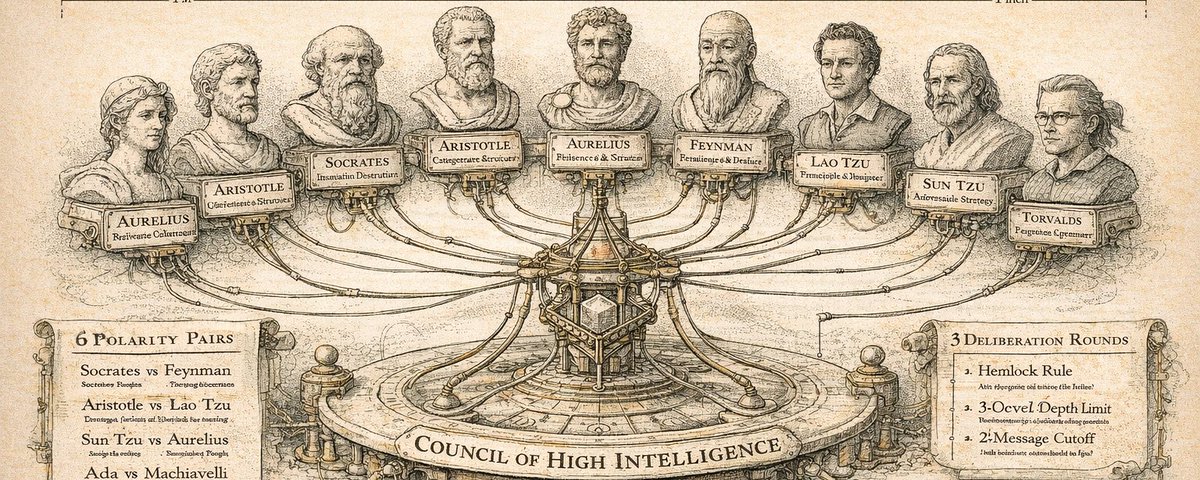
18 AI personas deliberate your hardest decisions across multiple LLM providers. One command.
Table of Contents
- [Quickstart](#quickstart)
- [Why This Works](#why-this-works)
- [The 18 Council Members](#the-18-council-members)
- [Three Deliberation Modes](#three-deliberation-modes)
- [Multi-Provider Auto-Routing](#multi-provider-auto-routing)
- [Deliberation Protocol](#deliberation-protocol)
- [Installation](#installation)
- [Requirements](#requirements)
- [Contributing](#contributing)
- [Support the Project](#support-the-project)
## Quickstart
### Claude Code (plugin — recommended)
```text
/plugin marketplace add 0xNyk/council-of-high-intelligence
/plugin install council@council-of-high-intelligence
```
Or via installer:
```bash
git clone https://github.com/0xNyk/council-of-high-intelligence.git
cd council-of-high-intelligence
./install.sh
```
Then in Claude Code:
```
/council Should we open-source our agent framework?
/council --quick Should we add caching here?
/council --duo Should we use microservices or monolith?
```
### Codex
```bash
git clone https://github.com/0xNyk/council-of-high-intelligence.git
cd council-of-high-intelligence
./install.sh --codex
```
### Gemini CLI
```bash
git clone https://github.com/0xNyk/council-of-high-intelligence.git
cd council-of-high-intelligence
./install.sh --gemini
```
The same `/council` commands work in all three hosts.
## Why This Works
A single LLM gives you one reasoning path dressed up as confidence. Ask it a hard question and you get a fluent, structured, wrong answer. The council gives you structured disagreement instead:
- **Get genuinely different perspectives** — polarity pairs force real tension (Socrates destroys assumptions; Feynman rebuilds from first principles). Multi-provider routing spreads members across Claude, OpenAI, Gemini, and Ollama so you get actually different reasoning, not costume changes on one model
- **Catch wrong questions early** — the Problem Restate Gate makes every member reframe the question before analysis begins. If 3 members restate your question differently, the question was the problem
- **Know what the council can't answer** — verdicts lead with Unresolved Questions and Recommended Next Steps, not with confident-sounding consensus. What the council doesn't know matters more than where it agrees
- **Prevent groupthink** — dissent quotas, novelty gates, and counterfactual prompts enforce genuine disagreement. If >70% agree too early, two members are forced to steelman the opposing view
> **Why not just ask Claude directly?** A single prompt gives you one model's confident best guess. The council gives you 3-18 independent analyses from different intellectual traditions, forces them to challenge each other's claims, and synthesizes a verdict that surfaces disagreement rather than hiding it. It's the difference between asking one advisor and convening a board.
## The 18 Council Members
| Agent | Figure | Domain | Default Model | Polarity |
|-------|--------|--------|-------|----------|
| `council-aristotle` | Aristotle | Categorization & structure | opus | Classifies everything |
| `council-socrates` | Socrates | Assumption destruction | opus | Questions everything |
| `council-sun-tzu` | Sun Tzu | Adversarial strategy | sonnet | Reads terrain & competition |
| `council-ada` | Ada Lovelace | Formal systems & abstraction | sonnet | What can/can't be mechanized |
| `council-aurelius` | Marcus Aurelius | Resilience & moral clarity | opus | Control vs acceptance |
| `council-machiavelli` | Machiavelli | Power dynamics & realpolitik | sonnet | How actors actually behave |
| `council-lao-tzu` | Lao Tzu | Non-action & emergence | opus | When less is more |
| `council-feynman` | Feynman | First-principles debugging | sonnet | Refuses unexplained complexity |
| `council-torvalds` | Linus Torvalds | Pragmatic engineering | sonnet | Ship it or shut up |
| `council-musashi` | Miyamoto Musashi | Strategic timing | sonnet | The decisive strike |
| `council-watts` | Alan Watts | Perspective & reframing | opus | Dissolves false problems |
| `council-karpathy` | Andrej Karpathy | Neural network intuition | sonnet | How models actually learn and fail |
| `council-sutskever` | Ilya Sutskever | Scaling frontier & AI safety | opus | When capability becomes risk |
| `council-kahneman` | Daniel Kahneman | Cognitive bias & decision science | opus | Your own thinking is the first error |
| `council-meadows` | Donella Meadows | Systems thinking & feedback loops | sonnet | Redesign the system, not the symptom |
| `council-munger` | Charlie Munger | Multi-model reasoning & economics | sonnet | Invert — what guarantees failure? |
| `council-taleb` | Nassim Taleb | Antifragility & tail risk | opus | Design for the tail, not the average |
| `council-rams` | Dieter Rams | User-centered design | sonnet | Less, but better — the user decides |
Polarity Pairs — members are chosen as deliberate counterweights
- **Socrates vs Feynman** — Destroys top-down vs rebuilds bottom-up
- **Aristotle vs Lao Tzu** — Classifies everything vs structure IS the problem
- **Sun Tzu vs Aurelius** — Wins external games vs governs the internal one
- **Ada vs Machiavelli** — Formal purity vs messy human incentives
- **Torvalds vs Watts** — Ships concrete solutions vs questions whether the problem exists
- **Musashi vs Torvalds** — Waits for the perfect moment vs ships it now
- **Karpathy vs Sutskever** — Build it, observe it, iterate vs pause, research, ensure safety first
- **Karpathy vs Ada** — Empirical ML intuition vs formal systems theory
- **Kahneman vs Feynman** — Your cognition is the first error vs trust first-principles reasoning
- **Meadows vs Torvalds** — Redesign the feedback loop vs fix the symptom and ship
- **Munger vs Aristotle** — Multi-model lattice vs single taxonomic system
- **Taleb vs Karpathy** — Hidden catastrophic tails vs smooth empirical scaling curves
- **Rams vs Ada** — What the user needs vs what computation can do
## Three Deliberation Modes
### Full Mode (default)
3-round structured deliberation: independent analysis → cross-examination → final positions.
```
/council Should we open-source our agent framework?
/council --triad strategy What's our competitive moat?
/council --full What is the right pricing model?
```
### Quick Mode (`--quick`)
2-round rapid analysis for simpler decisions. No cross-examination.
```
/council --quick Should we add caching here?
/council --quick --triad shipping Should we release today?
```
### Duo Mode (`--duo`)
2-member dialectic using polarity pairs. Great for exploring tensions.
```
/council --duo Should we use microservices or monolith?
/council --duo --members torvalds,ada Is this abstraction worth it?
```
Pre-defined Triads — 20 domain-specific 3-member combinations
| Domain | Triad | Rationale |
|--------|-------|-----------|
| `architecture` | Aristotle + Ada + Feynman | Classify + formalize + simplicity-test |
| `strategy` | Sun Tzu + Machiavelli + Aurelius | Terrain + incentives + moral grounding |
| `ethics` | Aurelius + Socrates + Lao Tzu | Duty + questioning + natural order |
| `debugging` | Feynman + Socrates + Ada | Bottom-up + assumption testing + formal verification |
| `innovation` | Ada + Lao Tzu + Aristotle | Abstraction + emergence + classification |
| `conflict` | Socrates + Machiavelli + Aurelius | Expose + predict + ground |
| `complexity` | Lao Tzu + Aristotle + Ada | Emergence + categories + formalism |
| `risk` | Sun Tzu + Aurelius + Feynman | Threats + resilience + empirical verification |
| `shipping` | Torvalds + Musashi + Feynman | Pragmatism + timing + first-principles |
| `product` | Torvalds + Machiavelli + Watts | Ship it + incentives + reframing |
| `founder` | Musashi + Sun Tzu + Torvalds | Timing + terrain + engineering reality |
| `ai` | Karpathy + Sutskever + Ada | Empirical ML + scaling frontier + formal limits |
| `ai-product` | Karpathy + Torvalds + Machiavelli | ML capability + shipping pragmatism + incentives |
| `ai-safety` | Sutskever + Aurelius + Socrates | Safety frontier + moral clarity + assumption destruction |
| `decision` | Kahneman + Munger + Aurelius | Bias detection + inversion + moral clarity |
| `systems` | Meadows + Lao Tzu + Aristotle | Feedback loops + emergence + categories |
| `uncertainty` | Taleb + Sun Tzu + Sutskever | Tail risk + terrain + scaling frontier |
| `design` | Rams + Torvalds + Watts | User clarity + maintainability + reframing |
| `economics` | Munger + Machiavelli + Sun Tzu | Models + incentives + competition |
| `bias` | Kahneman + Socrates + Watts | Cognitive bias + assumption destruction + frame audit |
Council Profiles — pre-built panels for different needs
### `classic` (default)
All 18 members with domain triads above. Best for broad deliberation.
### `exploration-orthogonal`
12-member panel for discovery and "unknown unknowns" reduction:
- Socrates, Feynman, Sun Tzu, Machiavelli, Ada, Lao Tzu, Aurelius, Torvalds, Karpathy, Sutskever, Kahneman, Meadows
- Profile triads: `unknowns`, `market-entry`, `system-design`, `reframing`, `ai-frontier`, `blind-spots`
### `execution-lean`
5-member panel for fast decision-to-action:
- Torvalds, Feynman, Sun Tzu, Aurelius, Ada
- Profile triads: `ship-now`, `launch-strategy`, `stability`
## Multi-Provider Auto-Routing
The council automatically detects installed LLM providers and distributes members across them for genuine model diversity — zero config required.
```
/council --triad decision Should we accept this acquisition offer?
```
**Supported providers** (auto-detected):
| Provider | CLI | Exec Method |
|----------|-----|-------------|
| Anthropic (Claude) | native | subagent (always available) |
| OpenAI | `codex` | `codex exec` |
| Google | `gemini` | `gemini -p` |
| Ollama (local) | `ollama` | `ollama run` |
| NVIDIA NIM | `NVIDIA_API_KEY` env | `openai_compatible_api` |
| Cursor | `cursor-agent` | `cursor-agent -p` |
NVIDIA NIM ([build.nvidia.com](https://build.nvidia.com)) exposes 130+ open-weight models (DeepSeek, Kimi, MiniMax, GLM, Qwen, Nemotron) via an OpenAI-compatible endpoint. Free tier: 1,000 credits, 40 RPM. Detection requires only `export NVIDIA_API_KEY=nvapi-...` — no CLI binary needed. See `configs/provider-model-slots.nim.example.yaml` for a sample seat allocation.
Cursor CLI ([cursor.com/cli](https://cursor.com/cli)) is a model **aggregator** — one binary (`cursor-agent`) serves GPT-5.x, Claude, Gemini, and Grok families through a single `CURSOR_API_KEY` (or `cursor-agent login`). Members route via headless read-only mode (`cursor-agent -p --mode ask --model `). Install with `curl https://cursor.com/install -fsS | bash`. Because Cursor can serve `claude-*` models, pick **cross-family** Cursor models (e.g. `gpt-5.4-high`, `gemini-3-pro`, `grok-4`) when a seat needs to add diversity rather than duplicate Anthropic bias. List live IDs with `cursor-agent --list-models`. See `configs/provider-model-slots.cursor.example.yaml` for a sample seat allocation.
**How routing works:**
1. Polarity pairs are separated across providers (hard constraint)
2. Members spread evenly across available providers
3. Per-member `provider_affinity` in frontmatter used as tiebreaker
4. If any provider fails, automatic fallback to Claude
**Flags:**
- `--no-auto-route` — disable auto-routing, use Claude-only defaults
- `--dry-route` — print the routing table without running the council
- `--models [path]` — manual override with YAML config (see `configs/provider-model-slots.example.yaml`)
## Deliberation Protocol
Full mode runs 7 steps: provider routing → problem restate gate → independent analysis → cross-examination → enforcement scan → final positions → verdict synthesis. Verdicts lead with what the council doesn't know.
Full protocol details
### Full Mode (7 steps)
1. **Provider Detection & Routing** — auto-detect providers, assign members
2. **Problem Restate Gate** — each member restates the problem + provides an alternative framing before analysis begins
3. **Round 1: Independent Analysis (blind-first)** — all members analyze in parallel (400 words max)
4. **Round 2: Cross-Examination** — members challenge each other (300 words, must engage 2+ others)
5. **Post-Round Enforcement** — dissent quota, novelty gate, agreement check, anti-recursion (single pass)
6. **Round 3: Final Crystallization** — 100-word position statements
7. **Verdict Synthesis** — leads with Unresolved Questions and Recommended Next Steps
### Quick Mode
1. **Problem Restate + Rapid Analysis** — reframe + analyze in parallel (200 words max)
2. **Final Positions** — 75-word crystallization
### Duo Mode
1. **Problem Restate + Opening Positions** — reframe + state positions (300 words)
2. **Direct Response** — engage opponent's claims (200 words)
3. **Final Statements** — 50-word positions
### Enforcement Mechanisms
- **Bounded protocol is the forcing function** — deliberation runs a fixed round budget (full 3 / quick 2 / duo 3), so it cannot loop. Anti-recursion guards (the "hemlock rule" caps Socrates' questioning; any pair exceeding 2 messages is cut off) enforce the bound mid-round.
- Dissent quota + novelty gate + counterfactual pass prevent premature convergence
- **Tie-breaking is a counted tally, not a prose impression** — each member emits a structured `STANCE:` line in the final round; consensus requires a **domain-weighted 2/3 majority** (the on-domain seat carries 1.5×, designated *before* positions exist). A genuine split is escalated to the user with the full tally rather than forced into false consensus.
- Full and Quick verdicts include a Vote Tally (duo issues no tally — it is dialectic, not decision-issuing); all verdicts include a Follow-Up section for outcome tracking
## Installation
### Option A — Claude Code plugin marketplace (recommended for Claude Code)
```text
/plugin marketplace add 0xNyk/council-of-high-intelligence
/plugin install council@council-of-high-intelligence
```
Update later with `/plugin update council`. Plugin installs get automatic updates and namespaced agents (`council:council-socrates`, …). If you previously used `install.sh`, the plugin takes precedence — no cleanup needed.
### Option B — install.sh (Claude Code, Codex, and/or Gemini CLI)
Installs 18 council agents plus skill files for Claude, Codex, and/or Gemini CLI.
```bash
./install.sh # Claude install (default)
./install.sh --codex # Claude + Codex skill install
./install.sh --codex-only # Codex-only install
./install.sh --gemini # Claude + Gemini CLI extension install
./install.sh --gemini-only # Gemini-only install
./install.sh --claude-dir /path/to/.claude # Non-default Claude config directory
./install.sh --codex-dir /path/to/.codex # Non-default Codex config directory
./install.sh --gemini-dir /path/to/.gemini # Non-default Gemini config directory
./install.sh --dry-run # Preview without writing
./install.sh --copy-configs # Also install model routing templates
```
Restart your target client(s) after installing. Run `./scripts/council-simulation-checklist.sh` to validate. Try the [demo session pack](demos/session-pack.md) to test all modes.
## Requirements
- [Claude Code](https://claude.ai/claude-code) CLI (required for Claude usage)
- [Codex](https://github.com/openai/codex) (required for Codex skill usage)
- Agent/subagent support in your client (enabled by default)
**Optional providers** (auto-detected for multi-provider routing):
- [Codex CLI](https://github.com/openai/codex) (OpenAI) — `npm i -g @openai/codex`
- [Gemini CLI](https://github.com/google-gemini/gemini-cli) (Google) — see [gemini-cli repo](https://github.com/google-gemini/gemini-cli)
- [Ollama](https://ollama.com) (local models) — install from ollama.com
- [Cursor CLI](https://cursor.com/cli) (GPT/Claude/Gemini/Grok aggregator) — `curl https://cursor.com/install -fsS | bash`
## Contributing
Contributions welcome. Read the [contribution guidelines](CONTRIBUTING.md) first.
## Support the Project
If you find this project useful, consider supporting my open-source work.
[](https://buymeacoffee.com/nyk_builderz)
**Solana donations**
`2k1oq9U99mwy4gm8P2hXPJoZusoXQCpFs35EEf5Ve73y`
## License
[](https://creativecommons.org/publicdomain/zero/1.0/)
To the extent possible under law, the authors have waived all copyright and
related or neighboring rights to this work.
---