




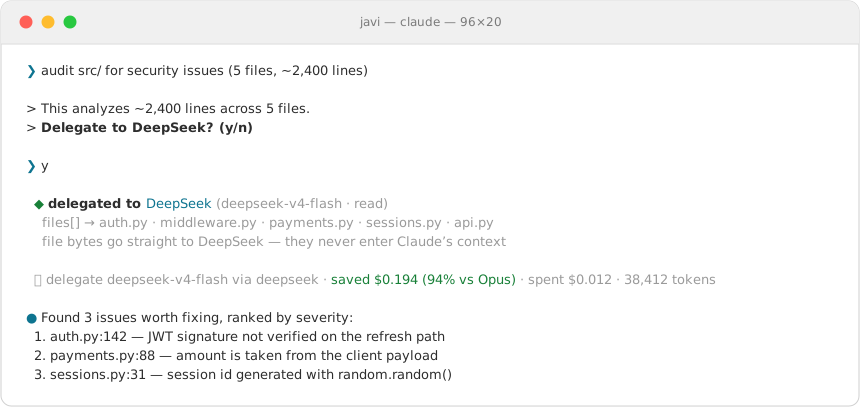
 Every call ends with a receipt — shown to you automatically, straight from the API's own token counts. You always know what you spent and what you saved.
---
## What's new in 3.0
- **Any model, not just DeepSeek.** 8 providers vendored (DeepSeek, Moonshot/Kimi, Z.AI + Zhipu/GLM, Alibaba/Qwen, Groq, xAI/Grok, OpenRouter) plus any OpenAI-compatible endpoint you add — including local ollama/vllm for **$0 delegation**.
- **Mix and match providers.** Select several providers in one init (space in the picker), give each its key, then route digestion to GLM-flash, code generation to DeepSeek-pro, keep a Kimi in your shortlist. Keys live in a keyring that survives re-runs and provider switches.
- **A setup wizard that's actually nice.** Arrow-key rail UI, live API-key validation against the real endpoint, full disclosure before anything is written, one question for model strategy.
- **Pick the model your way.** Smart split (cheap model digests, big model creates), a shortlist picker rendered by Claude Code's own UI, always-best, always-cheapest, or fully custom per kind of work.
- **Honest receipts.** Cost per call from the provider's own token counts, cached tokens billed at cached rates, savings baseline of your choice (Opus, Sonnet, or off).
- **Nothing breaks.** The `deepseek` tool name, env var, and hooks from v2 all keep working. No config = exact v2 behavior.
---
## Install (one command)
```bash
npx claude-code-deepseek-delegator init
```
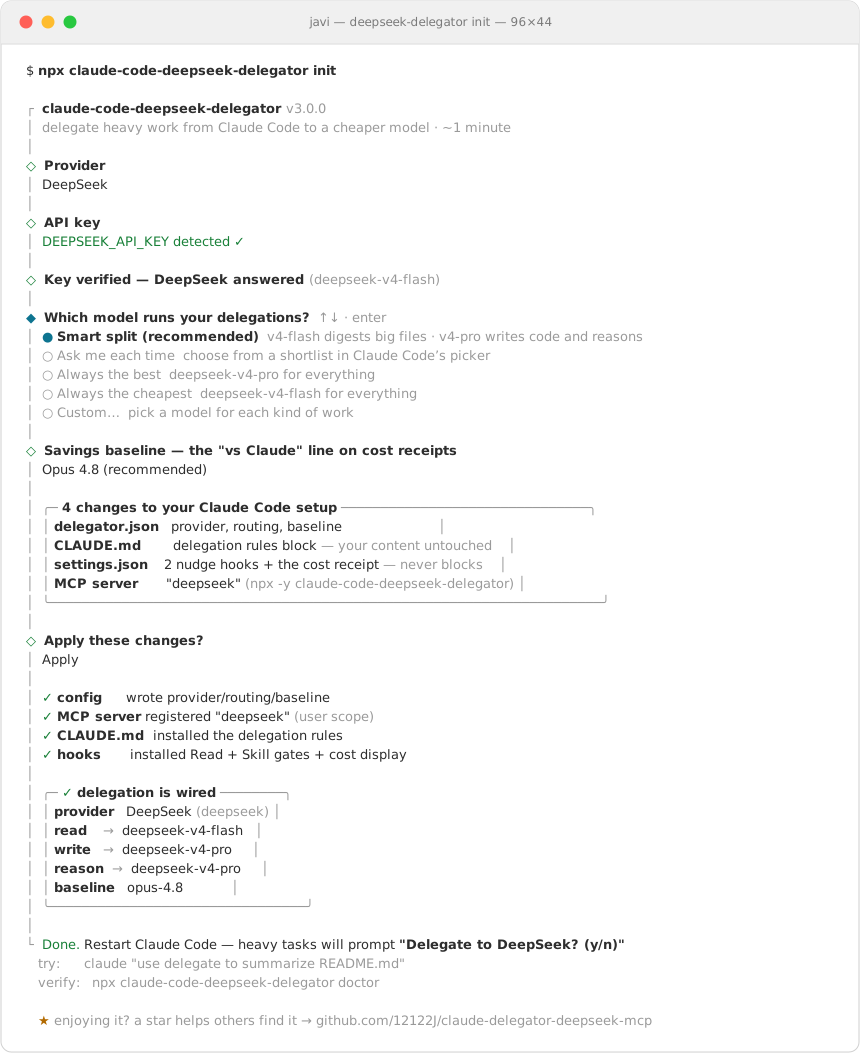
The wizard walks you through four choices — arrow keys, ~1 minute:
1. **Providers** — DeepSeek, Moonshot (Kimi), Z.AI / Zhipu (GLM), Alibaba (Qwen), Groq, xAI (Grok), OpenRouter, or any custom OpenAI-compatible endpoint (ollama, vllm, LM Studio, a proxy). Enter picks one; **space picks several** — enroll DeepSeek *and* Z.AI in the same run and mix them in step 3 (the first becomes the primary that names the gate).
2. **API keys** — one per chosen provider: detected from your environment, or paste it (hidden). The wizard **live-fires a 1-token request** so a bad key fails right there with the provider's real error, not on tomorrow's first delegation.
3. **Which model runs your delegations** — a smart split (the cheap model digests, the big one creates), a shortlist you pick from each time, always best / always cheapest, or custom (see below).
4. **Savings baseline** — measure savings against Opus 4.8, Sonnet 5, or don't show savings.
It then shows exactly what it will change, asks, applies, and prints a recap:
 Sanity-check anytime:
```bash
npx claude-code-deepseek-delegator doctor
```
`doctor` doesn't just check that files exist — it **actually fires the gate hooks**, resolves every configured model against the registry, and confirms the delegation prompt is live.
### What `init` actually changes (full disclosure)
1. **`~/.claude/delegator.json`** — your provider, model routing, and savings baseline. Edit it anytime; changes apply on the next call, no restart.
2. **A clearly-labeled block in `~/.claude/CLAUDE.md`** — the delegation rules, fenced with `` markers. **Never touches anything else in your file.**
3. **Three hooks in `~/.claude/settings.json`** — two `PreToolUse` nudges (before large reads and skill loads) and one `PostToolUse` cost receipt. They **only add context or display info — they never block, delete, or modify your tool calls.**
4. **An MCP server** named `delegate` (`npx -y claude-code-deepseek-delegator`) — so Claude Code shows "Calling delegate…" on every call. v2's `deepseek` server key keeps working on untouched installs and is migrated automatically when you re-run init.
Before any of that, it writes a timestamped backup of every file it changes. To undo everything — including the config files:
```bash
npx claude-code-deepseek-delegator uninstall
```
---
## Which model does the work?
Not every delegation deserves your best model. "Summarize this 2,000-line file" is digestion — a cheap model does it fine. "Rewrite this module" is creation — you want the good one. Paying pro prices for flash work is where delegation savings quietly leak.
So the wizard asks one question — **"Which model runs your delegations?"** — with answers that map to how people actually think:
- **Smart split (recommended)** — the cheap model digests big files, the big model writes code and reasons. You never think about it again; the receipt shows which one ran.
- **Ask me each time** — you keep a shortlist, and when you approve a delegation Claude shows it through Claude Code's **native picker UI** (the same one `/model` uses) with prices. You tap the model, it delegates there.
- **Always the best / Always the cheapest** — one model for everything, zero decisions.
- **Custom** — pick a model per kind of work (`read` / `write` / `reason`), **mixing providers freely**: the menus list models from every provider whose key is detected, so "reads on GLM-flash, writes on DeepSeek-pro, reasoning on Kimi" is three arrow-key picks.
### What each choice feels like in a session
**Smart split.** You never see a model decision — the same y/n gives cheap digestion and quality creation:
```
❯ summarize what src/auth.py does (2,100 lines)
> Delegate to DeepSeek? (y/n) y
⎿ delegate deepseek-v4-flash via deepseek · saved $0.081 (94% vs Opus) · spent $0.005
↑ digestion → the cheap model ran
❯ now rewrite it with proper token rotation
> Delegate to DeepSeek? (y/n) y
⎿ delegate deepseek-v4-pro via deepseek · saved $0.152 (91% vs Opus) · spent $0.019
↑ creation → the big model ran
```
**Ask me each time.** After your `y`, Claude opens Claude Code's picker with your shortlist and prices; your tap decides:
```
> Delegate to DeepSeek? (y/n) y
Which model? ← Claude Code's native picker
❯ deepseek-v4-flash $0.14 / $0.28 per 1M
deepseek-v4-pro $0.435 / $0.87 per 1M
moonshot:kimi-k2.5 $0.20 / $1.20 per 1M
⎿ delegate kimi-k2.5 via moonshot · saved $0.117 (88% vs Opus) · spent $0.016
```
**Always the best / cheapest.** Every delegation is the same model — exactly how v2 behaved, one price.
Under the hood every choice just writes `~/.claude/delegator.json`, which you can edit anytime — changes apply on the next call, no restart:
```jsonc
{
"provider": "deepseek",
"mode": "auto", // or "ask" for the shortlist picker
"shortlist": ["deepseek-v4-flash", "deepseek-v4-pro", "moonshot:kimi-k2.5"],
"routing": {
"read": "deepseek-v4-flash", // digest/summarize big inputs
"write": "deepseek-v4-pro", // generate code and docs
"reason": "deepseek-v4-pro" // math, logic, architecture
},
"baseline": "opus-4.8"
}
```
How the smart split works mechanically: Claude labels each delegation `task: "read" | "write" | "reason"`, the server looks the label up in `routing`, and that model id goes on the wire (this chain is covered by an end-to-end test against a mock provider). An explicit `model` argument — like the one your picker choice produces in ask mode — always beats the routing table. If Claude omits the label entirely, the provider's default large model runs: the failure mode is a price tier, never a crash.
## Providers
| Provider | id | Env var | Example models |
|----------|----|---------|----------------|
| DeepSeek | `deepseek` | `DEEPSEEK_API_KEY` | deepseek-v4-pro, deepseek-v4-flash |
| Moonshot | `moonshot` | `MOONSHOT_API_KEY` | kimi-k2.5, kimi-k2.7-code |
| Z.AI | `zai` | `ZAI_API_KEY` | glm-5, glm-4.7-flash |
| Zhipu | `zhipu` | `ZHIPU_API_KEY` | glm-5, glm-4.7 |
| Alibaba | `alibaba-singapore` | `ALIBABA_SINGAPORE_API_KEY` | qwen3.7-max, qwen3.6-flash |
| Groq | `groq` | `GROQ_API_KEY` | llama-4-maverick, kimi-k2 |
| xAI | `xai` | `XAI_API_KEY` | grok-4.5, grok-code-fast-2 |
| OpenRouter | `openrouter` | `OPENROUTER_API_KEY` | ~25 curated ids across every lab |
Provider definitions (endpoints, models, prices) follow the [catwalk](https://github.com/charmbracelet/catwalk) schema, vendored from charmbracelet's registry (MIT). Add your own in `~/.claude/delegator-providers.json` — any OpenAI-compatible endpoint works, including local ones:
```json
{
"name": "Local Ollama", "id": "ollama", "type": "openai-compat",
"api_key": "none", "api_endpoint": "http://localhost:11434/v1",
"default_large_model_id": "qwen3-coder",
"models": [{ "id": "qwen3-coder", "cost_per_1m_in": 0, "cost_per_1m_out": 0,
"context_window": 128000, "default_max_tokens": 8192 }]
}
```
---
## Why this instead of spawning a subagent?
The usual pattern for heavy work — spawning a Claude subagent — starts a **brand new context window**: you re-pay the full context, lose your current state, and still bill at Claude rates.
This MCP server stays **in your current session**. Claude calls `delegate(...)` like any tool — no new context, no re-init, no spawn overhead — and the delegate does the heavy compute at a fraction of the rate.
## The `files[]` trick (this is the real win)
When Claude reads files and pastes them into a prompt, those bytes land in **Claude's** context first — you pay Claude's rate just to pass content through.
With `files[]`, Claude passes only the **paths**. The MCP server reads the bytes off disk and forwards them straight to the delegate. Large codebases never touch Claude's context.
```jsonc
// Claude calls the tool like this — no Read calls first:
delegate({
prompt: "Audit these files for security vulnerabilities and rank by severity.",
task: "read",
files: ["/abs/path/auth.py", "/abs/path/middleware.py", "/abs/path/payments.py"]
})
```
Claude then **synthesizes** the answer for you instead of pasting it verbatim — so you get the conclusion, cheaply, in the same conversation.
## The cost receipt (you see every cent)
After every call, a one-line receipt is displayed to you:
```
delegate deepseek-v4-pro via deepseek · saved $0.2472 (96% vs Opus) · spent $0.0114 · 28,410 tokens
```
It's computed from the API's own token usage (cached prompt tokens billed at the cached rate) and shown by a `PostToolUse` hook — **deterministically, not by asking the model to remember.** Claude physically cannot swallow the number. The baseline is yours to choose: Opus 4.8, Sonnet 5, or off.
---
## Tools
### `delegate`
| Param | Type | Default | Description |
|-------|------|---------|-------------|
| `prompt` | string | *required* | The task for the delegate. Be specific. |
| `task` | string | — | `read` / `write` / `reason` — routes to the configured model. |
| `model` | string | routed | Override: bare id or `provider:model` (e.g. `openrouter:moonshotai/kimi-k2.5`). |
| `provider` | string | configured | Override the active provider by id. |
| `files` | string[] | — | Absolute paths. The server reads them — bytes never enter Claude's context. |
| `system` | string | — | Optional system prompt. |
| `temperature` | number | `0.3` | 0–2, lower = more deterministic. |
| `stream` | boolean | `false` | Stream chunks instead of buffering. Good for very large outputs. |
### `delegate_models`
Lists every provider with key status, models, context windows, and prices, plus your active routing.
### `deepseek` / `deepseek_models`
Aliases of the above — v2 names, kept working forever.
---
## CLI reference
```
npx claude-code-deepseek-delegator