# dsh-usage-balance-v2
[中文](README.md) | English
A DSH Web plugin that puts a compact balance / session readout **inside the native usage line**, between the token usage group and the context percentage:
```
… 4.8M tok · cache hit 98% [¥] ¥0.77 [⏱] 4m50s [◉] ¥230.88 peak ⌄ 13%
```
- **Coin icon** — current session cost
- **Clock icon** — current session duration
- **Wallet icon** — remaining balance
- **Peak / valley badge** — current DeepSeek pricing period
Click the readout to open the details card. There is **no automatic “turn finished” popup**; all details live in the card.
## Screenshots

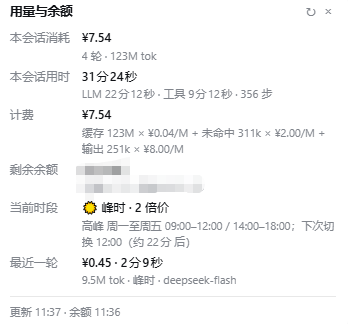
## What the details card shows
- **Session cost** — computed from DSH’s official `tokenUsage` projection for the whole session: cached-input, uncached-input and output tokens, each multiplied by the current peak/valley rate.
- **Session duration** — DSH’s official `sessionStats`: LLM time + tool time, plus step count.
- **Billing formula** — the exact multiplication is printed, e.g.
`cache 123M × ¥0.04/M + uncached 311k × ¥2.00/M + output 251k × ¥8.00/M`.
- **Remaining balance** — total, topped-up and granted components.
- **Current period** — peak/valley, the peak-hour rule, and a countdown to the next switch.
- **Last turn** — cost, duration, tokens, model and period, priced step by step with the actual peak/valley state of each step.
## Billing
Session cost is an estimate based on the official token usage:
```
cost = cacheReadTokens / 1e6 × cacheHitPrice
+ (uncachedInputTokens + cacheWriteTokens) / 1e6 × cacheMissPrice
+ outputTokens / 1e6 × outputPrice
```
The session readout uses the **current** period’s rates. The “last turn” value uses the exact peak/valley rate at each assistant step, so a turn crossing 12:00 or 18:00 is split correctly.
`reasoningTokens` is already included in `outputTokens` and is not charged twice.
## Peak / off-peak pricing
Beijing time:
- **Peak** — Monday to Friday (excluding Chinese statutory holidays), **09:00–12:00** and **14:00–18:00**
- **Valley** — all other periods, including weekends, make-up working weekends and statutory holidays
- **Peak price = valley price × 2**
Prices per million tokens, `[valley, peak]`:
| Model | Cache hit | Cache miss | Output |
| --- | --- | --- | --- |
| `deepseek-flash` / `deepseek-v4-flash` / `deepseek-v4-flash-vision-exp` | 0.02 / 0.04 | 1 / 2 | 4 / 8 |
| `deepseek-v4-pro` | 0.15 / 0.3 | 4.5 / 9 | 13.5 / 27 |
The table, peak hours and holiday list live in `lib/pricing.mjs` (`PRICING`, `PEAK_HOURS`, `HOLIDAY_VALLEY`). Add future statutory holidays there when the State Council publishes the next year’s schedule.
## Install
The plugin has no `@deepseek-ai/*` npm dependency, so it does not trigger DSH’s peer-version compatibility gate.
### 1. Clone and link it into the target profile
```powershell
git clone https://github.com/3493750852/dsh-usage-balance-v2.git
$plugin = (Resolve-Path .\dsh-usage-balance-v2).Path
New-Item -ItemType Junction `
-Path "$env:USERPROFILE\.dsh\profiles\desktop\node_modules\dsh-usage-balance-v2" `
-Target $plugin
```
Use the `web` profile instead of `desktop` if that is the profile you run.
### 2. Add the plugin to the profile patch
Append to `$env:USERPROFILE\.dsh\profiles\\cordis.patch.yml`:
```yaml
- insert:
- id: dsh-usage-balance-v2
name: dsh-usage-balance-v2
```
DSH profiles default to `patchReload: live`; save the file and refresh the page. If the readout still does not appear, restart DSH once.
### 3. Verify
```js
fetch('/dsh-usage-balance-v2/state.json').then((r) => r.json()).then(console.log)
```
The response contains `totals`, `session`, `balance`, `pricing`, `lastTurn` and `active`.
## Data and privacy
Host state is stored in `$DSH_HOME/.dsh-usage-balance-v2.json`.
- The host keeps cumulative counters and the last turn from the moment the plugin is enabled.
- The **session** cost/duration shown outside come from DSH’s official projections and therefore cover the whole session, including turns from before the plugin was enabled.
- The browser never talks to DeepSeek and never sees an API key. The host resolves `DEEPSEEK_API_KEY` through DSH credentials, falling back to the signed-in DSH account service.
## Tests
```powershell
node --test test/pricing.test.mjs test/host-smoke.mjs
```
8 tests cover peak/valley switching, next-switch calculation, the price table, usage-to-cost math, turn aggregation, subagent suppression and on-disk state recovery.
## License
MIT. See [LICENSE](LICENSE).