Methodology
Development of a Quality Assessment Framework for the AI Act's Article 53(1)(d) Public Summaries
Cite as: Blankvoort, D. A. H., Pandit, H. J., & Gahntz, M. (2026). Quality Assessment of Public Summary of Training Content for GPAI models required by AI Act Article 53(1)(d) (preprint). Zenodo. DOI:10.5281/zenodo.18803975
Overview
After conducting a literature review of documentation quality assessment frameworks, we picked Goal, Question, Metric (GQM) as the approach to identify criteria to assess the public summaries. Using GQM, we identified we identified Transparency and Usefulness as good overall indicators for intended stakeholders to understand the quality of the public summary. In this, transparency refers to the extent of information provided through the public summary, and usefulness represents the utility of provided information as well as its potential to be actionable by specific stakeholders. We selected transparency due to its existing and established application in the context of legal documentation, for example as a principle in the GDPR, as well as being listed as an objective of methods such as model cards. And we chose usefulness, which is well-defined as a quality dimension in literature, as a broad measure of whether the provided information is sufficient to take meaningful actions and ensure accountability.
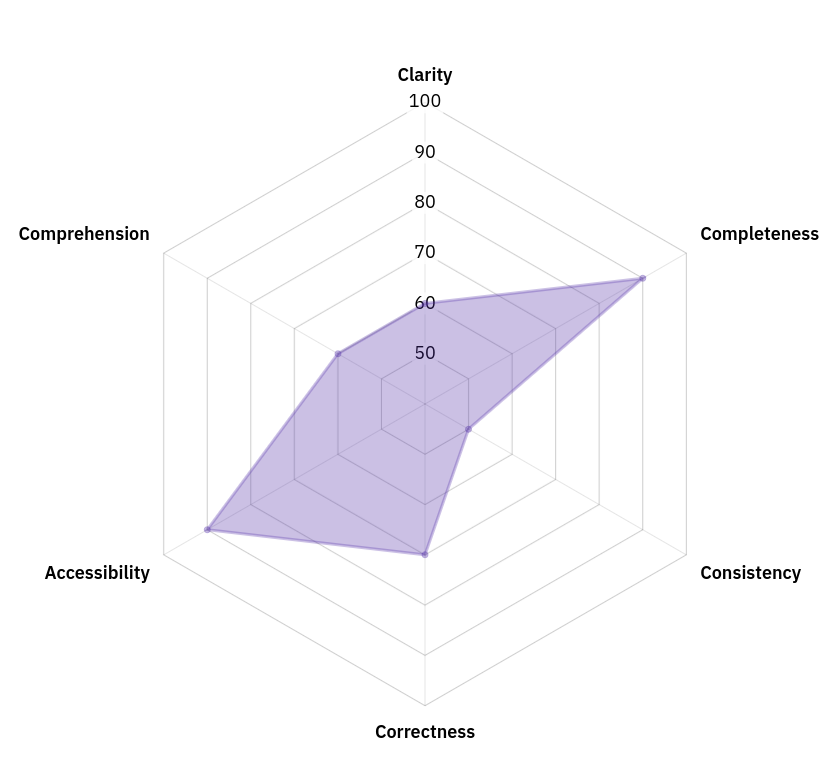
To assess Transparency, we identified 6 dimensions: Clarity, Completeness, Consistency, and Correctness, and for Usefulness we identified Accessibility and Comprehension. We then developed 242 metrics as specific questions or criteria that evaluate each field in each section of the public summary template. Since the public summary is structured such that each section has different implications for stakeholders, e.g. some may be interested only in Section 2.2 or Section 3, we evaluate each section using these metrics and then aggregate their scores to get the overall quality.
Using our framework, a ‘high-quality’ public summary is described as a document that provides information in a clear, structured, accurate, and consistent manner (transparency) such that it allows relevant stakeholders to understand the training process and to take relevant actions where necessary (usefulness). Public summaries that do not meet these requirements are considered as ‘low-quality’, and are potentially in breach of the template and the corresponding Article 53(1)(d) obligations.
Complete details of our methodology and its use in assessments is provided in the article linked above.