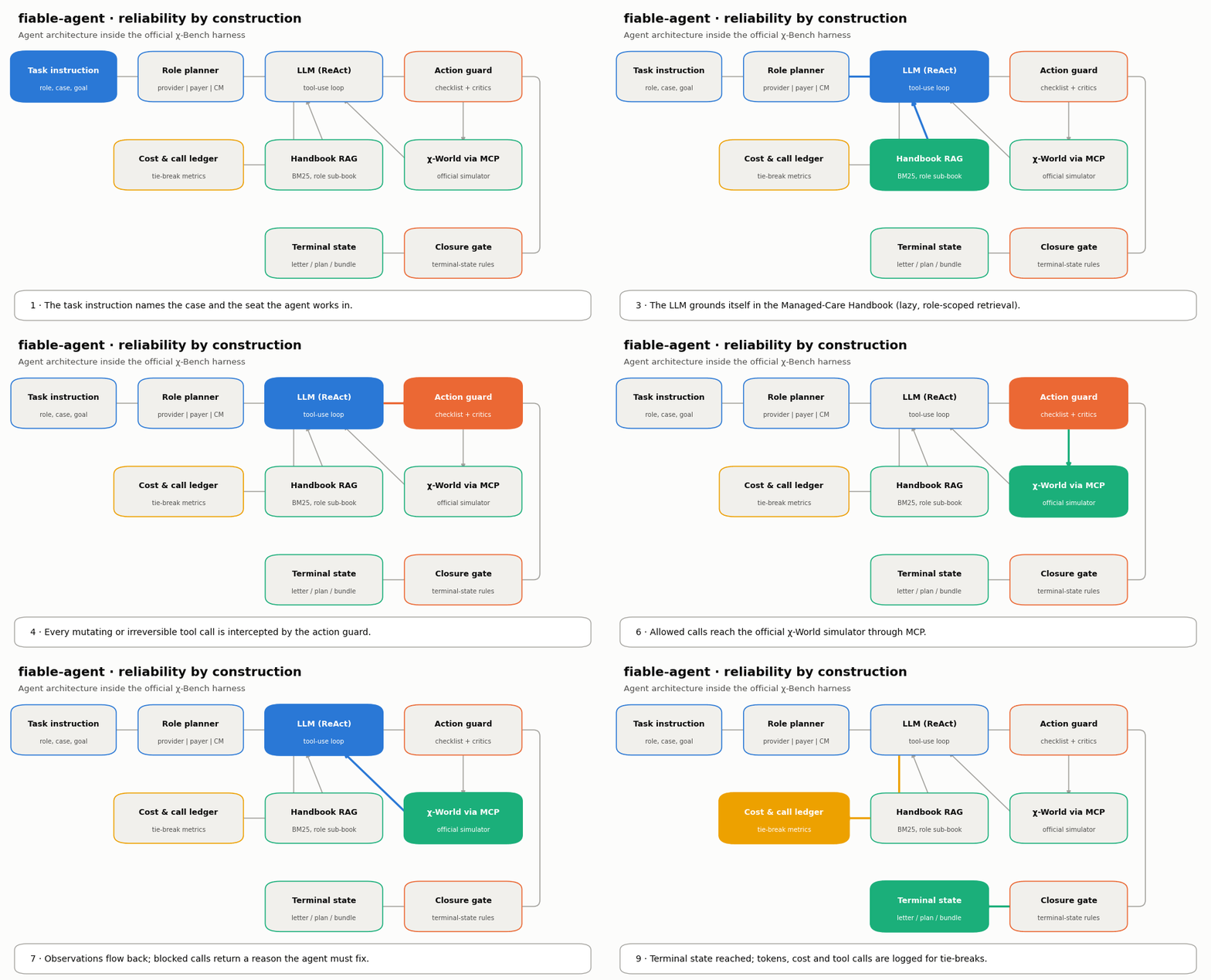
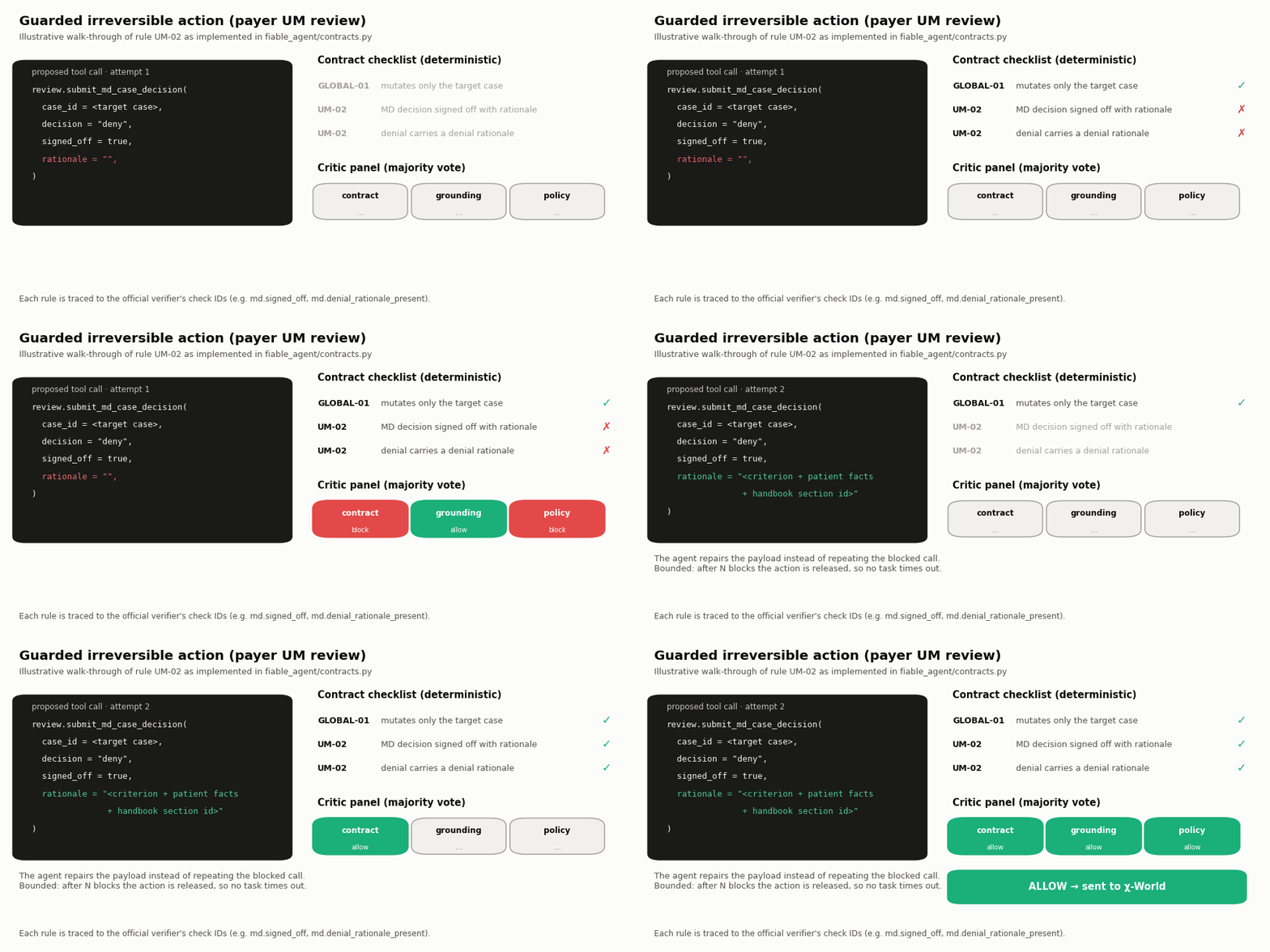
 | Hook | Component | What it does |
|---|---|---|
| system prompt | **Role planner** | Detects the seat (provider, payer or care manager) and appends operating principles plus an ordered, role-specific workflow plan. |
| `PreToolUse` | **Contract checklist** | Runs the rules for the active role on every mutating or terminal MCP call; blocks with the rule ID and a fixable reason. |
| `PreToolUse` | **Critic panel** | On terminal calls, three judges vote: *contract* (deterministic), *grounding* (every identifier and code must appear in observed evidence) and *policy* (rationale must be specific). |
| `PostToolUse` | **Evidence ledger** | Records each call and its result; locks the target case after the first successful mutation (rule GLOBAL-01). |
| `Stop` | **Closure gate** | Refuses to finish while terminal-state obligations (dispositions, letters, finalized plans) are still open. |
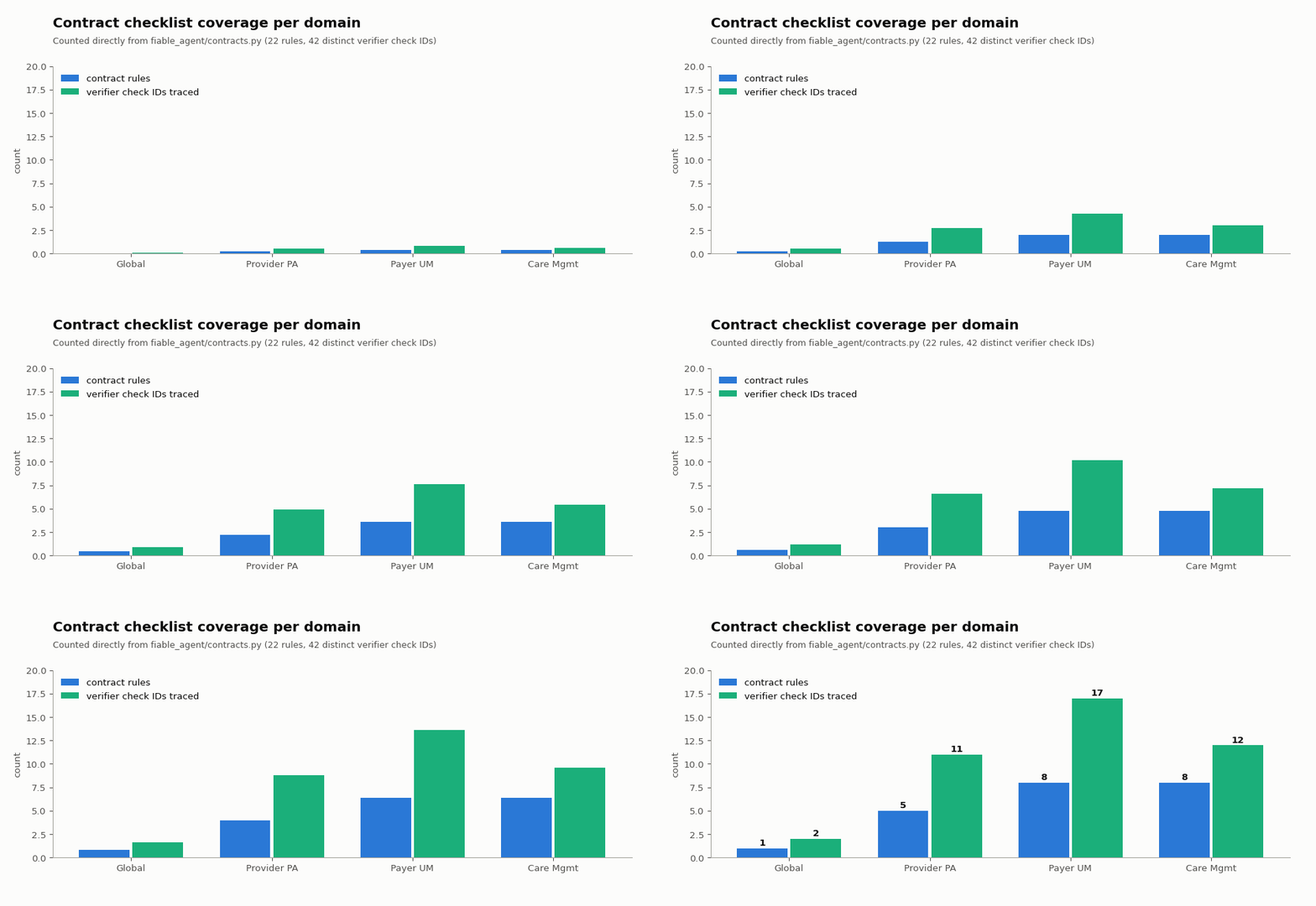 ## Why reliability pays twice
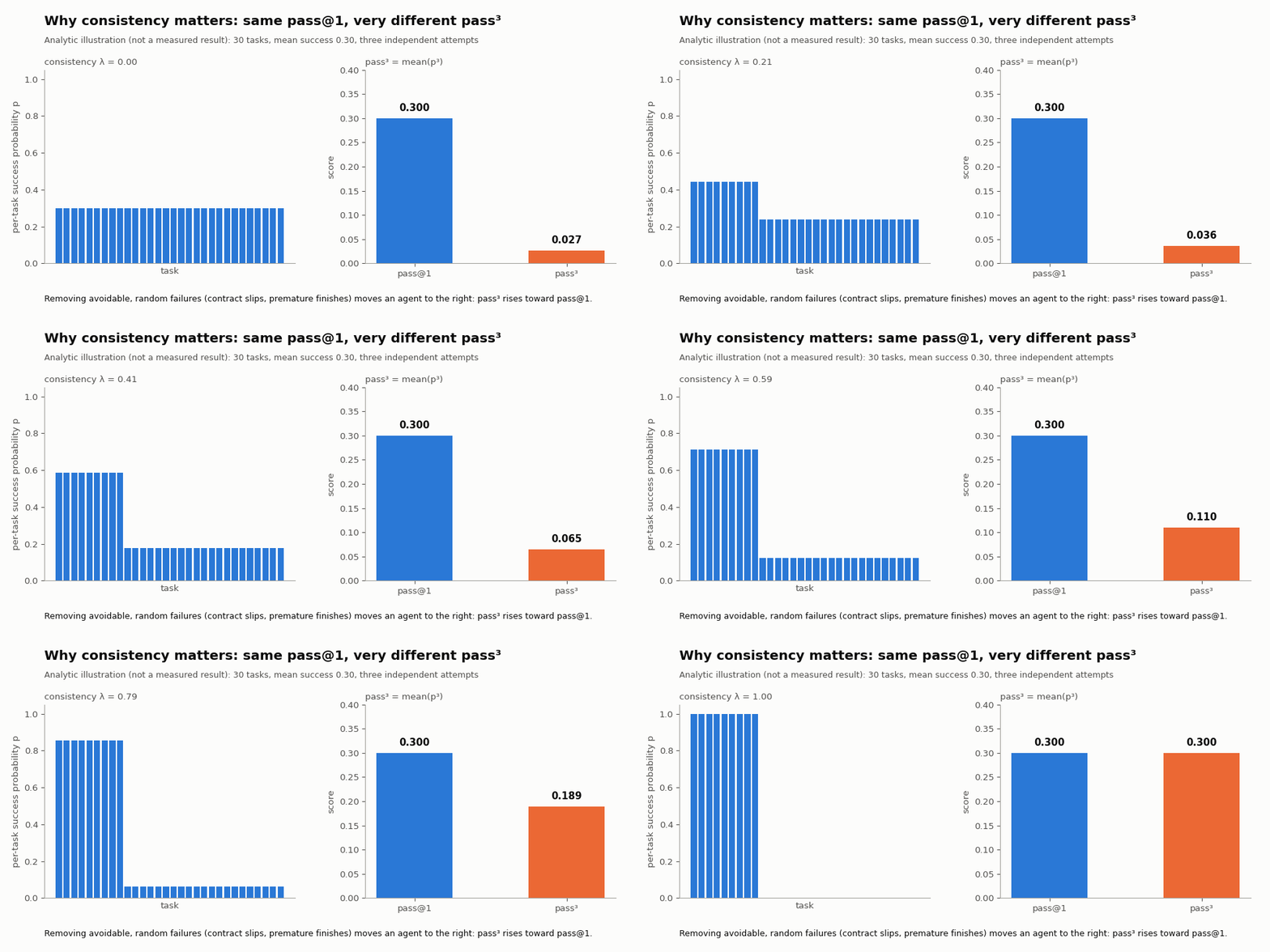
Final standings use pass@1 first and pass³ as the first tie-breaker. For the same pass@1, an agent whose failures
are *random* scores a far lower pass³ than one whose failures are *systematic*. Removing avoidable slips moves an
agent toward the consistent end, so the same engineering effort improves both the headline metric and the
reliability metric. The animation below is an analytic illustration of that effect, not a measured result.
 ## Results
**Execution status, 28 October 2026.** The authorised budget for this audit is
**EUR 0**. No paid Anthropic agent, judge or patient-simulator calls are
authorised, and none were initiated by this audit. Handbook access and the
official runtime must also be verified before an official run. The three
interventions C1–C3 below remain prospective experiments: offline tests verify
software behaviour, but do not demonstrate improved pass@1 or pass³.
The deterministic checklist adds no model calls of its own; running the
complete official agent and evaluator can still incur charges.
Evaluation follows the pre-registered protocol in [docs/EVALUATION_PROTOCOL.md](docs/EVALUATION_PROTOCOL.md):
official control (stock Claude Code harness) versus three cumulative arms (`plan`, `checklist`, `critic`), same
model (`anthropic/claude-sonnet-5`), same per-task limits, three attempts per task, official verifier
(`claude-opus-4-7` judge). Results, with mean and spread across attempts, are published in
[results/](results/README.md) as soon as each run completes; every number there comes from the official verifier's
`scorecard.json` files.
| Arm | Components | pass@1 | pass³ | mean cost / trial | mean tool calls |
|---|---|---|---|---|---|
| C0 official | stock Claude Code harness | pending | pending | pending | pending |
| C1 plan | + principles and role plan | pending | pending | pending | pending |
| C2 checklist | + contract checklist and closure gate | pending | pending | pending | pending |
| C3 critic | + three-judge critic panel | pending | pending | pending | pending |
The final competition score is computed by the organisers on an unreleased private task set.
## Quick start
```bash
# 1. Unit tests (no network, no credentials)
pip install pyyaml pytest
python -m pytest -q # 71 tests
# 2. Install into a checkout of the official benchmark (pinned commit 7998d113)
git clone https://github.com/actava-ai/chi-bench && cd chi-bench && git checkout 7998d113
uv sync --extra dev
python ../fiable-agent/scripts/install_into_chi_bench.py --chi-bench . --apply
uv run cb agent list # lists fiable-cc and fiable-agent
# 3. Data (the Handbook is gated: request access on Hugging Face first)
uv run hf download actava/chi-bench --repo-type dataset --revision chi-bench-v1.0.0 --local-dir data/
echo chi-bench-v1.0.0 > data/.chi-bench-version
uv run hf download actava/managed-care-operations-handbook --repo-type dataset \
--local-dir data/skills/managed-care-operations-handbook
uv run cb docker build && uv run cb data verify
# 4. Run an arm (credentials only in .env, never committed)
cp .env.example .env # ANTHROPIC_API_KEY or CLAUDE_CODE_OAUTH_TOKEN
python ../fiable-agent/experiments/generate_configs.py
uv run cb experiment run -f ../fiable-agent/experiments/configs/abl3_c2_checklist_um_x3.yaml
uv run python scripts/aggregate.py --trials-dir logs/experiments/abl3_c2_checklist_um_x3 \
--prices configs/prices.yaml --out-csv logs/abl3_c2_checklist_um_x3.csv
```
Select an arm with `FIABLE_CC_ARM` (`stock`, `plan`, `checklist`, `critic`) in the experiment's `agent_env`.
## Repository layout
```
fiable_agent/ core package
cc_guard.py Claude Code hook entry point (pre / post / stop)
contracts.py 22 contract rules traced to verifier check IDs
critic.py contract, grounding and policy judges; majority panel
roles.py role detection and role-specific workflow plans
state.py observed-evidence state and case lock
agent.py, llm.py, stand-alone ReAct loop on the Anthropic SDK (research arm)
rag.py, ledger.py BM25 handbook retrieval, cost and tool-call ledger
harness/
fiable_cc_harness.py official Claude Code harness + guard hooks (primary)
fiable_agent_harness.py harness for the stand-alone loop
scripts/install_into_chi_bench.py registers both harnesses in a chi-bench checkout
experiments/ config generator, ablation configs, ledger summariser
tools/make_figures.py regenerates every figure in this README
docs/ evaluation protocol, compliance notes
tests/ 71 offline tests
```
## Compliance
- No Handbook content, task solutions, verifier-only files or credentials are stored in this repository
(see [docs/COMPLIANCE.md](docs/COMPLIANCE.md)).
- Evaluated trials are fully autonomous; no human intervenes after a trial starts.
- All external code and data are credited below and used under their licenses.
## Credits and lineage
- **χ-Bench** benchmark, simulator, harnesses and verifier — actAVA.ai and the χ-Bench authors, Apache-2.0
([repository](https://github.com/actava-ai/chi-bench), [paper](https://arxiv.org/abs/2605.16679)). The
`fiable-cc` harness subclasses Harbor's `ClaudeCode` harness as shipped with χ-Bench.
- **Managed-Care Operations Handbook** — actAVA.ai, gated, non-commercial research license; used locally, never
redistributed.
- **BenchClaw** ([Agnuxo1/benchclaw](https://github.com/Agnuxo1/benchclaw)) — the multi-judge tribunal design
that inspired the critic panel (conceptual lineage; no code copied).
- **EnigmAgent** ([Agnuxo1/EnigmAgent](https://github.com/Agnuxo1/EnigmAgent)) — the principle that a model must
never see real secrets, applied here through environment-only credentials and secret-rejecting config loading
(conceptual lineage; no code copied).
- Related work: τ²-bench ([arXiv:2506.07982](https://arxiv.org/abs/2506.07982)), HealthBench
([arXiv:2505.08775](https://arxiv.org/abs/2505.08775)).
## Citation
```bibtex
@software{angulo2026fiableagent,
author = {Angulo de Lafuente, Francisco},
title = {fiable-agent: Reliability by Construction for Long-Horizon Healthcare Agents on chi-Bench},
year = {2026},
url = {https://github.com/Agnuxo1/chi-bench-fiable-agent},
note = {IEEE Big Data Cup 2026, Challenge 07}
}
```
## Known limitations
As in any benchmark engineering work, a few points remain open and are tracked transparently:
- The guard's rules encode the verifier contracts we could derive from public code and documentation; private tasks
may exercise workflows they do not cover, in which case the guard simply stays silent.
- The grounding judge compares identifiers as exact strings, so an equivalent code written in a different format
may be flagged; the bounded block limit keeps such cases from stalling a trial.
- Care-management runs require a paid API key for the official patient simulator, so the development ablation
focuses on prior authorization and utilization management unless that key is available.
## License
[Apache-2.0](LICENSE) © 2026 Francisco Angulo de Lafuente.