# Regulation Change Sentinel
**When the rules behind your grants change overnight, which compliance decisions are now wrong?**
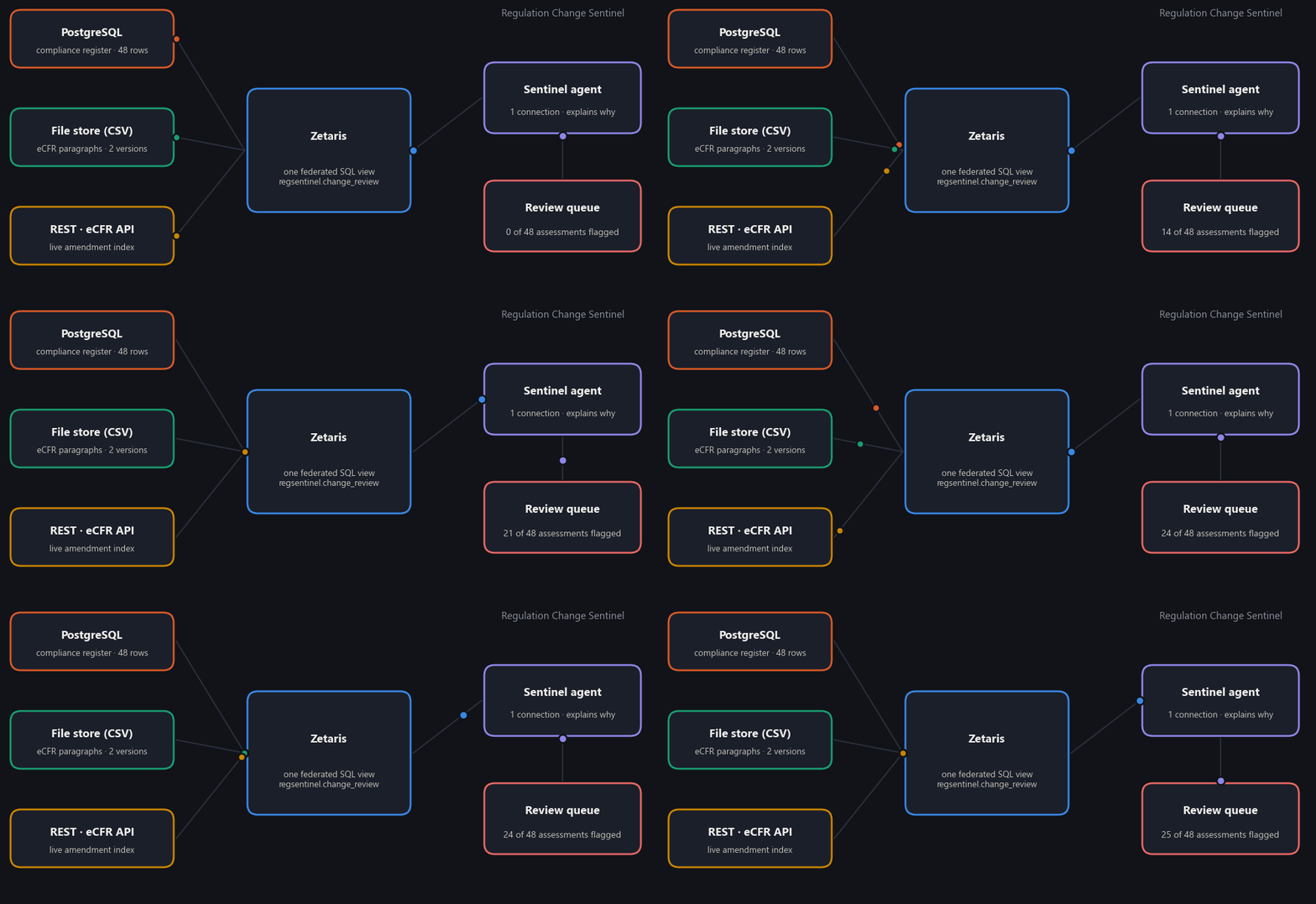
An explainable agent that re-checks a grant recipient's compliance register against a rewritten federal regulation, using **one federated [Zetaris](https://www.zetaris.com) view** over a PostgreSQL database, a file store and the **live eCFR government API**.
[](https://github.com/Agnuxo1/zetaris-regulation-change-sentinel/actions/workflows/ci.yml)



 ## Zetaris, live
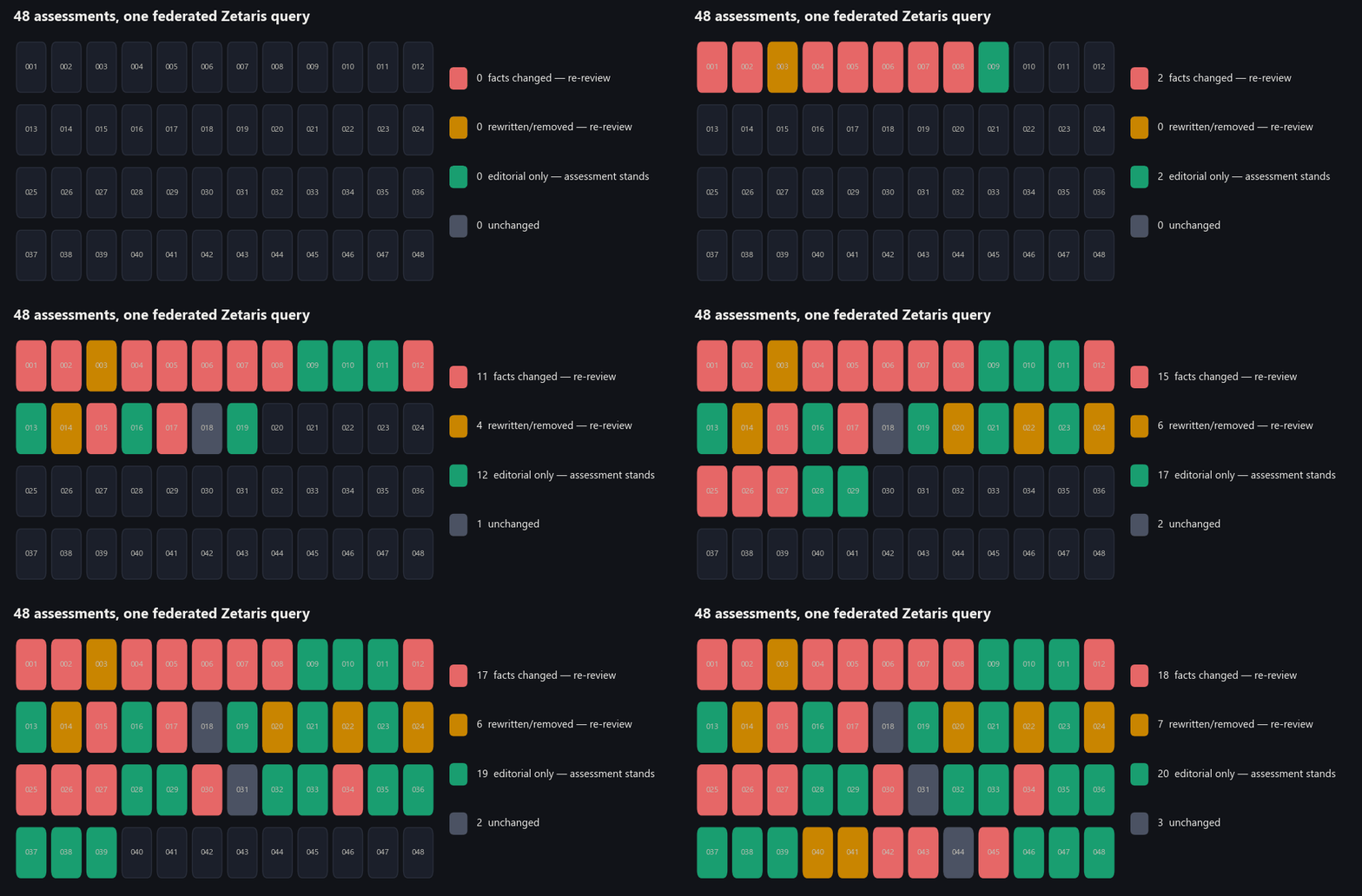
A continuous browser capture (sped up ×1.6) of the Zetaris SQL Workspace running on our own server, recorded on 28 October 2026. One statement counts rows from all three sources at once — **48** assessments from PostgreSQL, **1,289** regulation paragraphs from the file store and **878** version records straight from the eCFR API — then the federated view produces the verdict summary and the review queue.
 The full demo video (3 min 47 s, English narration and subtitles) is attached to the [latest release](https://github.com/Agnuxo1/zetaris-regulation-change-sentinel/releases/latest).
## Results
### Detection quality — 48 assessments, blind labels
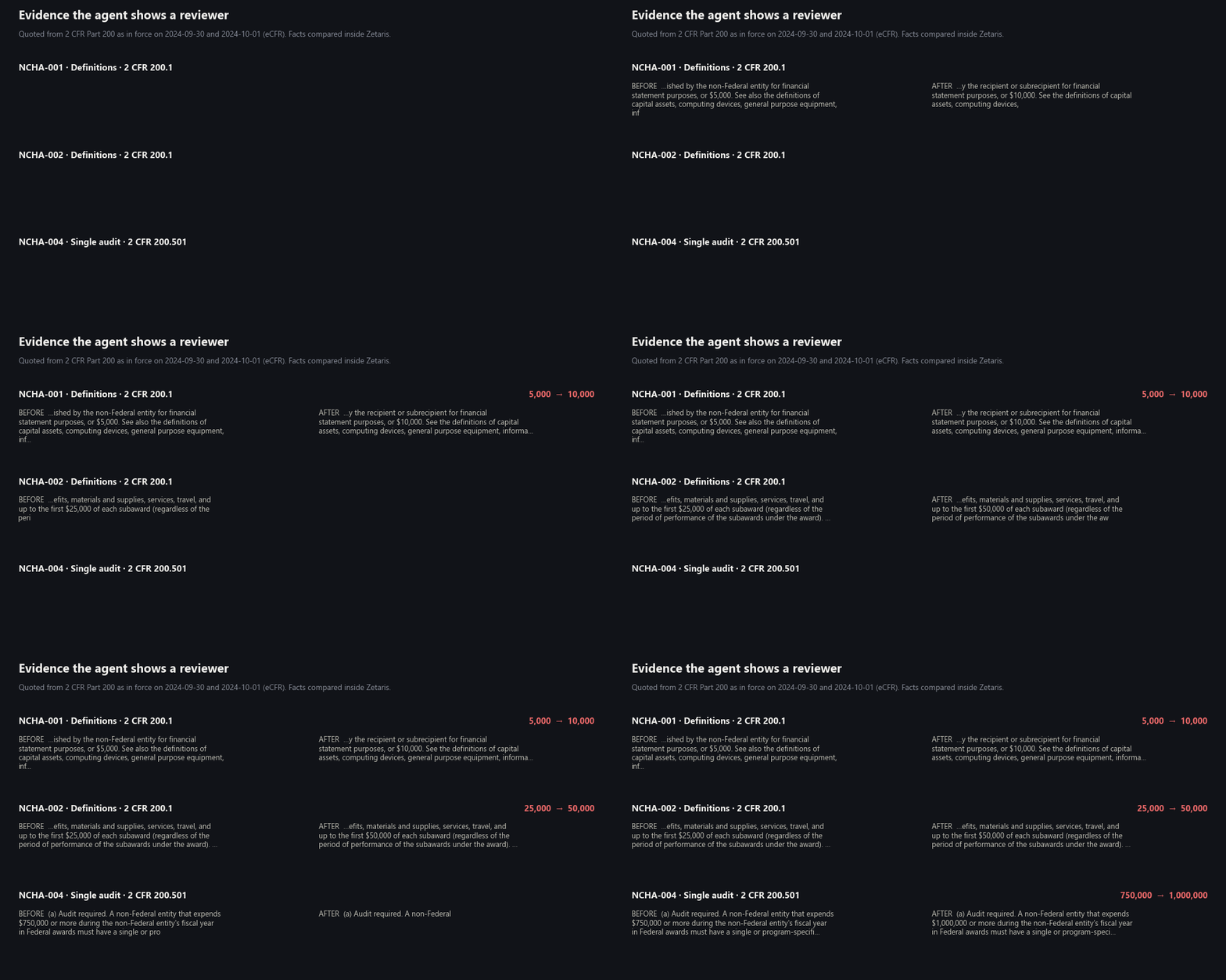
Ground truth comes from an **independent annotator who never saw the detection method**: for each assessment it read the cited 2024-09-30 paragraph and the 2024-10-01 text and decided whether the requirement changed in substance (19 material, 26 editorial, 3 byte-identical). The decision rule and its one threshold (successor distance ≤ 0.60) were fixed **before** the labels existed and were not tuned on them.
| Method | Sent to re-review | Precision | Recall | F1 | F1 95% CI (bootstrap, 3 seeds) |
|---|---:|---:|---:|---:|---|
| Control A — re-review every section the eCFR marks as amended | 48 | 0.40 | 1.00 | 0.57 | 0.41 – 0.70 |
| Control B — re-review whenever the cited text is not identical | 45 | 0.42 | 1.00 | 0.59 | 0.44 – 0.72 |
| **Sentinel — federated Zetaris view** | **25** | **0.64** | **0.84** | **0.73** | **0.55 – 0.86** |
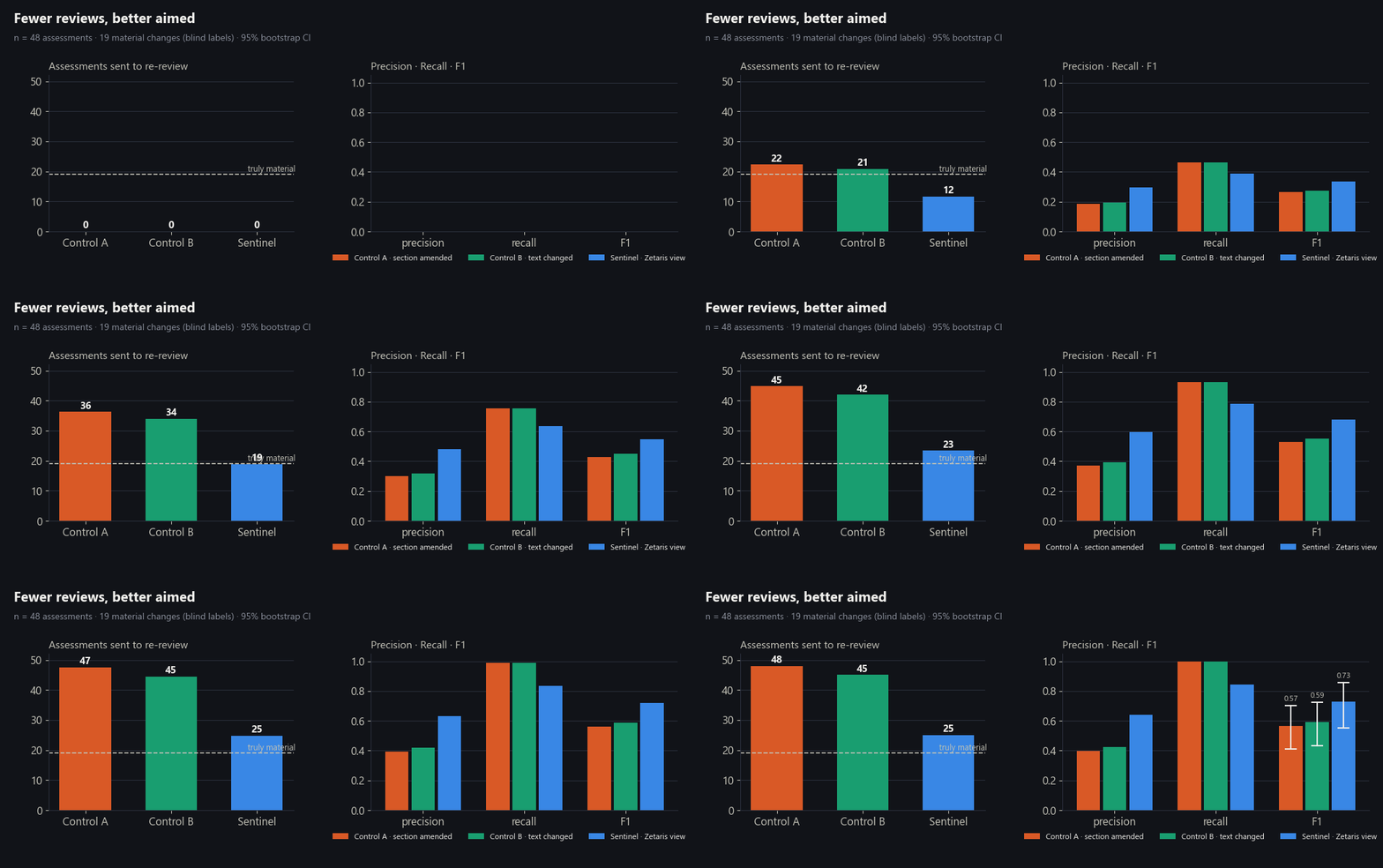 - The Sentinel **halves the review load** (25 instead of 48) and finds **16 of the 19** material changes.
- Robustness: on the 40 randomly sampled assessments only (excluding 8 hand-picked anchors) F1 is 0.62 vs 0.46 / 0.49; on the 32 high-confidence labels it is 0.80 vs 0.48 / 0.51.
- Its three misses are wording-only shifts in obligation (`will` → `should`, a narrowed approver, a widened scope); its nine false alarms are mostly restatements such as "unallowable except with approval" → "allowable only with approval". Every error is listed in [`eval/results.json`](eval/results.json).
### Correctness and latency — Zetaris view vs. a direct control
The same rule was re-implemented in plain Python (`src/control_direct.py`), connecting to PostgreSQL, reading the CSV and calling the eCFR API itself. Both paths ran in a container on the Zetaris host network: 3 sessions × 30 timed runs after 3 warm-ups.
| | Zetaris federated view | Direct control (no Zetaris) |
|---|---:|---:|
| Verdict agreement | **48 / 48** in all 3 sessions | — |
| Median end-to-end latency per session | 1.79 s · 2.36 s · 1.85 s | 0.46 s · 0.46 s · 0.46 s |
| Connections the agent must hold | **1** | 3 |
| Client libraries in the agent | **Python stdlib only** | psycopg, csv, urllib, rapidfuzz |
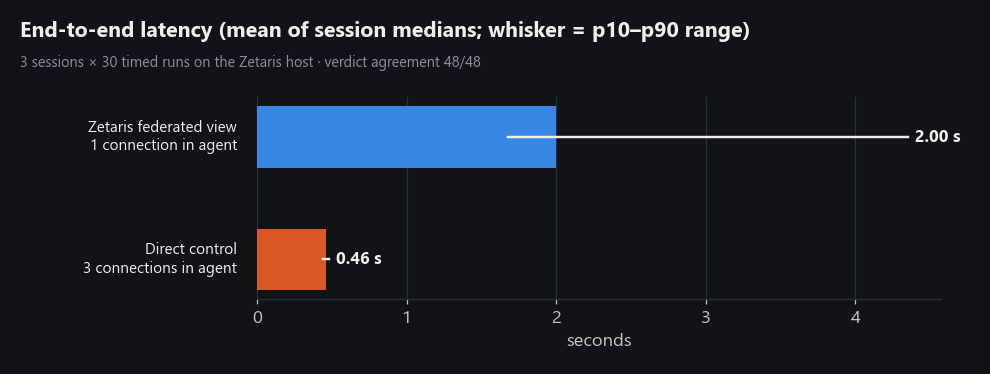 Zetaris is **slower** here — about 1.5 s more per run on a 48-row register — and we report it as such. For a job that runs when a regulation changes, that cost buys a single governed endpoint, no per-source client code in the agent, and a rule that any SQL user can audit.
Raw numbers: [`bench/results/`](bench/results) · [`eval/metrics.csv`](eval/metrics.csv) · [`experiments/LOG.md`](experiments/LOG.md).
## How it works
```mermaid
flowchart LR
subgraph Sources
PG[(PostgreSQL