# RecallNest
**Shared Memory Layer for Claude Code, Codex, and Gemini CLI**
*One memory. Three terminals. Context that survives across windows.*
A local-first memory system backed by LanceDB that turns scattered conversation history into reusable knowledge — shared across your coding agents, recalled automatically.
[](https://github.com/AliceLJY/recallnest)
[](LICENSE)
[](https://bun.sh)
[](https://lancedb.com)
[](https://modelcontextprotocol.io)
[](https://github.com/AliceLJY/recallnest)
[](https://github.com/AliceLJY/recallnest)
**English** | [简体中文](README_CN.md) | [Roadmap](ROADMAP.md)
---
## Why RecallNest?
Coding agents forget everything between windows. Your context — project configs, debugging decisions, entity mappings — is scattered across Claude Code, Codex, and Gemini CLI with no shared memory.
RecallNest solves this: **a single LanceDB-backed memory layer that your coding agents read and write**. Context stored in one window is auto-recalled in another. Sessions checkpoint on exit and resume on start. Memory decays, evolves, and self-organizes — not just raw log storage.
## Quick Start
### Option A: Claude Code Plugin (recommended)
```bash
/plugin marketplace add AliceLJY/recallnest
/plugin install recallnest@AliceLJY
```
RecallNest starts automatically with Claude Code. No manual MCP config needed.
> **Requires:** [Bun](https://bun.sh) (recommended) or Node.js 18+. Dependencies install on first start.
### Option B: npm install
```bash
npx recallnest --help # run directly
# or
npm install -g recallnest # install globally
recallnest doctor
```
Works with Node.js 18+ (via tsx) or Bun. No git clone needed.
### Option C: Manual setup
```bash
git clone https://github.com/AliceLJY/recallnest.git
cd recallnest
bun install
cp config.json.example config.json
cp .env.example .env
# Edit .env → add your JINA_API_KEY
```
### Start the server
```bash
bun run api
# → RecallNest API running at http://localhost:4318
```
### Try it
```bash
# Store a memory
curl -X POST http://localhost:4318/v1/store \
-H "Content-Type: application/json" \
-d '{"text": "User prefers dark mode", "category": "preferences"}'
# Recall memories
curl -X POST http://localhost:4318/v1/recall \
-H "Content-Type: application/json" \
-d '{"query": "user preferences"}'
# Check stats
curl http://localhost:4318/v1/stats
```
### Connect your terminals
```bash
bash integrations/claude-code/setup.sh
bash integrations/gemini-cli/setup.sh
bash integrations/codex/setup.sh
```
Each script installs MCP access and managed continuity rules, so `resume_context` fires automatically in fresh windows.
### Index existing conversations
```bash
bun run src/cli.ts ingest --source all
bun run seed:continuity
bun run src/cli.ts doctor
```
---
## Web UI
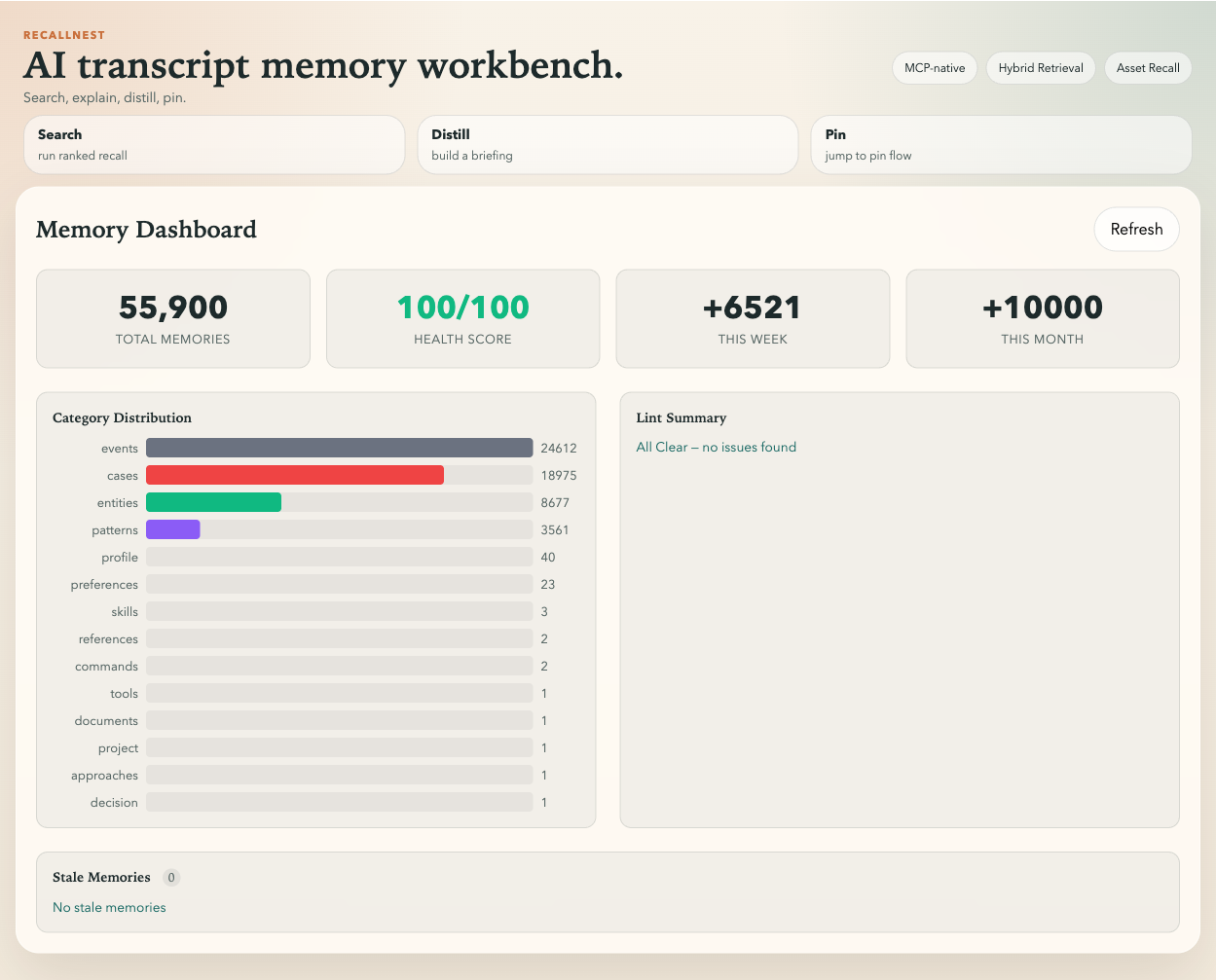
Dashboard — total count, category distribution, health score, and growth trends at a glance.
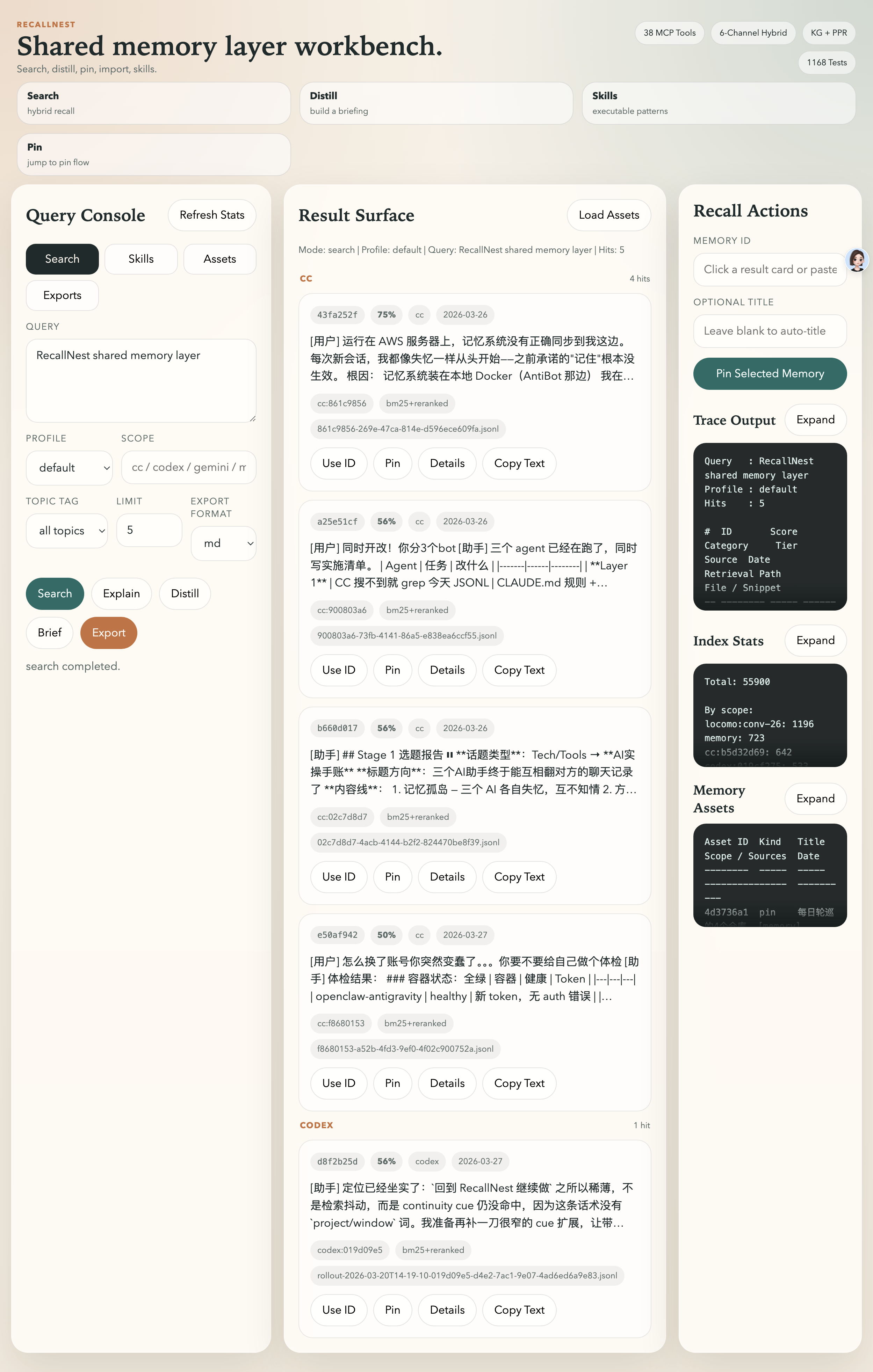
Search Workbench — hybrid search with topic tag filtering, 4 retrieval profiles, Skills browser, and asset management.
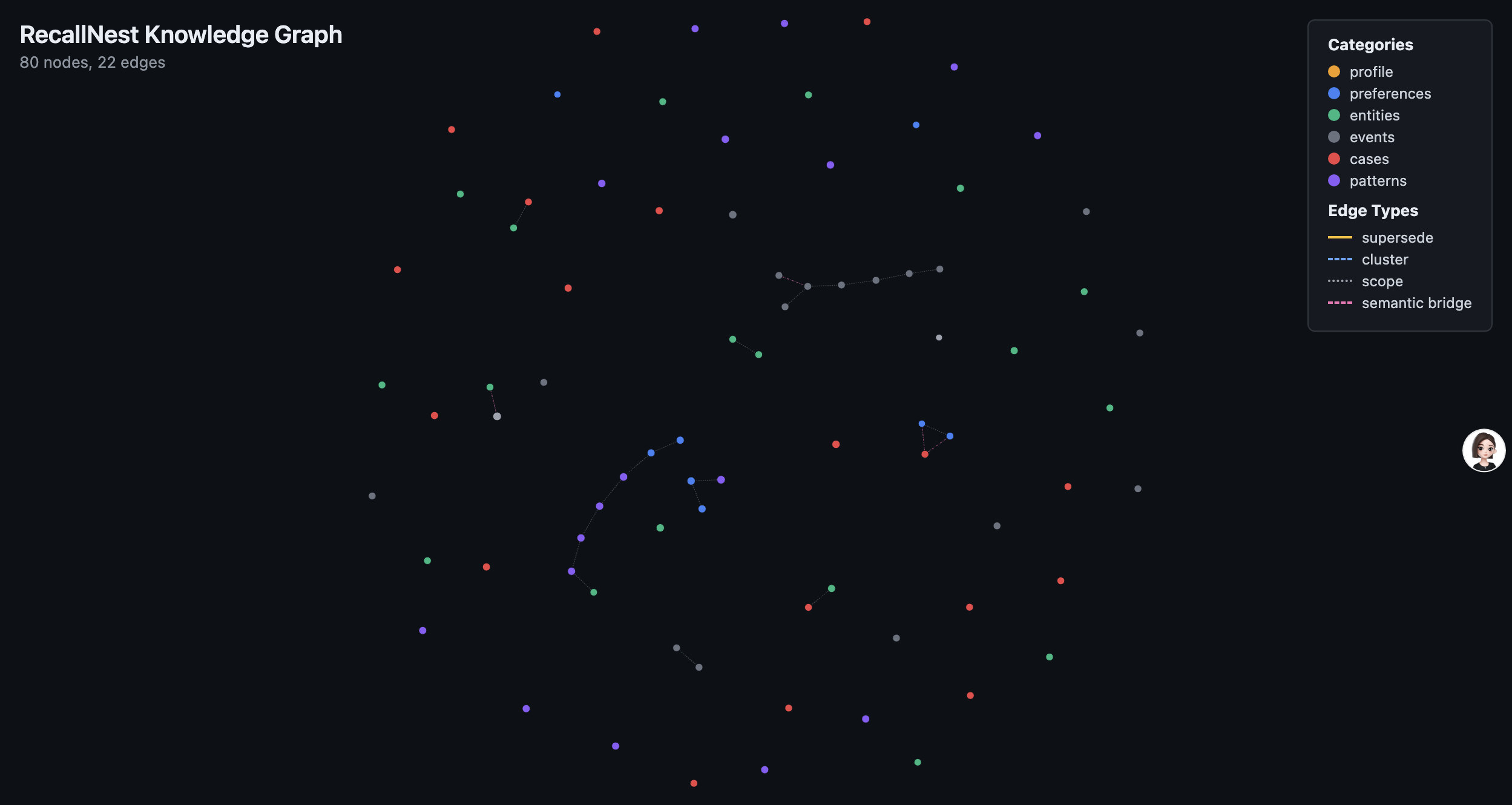
Knowledge Graph — interactive force-directed visualization with semantic bridges revealing cross-domain connections.
```bash
bun run src/ui-server.ts
# → http://localhost:4317
```
---
## Core Capabilities
### Access & Setup
| Capability | Description |
|---|---|
| **CC Plugin** | Install in Claude Code with one command — no manual config |
| **Shared Index** | One LanceDB store for Claude Code, Codex, and Gemini CLI |
| **Dual Interface** | MCP (stdio) for CLI tools + HTTP API for custom agents |
| **One-Click Setup** | Integration scripts install MCP access and continuity rules |
### Recall & Continuity
| Capability | Description |
|---|---|
| **Hybrid Retrieval** | 6-channel: vector + BM25 + L0/L1/L2 multi-vector + KG graph (PPR) |
| **4 Retrieval Profiles** | default, writing, debug, fact-check — tuned for different tasks |
| **Session Continuity** | `checkpoint_session` + `resume_context` (full/light/summary modes) with repo-state guard |
| **Session Distiller** | 3-layer conversation compression: microcompact → LLM summary → knowledge extraction |
| **Conversation Import** | Import from Claude Code, Claude.ai, ChatGPT, Slack, and plaintext |
| **Topic Tags** | Intra-scope topic partitioning — auto-detected, filterable in search |
| **Related Scope Sidecar** | Opt-in `includeRelatedScopes` search over configured `scopeRelations`, shown separately from the main scoped ranking |
### Memory Lifecycle & Governance
| Capability | Description |
|---|---|
| **Memory Evolution** | Supersede chains, decay scoring, LLM importance, consolidation, archival |
| **Smart Promotion** | Evidence → durable memory with conflict guards, merge resolution, and audit trail |
| **Privacy Tiers** | 4-tier (`ephemeral` / `private` / `durable` / `shared`) with cascade forgetting |
| **Admission Control** | Write-time gating: noise filter, importance floor, dedup, rate limiting |
| **Memory Lint** | Contradiction, duplicate, stale, and orphan detection with health score |
| **Offline Consolidation** | `dream` command: clustering, merging, pruning of accumulated memories |
### Reasoning & Structure
| Capability | Description |
|---|---|
| **Knowledge Graph** | Entity relation graph with PPR algorithm for multi-hop questions |
| **Constructive Retrieval** | Multi-source candidate expansion + grounded context reconstruction |
| **Narrative Architecture** | 3-layer autobiographical metadata (life-period → general-event → specific-event) |
| **Skill Memory** | Store, retrieve, and promote executable skills from recurring patterns |
| **Predictive Reminders** | Behavioral-signal prediction engine surfaces "you might need this" suggestions |
| **6 Categories** | profile, preferences, entities, events, cases, patterns — with category-aware merge strategies |
### Visibility & Operations
| Capability | Description |
|---|---|
| **Dashboard** | Web UI with stats, category distribution, growth trends, and health |
| **Workflow Observation** | Dedicated append-only workflow health records, outside regular memory |
| **Structured Assets** | Pins, briefs, and distilled summaries — not just raw logs |
| **Data Checkup** | Data quality health checks on the memory store (including source health) |
| **Source Heartbeats** | Automatic ingest health tracking per data source with staleness alerts |
| **Export Graph** | Export interactive HTML knowledge graph visualization |
| **Batch Operations** | Store up to 20 memories in a single call with dedup |
| **Connector Framework** | Standard connector-v1 format for external data sources with example adapters |
---
## New in v2.1: Philosophy-Informed Memory
v2.0 built the operational memory platform; v2.1 added philosophy-informed memory behavior.
Five upgrades derived from 9 research dimensions in philosophy of memory, each mapped to concrete engineering:
- **Emotion-Aware Decay** *(Affective Memory Theory)* — Memories with strong emotional content decay 20-30% slower. Keyword-based emotion detection computes `salience` (mnemonic significance), which feeds into the Weibull half-life formula and a rebalanced 4-factor evolution score. Zero LLM cost.
- **Memory Ethics Layer** *(Right to Be Forgotten / GDPR Art. 17)* — Four privacy tiers (`ephemeral` / `private` / `durable` / `shared`). Cascade forgetting engine that propagates deletion through KG triples, evolution chains, pin assets, and briefs. Full audit trail. `forget_memory` MCP tool for agent-driven deletion.
- **Autobiographical Narrative** *(Narrative Identity Theory / Conway's 3-layer model)* — Memories are tagged with `lifePeriod → generalEvent → specificEvent` hierarchy, orthogonal to existing 6 categories. Retrieval pulls narrative siblings. Context rendering groups by life period. Rule-based tagger with EN+CN support.
- **Constructive Retrieval** *(Simulation Theory / Michaelian)* — Instead of returning raw stored text, RecallNest now reconstructs context from an expanded candidate set: KG neighbors + evolution chains + cluster members + narrative siblings. Source-map grounded coverage replaces lexical overlap. Contradictions are detected and flagged.
- **Predictive Prospective Memory** *(Mental Time Travel / Tulving)* — Heuristic prediction engine that surfaces "you might need this" reminders from behavioral signals: stale checkpoint open loops, corrected workflow observations, high-frequency dormant memories, and uncovered query topics. Zero LLM cost. Auto-expire in 7 days if unaccepted.
---
## New in v2.2: Retrieval Quality Hardening
v2.1 added philosophy-informed behavior; v2.2 closes the last three engine-layer gaps identified by a frontier research scan (ACC, PI-LLM, TSM).
- **Memory Confidence Meta-tags** *(ACC / Dual-Process UQ)* — Each memory now carries structured `ConfidenceMetadata` (score, reliability tier: `direct` / `inferred` / `hearsay`). Auto-assigned from source on write (`manual` = 0.9, `agent` = 0.7, `conversation_import` = 0.5). Retrieval scores are weighted by confidence. `resume_context` tags low-confidence items with `[低置信]`.
- **Interference Detection + Active Forgetting Gate** *(PI-LLM / SleepGate)* — Semantic cluster detection identifies groups of near-duplicate memories competing for retrieval. Enhanced RIF keeps only top-K (default 3) per cluster; extras are demoted 50% instead of removed. Write-time pre-warning: when a scope accumulates ≥5 high-similarity active memories, the weakest is flagged `pending_review`. `data_checkup` reports interference density.
- **Temporal Validity Windows** *(TSM / TiMem / Zep)* — `store_memory` accepts `validUntil` (expiration) and `eventTime` (when the event actually happened). `search_memory` supports `validAt` (point-in-time query) and `includeExpired` (demote 80% instead of hide). Auto-GC applies 2× decay acceleration to expired memories.
- **Usage-Adjusted Auto-GC** *(off by default)* — `RECALLNEST_USAGE_DECAY=true` enables a GC-only cold-memory penalty when constructive retrieval is also active. Cold memories discount the frequency component instead of changing online retrieval ranking.
---
## New in v2.3: Connector Ecosystem + Source Health
v2.2 hardened retrieval quality; v2.3 opens RecallNest to external data sources with a standard connector framework and operational health monitoring.
- **Connector-v1 Standard** *(GB-2)* — A JSON format (`ConnectorOutputV1`) that any external script can produce. Obsidian vaults, emails, RSS feeds, log files — normalize once, ingest through the full dedup/embed/extract pipeline. See [`docs/connector-spec.md`](docs/connector-spec.md) for the specification and [`connectors/examples/`](connectors/examples/) for adapter skeletons (email, logs, RSS).
- **Obsidian Vault Ingestion** *(GB-1)* — First-party Obsidian connector: scans `.md` files, extracts frontmatter + wikilinks, maps folder structure to tags. One command: `lm ingest --obsidian /path/to/vault`.
- **Source Health Monitoring** *(GB-3)* — Every connector ingest writes a heartbeat to `data/source-heartbeat.json`. `data_checkup` flags stale sources (>7d warning, >30d error). `doctor --ci` shows a per-source heartbeat summary with human-readable age.
---
## Architecture
```
┌──────────────────────────────────────────────────────────┐
│ Client Layer │
├──────────┬──────────┬──────────┬──────────────────────────┤
│ Claude │ Gemini │ Codex │ Custom Agents / curl │
│ Code │ CLI │ │ │
└────┬─────┴────┬─────┴────┬─────┴──────┬──────────────────┘
│ │ │ │
└──── MCP (stdio) ───┘ HTTP API (port 4318)
│ │
▼ ▼
┌──────────────────────────────────────────────────────────┐
│ Integration Layer │
│ ┌─────────────────────┐ ┌────────────────────────────┐ │
│ │ MCP Server │ │ HTTP API Server │ │
│ │ 43 tools │ │ 21 endpoints │ │
│ └─────────┬───────────┘ └──────────┬─────────────────┘ │
└────────────┼─────────────────────────┼───────────────────┘
└──────────┬──────────────┘
▼
┌──────────────────────────────────────────────────────────┐
│ Core Engine │
│ │
│ ┌────────────┐ ┌────────────┐ ┌─────────────────────┐ │
│ │ Retriever │ │ Classifier │ │ Context Composer │ │
│ │ (vector + │ │ (6 cats) │ │ (resume_context) │ │
│ │ BM25 + RRF)│ │ │ │ │ │
│ └────────────┘ └────────────┘ └──────────────────────┘ │
│ ┌────────────┐ ┌────────────┐ ┌─────────────────────┐ │
│ │ Decay │ │ Conflict │ │ Capture Engine │ │
│ │ Engine │ │ Engine │ │ (evidence → durable) │ │
│ │ (Weibull) │ │ (audit + │ │ │ │
│ │ │ │ merge) │ │ │ │
│ └────────────┘ └────────────┘ └──────────────────────┘ │
└──────────────────────────┬───────────────────────────────┘
▼
┌──────────────────────────────────────────────────────────┐
│ Storage Layer │
│ ┌─────────────────────┐ ┌────────────────────────────┐ │
│ │ LanceDB │ │ Jina Embeddings v5 │ │
│ │ (vector + columnar) │ │ (1024-dim, task-aware) │ │
│ └─────────────────────┘ └────────────────────────────┘ │
└──────────────────────────────────────────────────────────┘
```
### Internal Design
- **L0 / L1 / L2 Dynamic Folding** — every memory stores 3 granularity layers (one-liner / bullet summary / full content); retrieval dynamically selects which layer to return based on relevance score and token budget
- **Weibull Decay + Emotion Modulation** — memories decay along a parametric Weibull curve; importance scores modulate the half-life, and emotional salience extends it further (up to 30%)
- **Vector Pre-filter + LLM Dedup** — 90% of dedup decisions use cheap cosine similarity (>= 0.92); only borderline cases invoke LLM judgment, keeping costs low without sacrificing accuracy
- **Category-Aware Merge Strategies** — `profile` and `preferences` use merge-on-conflict (latest wins); `events` and `cases` use append-only (history preserved)
- **Display Score vs Elimination Score** — dual-track retrieval: tier floor prevents core memories from ever dropping out, while decay boost lets fresh memories surface temporarily without permanently displacing stable ones
> Full architecture deep-dive: [`docs/architecture.md`](docs/architecture.md)
---
## Interfaces
RecallNest serves two interfaces:
- **MCP** — for Claude Code, Gemini CLI, and Codex (native tool access)
- **HTTP API** — for custom agents, SDK-based apps, and any HTTP client
### Agent framework examples
Examples live in [`integrations/examples/`](integrations/examples/):
| Framework | Example | Language |
|-----------|---------|----------|
| [Claude Agent SDK](integrations/examples/claude-agent-sdk/) | `memory-agent.ts` | TypeScript |
| [OpenAI Agents SDK](integrations/examples/openai-agents-sdk/) | `memory-agent.py` | Python |
| [LangChain](integrations/examples/langchain/) | `memory-chain.py` | Python |
---
MCP Tools (43 tools)
| Tool | Description |
|------|-------------|
| `workflow_observe` | Store an append-only workflow observation outside regular memory; accepts `idempotencyKey` for retry-safe writes |
| `workflow_health` | Inspect workflow observation health or show a degraded-workflow dashboard |
| `workflow_evidence` | Build an evidence pack for a workflow primitive |
| `store_memory` | Store a durable memory for future windows |
| `store_workflow_pattern` | Store a reusable workflow as durable `patterns` memory |
| `store_case` | Store a reusable problem-solution pair as durable `cases` memory |
| `promote_memory` | Explicitly promote evidence into durable memory |
| `promote_scan` | Scan recent evidence and auto-promote qualifying memories into durable storage |
| `list_conflicts` | List or inspect promotion conflict candidates |
| `audit_conflicts` | Summarize stale/escalated conflict priorities |
| `escalate_conflicts` | Preview or apply conflict escalation metadata |
| `resolve_conflict` | Resolve a stored conflict candidate (keep / accept / merge) |
| `checkpoint_session` | Store the current active work state outside durable memory; accepts `idempotencyKey` for retry-safe writes |
| `latest_checkpoint` | Inspect the latest saved checkpoint by session or scope |
| `resume_context` | Compose startup context for a fresh window |
| `search_memory` | Proactive recall at task start |
| `explain_memory` | Explain why memories matched |
| `distill_memory` | Distill results into a compact briefing |
| `brief_memory` | Create a structured brief and re-index it |
| `pin_memory` | Promote a scoped memory into a pinned asset |
| `export_memory` | Export a distilled memory briefing to disk |
| `list_pins` | List pinned memories |
| `list_assets` | List all structured assets |
| `list_dirty_briefs` | Preview outdated brief assets created before the cleanup rules |
| `clean_dirty_briefs` | Archive dirty brief assets and remove their indexed rows |
| `memory_stats` | Show index statistics |
| `memory_drill_down` | Inspect a specific memory entry with full metadata and provenance |
| `auto_capture` | Heuristically extract and store memory signals from text (zero LLM calls) |
| `set_reminder` | Set a prospective memory reminder to surface in a future session |
| `consolidate_memories` | Cluster near-duplicate memories and merge them (dry-run by default) |
| `store_skill` | Store an executable skill with trigger conditions and verification |
| `retrieve_skill` | Retrieve matching executable skills by semantic similarity |
| `scan_skill_promotions` | Scan cases/patterns for promotion candidates to skills |
| `list_tools` | Discover available tools by tier (core/advanced/full) |
| `batch_store` | Store up to 20 memories in a single call with dedup |
| `distill_session` | Distill a conversation into structured knowledge via 3-layer pipeline |
| `import_conversations` | Import conversations from Claude Code, ChatGPT, Slack, and more |
| `data_checkup` | Run data quality health checks on the memory store |
| `dream` | Run offline memory consolidation (clustering, merging, pruning) |
| `memory_lint` | Run memory quality checks: contradictions, duplicates, stale entries, orphans |
| `forget_memory` | Cascade-delete a memory with KG cleanup, pin archival, and audit trail |
| `export_graph` | Export memories as an interactive HTML knowledge graph |
HTTP API (21 endpoints)
Base URL: `http://localhost:4318`
| Endpoint | Method | Description |
|----------|--------|-------------|
| `/v1/recall` | POST | Quick semantic search |
| `/v1/store` | POST | Store a new memory |
| `/v1/capture` | POST | Store multiple structured memories |
| `/v1/pattern` | POST | Store a structured workflow pattern |
| `/v1/case` | POST | Store a structured problem-solution case |
| `/v1/promote` | POST | Promote evidence into durable memory |
| `/v1/conflicts` | GET | List or inspect promotion conflict candidates |
| `/v1/conflicts/audit` | GET | Summarize stale/escalated conflict priorities |
| `/v1/conflicts/escalate` | POST | Preview or apply conflict escalation metadata |
| `/v1/conflicts/resolve` | POST | Resolve a stored conflict candidate (keep / accept / merge) |
| `/v1/checkpoint` | POST | Store the current work checkpoint |
| `/v1/workflow-observe` | POST | Store a workflow observation outside durable memory |
| `/v1/checkpoint/latest` | GET | Fetch the latest checkpoint by session or scope |
| `/v1/workflow-health` | GET | Inspect workflow health or return a degraded-workflow dashboard |
| `/v1/workflow-evidence` | GET | Build a workflow evidence pack from recent issue observations |
| `/v1/resume` | POST | Compose startup context for a fresh window |
| `/v1/search` | POST | Advanced search with full metadata |
| `/v1/stats` | GET | Memory statistics |
| `/v1/lint` | GET | Memory quality lint report |
| `/v1/health` | GET | Health check |
Full documentation: [`docs/api-reference.md`](docs/api-reference.md)
CLI Commands
```bash
# Search & explore
bun run src/cli.ts search "your query"
bun run src/cli.ts explain "your query" --profile debug
bun run src/cli.ts distill "topic" --profile writing
bun run src/cli.ts stats
# Workflow observation
bun run src/cli.ts workflow-observe resume_context "Fresh window skipped continuity recovery." --outcome missed --scope project:recallnest --idempotency-key smoke-2026-06-26
bun run src/cli.ts workflow-health resume_context --scope project:recallnest
bun run src/cli.ts workflow-evidence checkpoint_session --scope project:recallnest
# Conflict management
bun run src/cli.ts conflicts list
bun run src/cli.ts conflicts list --attention resolved
bun run src/cli.ts conflicts list --group-by cluster --attention resolved
bun run src/cli.ts conflicts audit
bun run src/cli.ts conflicts audit --export --format md
bun run src/cli.ts conflicts escalate --attention stale
bun run src/cli.ts conflicts show af70545a
bun run src/cli.ts conflicts resolve af70545a --keep-existing
bun run src/cli.ts conflicts resolve af70545a --merge
bun run src/cli.ts conflicts resolve --all --keep-existing --status open
# Memory health & visualization
bun run src/cli.ts lint # memory quality report
bun run src/cli.ts lint --scope project:myapp # lint a specific scope
bun run src/cli.ts graph --open # export & open knowledge graph
bun run src/cli.ts graph --max-nodes 50 # smaller graph
# Ingestion & diagnostics
bun run src/cli.ts ingest --source all
bun run src/cli.ts doctor
```
---
## Multilingual Support
RecallNest works out of the box with English. For multilingual memory (Chinese, Japanese, Thai, and 20+ more), install [babel-memory](https://github.com/AliceLJY/babel-memory) with the language packs you need:
```bash
# Chinese
npm install babel-memory jieba-wasm
# Japanese
npm install babel-memory @sglkc/kuromoji
# Thai
npm install babel-memory wordcut
# European languages (German, French, Spanish, Russian, etc.)
npm install babel-memory snowball-stemmers
# Multiple languages at once
npm install babel-memory jieba-wasm @sglkc/kuromoji snowball-stemmers
```
RecallNest auto-detects babel-memory at startup — no configuration needed. Without babel-memory, RecallNest still works perfectly with standard BM25 text search.
---
## Project Status & Roadmap
RecallNest is actively maintained. All major architecture phases are complete — see the full [Roadmap](ROADMAP.md) for current priorities and future plans.
---
## Relationship to memory-lancedb-pro
RecallNest started as a fork of [memory-lancedb-pro](https://github.com/CortexReach/memory-lancedb-pro) and shares its core ideas around hybrid retrieval, decay modeling, and memory-as-engineering-system. The key difference:
- **memory-lancedb-pro** is an OpenClaw plugin — it adds long-term memory to a single OpenClaw agent.
- **RecallNest** is a standalone memory layer — it serves Claude Code, Codex, and Gemini CLI simultaneously through MCP + HTTP API, with session continuity, structured assets, and conflict management built in.
## Credit
| Source | Contribution |
|--------|-------------|
| [memory-lancedb-pro](https://github.com/CortexReach/memory-lancedb-pro) by [@win4r](https://github.com/win4r) | Fork base — hybrid retrieval, decay modeling, and memory architecture |
| Claude Code | Foundation and early project scaffolding |
| OpenAI Codex | Productization and MCP expansion |
Special thanks to Qin Chao ([@win4r](https://github.com/win4r)) and the [CortexReach](https://github.com/CortexReach) team for the foundational work.
Ecosystem
Part of the **小试AI** open-source AI workflow:
| Project | Description |
|---------|-------------|
| [babel-memory](https://github.com/AliceLJY/babel-memory) | Multilingual preprocessing for BM25 — 27+ languages, zero deps |
| [cc-empire](https://github.com/AliceLJY/cc-empire) | Hooks/rules/methodology — the connective tissue of the whole ecosystem |
| [telegram-ai-bridge](https://github.com/AliceLJY/telegram-ai-bridge) | Telegram bots for Claude, Codex, and Gemini |
| [tg-bridge-channel](https://github.com/AliceLJY/tg-bridge-channel) | Sister Telegram bridge using Claude Agent View background sessions |
| [wechat-ai-bridge](https://github.com/AliceLJY/wechat-ai-bridge) | Run Claude Code / Codex / Gemini in WeChat with session management |
| [openclaw-tunnel](https://github.com/AliceLJY/openclaw-tunnel) | Docker ↔ host CLI bridge (maintenance mode — LanceDB test only) |
| [digital-clone-skill](https://github.com/AliceLJY/digital-clone-skill) | Build digital clones from corpus data |
| [claude-code-studio](https://github.com/AliceLJY/claude-code-studio) | Multi-session collaboration platform for Claude Code |
| [workflow-orchestrator](https://github.com/AliceLJY/workflow-orchestrator) | Natural-language pipeline orchestrator for Claude Code |
## License
MIT