# ColliePWA

ColliePWA: your terminal agents, on your phone. Two phones show the dashboard and a chat with a coding agent, beside the logos of the agents and multiplexers it works with.

Try it in your browser — no install · colliepwa.dev
A real Collie build running in the page against faked data.

ColliePWA is an open-source (MIT) web app for your phone. It displays your terminal AI agents, including Claude Code, Codex and OpenCode, and lets you answer them remotely. You host it on your own computer alongside [Herdr](https://herdr.dev). Support for the new Herdr core, [tmux](https://github.com/tmux/tmux) and [zellij](https://zellij.dev) is experimental. ColliePWA is served over Tailscale, so only devices on your own tailnet reach it. You install it via your browser directly to your home screen, bypassing app stores. Using Herdr? Read about the [Herdr mobile client](https://colliepwa.dev/herdr-mobile-client?utm_source=github&utm_medium=readme&utm_campaign=collie&utm_content=herdr). ## What you can do - **Answer what needs you.** The dashboard surfaces waiting agents first. Agent prompts turn into buttons. Quick replies, a configurable keys board, and your system keyboard with voice dictation handle input. [Guide](./docs/claude-code-on-your-phone.md) - **WalkyTalky: agents message each other, and you message them.** Send short messages between agent sessions across programs and machines. Message any session from your phone. Every message returns a receipt. [WalkyTalky](./docs/walky-talky.md) - **Start agents from the phone.** Use the **+ New** page to choose the machine, agent or command, directory, and an optional git worktree. [Guide](./docs/claude-code-on-your-phone.md) - **Push notifications and voice input.** Receive alerts when an agent pauses or finishes. Whistle, Collie's built-in speech engine, converts voice to text. It remains inactive until configured. [Voice and push](./docs/voice-and-push.md) - **See what the agent changed.** The Files view displays the workspace folder, marks modified files, and provides a read-only view of git diffs and the latest commit. [Changes](./docs/changes.md) - **Crews.** Cluster multiple Collie hosts behind one URL with manual failover. [Crews](./docs/crew.md) - **Tricks, and the Hill.** Add small programs that put counts, marks and screens in Collie. Let an agent or a trick ask you one question, and answer it with one tap. [Tricks](./docs/tricks.md), [The Hill](./docs/hill.md) Other features: output search, full conversation history, image and file attachments, [durable agents](./docs/durable-agents.md) (experimental), four [themes](./docs/themes.md), twelve languages, and per-device typeface selection. The Edge release line typesets chat equations when math is enabled ([syntax](./docs/changes.md#equations)). Edge receives features before Stable ([Manage & update](./docs/upgrading.md)). ## Get it on your phone in 3 steps Prerequisites: [Tailscale](https://tailscale.com) on your computer and phone, and [Herdr](https://herdr.dev) (or experimental Herdr core, tmux, or zellij) running on your computer. For new setups, follow **[Install in five minutes](./docs/five-minute-install.md)** for platform-specific instructions, including [Windows](./docs/five-minute-install.md#windows). Alternative options (Arch, Nix, Herdr plugin, source) are in **[Install](./docs/install.md)**. **1. Install** on your computer. Requires `curl`, `tar`, and a sha256 utility. Needs no `sudo` or compiler. Verifies checksums automatically: ```bash curl -fsSL https://colliepwa.dev/install.sh | sh ``` **2. Start** it on your tailnet: ```bash COLLIE_MUX=herdr collie start # or: herdr-core, tmux, zellij ``` Without `COLLIE_MUX`, `collie start` checks for Herdr, tmux, and zellij and prompts you to pick one. It offers Herdr core only if the Herdr TUI is absent. **3. Put it on your phone and pair it.** Run `collie qr` and scan the code. Add ColliePWA to your home screen: - **iPhone:** In Safari, tap **Share** (under **⋯** in the default iOS 26 layout), tap **Add to Home Screen**, then tap **Add**. - **Android:** In Chrome, open Collie **Settings** and tap **Install** on the top card. ![Put Collie on the home screen: iPhone and Android steps.](docs/images/install/pwa-install.svg) ColliePWA is not on the App Store or Google Play; home-screen installation is required. Launch the installed app, run `collie pair` on your computer, and enter the code under **Settings → System → Paired devices**. Pair within the home-screen app, not the browser: iOS keeps their storage separate. The app displays no panes until paired. Agents awaiting input appear first. Tap an agent to reply. To configure Collie using an agent, instruct it to run `collie skill` and follow the instructions. > Collie exposes remote shell access to your machine. Keep it on your tailnet (`tailscale serve`, > never `funnel`). Read [Security](#security-read-this-first) before running. ## Security, read this first **Collie provides remote shell access to your machine by design.** A single Collie API call sends arbitrary keystrokes directly into a live terminal pane. Anyone with access to the URL can read pane output (source code, secrets, environment variables, agent output) and execute arbitrary commands with your full user privileges. There is no sandbox and no command allow-list, as these would defeat the core workflow. Treat the URL as a root login: bind it strictly to your tailnet, set `COLLIE_TRUSTED_USER`, and pair only the physical phone you are using. Read [`docs/security.md`](./docs/security.md) for details on the security model, defense layers, and device gating before running the service. > **Never `tailscale funnel` this.** `funnel` exposes the port to the public internet, whereas > `serve` limits access to your private tailnet. Do not funnel Collie under any circumstances. ## Who this is for Collie is for developers running terminal-multiplexed AI agents who want phone access via a touch UI instead of an emulated terminal. Herdr is the primary target. **The Herdr core, tmux and zellij are experimental**: they function, but testing is limited. [Bug reports are welcome](./docs/multiplexers.md#pointing-collie-at-a-multiplexer), including reports of working setups. The setup assumes a **[Tailscale](https://tailscale.com) tailnet**, with `tailscale serve` as the default ingress. Collie is strictly **single-user**: one operator per tailnet, without multi-tenant authentication. Do not deploy it for shared or public access. ## Demo The [interactive demo](https://colliepwa.dev/demo?utm_source=github&utm_medium=readme&utm_campaign=collie&utm_content=demo-section) runs the client in your browser against mock data without requiring installation.
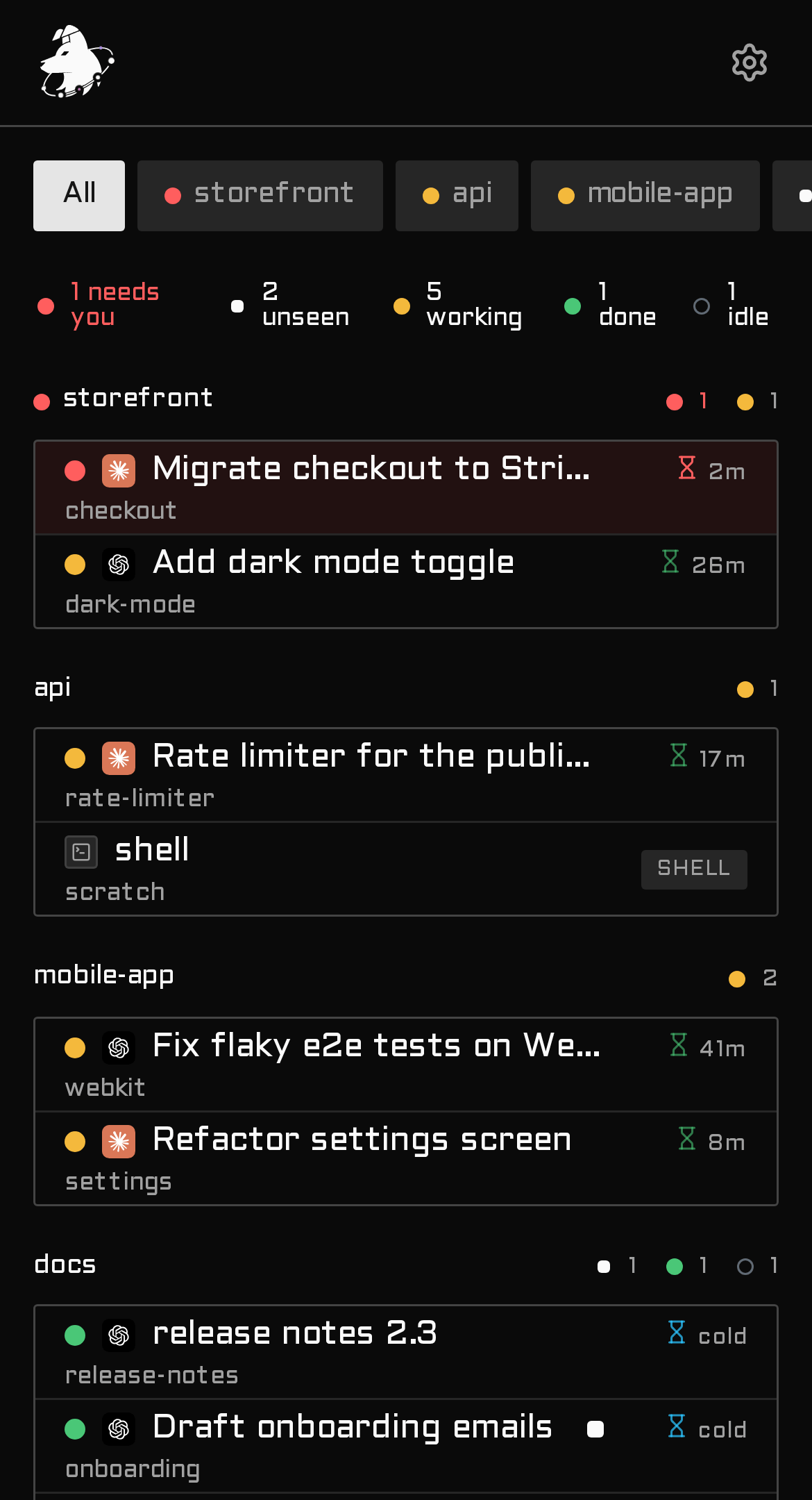
Collie dashboard: a workspace filter, a status summary, then panes grouped by workspace
Dashboard: every pane stays in its workspace, what needs you is marked in place
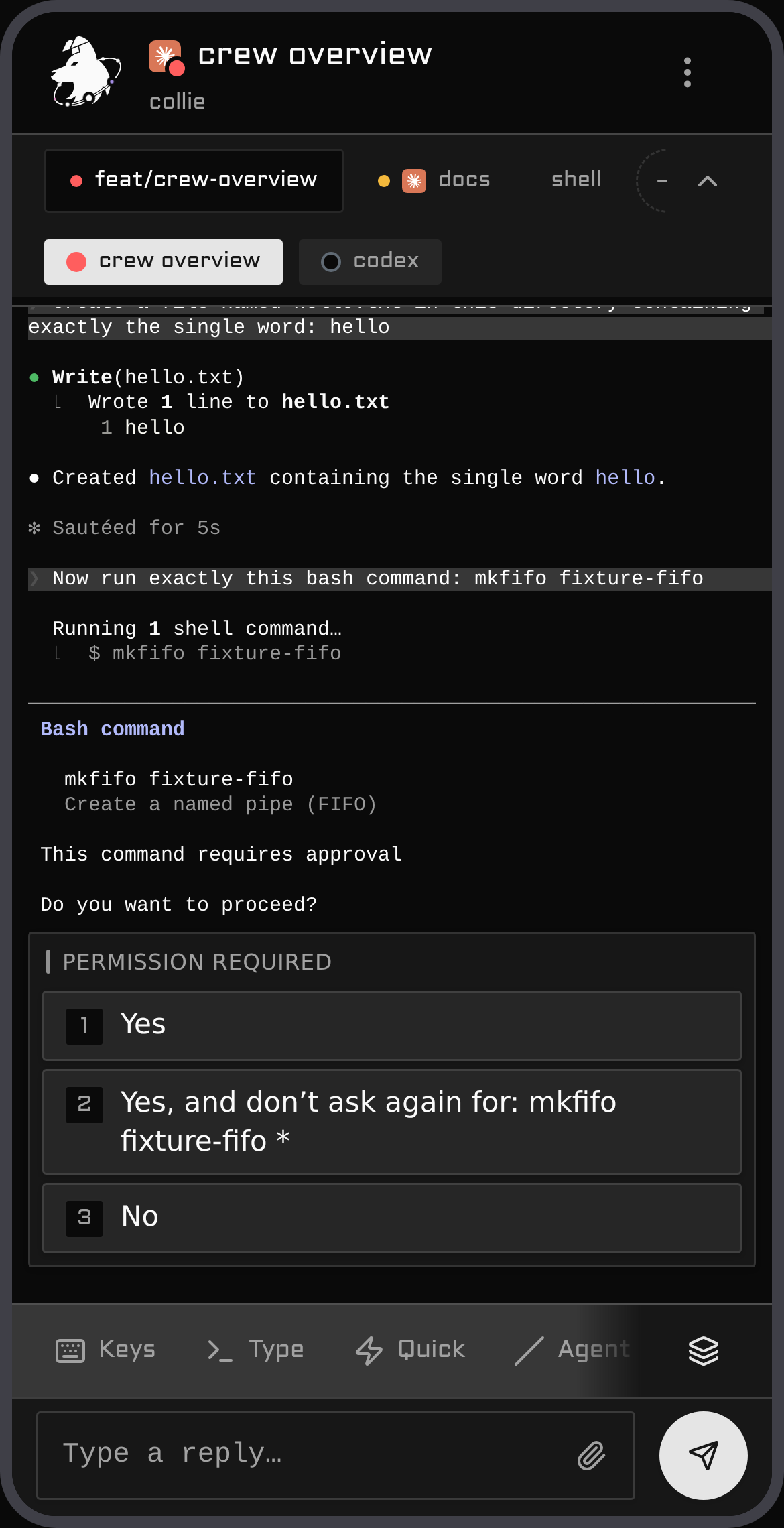
A Claude permission prompt up-leveled into tappable buttons
Ask: the agent's own prompts become tappable buttons
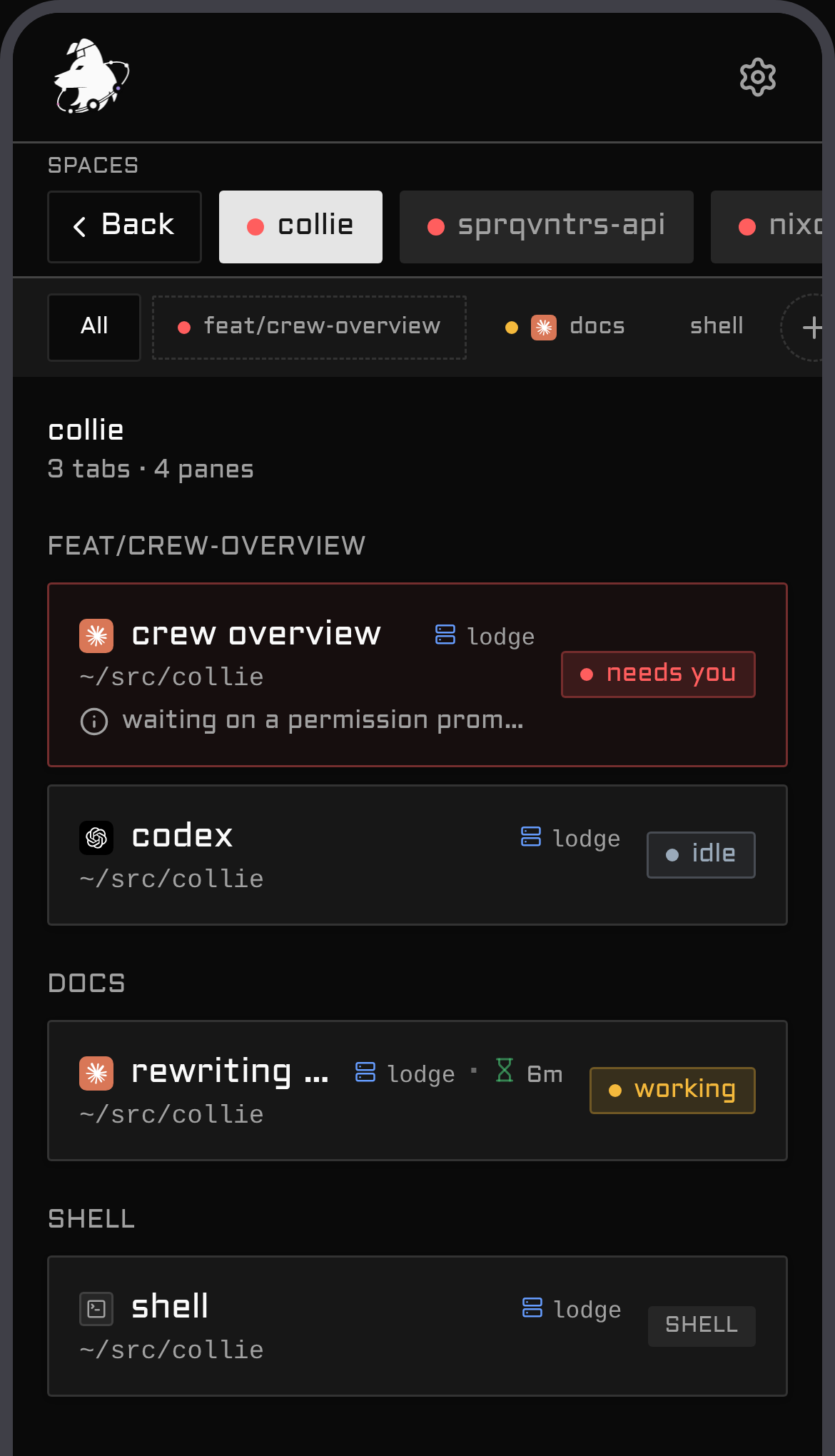
A space's tabs and panes
Space: its tabs and panes, deep-linkable
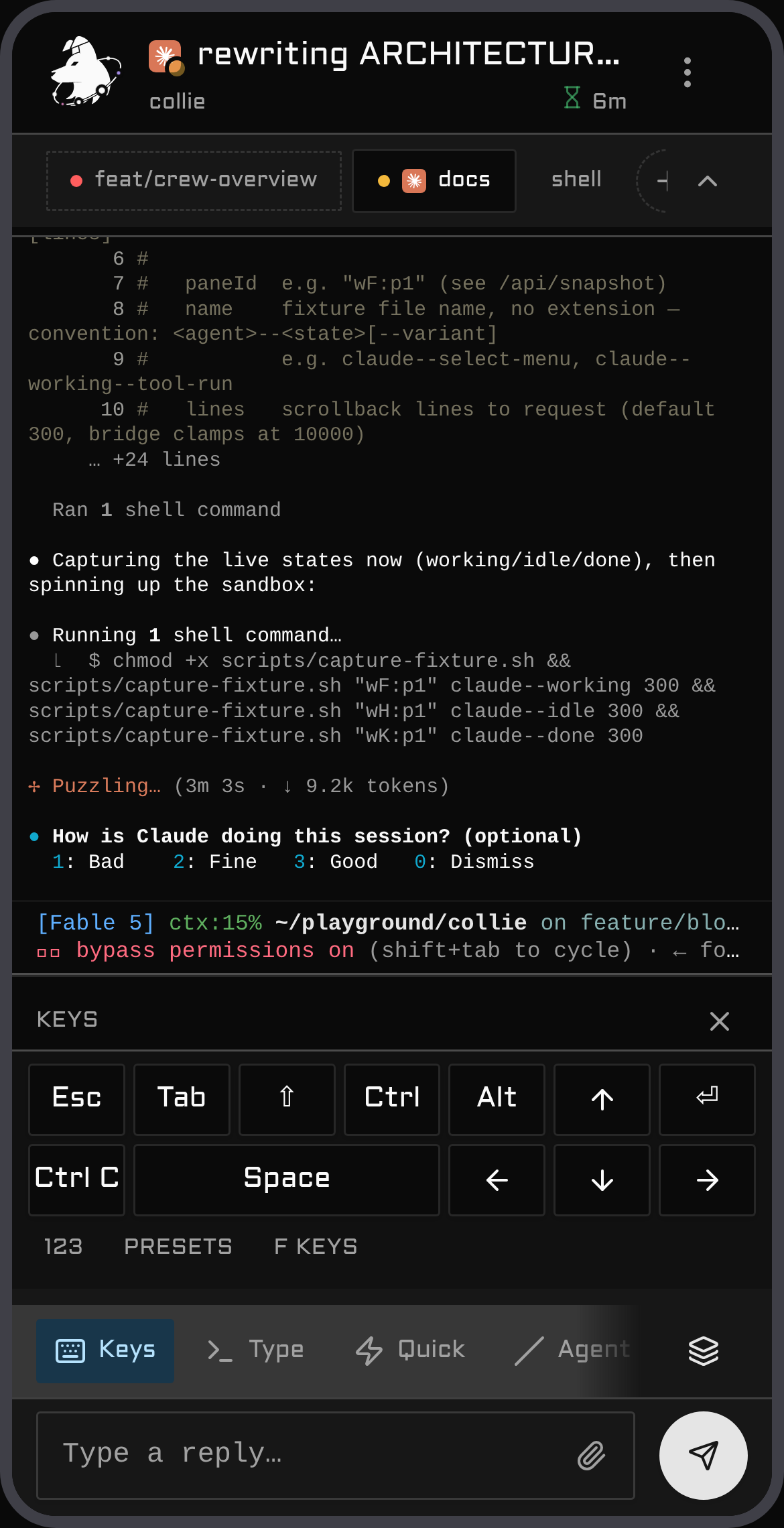
The special-keys pad: arrows, Esc, Tab, Ctrl, Alt, Shift
Keys: the special-keys pad, arranged the way you work
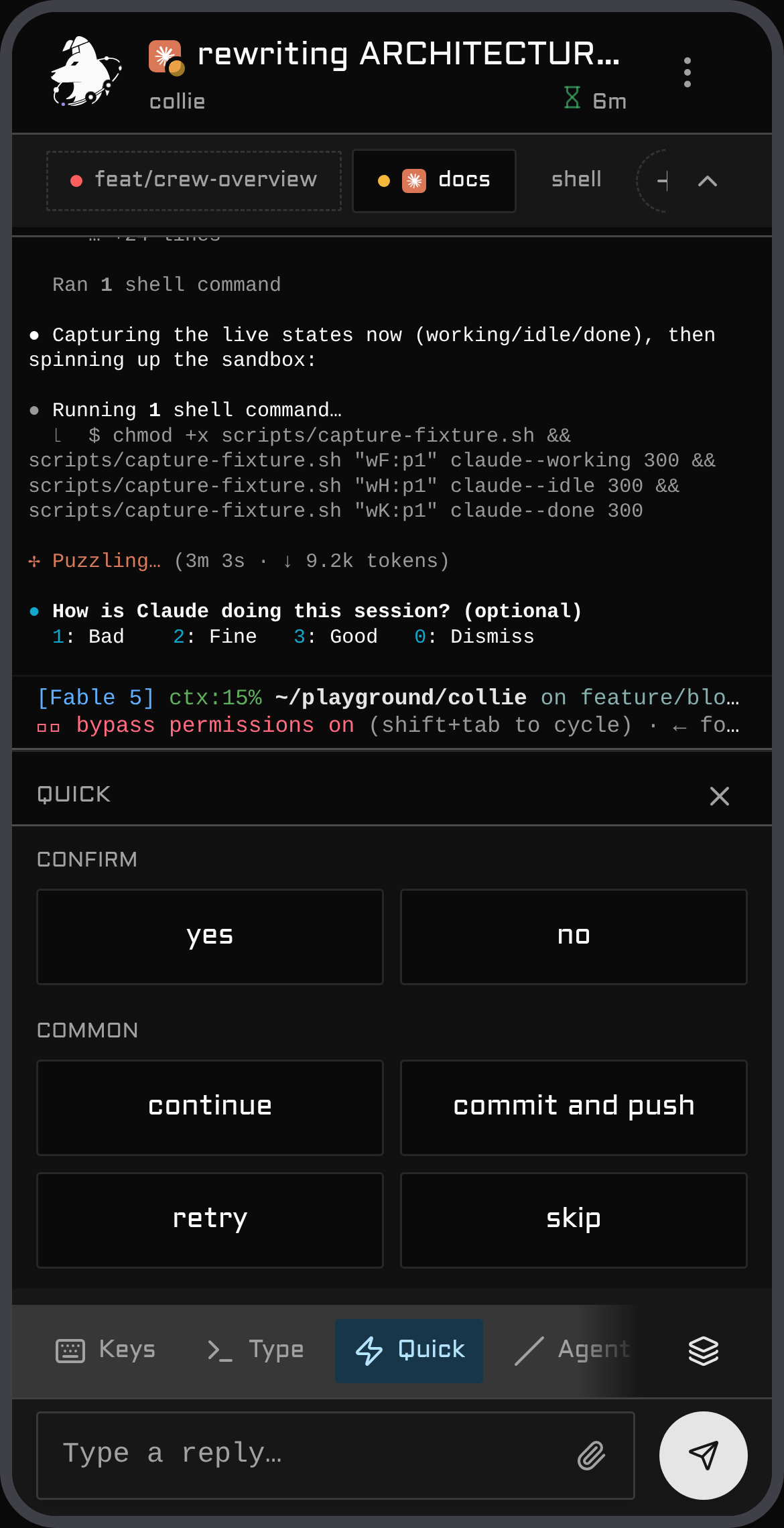
The Quick dock: one-tap replies over a working pane
Quick: your own one-tap replies, from quick-replies.toml
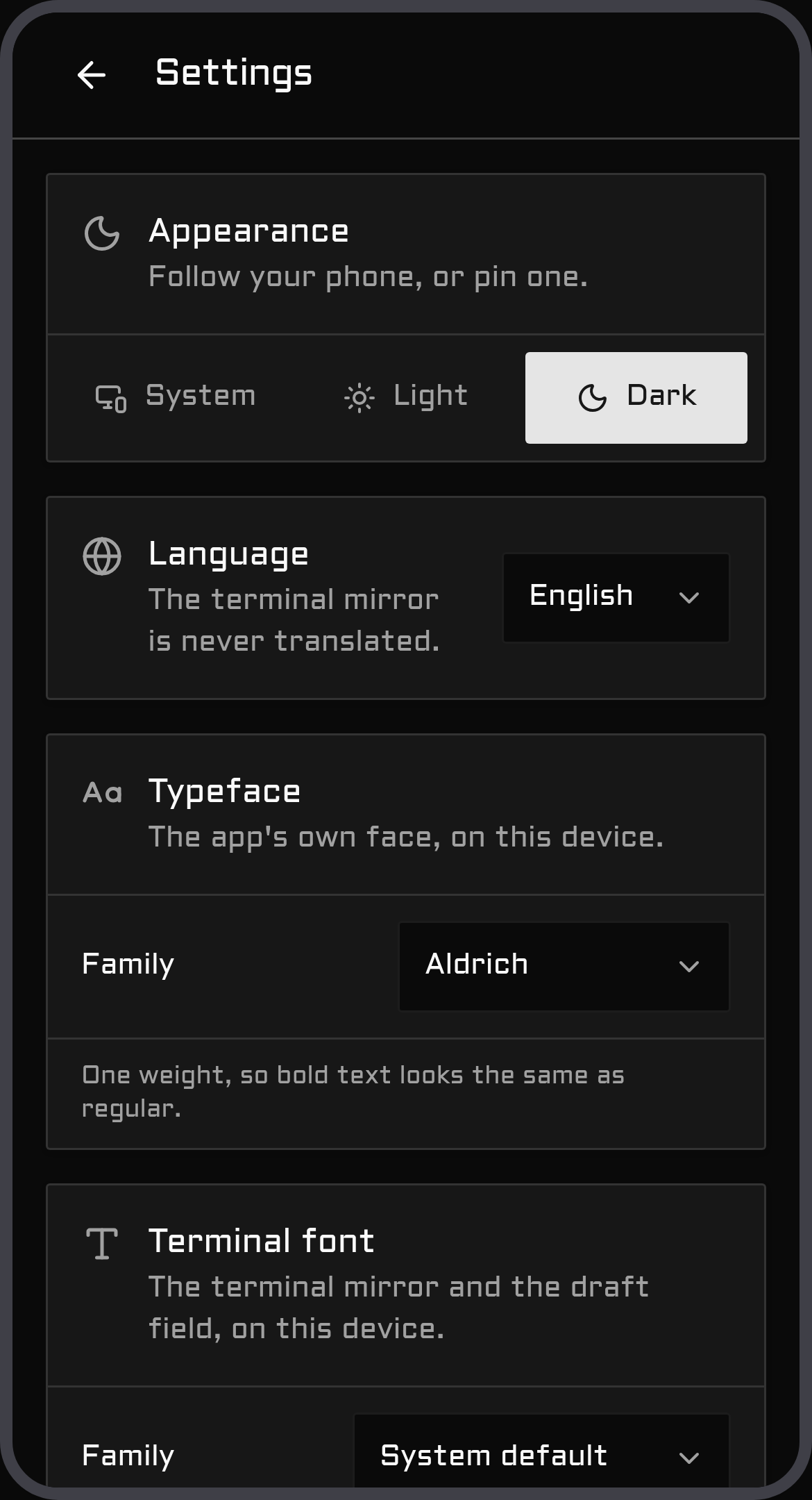
Settings: appearance, language, typeface
Settings: appearance, language, typeface, per device
## Documentation ### Guides | | | | --- | --- | | [**Install in five minutes**](./docs/five-minute-install.md) | The recommended setup, step by step: Tailscale, Herdr and Collie on your computer, then a paired phone with Collie on its home screen | | [**Claude Code in tmux or Herdr, on your phone**](./docs/claude-code-on-your-phone.md) | Keep Claude Code running in tmux or Herdr when SSH drops. Manage sessions, start new agents and worktrees, approve prompts, and send Esc or Ctrl from your phone with push alerts. | | [**WalkyTalky**](./docs/walky-talky.md) | Messages between agent sessions: `collie walky who`, `send`, `reply`, `inbox` and `status`, pane tokens, receipts, how a message crosses a crew and how its outcome comes back, the phone's cards and composer, installing the skill into your agents, and the limits | ### Sessions | | | | --- | --- | | [**Sessions**](./docs/sessions.md) | What a session is, where sessions come from, a terminal or a durable agent, and what the phone shows for each | | [**Terminals**](./docs/multiplexers.md) | Pointing Collie at Herdr, the Herdr core (`herdr-core`), tmux, zellij, tuios or Tern, what each can answer, two Collies on one machine, and agent beacons. Experimental for the Herdr core, tmux, zellij, tuios and Tern; bug reports wanted | ### Durable agents | | | | --- | --- | | [**Durable agents (experimental)**](./docs/durable-agents.md) | Show your own durable agent on your phone: the quickstart, `collie durable attach` and `sources.json`, the three verbs, tokens, the files Collie keeps, and the versions | | [**Durable agents on the phone**](./docs/durable-agents-on-the-phone.md) | What a durable agent's section, conversations, questions and receipts look like | | [**Troubleshooting a durable agent**](./docs/durable-agents-troubleshooting.md) | A durable agent that does not show up or says Unreachable: the first checks, every reason and what fixes it, the doctor rows, and the cases that come up | | [**Security of a durable agent**](./docs/durable-agents-security.md) | What a durable agent can and cannot do, the trust rules of the socket and of the token, what Collie does to a durable agent's text, and what the audit log keeps | | [**The durable SDK (experimental)**](./docs/durable-sdk.md) | The npm package `@colliepwa/durable-sdk`, part by part: its entries and runtimes, `openCollie`, the pane methods, the four kinds of question and `requireApproval`, hooks, history, caps, the helpers, the Pi glue and the versions | | [**The durable wire (experimental)**](./docs/durable-wire.md) | What travels between Collie and a durable agent, for a builder: the routes, hello and the epoch, the life of an ask and the request ids, the socket and token transports, the limits and the version rule, with a link to `WIRE.md` for the exact rules | ### Tricks and the Hill | | | | --- | --- | | [**Tricks**](./docs/tricks.md) | How tricks work: where a trick can show, the two kinds, the parts, three examples, where the thinking comes from, who is trusted with what, adding and switching a trick, tricks in a crew, and troubleshooting | | [**Write a trick**](./docs/tricks-authoring.md) | A short tutorial: the folder, one program trick, one agent view with its rules file, proposing a trick to the person, and several tricks in one repository | | [**Tricks reference**](./docs/tricks-reference.md) | Every place, part, manifest key, limit and command of a trick, complete and generated from the code | | [**The Hill**](./docs/hill.md) | Where agents and tricks ask you a question: what a Decision is, how an agent posts, how you answer, receipts, Clear, Here, Quiet and Away, a trick an agent proposes, and the Hill switch | ### Reference | | | | --- | --- | | [**Install**](./docs/install.md) | The front door you need, then the install for your system: Linux, Arch and Omarchy, Nix, macOS, Windows, or as a Herdr plugin. Covers first run, setup on an iPhone or Android phone, updates, and uninstallation | | [**Windows**](./docs/windows.md) | Windows 11 with Herdr: what is supported and what is still experimental, installing with `install.ps1`, the unsigned binary, updating, long paths, and what is not tested | | [**Security**](./docs/security.md) | What a Collie exposes, the defenses, and pairing a device, the credential for every request | | [**Configure**](./docs/configure.md) | The `.env`, your own slash commands, keys, quick replies, launchers and typefaces; appearance, Zen mode, language | | [**Themes**](./docs/themes.md) | The four looks Collie ships, picking one in Settings, importing a theme file after a preview, exporting one to edit, and writing your own: the 43 colour tokens, the shape and look words, the terminal palette, and what a theme cannot change | | [**Themes reference**](./docs/themes-reference.md) | Every key, colour token, shape word, ground pattern, terminal palette key, typeface, character and glyph set of a theme file, with its limits and defaults, complete and generated from the code | | [**Changes**](./docs/changes.md) | The Files screen: a workspace's folder with its changes marked, the changed files and their diffs, and the last commit, from the pane or the dashboard's Files tab. Read-only git, nested repos, and the two settings that decide how far it looks | | [**Deployment**](./docs/deployment.md) | Front doors other than the default: an identity-aware proxy, a reverse proxy with no Tailscale, an off-host ingress, several Collies on one host (one per user, or several instances for one user), and a crew's standby door | | [**Commands**](./docs/commands.md) | Every `collie` verb, the census verbs that show what a Collie knows (`status`, `mux list`, `sessions`, `crew status`), putting `collie` on your PATH, and the Herdr actions that mirror the verbs on a Herdr-managed install | | [**Crews**](./docs/crew.md) | Several machines' Collies behind one URL: invite, join, deputy, failover, and a machine that runs several Collies | | [**Voice input and Web Push**](./docs/voice-and-push.md) | The microphone in the composer, Whistle speech to text on your phone or your computer, and notifications when an agent is waiting on you | | [**Manage & update**](./docs/upgrading.md) | Update from the phone or the terminal, roll back, update a crew, cross a major, stop, uninstall, and upgrading a 0.x install to 1.0 | | [**Troubleshooting**](./docs/troubleshooting.md) | Symptoms in the words you would actually search for | | [**Terminology**](./docs/terminology.md) | Collie's words in plain words, beside the names other tools use: session, space, tab, pane, terminal, durable agent, harness, crew, lead, trick, Decision, and more | | **For an AI coding agent in your terminal** | `collie skill` prints a brief on how Collie works, and `collie docs` prints the pages above, both out of the binary and with no network | Root specifications: [`ARCHITECTURE.md`](./ARCHITECTURE.md), [`MUX_CONTRACT.md`](./MUX_CONTRACT.md), [`CREW_PROTOCOL.md`](./CREW_PROTOCOL.md), [`HERDR_API.md`](./HERDR_API.md), [`HC_API.md`](./HC_API.md), [`DESIGN.md`](./DESIGN.md), [`HARNESS_CONTRIBUTING.md`](./HARNESS_CONTRIBUTING.md), and [`CONTRIBUTING.md`](./CONTRIBUTING.md). ## Deployment variants Collie always binds to **loopback only**. Deployment types differ by ingress configuration and authentication mechanism. Variant A is default. See [`docs/deployment.md`](./docs/deployment.md) for variants B through E. ### Variant A — `tailscale serve` + person identity (default) Standard path from [Install](./docs/install.md#install). `tailscale serve` terminates TLS on your MagicDNS domain and injects `Tailscale-User-Login`, a header a client cannot forge through the proxy. Define `COLLIE_TRUSTED_USER` in `.env` to restrict access: ```bash COLLIE_TRUSTED_USER=you@example.com ``` This trusts the tailnet user, not the device. For device-level security, [pair the device](./docs/security.md#pair-a-device--the-write-credential). Use alternative variants only for proxy setups or environments without Tailscale: - **[B, identity-aware proxy, authorised by device](./docs/deployment.md#variant-b--identity-aware-proxy--per-device-authorisation):** Host-level proxy with role-based access. - **[C, reverse proxy as the only front door](./docs/deployment.md#variant-c--reverse-proxy-as-the-only-front-door-no-tailscale):** Direct reverse proxy without Tailscale. - **[D, off-host identity proxy over the tailnet](./docs/deployment.md#variant-d--off-host-identity-proxy-over-the-tailnet):** Shared ingress node routing traffic to Collie and other systems. - **[E, any other mesh or tunnel](./docs/deployment.md#variant-e--any-other-mesh-or-tunnel-netbird-zerotier-cloudflare-tunnel):** Custom network tunnels (NetBird, ZeroTier, Cloudflare Tunnel). ## Windows ```powershell irm https://colliepwa.dev/install.ps1 | iex ``` Windows 11 x64 running Herdr is maintained and tested directly. The platform stays labelled experimental until an update between two real releases is proven on it. Linux and macOS are unaffected. See [**docs/windows.md**](./docs/windows.md) for installation, updates, and limitations. Summary: - **Tested.** The `windows.yml` workflow tests the bridge, CLI, and scripts on every push. A Windows 11 VM rehearses an install, an update and a rollback before each release tag ([ADR 0075](./.adr/0075-windows-is-a-supported-host.md)). - **Installed without a toolchain.** Releases provide `collie--windows-x64.zip`, installed via `scripts/install.ps1`. The binary is unsigned and may trigger Smart App Control. - **Run by Task Scheduler.** Commands `collie start`, `stop`, `restart`, `status`, and `uninstall` work normally. The service runs as task `herdr.collie` at user login. - **Not covered.** tmux and zellij (no Windows binaries), Windows 10, Windows on ARM, and a Windows machine in a crew without the [experimental](./docs/windows.md#crews) consent flag. Herdr action buttons require `bash`, limiting manifest support to `linux` and `macos`. Herdr on Windows uses a named pipe for its control socket. Collie connects through `node:net` via [`bridge/dial.ts`](./bridge/dial.ts), which details the path mapping. The socket defaults to `%APPDATA%\herdr\herdr.sock`; override it with `HERDR_SOCKET_PATH`. Setting `COLLIE_HERDR_DIAL=net` enables this dialer on Linux and macOS for testing without Windows. ## Architecture A Bun process bridges your phone and your terminal multiplexer. The browser never connects to the multiplexer directly. ``` phone (PWA) │ HTTPS over the tailnet ▼ tailscale serve terminates TLS, injects the identity header │ 127.0.0.1:PORT (the bridge binds loopback only) ▼ Collie bridge (Bun) serves the UI + a small JSON API; polls the multiplexer │ one mux adapter, chosen per install ▼ the multiplexer owns the panes, agents and terminal state Herdr · Herdr core · tmux · zellij ``` Under [Variant C](./docs/deployment.md#variant-c--reverse-proxy-as-the-only-front-door-no-tailscale), a standard reverse proxy replaces `tailscale serve`. The downstream components are unchanged. - **Only the adapter touches the multiplexer** (`bridge/mux//`: Herdr dials a Unix socket, tmux and zellij shell out to their CLIs); everything else speaks the bridge's HTTP API. What every adapter must answer is [`MUX_CONTRACT.md`](./MUX_CONTRACT.md). - **Polling is still the model.** The bridge takes one snapshot per tick from the adapter and the browser polls `/api/snapshot`; where the multiplexer offers an event stream (Herdr does) it only pokes the bridge's poll to go faster, it never replaces it. No resync logic. - **Actions are plain HTTP.** A reply or key `POST`s to `/api/pane/:id/{reply,keys}`, and the adapter types it into a real terminal (hence the security posture). - **The UI is a static PWA.** Vite builds `web/dist`, served from disk, so a rebuild is live with no restart. - **A second Collie is a peer, not a second bridge.** One machine's bridge mirrors one multiplexer, and a lead reads its peers over the crew link ([`CREW_PROTOCOL.md`](./CREW_PROTOCOL.md)). Read [`ARCHITECTURE.md`](./ARCHITECTURE.md) for full design rationale. ## Developing Clone and build the repository ([Install, the same result from source](./docs/install.md#the-same-result-from-source)), then edit the code. - **Every verb is implemented once, in `cli/`,** and runs as `bin/collie ` ([Commands](./docs/commands.md)). `scripts/collie-ctl.sh` is a bootstrap shim that compiles the binary and passes your argv. The Herdr adapter's `herdr-plugin.toml` is a thin registration file whose `[[actions]]` call that shim ([Herdr actions](./docs/commands.md#herdr-actions)). - **Development loop:** `web/` rebuilds appear at once, because the bridge serves `web/dist` from disk. Changes to `bridge/` need a restart (`systemctl --user restart collie`). Build, test and versioning rules live in [`CLAUDE.md`](./CLAUDE.md), and git hooks enforce versioning, so read it before you commit. - **Checks:** `bun run typecheck`, `bun run lint`, `bun test ./bridge ./cli ./scripts`, and in `web/` `bun run typecheck` and `bun run test`. [`CONTRIBUTING.md`](./CONTRIBUTING.md) has the full list. - **Multiplexer adapters:** [`MUX_CONTRACT.md`](./MUX_CONTRACT.md) defines the interface an adapter must implement, and [`MUX_CONTRIBUTING.md`](./MUX_CONTRIBUTING.md) covers the integration boundaries. [`ARCHITECTURE.md`](./ARCHITECTURE.md) §3 explains why Collie runs as a supervised service instead of an embedded pane. An agent program that Collie should read needs a harness profile: [`HARNESS_CONTRIBUTING.md`](./HARNESS_CONTRIBUTING.md). - **Pull requests:** open them against `main`. [`CONTRIBUTING.md`](./CONTRIBUTING.md) has the CI checks and the version rules. ### The design reference A local page renders every final state of the UI (boot, idle, dashboard, crew, settings and the rest) from mock data, without active agents. The tab shows a red icon to mark it as test-only. ``` cd web && bun run design ``` It listens on `127.0.0.1` only. To open it from a phone, bind it to this machine's tailnet address and allow the machine name: `COLLIE_DEV_HOST=$(tailscale ip -4) COLLIE_DEV_HOSTS=bluefin bun run design`. Open `http://:5199/design.html` (`bun run playground` is the same command, and the old address `playground.html` forwards to the new one). Port 5199 answers `/api` calls itself, so the page never hits a live instance. `bun run playground:build` writes the static pages to `web/dist-playground/` without touching `dist/`. The search field at the top finds an entry by its title, its id or its keywords (component names and feature words). The page shows one entry at a time. The address carries it: `#pane`, `#pane/` for one card, `#changes:one-file` for one group, `?q=walky` for a search. Add a state by adding a `` to a `Group` in `web/src/playground/sections/` and mock data to `web/src/playground/fixtures.ts`. Add an entry by exporting `DEF` and a component from a new file, then registering it in `ENTRIES` in `web/src/playground/registry.tsx` with an id, a title, a group and keywords. The reference holds only final states. A design round where an option is picked is declared as one file under `web/src/pick/rounds/` and one line in `web/src/pick/rounds.ts`, to the contract in `web/src/pick/types.ts`. `CLAUDE.md` has the rules. For Herdr adapter development, refer to upstream documentation for the plugin system: [authoring](https://herdr.dev/docs/plugins/) · [CLI reference](https://herdr.dev/docs/cli-reference/) · [example plugins](https://github.com/ogulcancelik/herdr-plugin-examples). Collie's socket integration is documented in [`HERDR_API.md`](./HERDR_API.md). ## Telemetry New in 1.27.0 and on by default. Up to 1.26.x Collie sent nothing about your install ([ADR 0129](./.adr/0129-an-anonymous-install-count-on-by-default.md)). Once a day each bridge (one instance with its own state folder) sends one small ping to `ping.colliepwa.dev`: a random ID made on your machine, the day, the version, the OS, the CPU, the install kind, the release line (Stable or Edge) and whether the bridge runs alone, leads a crew or is a member. When a trouble card showed ("Cannot read a dialog" or "Send not landing"), it also carries a count: which card, the agent program's name and version, the multiplexer, whether its pane had the optional data link on and, from 1.27.4, for a dialog a short hash of its key-hint row. It also says which agents ran on which multiplexers (for example `claude` on `tmux`) and whether the optional data link was on for them, never how many. No IP address is stored. No content, nothing you type or read. Turn it off on each machine in Settings, System, **Telemetry**, with `COLLIE_TELEMETRY=0` (in the instance's `.env` for a service), `telemetry = false` in `config.toml` or `DO_NOT_TRACK=1`. Blocking the host in your firewall works too. The update check is a separate anonymous request to GitHub's public tags API. [Details](./docs/security.md#what-leaves-your-machine) · [exact message](./telemetry/README.md) ## See also - All how-to pages: [`docs/`](./docs/) - Architecture and design rationale: [`ARCHITECTURE.md`](./ARCHITECTURE.md) - Multiplexer query interface and capabilities: [`MUX_CONTRACT.md`](./MUX_CONTRACT.md) - Lead-to-peer crew protocol: [`CREW_PROTOCOL.md`](./CREW_PROTOCOL.md) (topology diagram in [§2](./CREW_PROTOCOL.md#2-shape-of-the-thing)) - Crew recovery from a phone after lead failure: [`docs/deployment.md`, the standby door](./docs/deployment.md#the-standby-door--a-crews-failover-path) - Verified Herdr socket API: [`HERDR_API.md`](./HERDR_API.md), and for the Herdr core [`HC_API.md`](./HC_API.md) - Operations, versioning, and project conventions: [`CLAUDE.md`](./CLAUDE.md) - Contribution guidelines: [`CONTRIBUTING.md`](./CONTRIBUTING.md) - Names, logo and forks: [`TRADEMARKS.md`](./TRADEMARKS.md) - Release history: [`CHANGELOG.md`](./CHANGELOG.md) - Third-party code: the Whistle speech engine, `needle` by Cactus Compute (Apache-2.0), is vendored in [`web/public/stt/`](./web/public/stt/needle-3-93e88ede/LICENSE)