# AVQA
This is the official repo for our ACM Multimedia 2022 paper [AVQA: A Dataset for Audio-Visual Question Answering on Videos](https://dl.acm.org/doi/10.1145/3503161.3548291).
Dataset Website: https://mn.cs.tsinghua.edu.cn/avqa.
Download links: [Baidu Netdisk](https://pan.baidu.com/s/1nftHgOAGYSCF6j8MxCjPqA?pwd=awd7), [Onedrive](https://tsinghuaeducn-my.sharepoint.com/:u:/g/personal/xin_wang_tsinghua_edu_cn/EQ_7OroeDPZFjajxJXsCh34BtYs-6GDdb-KFPfqgsu50cw?e=qeCgOO).
## AVQA Dataset
AVQA is an audio-visual question answering dataset for the multimodal understanding of audio-visual objects and activities in real-life scenarios on videos. AVQA provides diverse sets of questions specially designed considering both audio and visual information, involving various relationships between objects or in activities.
We collect 57,015 videos from daily audio-visual activities and 57,335 specially-designed question-answer pairs relying on clues from both audio and visual modalities. More Detailed information listed on the [Dataset Website](https://mn.cs.tsinghua.edu.cn/avqa).
## Description
### Repo directories
- ./data: data dictionary;
- ./preprocess: code and scripts for data preprocessing and feature extraction;
- ./HAVF: our proposed HAVF model to reproduce the results.
## Usage
### Before we start
1. Clone this repo
```
git clone git@github.com:AlyssaYoung/AVQA.git
```
2. Download data
You can download the raw videos and extract features according to your needs. Besides, you can also directly use the features we provide. More detailed information for downloading data can be found in the #Downloads Section of the [Dataset Website](https://mn.cs.tsinghua.edu.cn/avqa).
3. Data preprocessing and feature extraction
**Extract audio waveforms.** We write a shell script for you to extract audio waveforms. Just fix the directory path of raw videos in the script file `extract_audio.sh` and run the command:
```
cd data
mkdir audio
cd ..
bash preprocess/extract_audio.sh
```
wav files path: `./data/audio`
**Extract audio features.** We have written the script `extract_audio_feat.sh` for audio feature extraction, just create a new python virtual environment and run the following command:
```
cd preprocess/preprocess_audio/
conda create -n preprocess_audio python=3.7
conda activate preprocess_audio
pip install -r requirements.txt
sh extract_audio_feat.sh
```
**Extract visual frames.** Videos are segmented into 8 clips, each clip contains 16 frames by default (following the setting in [HCRN](https://github.com/thaolmk54/hcrn-videoqa)). We have provided the instruction step by step:
- Create a new python virtual environment and run the following command:
```
cd preprocess/preprocess_visual/
sh create_virtualenv.sh
```
- **Extract appearance feature:** Fix the file paths in `extract_appearance_feat.sh` and run the command:
```
sh extract_appearance_feat.sh
```
- **Extract motion feature:** Download ResNeXt-101 [pretrained model](https://drive.google.com/drive/folders/1zvl89AgFAApbH0At-gMuZSeQB_LpNP-M)(resnext-101-kinetics.pth). Fix the arguments of file paths in `extract_motion_feat.sh` and run the command:
```
sh extract_motion_feat.sh
```
**Preprocess questions.**
- Download [glove pretrained 300d word vectors](http://nlp.stanford.edu/data/glove.840B.300d.zip) to `data/glove/` and process it into a pickle file:
```
cd data/glove
python txt2pickle.py
cd ../..
```
- Preprocess train/val questions: Fix the file paths in `preprocess_text_feat.sh` and run the command:
```
cd preprocess/preprocess_text
sh preprocess_text_feat.sh
```
Finally, the feature dimensions of extracted features are as follows:
| | Dimension |
| ---- | ---- |
| Audio features | (#num_videos, 2048) |
| Appearance features | (#num_videos, 8, 16, 2048) |
| Motion features | (#num_videos, 8, 2048) |
Note: You can also develop data preprocessing and feature extraction methods in your own original and innonative ways. Here we just provide a possible way to utilize the audio and visual data :)
### Our proposed HAVF
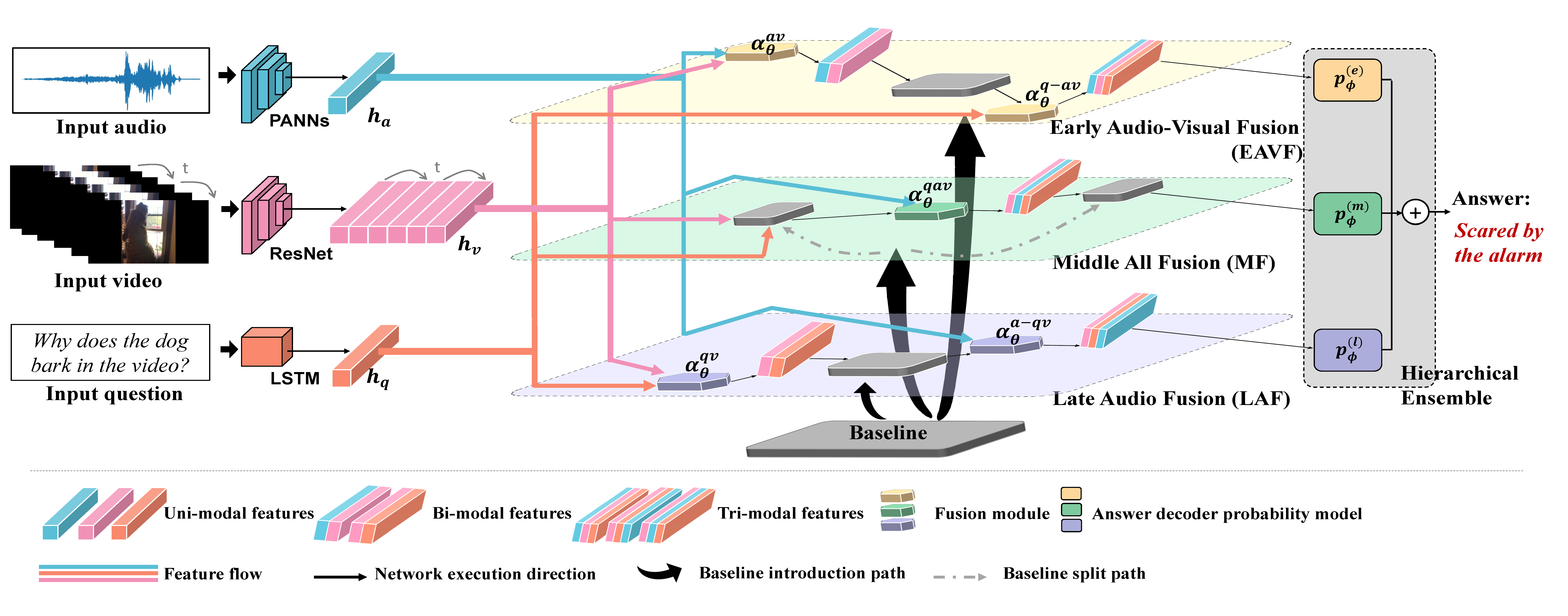
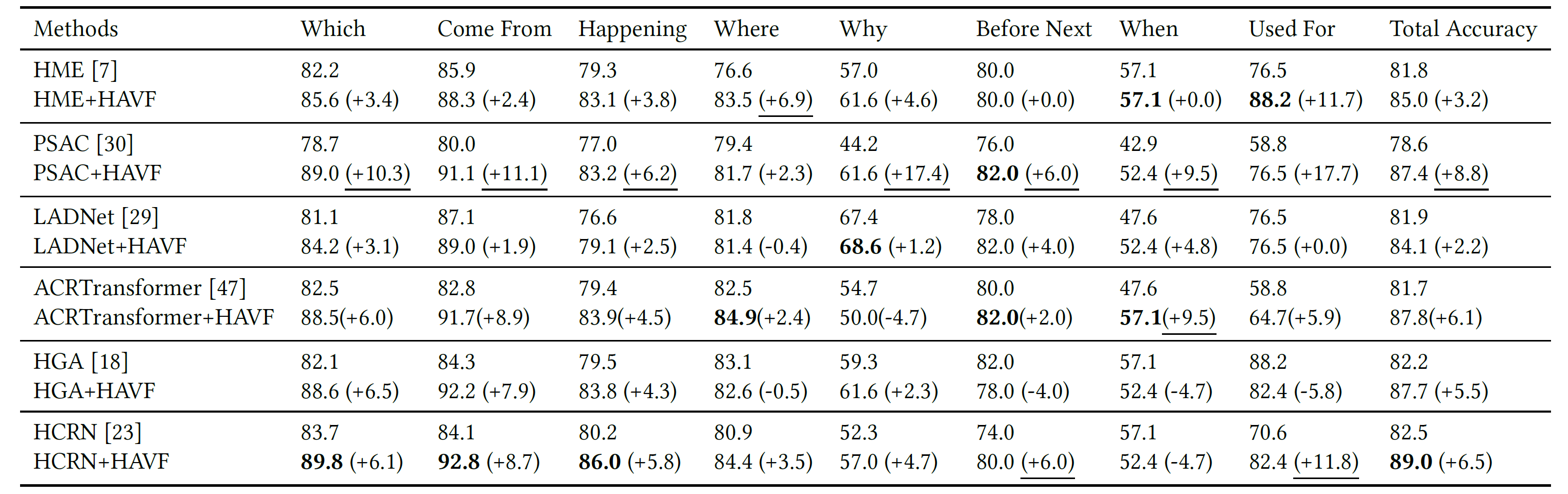
- [x] HCRN+HAVF: Please refer to [HAVF/hcrn_havf/README.md](https://github.com/AlyssaYoung/AVQA/tree/main/HAVF/hcrn_havf).
- [ ] PSAC+HAVF
- [ ] HME+HAVF
- [ ] LADNet+HAVF
- [ ] ACRTransformer+HAVF
- [ ] HGA+HAVF
## Results
## Dependency
- Anaconda3
- Pip
## Notice
To improve the code readability, we have recently rebuilded our code. You may encounter some bugs or find performance difference compared with the results reported in the paper. Please feel free to contact us if you have any questions or suggestions. Both [issues](https://github.com/AlyssaYoung/AVQA/issues) and emails(pinci_yang@outlook.com) are available.
## Citation
If you find our paper or code useful, please cite our paper using the following bibtex:
```
@inproceedings{yang2022avqa,
title={AVQA: A Dataset for Audio-Visual Question Answering on Videos},
author={Yang, Pinci and Wang, Xin and Duan, Xuguang and Chen, Hong and Hou, Runze and Jin, Cong and Zhu, Wenwu},
booktitle={Proceedings of the 30th ACM International Conference on Multimedia},
pages={3480--3491},
year={2022}
}
```
## Acknowledgement
- As for audio feature extraction, we adapt PANNs from this [repo](https://github.com/qiuqiangkong/audioset_tagging_cnn) to our code. Thank @qiuqiangkong for releasing the code and the pretrained models.
- We refer to this [repo](https://github.com/thaolmk54/hcrn-videoqa) to preprocess visual frames and extract appearance and motion features. Thank @thaolmk54 for this excellent work.
- In this work, we conduct our experiments based on six video-qa backbone models. Here we list the original repositories:
- [PSAC](https://github.com/lixiangpengcs/PSAC) @lixiangpengcs
- [HME](https://github.com/fanchenyou/HME-VideoQA) @fanchenyou
- [LADNet](https://github.com/lixiangpengcs/LAD-Net-for-VideoQA) @lixiangpengcs
- [ACRTransformer](https://github.com/op-multimodal/ACRTransformer/) @op-multimodal
- [HGA](https://github.com/Jumpin2/HGA) @Jumpin2
- [HCRN](https://github.com/thaolmk54/hcrn-videoqa) @thaolmk54