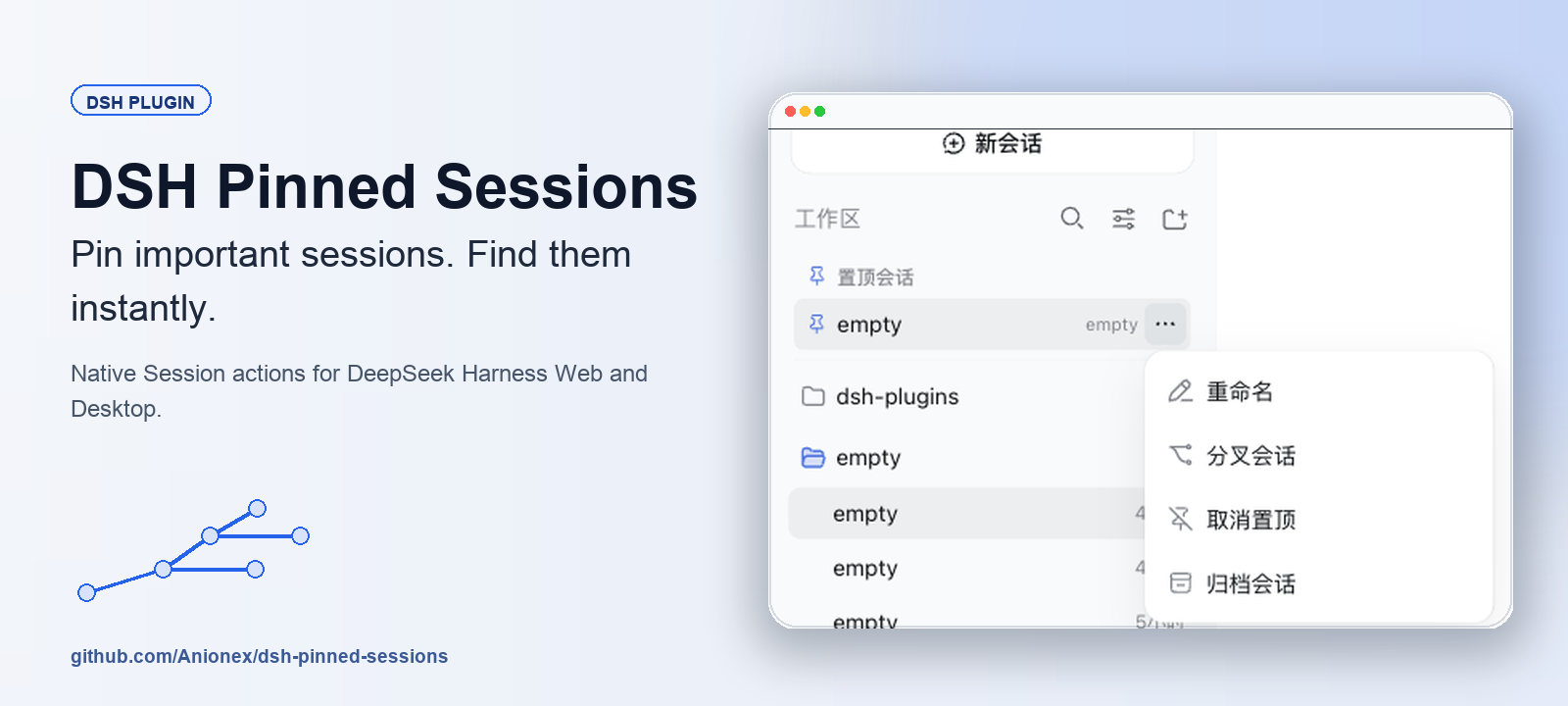
# DSH Pinned Sessions



Pin important Sessions. Open them without searching through every Workspace.
English · 简体中文
DeepSeek Harness keeps Sessions inside their original Workspaces. Once the list grows, returning to a few active Sessions takes repeated scanning. DSH Pinned Sessions adds a compact pinned section below the Workspace header while leaving every native Session row in place.
## See It in Action
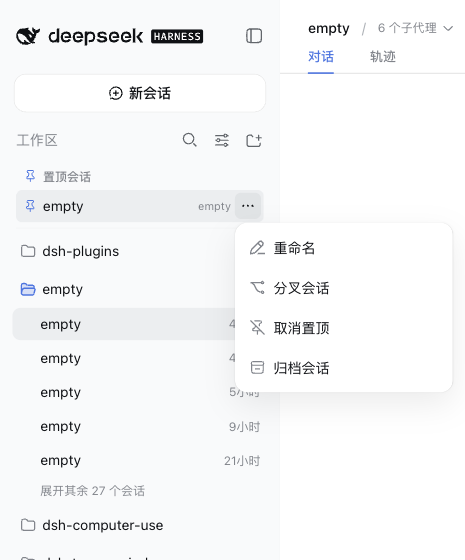
Hover a pinned row to reveal its ellipsis menu. The Web profile shows **Rename**, **Fork session**, **Unpin from top section**, and **Archive session**. The Desktop profile also shows **Delete session** when Archive Manager provides the same action on native rows.
## Highlights
- **Reach active work from the top of the sidebar:** pinned copies stay below the Workspace header, ordered newest first.
- **Keep native organization intact:** the original Session remains in its Workspace.
- **Use familiar actions:** pinned rows use DSH Menu, Modal, Button, icon, and service APIs.
- **Work with exact Session identities:** pinning never guesses from a title or list position.
- **Stay local:** the plugin stores Session IDs and pin timestamps in browser storage. It does not read or copy conversation content.
- **Navigate by keyboard:** Arrow keys move through the menu, Escape returns focus, and removed rows hand focus to the next useful target.
## Quick Start
Install the plugin in either profile, or run both commands:
```bash
dsh plugin add @anionex/dsh-pinned-sessions --profile web
dsh plugin add @anionex/dsh-pinned-sessions --profile desktop
```
Refresh Web or restart Desktop. Open any native Session ellipsis menu and choose **Pin to top section**. The pinned copy appears below the Workspace header; use **Unpin from top section** from either menu to remove it.
### Requirements
- DeepSeek Harness `>=0.1.0-rc.8 <0.2.0`
- Node.js `^22.19.0` or `>=24.0.0`
- A `web` or `desktop` DSH profile
## Compatibility
| Profile | Pinned-row actions | Verified behavior |
| --- | --- | --- |
| Web | Rename, Fork, Unpin, Archive | Official DSH primitives and Session/Workspace services |
| Desktop | Rename, Fork, Unpin, Archive, optional Delete | Delete and failure Toasts appear only while Archive Manager exposes its Session deletion capability |
Existing release ranges are preserved. Version 0.1.2 adds DSH `0.2.0-rc.2` installation support and uses its official session-menu slot and workspace navigation service. The plugin's top section remains separate from native workspace pinning. Web and official Electron Desktop installation and interactions have been verified; see [CHANGELOG](CHANGELOG.md). Legacy hosts retain the stable slot/ARIA bridge.
## How It Works
1. A click in the native Session menu captures that Session's exact ID synchronously.
2. `PinStore` persists the ID and pin timestamp under `dsh.pinned-sessions.v1` in `localStorage`.
3. The `shell.overlay` mount observes `[data-slot="sidebar.workspaces"]` and portals a compact list below its header.
4. Pinned actions call DSH Session and Workspace services; Desktop Delete calls the optional Workspace Registry service.
The store keeps at most 500 unique IDs and prunes Sessions that no longer exist or have been archived.
## Data and Limitations
- Pins belong to the current DSH browser origin/profile. The plugin does not sync them between machines.
- The plugin stores only Session IDs and `pinnedAt` timestamps in `localStorage`.
- Pinned rows duplicate native rows by design; they do not move or remove the originals.
- Delete stays hidden unless the Desktop deletion provider is active.
- DSH client APIs change across prereleases; use the exact tested release verdicts in the package compatibility metadata.
## Development
```bash
git clone https://github.com/Anionex/dsh-pinned-sessions.git
cd dsh-pinned-sessions
corepack enable
pnpm install --frozen-lockfile
pnpm run check
```
`pnpm run check` type-checks both targets, rebuilds the distributable client, runs the Vitest and package-layout suites, and performs an npm pack dry run.
## Community
- Read [CONTRIBUTING.md](CONTRIBUTING.md) before opening a pull request.
- Report vulnerabilities through the process in [SECURITY.md](SECURITY.md).
- Use [SUPPORT.md](SUPPORT.md) to choose the right issue path.
- Review release history in [CHANGELOG.md](CHANGELOG.md).
- Read [FUNDING.md](FUNDING.md) before sponsoring maintenance.
- Follow the [Code of Conduct](CODE_OF_CONDUCT.md) in project spaces.
Released under the [MIT License](LICENSE).