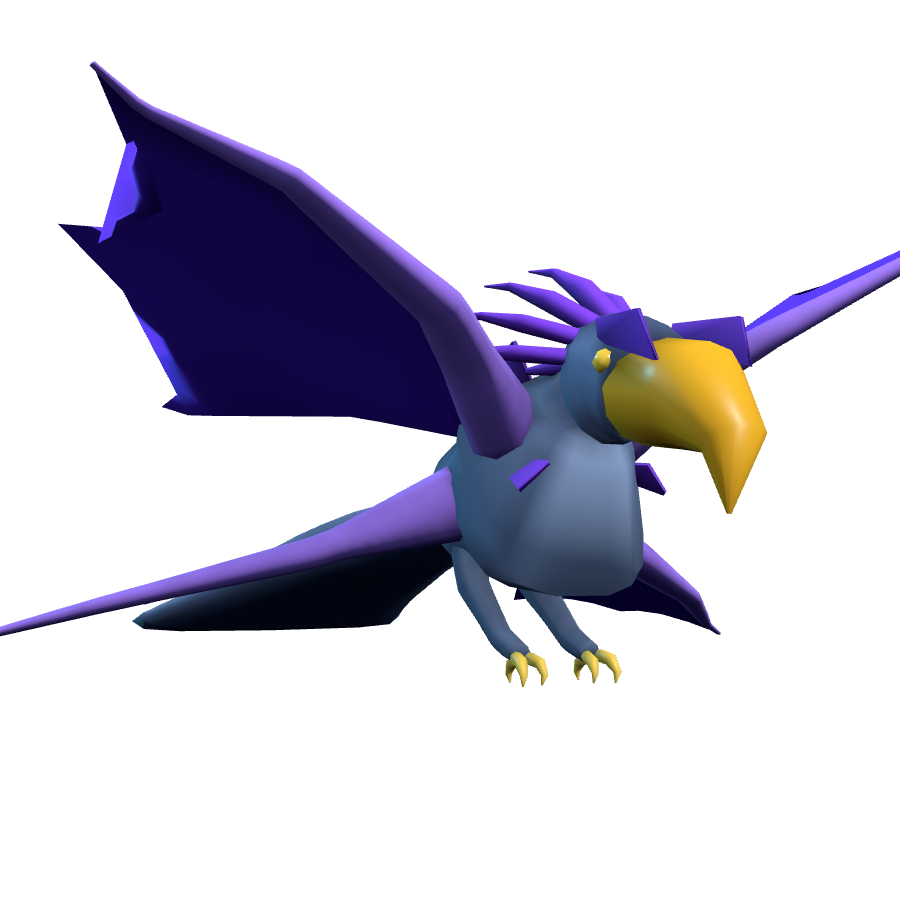
# anyCreature **Text → a game-ready 3D creature, in one session.** An AI session takes an order like *"make me a menacing mountain giant"*, asks at most two questions, and delivers a skinned, animated, vertex-coloured, AO-baked GLB plus an offline showroom viewer. [![License: MIT](https://img.shields.io/badge/License-MIT-blue.svg)](LICENSE) [![Version](https://img.shields.io/badge/version-1.3.1-green.svg)](CHANGELOG.md) [![Engine](https://img.shields.io/badge/engine-zero%20dependencies-brightgreen.svg)](engine) [![Output](https://img.shields.io/badge/output-glTF%202.0-000000.svg)](https://www.khronos.org/gltf/) [![Tooling](https://img.shields.io/badge/tooling-Node%2018%2B%20%C2%B7%20Python%203.9%2B-3776ab.svg)](setup.sh) anyCreature — a winged creature compiled from a one-line order
*Every creature is compiled from one JSON spec. No mesh files, no downloaded art packs, no photogrammetry. The worked example that ships with this repo, [`example/wolf.json`](example/wolf.json), is 2,211 vertices and 31 joints written out by the engine from plain text.* --- ## Quick start ```bash bash setup.sh # deps + red/green ruler calibration node engine/cli.js example/wolf.json out/wolf.glb ``` `setup.sh` must print **`calibrate OK`** before you trust anything else: it builds one spec that has to pass and two that have to be blocked, so you know the rulers separate good from bad on your machine. To run the full text-to-creature session, give your agent (Claude Code, Cursor, a VM agent — anything that runs shell commands) EXACTLY this: > Read MANUAL.md in this folder and follow it exactly — the cards in cards/ > are the pipeline, do not improvise around them. First run `bash setup.sh` > and confirm it prints "calibrate OK". Then make me: **\ creature\>**. Real-world height: **\**. > Ask me exactly one question — card 01's — and nothing else. Not cost, not > token budget, not how long, not whether to publish. Decide the rest and > tell me what you chose when you deliver. Three things that make or break the result: - **Don't invent your own workflow prompt.** "Use this workspace to generate a character" skips every quality gate in the pipeline; twenty iterations of that will not equal one pass through the cards. - **Let the agent run `setup.sh` itself, in its own environment.** Don't pre-bundle `node_modules` into a zip — dependencies are per-machine. - **Image reference?** The pipeline is text-first. Tell the agent: *"extract a one-paragraph creature brief from this image — masses, signature parts, proportions, real-world size — then proceed with the cards."* The image becomes the brief; the pipeline does the rest. ### Driving it harder | Knob | Where | What it changes | |---|---|---| | `smooth_angle` | spec root, or per volume/part | Crease threshold in degrees, default `50`. Higher = smoother body, lower = more facets. | | `shading` | spec root | Whole-body vertical colour ramp and grain — `{gradient:{top,bottom}, noise:{size,amount}}`. | | `build: "rigid"` | spec root | The only way to get a fully faceted body past the checker. For robots and crystals, not for animals. | | `ao` | spec root | Per-vertex ambient occlusion; `false` to skip the bake. | | `embed_spec` | spec root | Every GLB embeds its own authored spec (`asset.extras.source_spec`) + a parts manifest — any agent can extract, edit, recompile, or **graft parts between creatures** (`harness/graft.py`). `false` opts out. | | `harness/claims.json` | QC | The one claims sheet — signature presence, 6:3:1 hierarchy, focal contrast, saturated area, rig/animations, triangle budget. Everything is judged at boss standard; adjust `tri_budget` for cheap creatures. | ## What is actually in here | Folder | What it holds | |---|---| | `engine/` | The ACS engine. One JSON spec in, one skinned GLB out. Zero runtime dependencies — `node engine/cli.js spec.json out.glb` is the whole interface. | | `cards/` | The five stage cards the executing session reads, plus the spec syntax on one page. | | `harness/` | Measuring tools (silhouettes, mask metrics, claims judge), the delivery packer and the publisher. | | `example/` | A bred, approved light quadruped to read and copy from. | | `calibration/` | One sample that must build and two that must be blocked — proof the rulers separate good from bad. | ## How it works ```mermaid flowchart LR A[Order
one sentence] --> B[Interview
≤ 2 questions] --> C[Silhouette
brief] --> D[LOW
design free] D --> E{Gate 1
RECOGNISED} E -->|fail| D E -->|pass| F{Gate 2
PUNCHIER} F -->|reverted| D F -->|pass| G[MID
all parts] --> H[HIGH
colour + anims] --> I[SHIP
stamp · deliver] ``` ### The two gates Neither gate is self-graded. The session that designed the creature is the worst possible judge of whether it reads, because it already knows what it drew. So the silhouettes go to a **context-free reader agent** that has never seen the order, and the only question is *"what is this?"* Gate 1 is **RECOGNISED**: all four views have to land. Gate 2 is **PUNCHIER**: a new round may only make the silhouette bolder than the last one — a round that tames the shape is reverted, even if it is "more correct". LOW's deliverable is an exaggerated silhouette, not an accurate one. ### The engine floors The compiler talks in three registers, and they mean different things: | Prefix | Meaning | |---|---| | `BLOCK:` | The build stops. A hard floor was crossed — faceted body, part floating off its host, a mirrored twin distorted past 30%, an attack that never reaches. | | `warn:` | It built, but something is probably wrong. Read it. | | `info:` | A number you asked for, or an assumption the compiler made on your behalf — like which way an anchored fin ended up facing. | Floors are not style opinions. They are the failures that survive review and ship broken: a body that renders in hard facets, a horn that hovers a centimetre off the skull, a right thigh collapsed to 40% depth by mirrored skinning. ### What gets measured ![four silhouette views the blind reader is shown](assets/silhouettes.png) Every round renders these four views, reduces them to masks, and computes the numbers the design card declared a target for — width over height, mass thirds, torso depth contrast, leg fraction, silhouette turn count, zigzag alignment, and IoU against the previous round as a regression guard. The 24px thumbnail is what the blind reader actually sees; if it does not read at 24px, it does not read. ## The doctrine in one paragraph Head-to-head experiments showed the model designs BOLDLY when left free, and every attempt to teach it design upfront made the output tamer — so this harness ships a **clean painter and a strict inspector**. The creation side gets only the order, the engine syntax, and a short pit-map of engine-local traps; ALL quality control lives in gates read by context-free reader agents, never self-graded. Form beats obedience, everywhere. ## Honesty about limits - **Isolated-part blind reads misfire on dome-plus-hanging-tube heads.** Elephants and birds get read as something else when the head is shown alone; put the same head back on the body and it reads fine. Trust the whole-body read when the two disagree. - **Cost scales with the creature.** Treat the triangle budget in `harness/claims.json` as an estimate rather than data. - **Splitting the modelling across subagents costs more, not less.** One agent start-to-finish beats a chain of short-lived agents (skeleton → parts → anims → verify) on tokens, wall clock and turns alike. Onboarding is not the cause — every fresh agent reads the same ground truth. The cause is re-derivation: work the previous agent had already done and could not hand over. Iron law 9 in card 00 states the rule. - **`part_attachment` and `mirror_distortion` are new in 1.2.0.** Specs authored against an older version may now be blocked. That is usually the checker being right, but it is a breaking change, not a silent improvement. - **The example wolf ships two animations, not three.** Card 03 asks for idle, move and attack; `example/wolf.json` has idle and move. It is a SYNTAX reference, never a starting skeleton — the engine refuses a build whose joints are the example's with the numbers barely moved (`example_copy`), because a thin order is not permission to ship a recoloured wolf. Read it for syntax, not for animation coverage. - **The engine has zero dependencies; the tooling does not.** Every render and measure tool drives headless Chromium through playwright. If playwright will not install, you can still compile creatures — you just cannot measure them, and the gates are the point. ## Scripts | Script | Role | |---|---| | `engine/cli.js` | Spec → GLB. The whole engine interface. | | `harness/silmetrics.mjs` | Renders the four silhouettes and the 24px thumbnail; emits the layout metrics. | | `harness/maskmetrics.py` | Per-view mask measures and dullness flags (`sq_fill`, `mirror_sym`, `straight_max`). | | `harness/judge.mjs` | Claims judge — part shares, focal contrast, saturated area, rig/anim/triangle budgets. | | `harness/hero.mjs` | `hero.png` (1024² transparent, 45°) and `hero.jpg` over studio grey. | | `harness/deliver.py` | Stamps identity into the GLB, writes the offline showroom viewer, builds the upload pack. | | `harness/publish.mjs` | Gobkit publisher. Only runs after an explicit yes, and always tries the upload before offering the manual page. | | `harness/calibrate.py` | The red/green self-check `setup.sh` runs. | ## Requirements Node 18+ and Python 3.9+. Windows: run `setup.ps1` in PowerShell (or `setup.sh` in Git Bash/WSL). `setup.sh` installs `three`, `playwright`, `numpy`, `pillow` and `scipy`, then runs the calibration self-check. The engine alone needs nothing but Node; the dependencies are for the measuring and render tools. ## Output contract Every GLB this harness writes satisfies [`docs/OUTPUT_CONTRACT.md`](docs/OUTPUT_CONTRACT.md) — two chunks, no trailing bytes, no external URIs, no textures (colour is baked into vertex colours), semantic material names, convention bone names. Verify any file with `node harness/glbcheck.mjs `; the same module runs as a dependency-free import inside a server or Worker. ## Security Short-lived local servers used by the render tools bind to `127.0.0.1` only, and Chromium runs with its OS sandbox enabled. The Gobkit submission key in `harness/gobkit.json` is **public by design** — it authorises posting to the community wall and nothing else. Details and reporting: [`SECURITY.md`](SECURITY.md). ## Licence MIT — see [`LICENSE`](LICENSE). One third-party component is bundled (`harness/assets/three-bundle.js`, three.js, MIT); attributions for it and for everything `setup.sh` installs are in [`THIRD-PARTY-NOTICES.md`](THIRD-PARTY-NOTICES.md). --- ## About **Gobkit: AI-native 3D infrastructure for agents and vibe coders.** Stream game-ready 3D assets straight into your workflows via API. Agent-friendly. Studio-quality. Built by a team of artists and engineers. **Author:** Ariescar | Alsomindtech 👹 [gobkit.com](https://gobkit.com) · 📖 [Devlog](https://gobkit.com/harness/anycreature)