
Ever lost at chess to an insect? Here's your chance.
Your opponent is the brain of a fruit fly. Not a cartoon of one: the real
wiring of a *Drosophila*, 134,181 neurons and 2.7 million connections, mapped
cell by cell under an electron microscope by [FlyWire](https://flywire.ai).
We kept that wiring fixed, trained the strength of its connections on
Stockfish's analysis, and put the whole thing in your browser.
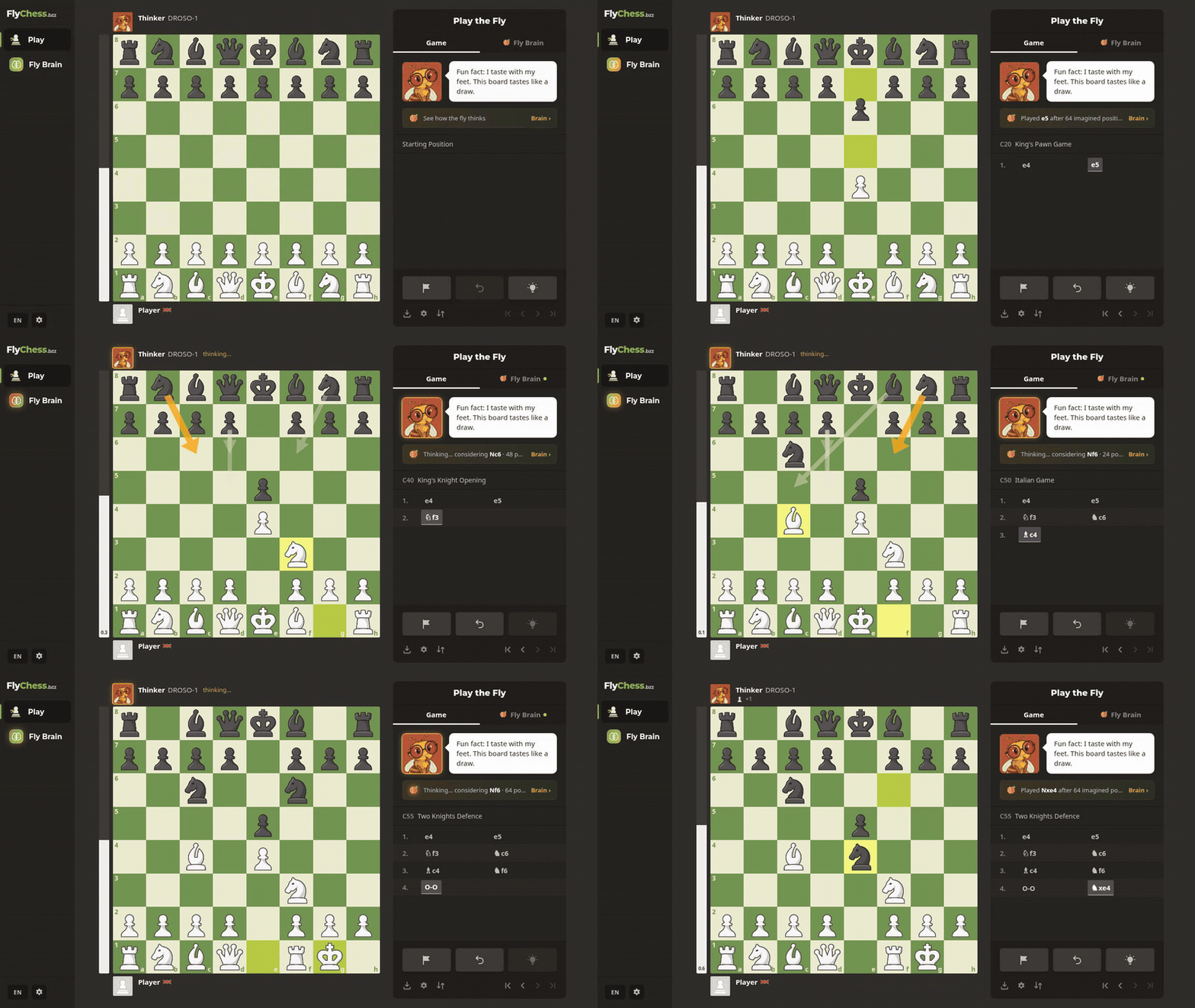 ## Play
**[fly-chess-thinker.vercel.app](https://fly-chess-thinker.vercel.app/)**:
pick an opponent, pick a colour, press **Play**.
- **Thinker** is the main opponent: it looks at 64 positions before it moves
and is the only fly with a measured rating, about **1500 Elo** (see
[Is it any good?](#is-it-any-good)). **Scout** looks at 8 and **Tactician**
at 32. Same brain, different patience.
- **Sage** is an experimental proof of concept, folded away under the other
flies: it decides for itself how long to think, from one look for an obvious
move up to 256 when it can't make up its mind. Its search can be unstable,
so expect the odd slow or strange move.
- Not ready for an insect? Three other bugs play from Stockfish's ideas, each
in their own style: **Marvin** the beginner beetle, **Nelsen** the wasp who
brings his queen out early, and **Mitzi**, a ladybug in knitted mittens who
almost never lets go. Or play **Stockfish** itself at the skill level, depth
and time per move you choose.
- **Bot vs bot** pairs any two of them, the fly included, and lets you watch.
Pause whenever you like; when a fly plays, look inside its brain (both
brains when it plays itself).
- The first visit downloads the brain (about 51 MB). After that everything
runs on your own computer, with no account and no backend. Phones work too;
they just think a little slower.
## Watch it think
Every move sends a wave of activity from the fly's eyes through its brain, and
you can watch it happen: neurons lighting up in 3D, signals flowing between
brain regions, the moves it is weighing, and the board as its eyes see it.
 ## Is it any good?
Better than you'd expect from something that tastes with its feet. The Thinker
scored about **1500** in 64 games against a deliberately weakened Stockfish 19
([how we tested](benchmarks/droso-1/README.md)). That number belongs to this
one test, not to FIDE, and the other flies haven't been measured.
It learned from scratch which moves look promising and who is winning, working
through 26 million chess positions (some more than once). Not bad for a
creature that lives about 50 days. The rules come from ordinary code, so it
never plays an illegal move.
## Under the hood
The model is called **DROSO-1**, and everything you need to run it, retrain it
or train your own is in this repository:
- [How the fly plays](docs/how-it-works.md): how it sees the board and picks a move
- [How it was trained](docs/training.md), with the [recipe](docs/droso-1/recipe.md)
and [research notes](docs/droso-1/research.md)
- [The trained model](artifacts/droso-1/README.md), ready to run in Python
- [Development](docs/development.md): run the site locally and test it
- [Data and licences](docs/data.md)
Code: [MIT](LICENSE). Connectomes: FlyWire v783, plus MaleCNS v1.0 for the
[old prototypes](artifacts/legacy/), both CC BY 4.0. The evaluation bar, the
game review and the Stockfish-powered opponents use Stockfish (GPL-3.0).