> **Part of the [Ataraxy Labs](https://ataraxy-labs.com) stack** — agent-native infrastructure for software development. See also: [sem](https://ataraxy-labs.com/sem) (semantic version control) · [inspect](https://github.com/Ataraxy-Labs/inspect) (semantic code review) · [opensessions](https://github.com/Ataraxy-Labs/opensessions) (tmux sidebar for coding agents).
>
> Read the manifesto: https://ataraxy-labs.com/#thesis · Essays: https://ataraxy-labs.com/blogs · LLMs: https://ataraxy-labs.com/llms.txt

Entity-level semantic merge driver for Git.
Resolves merge conflicts that Git can't by understanding code structure via tree-sitter.
Install ·
How It Works ·
MCP Server ·
Releases






## The Problem
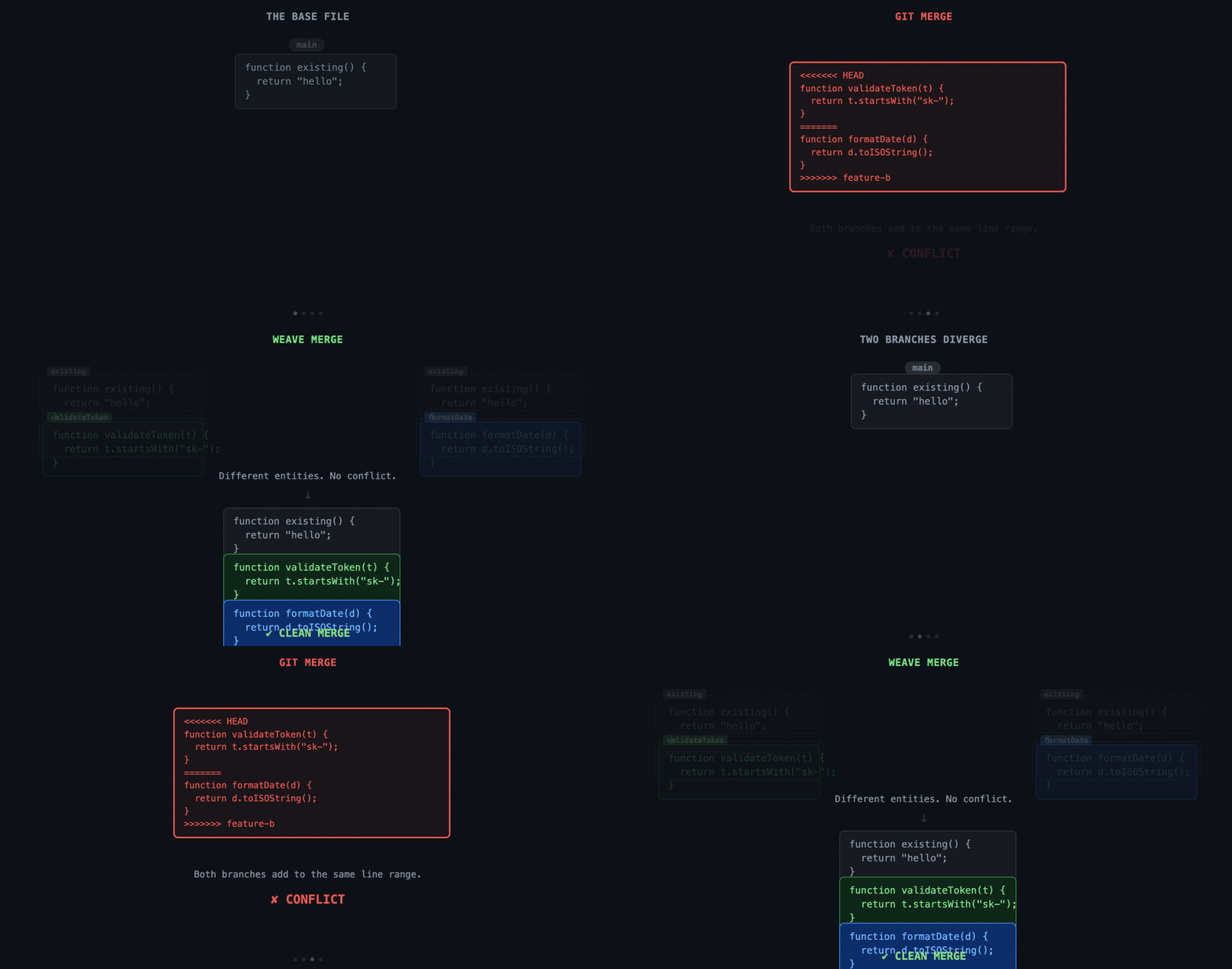
Git merges by comparing **lines**. When two branches both add code to the same file — even to completely different functions — Git sees overlapping line ranges and declares a conflict:
```
<<<<<<< HEAD
export function validateToken(token: string): boolean {
return token.length > 0 && token.startsWith("sk-");
}
=======
export function formatDate(date: Date): string {
return date.toISOString().split('T')[0];
}
>>>>>>> feature-branch
```
These are **completely independent changes**. There's no real conflict. But someone has to manually resolve it anyway.
This happens constantly when multiple AI agents work on the same codebase. Agent A adds a function, Agent B adds a different function to the same file, and Git halts everything for a human to intervene.
## How Weave Fixes This
Weave replaces Git's line-based merge with **entity-level merge**. Instead of diffing lines, it:
1. Parses all three versions (base, ours, theirs) into semantic entities — functions, classes, JSON keys, etc. — using [tree-sitter](https://tree-sitter.github.io/)
2. Matches entities across versions by identity (name + type + scope)
3. Merges at the entity level:
- **Different entities changed** → auto-resolved, no conflict
- **Same entity changed by both** → attempts intra-entity merge, conflicts only if truly incompatible
- **One side modifies, other deletes** → flags a meaningful conflict
The same scenario above? Weave merges it cleanly with zero conflicts — both functions end up in the output.
## Weave vs Git Merge
| Scenario | Git (line-based) | Weave (entity-level) |
|----------|-----------------|---------------------|
| Two agents add different functions to same file | **CONFLICT** | Auto-resolved |
| Agent A modifies `foo()`, Agent B adds `bar()` | **CONFLICT** (adjacent lines) | Auto-resolved |
| Both agents modify the same function differently | CONFLICT | CONFLICT (with entity-level context) |
| One agent modifies, other deletes same function | CONFLICT (cryptic diff) | CONFLICT: `function 'validateToken' (modified in ours, deleted in theirs)` |
| Both agents add identical function | **CONFLICT** | Auto-resolved (identical content detected) |
| Both agents add different properties to same object | **CONFLICT** | Auto-resolved |
| Different JSON keys modified | **CONFLICT** | Auto-resolved |
The key difference: Git produces false conflicts on **independent changes** because they happen to be in the same file. Weave only conflicts on **actual semantic collisions** when two branches change the same entity incompatibly.
## Weave vs Mergiraf
Tested on 31 real-world merge scenarios across Python, TypeScript, Rust, Go, Java, and C:
| Tool | Clean Merges | Score |
|------|-------------|-------|
| **Weave** | **31/31** | 100% |
| Mergiraf (v0.16.3) | 26/31 | 83% |
| Git | 15/31 | 48% |
Mergiraf fails on both-add-at-end-of-file, insert-between-existing, and decorator conflict scenarios. Weave resolves all of these because it operates at entity granularity (functions, classes, methods) rather than AST node level. Full breakdown at [ataraxy-labs.github.io/weave](https://ataraxy-labs.github.io/weave/).
## Real-World Benchmarks
Tested on real merge commits from major open-source repositories. For each merge commit, we replay the merge with both Git and Weave, then compare against the human-authored result.
- **Wins**: Merge commits where Git conflicted but Weave resolved cleanly
- **Regressions**: Cases where Weave introduced errors (0 across all repos)
- **Human Match**: How often Weave's output exactly matches what the human wrote
- **Resolution Rate**: Percentage of all merge commits Weave resolved vs total attempted
| Repository | Language | Merge Commits | Wins | Regressions | Human Match | Resolution |
|------------|----------|---------------|------|-------------|-------------|------------|
| [git/git](https://github.com/git/git) | C | 1319 | 39 | 0 | 64% | 13% |
| [Flask](https://github.com/pallets/flask) | Python | 56 | 14 | 0 | 57% | 54% |
| [CPython](https://github.com/python/cpython) | C/Python | 256 | 7 | 0 | 29% | 13% |
| [Go](https://github.com/golang/go) | Go | 1247 | 19 | 0 | 58% | 28% |
| [TypeScript](https://github.com/microsoft/TypeScript) | TypeScript | 2000 | 65 | 0 | 6% | 23% |
Zero regressions across all repositories. Every "win" is a place where a developer had to manually resolve a false conflict that Weave handles automatically.
## Conflict Markers
When a real conflict occurs, weave gives you context that Git doesn't:
```
<<<<<<< ours — function `process` (both modified)
export function process(data: any) {
return JSON.stringify(data);
}
=======
export function process(data: any) {
return data.toUpperCase();
}
>>>>>>> theirs — function `process` (both modified)
```
You immediately know: what entity conflicted, what type it is, and why it conflicted.
## Supported Languages
TypeScript, TSX, JavaScript, Python, Go, Rust, Java, C, C++, Ruby, C#, PHP, Swift, Kotlin, Elixir, Bash, HCL/Terraform, Fortran, Dart, Perl, OCaml, Scala, Zig, Vue, Svelte, XML, ERB, JSON, YAML, TOML, CSV, Markdown. Falls back to standard line-level merge for unsupported file types.
## Install
```bash
brew install weave
```
Or build from source (requires Rust):
```bash
git clone https://github.com/Ataraxy-Labs/weave
cd weave
cargo install --path crates/weave-cli
cargo install --path crates/weave-driver
```
## Setup
In any Git repo:
```bash
weave setup
```
This configures Git to use weave for all supported file types. Then use `git merge` as normal.
To revert back to normal git merging:
```bash
weave unsetup
```
To set up for just yourself (without modifying `.gitattributes`), write the same supported file type rules to `.git/info/attributes` instead:
```bash
weave setup --local
```
### Global (every repo)
To make weave the default merge driver for **all** your repos at once (no per-repo setup, like [mergiraf](https://mergiraf.org/usage.html#registration-as-a-git-merge-driver)):
```bash
weave setup --global
```
This writes the driver to your `~/.gitconfig` and the supported file-type rules to git's global attributes file (`~/.config/git/attributes`, or your `core.attributesfile` if set). No git repo required. Make sure `weave-driver` is on your `PATH` (it ships next to the `weave` binary).
The equivalent manual config, if you prefer:
```bash
git config --global merge.weave.name "Entity-level semantic merge"
git config --global merge.weave.driver "weave-driver %O %A %B %L %P"
# then add `*.ts merge=weave` (etc.) to ~/.config/git/attributes
```
## Jujutsu (jj)
Add to your jj config (`jj config edit --user`):
```toml
[merge-tools.weave]
program = "weave-driver"
merge-args = ["$base", "$left", "$right", "-o", "$output", "-l", "$marker_length", "-p", "$path"]
merge-conflict-exit-codes = [1]
merge-tool-edits-conflict-markers = true
conflict-marker-style = "git"
```
Resolve conflicts with `jj resolve --tool weave`, or set as default:
```bash
jj config set --user ui.merge-editor "weave"
```
## Preview
Dry-run a merge to see what weave would do:
```bash
weave-cli preview feature-branch
```
```
src/utils.ts — auto-resolved
unchanged: 2, added-ours: 1, added-theirs: 1
src/api.ts — 1 conflict(s)
✗ function `process`: both modified
✓ Merge would be clean (1 file(s) auto-resolved by weave)
```
## Architecture
```
weave-core # Library: entity extraction, 3-way merge algorithm, reconstruction
weave-driver # Git merge driver binary (called by git via %O %A %B %L %P)
weave-cli # CLI: `weave setup` and `weave preview`
```
Uses [sem-core](https://github.com/Ataraxy-Labs/sem) for entity extraction via tree-sitter grammars.
## How It Works
```
base
/ \
ours theirs
\ /
weave merge
```
1. **Parse** all three versions into semantic entities via tree-sitter
2. **Extract regions** — alternating entity and interstitial (imports, whitespace) segments
3. **Match entities** across versions by ID (file:type:name:parent)
4. **Resolve** each entity: one-side-only changes win, both-changed attempts intra-entity 3-way merge
5. **Reconstruct** file from merged regions, preserving ours-side ordering
6. **Fallback** to line-level merge for files >1MB, binary files, or unsupported types
## Star History
[](https://star-history.com/#Ataraxy-Labs/weave&Date)