




| 1. | 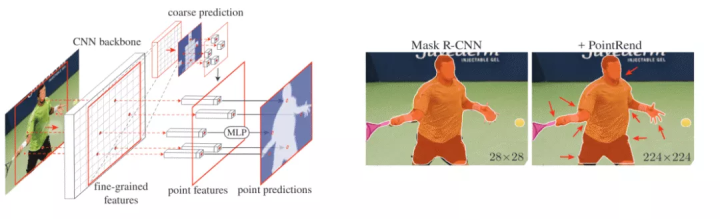 |
PointRend: Image Segmentation as Rendering
Abstract. We present a new method for efficient high-quality image segmentation of objects and scenes. By analogizing classical computer graphics methods for efficient rendering with over- and undersampling challenges faced in pixel labeling tasks, we develop a unique perspective of image segmentation as a rendering problem. From this vantage, we present the PointRend (Point-based Rendering) neural network module: a module that performs point-based segmentation predictions
|
| 2. | 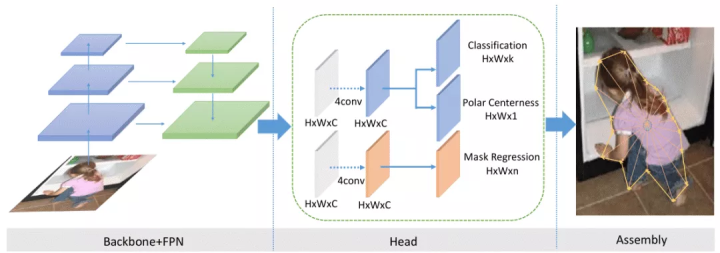 |
PolarMask: Single Shot Instance Segmentation with Polar Representation
Abstract. In this paper, we introduce an anchor-box free and single shot instance segmentation method, which is conceptually simple, fully convolutional and can be used as a mask prediction module for instance segmentation, by easily embedding it into most off-the-shelf detection methods. Our method, termed PolarMask, formulates the instance segmentation problem as instance center classification and dense distance regression in a polar coordinate. Moreover, we propose two effective approaches to deal with sampling high-quality center examples and optimization for dense distance regression, respectively, which can significantly improve the performance and simplify the training process.
|
| 3. |   |
End-to-end Animal Image Matting
Abstract. Extracting accurate foreground animals from natural animal images benefits many downstream applications such as film production and augmented reality. However, the various appearance and furry characteristics of animals challenge existing matting methods, which usually require extra user inputs such as trimap or scribbles. To resolve these problems, we study the distinct roles of semantics and details for image matting and decompose the task into two parallel sub-tasks: high-level semantic segmentation and low-level details matting. Specifically, we propose a novel Glance and Focus Matting network (GFM), which employs a shared encoder and two separate decoders to learn both tasks in a collaborative manner for end-to-end animal image matting.
|
 CVPR 2020