# PoopFly
**A whole-MaleCNS spiking fly brain. It decides for itself when to poop.**
A housefly eats, builds up gut pressure, *feels* it through interoceptive neurons, and the
simulated brain decides to find the toilet and defecate. Relief lowers pressure, which produces a
homeostatic reward (dopamine-like) that drives **three-factor synaptic plasticity** — so over
trials the fly gets faster at pooping when full, and learns which background song it prefers.
There is no `if pressure > threshold: poop()`. The action is read out of **motor-population firing
rates** on the real connectome, in a Web Worker, in your browser.





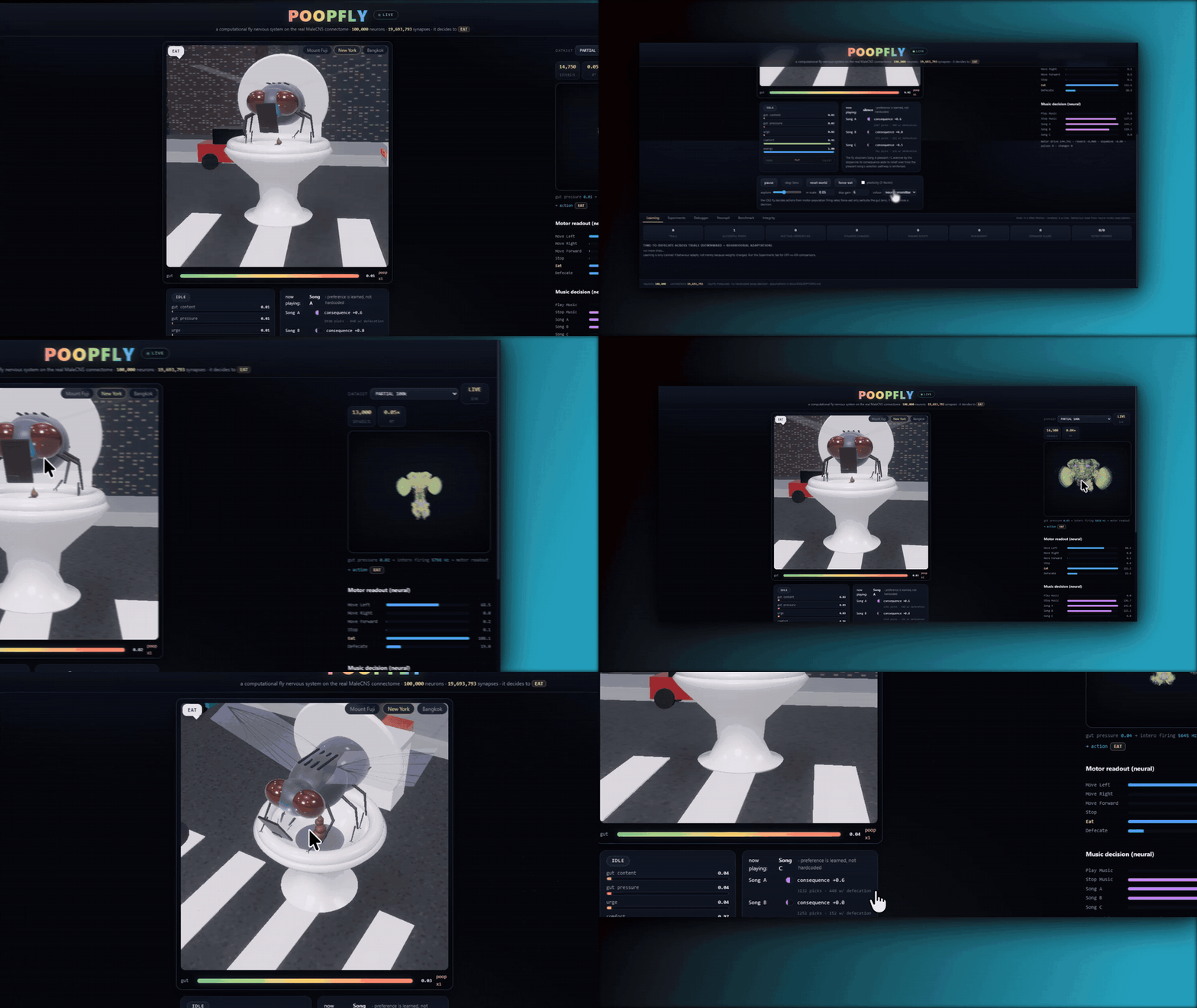
*The real UI at `partial_100000` — 100,000 neurons, 19,716,276 synapses. The fly picks `EAT` here from
its own motor readout while the brain view shows the spiking network behind it.*
---
## Quick start
Prereqs: **Python 3.11** and **Node 20**.
```bash
pip install -r pipeline/requirements.txt
# one-shot bootstrap: build the graphs if missing, validate, then start the app
.\run.ps1 # Windows
```
Or step by step:
```bash
python pipeline/preprocess.py --modes debug,core # -> webapp/public/data/
python pipeline/validate_runtime.py --mode core # prove the export is self-consistent
cd webapp
npm install
npm run dev # http://localhost:5173
```
```bash
npm test # 25 tests: LIF kernel, graph integrity, the closed behaviour loop
npm run build # production bundle
```
`full` and the 100k/50k/10k subsets are built with the benchmark ladder:
```bash
python pipeline/preprocess.py --modes bench
```
---
## The question this answers
*Did the fly poop because the simulated nervous system produced the behaviour, or because the
programmer told it to?*
The code path and the test suite are built so the answer is the former. Interoceptive pressure
becomes a **real Poisson spike train** injected into real neurons; those spikes propagate through
**real measured synapses**; whichever motor population fires hardest *is* the action. Ablate a
region, cut dopamine, disable plasticity — behaviour changes because the **network** changed, not
because a branch in the code did.
The renderer is a **view**. It never produces activity.
---
## Data verification & neuron counts (read first)
The `.feather` files in this folder are the **official Janelia/GCS MaleCNS v1.0 release**, verified
byte-for-byte: the provided `connectome-weights` MD5 matches the published object exactly. An
earlier version of this project misread the official file as corrupt — that reading was wrong, and
this section replaces it.
What the official files actually contain (measured):
| | Value | Note |
|---|---:|---|
| `connectome-weights` rows | **151,856,684** | documented as "connection strengths for all segments in the dataset" |
| segments with T-bars | **1,834,661** | every `body_pre` is one of these |
| distinct `body_post` segments | **87,576,984** | most are unannotated fragments |
| edges between two T-bar segments | **32,751,675** | the graph this pipeline exports |
| official annotated neurons | **166,700** | `body-annotations` rows with a `superclass` (matches FlyWire Codex) |
| neurons with ≥1 validated edge | **165,650** | the `core` graph |
- The official connectome-weights is the **full segment graph, not a neuron-only graph** — it
includes unmerged fragments, glia and other unannotated segments (which appear in the official
`tbar` and `syn-partners` tables too).
- `body-annotations` and `body-neurotransmitters` **are present** here (from the official
[download page](https://male-cns.janelia.org/download/)); the pipeline reads `body-annotations`
(`superclass` present) as the authoritative neuron set.
**How the pipeline handles it (no silent discarding):** edges are kept only when *both* endpoints
are segments of the T-bar set; a body counts as a neuron only with the official `superclass`
annotation. Everything filtered is reported per mode — see `webapp/public/data/build_summary.json`
and the **Integrity** tab in the app.
### Exported graphs (measured, never theoretical)
| mode | neurons | connections | on disk |
|---|---:|---:|---:|
| `debug` | 3,000 | 340,857 | 7 MB |
| `partial_10000` | 10,000 | 1,741,608 | 35 MB |
| `partial_50000` | 50,000 | 11,103,313 | 224 MB |
| `partial_100000` — fast interactive subset | 100,000 | 19,716,276 | 399 MB |
| **`core`** ← default — the genuine MaleCNS neuron connectome | **165,650** | **25,552,591** | **518 MB** |
| `full` — all segments (not only neurons) | **1,745,204** | **32,751,675** | 730 MB |
`core` reproduces the published edge count (25.55M ≈ 25.6M) — it *is* the annotated MaleCNS neuron
graph: 165,650 of the 166,700 official neurons have at least one edge at minconf 0.5. `full` is
every segment in the edge list, **not** an all-neuron graph. The app always shows **measured**
counts.
**Which mode to use:** `core` is the default — the complete annotated neuron connectome
(165,650 of the 166,700 official neurons). `partial_100000` is the lighter, faster interactive
subset and a single click away in the dataset picker. `full` carries the most bodies but is
sparsely wired and sits near 0.03× real time; it is a validation scale, not an interactive one.
---
## How the loop works
```
PHYSIOLOGY ENCODING CONNECTOME (Web Worker)
┌───────────────┐ ┌────────────────────┐ ┌──────────────────────────────┐
│ gut content │ │ PRESSURE │ │ LIF spiking network │
│ gut pressure │─────▶│ HUNGER │─────▶│ on the real MaleCNS graph │
│ energy │ │ MUSIC_A|B|C │ │ typed-array kernel │
│ position │ │ (Poisson drive) │ │ │
└───────────────┘ └────────────────────┘ │ motor populations → rates │
▲ └──────────────┬───────────────┘
│ │
│ winner-take-all decode
│ ▼
│ dopamine ◀── homeostatic improvement ◀── chosen action
└──────────────────────────────────────────────────────────┘
```
1. **Drive** — gut pressure / hunger / context become Poisson spike rates onto dedicated real
neuron pools.
2. **Propagate** — spikes cross the real connectome. Synaptic current is *leaky* (`tauSyn`), so
convergent input summated across the synaptic window is what brings a neuron to threshold.
3. **Decide** — eleven motor populations (`MOVE_*`, `STOP`, `EAT`, `DEFECATE`, `PLAY_MUSIC`,
`SONG_*`) are read out as firing rates. The strongest one above threshold wins.
4. **Consequence** — the environment applies the action physically, then reports homeostatic
improvement → reward → dopamine.
5. **Learn** — three-factor plasticity (eligibility × dopamine) changes real synapse weights,
which changes what the fly does next time.
Exploration is the one deliberately non-neural term: behavioural variability so the fly can
*discover* a rewarded action before reinforcement takes over.
---
## Layout
```
pipeline/ Python 3.11 — raw feathers to runtime graphs
inspect_data.py schema / row inspection of the raw feathers
preprocess.py feather -> CSR/CSC runtime graphs + integrity report
validate_runtime.py proves exported graphs are self-consistent
synapse_detail.py on-demand per-neuron synapse JSON (streams 13 GB safely)
malecns_common.py shared constants / body-id handling
docs/
ARCHITECTURE.md data flow, sparse representation, the kernel, the loop
ASSUMPTIONS.md strict real-vs-modelled split, and what this does NOT claim
webapp/ Vite + React + TypeScript + Three.js (see webapp/README.md)
src/sim/ protocol, LIF kernel, env (physiology), populations, agent, worker
src/three/ BrainView (spike cloud), ToiletScene (3D stage)
src/components/ vitals, behaviour, music, learning, experiments, debugger, benchmark
public/data// generated runtime files (git-ignored)
tests/ vitest
run.ps1 one-shot dev bootstrap
```
Runtime files per mode: `graph.{indptr,indices,weights}`, `graph_r.*` (reverse, for the debugger),
`neurons.{bodyid,nt,region,pos,deg}`, `manifest.json`.
---
## What is real vs. what is modelled
Full detail in **[docs/ASSUMPTIONS.md](docs/ASSUMPTIONS.md)**. In short:
**Real** — taken from the provided MaleCNS files, never overwritten:
- neuron identities (body IDs, mapped 1:1 to runtime indices)
- directed connectivity and the immutable `baseW` synapse counts
- neurotransmitter predictions (`tbar-neurotransmitters`)
- anatomy / neuropil labels (80 regions) and per-synapse compartments
**Modelled** — explicit, configurable, documented:
- the LIF point-neuron model and all its parameters (`DEFAULT_CONFIG.lif`)
- synaptic kinetics, transmission delay, and the NT → sign mapping
- input encoding, the choice of drive/motor populations, and output readout
- physiology, homeostatic reward, dopamine, music valence
- plasticity rule, and the per-dataset excitability calibration
Every parameter is live-editable in the app. Change the membrane time constant and the fly's
behaviour changes because the *simulation* changed.
The simulation is **deterministic** given the same graph, seed and parameters (plasticity off):
all randomness uses a seeded PRNG, and the test suite asserts identical spike counts across runs.
**What this does not claim:** it is not a molecular or biophysical reconstruction, the LIF neurons
do not reproduce real ion-channel dynamics, and nothing here is presented as proof of how a real
fly's brain works.
---
## Tests
```bash
cd webapp && npm test
```
```
✓ tests/kernel.test.ts (7) LIF dynamics, delays, plasticity, ablation, lazy reverse graph
✓ tests/graph.test.ts (10) CSR/CSC integrity, reversed-graph mapping
✓ tests/poopfly.test.ts (9) closed loop: neural decisions, reward, determinism
```
The behavioural tests assert the *causal chain*, not just outcomes — forcing a motor population is
what produces the action, and high gut pressure alone never hardcodes `DEFECATE`.
---
## Deployment
The app is 771 KB; the connectome is 1.8 GB. Deploying means deciding where that data lives.
- **Vercel + object storage** — app on Vercel, graphs on Cloudflare R2, pointed at with
`VITE_DATA_BASE`. Full walkthrough in **[webapp/README.md](webapp/README.md#deployment-vercel)**.
- **GitHub-only** — `partial_100000` (399 MB, largest file 79 MB) fits GitHub's 100 MB per-file
limit and Vercel's limits better than the other modes. `core` and `full` have 102–131 MB files
and are **rejected** by GitHub.
The app probes which manifests actually exist at startup and only offers those modes, so hosting
any subset works without code changes.