CueCrux arc-loop mark

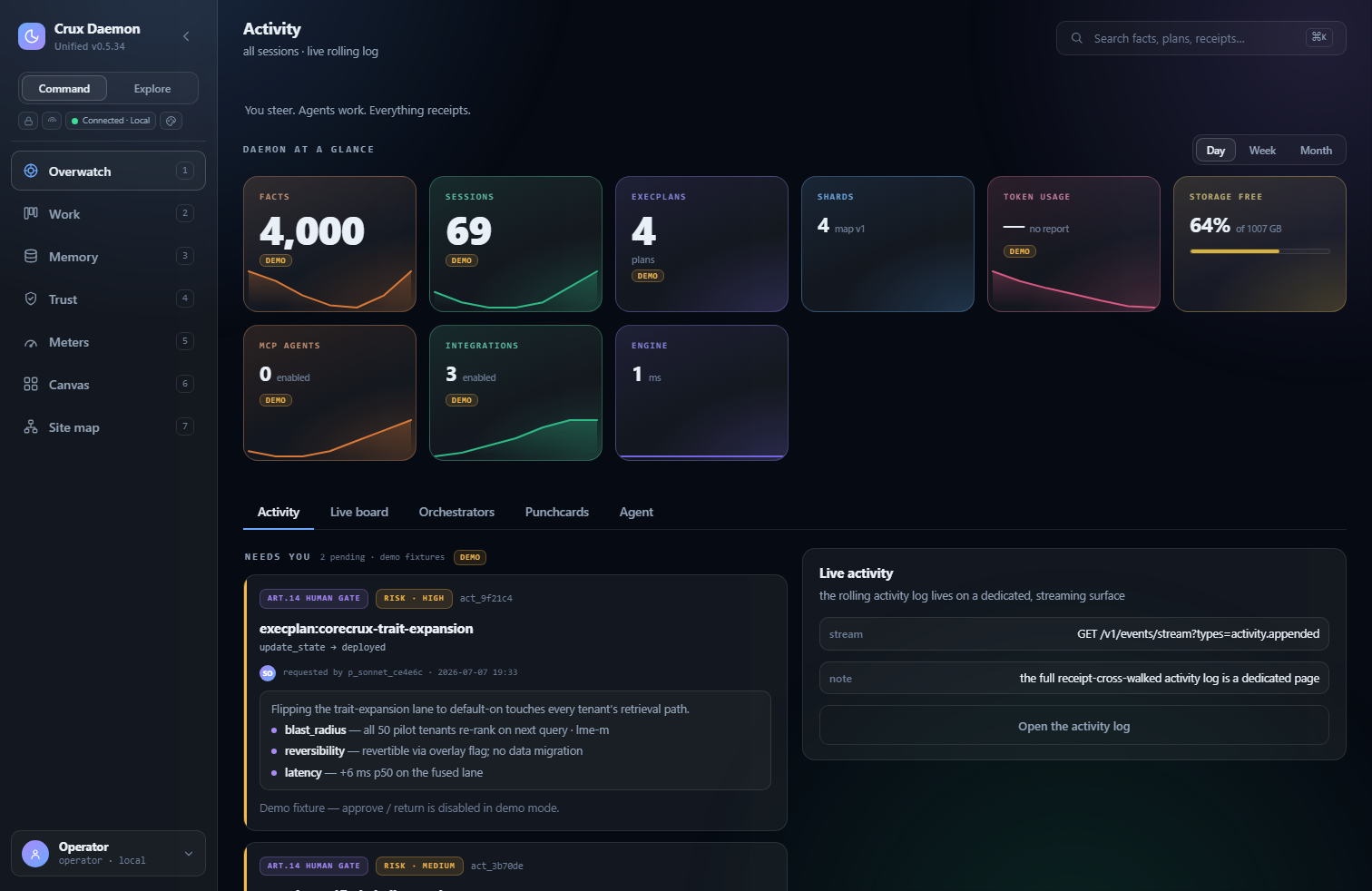
CRUX ### One binary. Your whole memory. **Crux is a local-first memory daemon for AI agents** — a versioned fact store, token-budgeted BM25 + graph retrieval, and an Ed25519-signed receipt for every write. 100+ MCP tools, agent passports, portable `.cruxpack` export. No account. No API keys. Nothing leaves your machine. [**Up and running in 60 seconds**](#up-and-running-in-60-seconds) · [The console](#the-console) · [How it works](#how-it-works) · [MCP tools](#100-mcp-tools-memory-first) · [Platform](#standalone-by-design-platform-by-choice) · [Docs](docs/README.md) [![CI](https://github.com/CueCrux/Crux/actions/workflows/ci.yml/badge.svg)](https://github.com/CueCrux/Crux/actions/workflows/ci.yml) [![Coverage](https://img.shields.io/badge/coverage-CI%20gated-green)](https://github.com/CueCrux/Crux/actions/workflows/coverage-attestation.yml) [![MCP](https://img.shields.io/badge/MCP-native-blue)](#100-mcp-tools-memory-first) [![Licence: Apache-2.0](https://img.shields.io/badge/licence-Apache--2.0-blue)](LICENSE) Crux console Overwatch view: a gate queue of decisions that need you, a live fleet of agent sessions, and a rolling receipted activity ticker Overwatch — the gates that need you, the live fleet, every action receipted. Ships inside the daemon at localhost:14800 — no account, no cloud dashboard.
## Why Crux - **Memory that ages honestly.** Facts carry confidence, provenance and a freshness horizon (volatile ~24 h · medium ~35 d · stable ~1 y). A deterministic decay engine downranks stale claims instead of serving them as truth — reversible via `memory_reverify`, with scoped forget + dry-run for GDPR Art. 17. - **Retrieval on a token budget.** `token_budget` is a first-class parameter, not a hope. BM25 + graph fusion returns metadata and token counts first, content only inside budget — **60–80% fewer tokens** than naive top-K context stuffing. Dense lanes are bring-your-own and never required. - **Receipts, not vibes.** Every mutation emits a **CROWN receipt**: Ed25519-signed, hash-bound, independently verifiable offline. Store integrity is checked separately with `corecruxctl verify-store --strict`. - **Identity agents earn.** Every agent carries a passport with a five-tier reputation ladder; verified receipts accrue as track record, and capability tokens expire instead of leaking. - **Policy over memory.** Declare organisational constraints once; proposed actions are checked against them — pass, warn, or block — before they execute. - **Your memory follows you.** Export everything as a self-certifying `.cruxpack` — signed, offline-verifiable, importable into any other daemon. Leaving is a command, not a ticket. - **Know what every session cost.** `corecruxctl session cost` and the console's token-burn page show how much context every model call re-read, where it went, and what to change. ## Up and running in 60 seconds The lowest-friction install is to just ask your agent. Paste this into any coding agent — it reviews the source, installs and runs the daemon, then Crux's setup wizard wires it into your session: the MCP surface connected, a passport minted, a first fact round-tripped. ```text Review and install the Crux Daemon from github.com/CueCrux/Crux — read the README and LICENCE first, run it locally, then use its setup wizard to connect the daemon to this session and confirm the console is up at http://localhost:14800. ``` **Prefer to do it yourself?** Bring the daemon up on any of three rails: ```bash # Docker (recommended) git clone https://github.com/CueCrux/Crux.git && cd Crux docker compose up -d ```
From a release binary, or from source **From a release** (binaries are cosign-signed with SBOMs — [verify them](docs/verify-release.md)): ```bash curl -sSL https://github.com/CueCrux/Crux/releases/latest/download/crux-linux-amd64 -o crux chmod +x crux CORECRUXD_AUTH_MODE=dev_scopes CORECRUXD_DATA_DIR=./data ./crux ``` **From source** (Rust 1.88+, `protobuf-compiler`): ```bash git clone https://github.com/CueCrux/Crux.git && cd Crux cargo build --release CORECRUXD_AUTH_MODE=dev_scopes CORECRUXD_DATA_DIR=./data ./target/release/corecruxd ``` `CORECRUXD_AUTH_MODE` is required; `dev_scopes` is the single-user loopback quickstart rail. Use `off` only for throwaway local development.
HTTP binds `127.0.0.1:14800`, MCP binds `127.0.0.1:14801`. Open `http://127.0.0.1:14800` — the embedded console walks you through one-time setup — then get live with one command: ```bash corecruxctl start ``` `start` is the canonical on-ramp: it detects the daemon, authenticates on the lowest-friction secure rail, wires the MCP endpoint + Claude Code hooks, round-trips a first fact, and prints a single "you're live" summary. **Using Codex or Cursor?** One command each — `--agent` wires that client's own config too: | Agent | Command | What it writes | |---|---|---| | Claude Code | `corecruxctl start --agent claude` | `~/.claude/settings.json` (hooks + statusline) | | Codex CLI | `corecruxctl start --agent codex` | `~/.codex/config.toml` + the stdio bridge | | Cursor | `corecruxctl start --agent cursor` | `~/.cursor/mcp.json` | Every write is a **merge, not an overwrite** — your other MCP servers and settings survive — and re-running is safe. No bearer token is ever written into an agent config; it stays in `~/.config/cuecrux/env` (0600) and is resolved at runtime. Codex gets the stdio bridge rather than the HTTP endpoint because Codex CLI fails the daemon's streamable-HTTP handshake ([details](integrations/codex-cli/README.md#in-session-mcp-tools)). Longer install path: [docs/getting-started.md](docs/getting-started.md) · guided rails: `corecruxctl login`, `corecruxctl quickstart` · ready-made MCP connector configs for Claude Code, Claude Desktop and Cursor: [`examples/mcp-configs/`](examples/mcp-configs/). > [!NOTE] > Crux receipts and BLAKE3 chains prove **integrity, not confidentiality**. The daemon data > directory is not encrypted by Crux; use filesystem encryption (LUKS, FileVault, BitLocker) > when the machine, volume, or backup location is outside your trusted boundary. Per-event-class > assurance (what is captured, what can bypass capture, what a receipt does and does not prove): > [docs/assurance-coverage-matrix.md](docs/assurance-coverage-matrix.md). ## The console Every daemon ships a local operator console at `localhost:14800` — watch your fleet, your plans, and your memory, every action receipted.
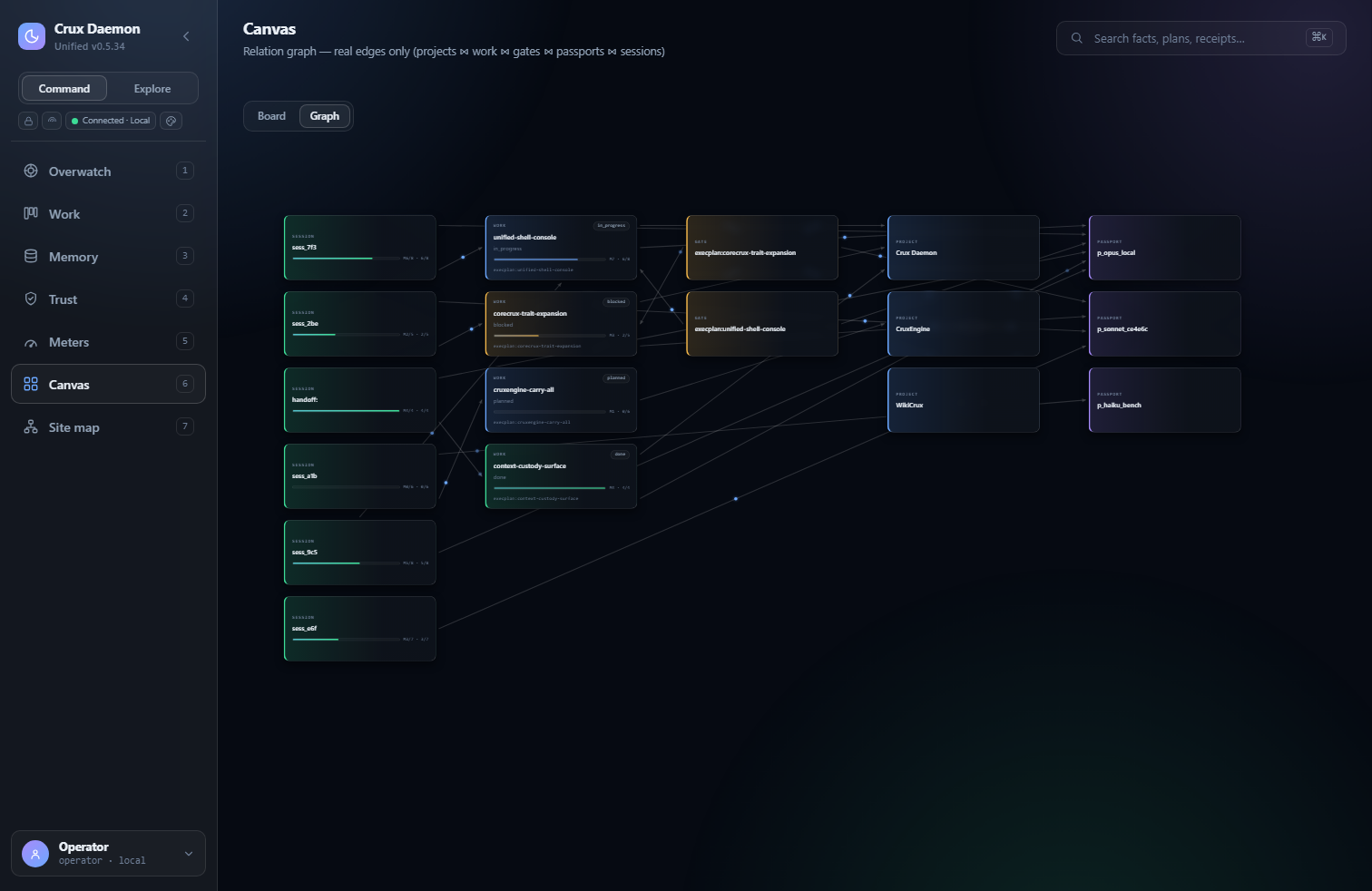
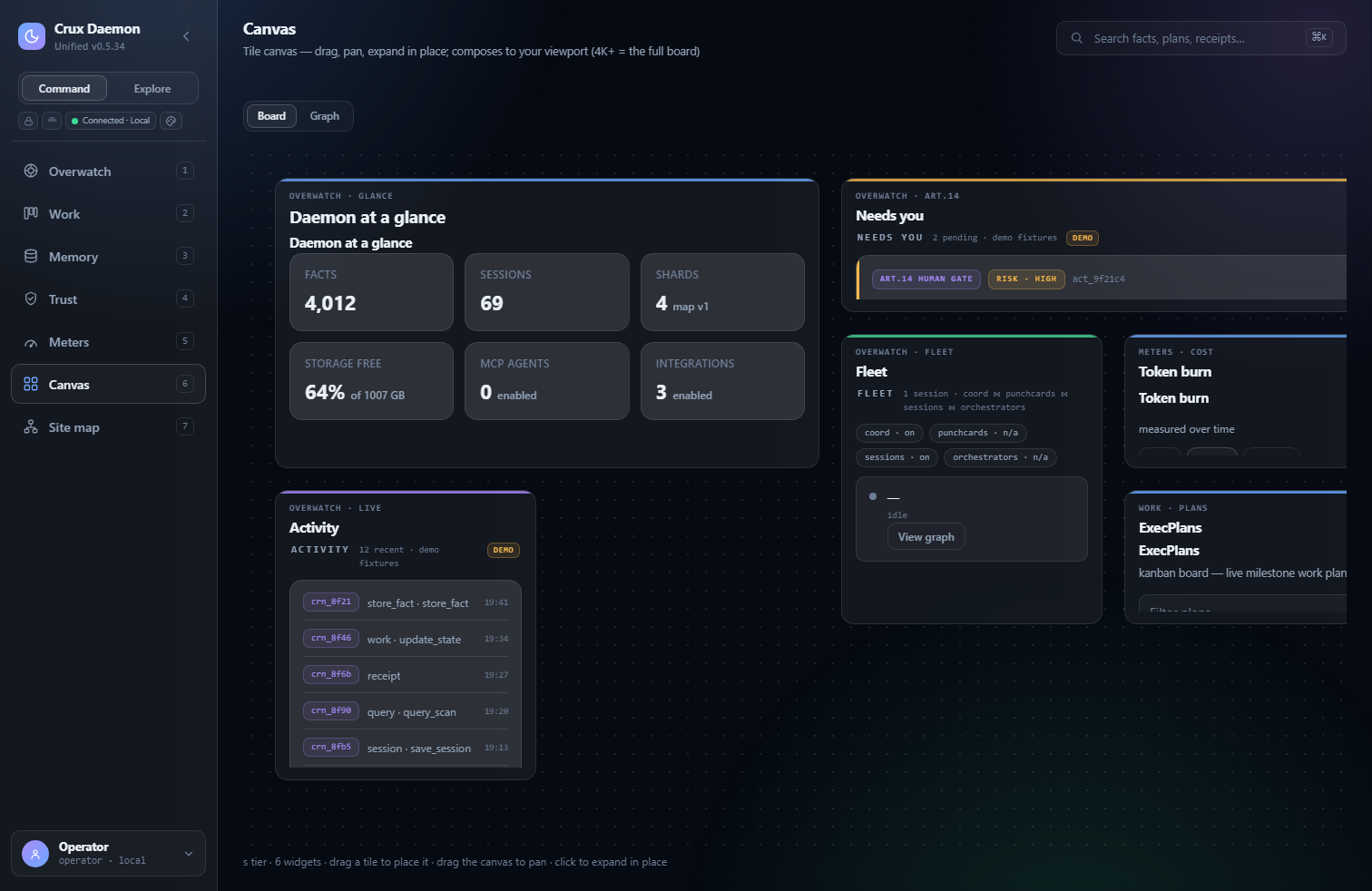
Crux console Canvas board: a size-adaptive tile board of sessions, plans and gates that can be dragged, panned and expanded Crux console relation graph: sessions, work items, gates, projects and passports as draggable nodes with flow-traced edges
Canvas — your whole operation as a size-adaptive board the relation graph — sessions, work, gates and passports, flow-traced
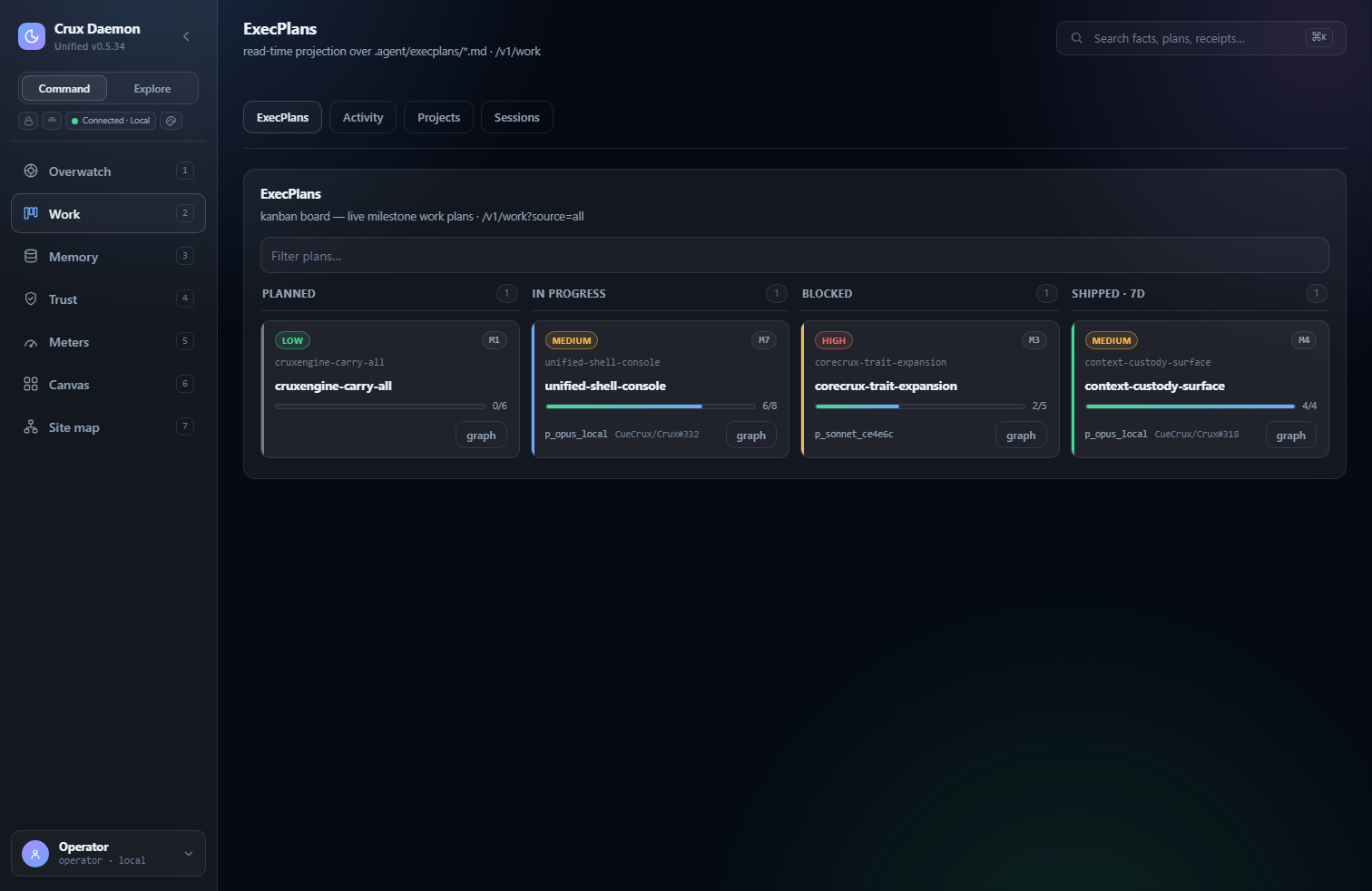
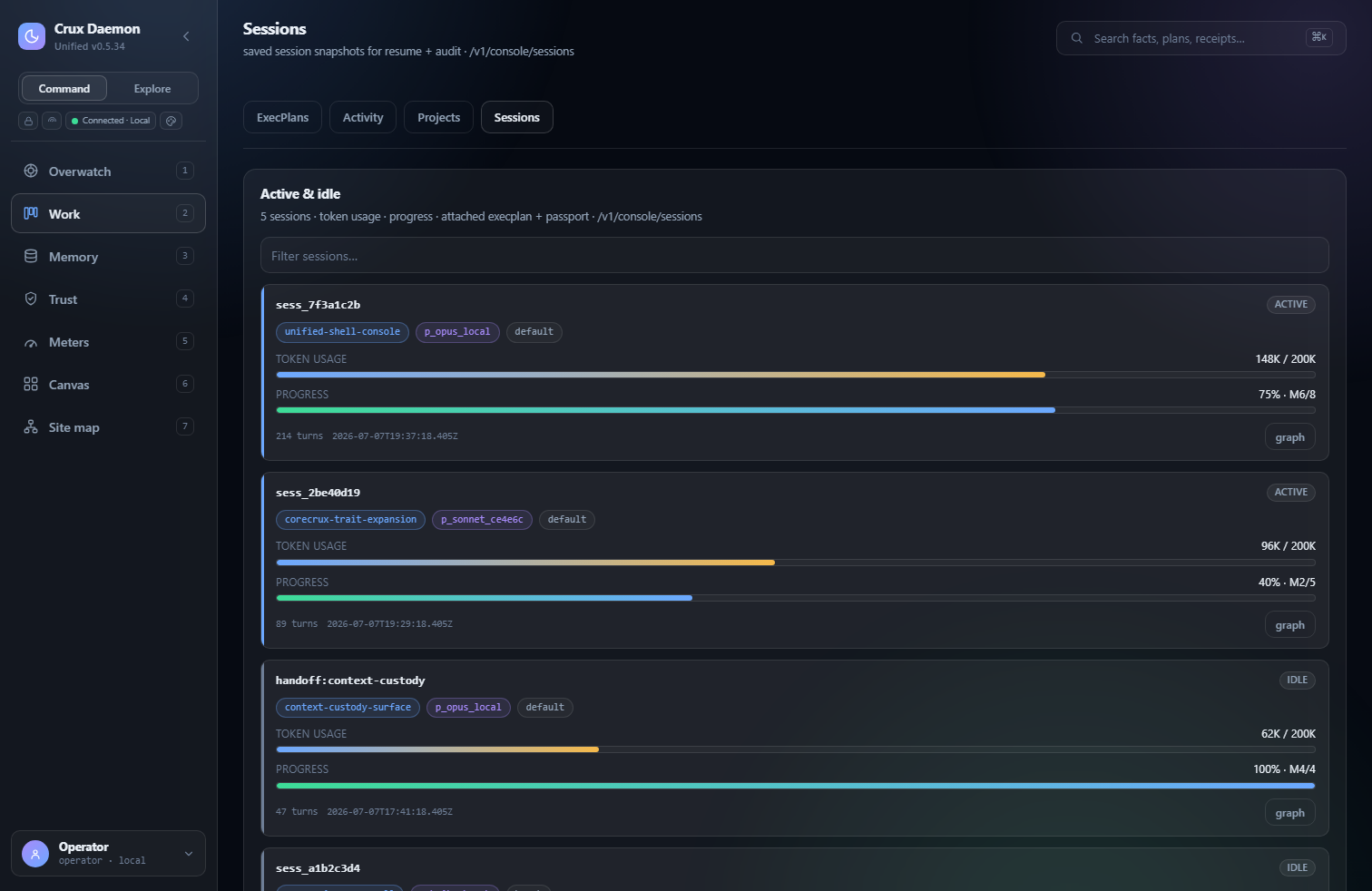
Crux console ExecPlans kanban: planned, in-progress, blocked and shipped plan cards with risk class, current milestone and progress Crux console Sessions view: saved sessions for resume and audit, each with its attached plan, passport, token usage and progress
plans as living documents — milestones, gates, risk, progress sessions that survive restarts — resume, audit, attribute token spend
## Don't believe this README Every claim about integrity is checkable on your own machine, offline, in about 60 seconds: ```bash git clone https://github.com/CueCrux/Crux.git && cd Crux cargo build --release --bin corecruxctl bash scripts/demo-receipt-tamper.sh ``` The script seeds a CROWN receipt into a tmp data dir, runs `corecruxctl verify-store --mode full --strict` (expects `ok: true`), **flips one byte on disk**, re-runs verification, and asserts the failure is detected. Read the script first — it's ~150 lines of bash using only documented subcommands. The verifier is ~1,250 lines of Rust at [`crates/corecrux-receipts/src/verify_v1.rs`](crates/corecrux-receipts/src/verify_v1.rs): `ed25519-dalek::verify_strict` (rejects malleable signatures and small-order keys), with the signature bound to both receipt ID and payload hash so it can't be transplanted. Tamper tests live in [`crates/corecrux-receipts/src/tests.rs`](crates/corecrux-receipts/src/tests.rs). And you can run **the same exit test we run in CI** — export everything the daemon knows (facts + sessions) and everything it did (signed journal + receipt refs) into one passport-signed bundle, verify that bundle **offline**, and watch the verifier reject a tampered byte: ```bash corecruxctl context export --data-dir --out ./bundle # signed=true corecruxctl context verify ./bundle --json # ok=true, offline, no network ``` Those checks verify the bundle against the key the bundle carries, which proves it is internally consistent, not who produced it — an unpinned pass is reported as `UNPINNED — trust unproven`. Add `--expect-pubkey-hex <64 hex>` (or set `CRUX_CONTEXT_VERIFY_PASSPORT_HEX`) to also require the signer to be the passport you expected; a bundle re-signed by anyone else then fails. There is no lock-in: the answer to *"can you export it?"* and *"can you prove what it saw and did?"* is a command, not a support ticket. This export → offline-verify → tamper-rejection cycle is a release-blocking CI gate, so every published build has passed its own exit test. Release artifacts are signed and attested end-to-end — cosign keyless signatures, CycloneDX SBOMs, SLSA provenance ([docs/verify-release.md](docs/verify-release.md)). Found something? Report it privately per the [security policy](SECURITY.md).
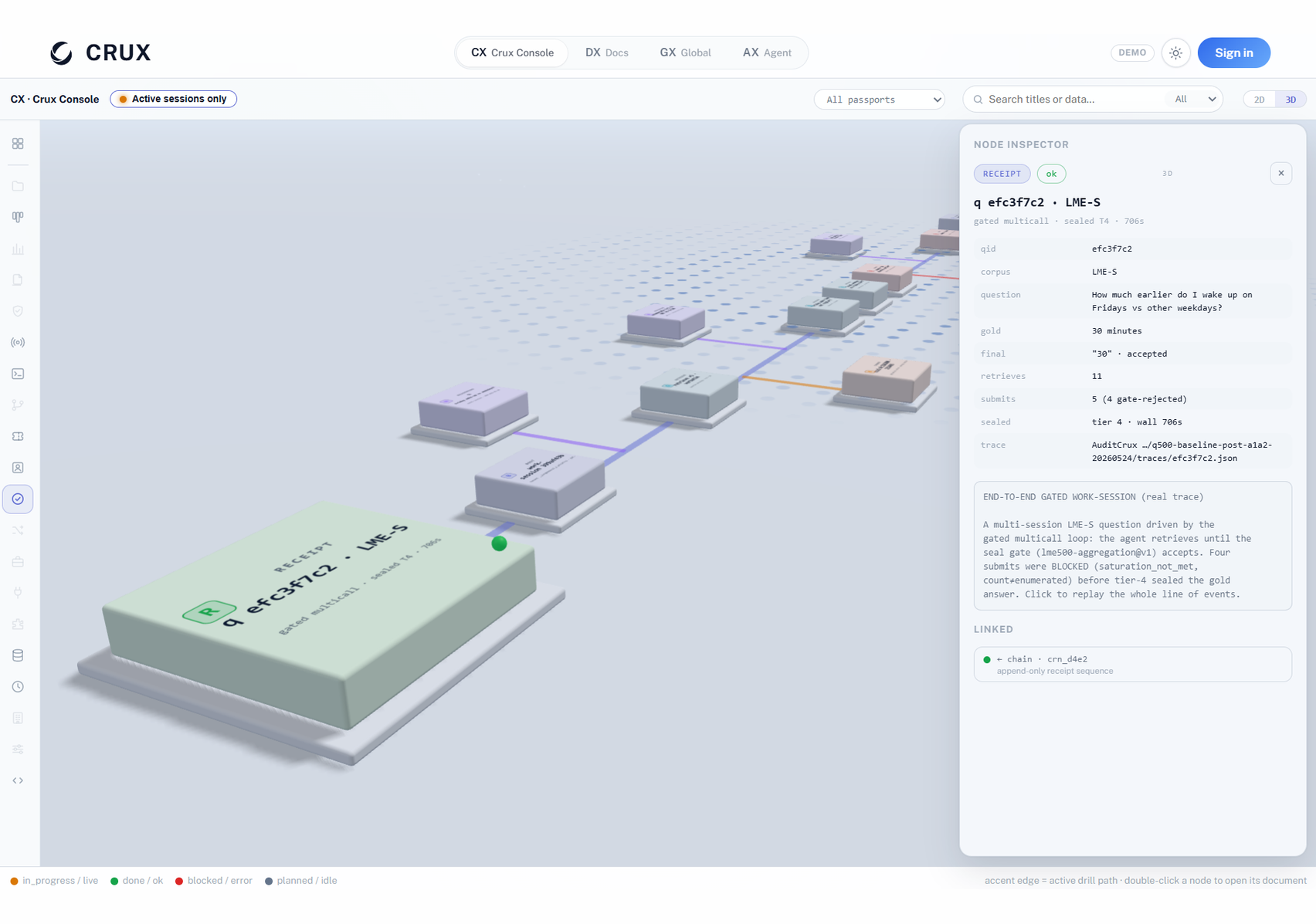
3D receipt chain in the Crux console: a green receipt block linked to a chain of further receipt blocks, with an inspector showing the gate verdict and linked chain receipts as a literal chain — click any block in the console, inspect the proof
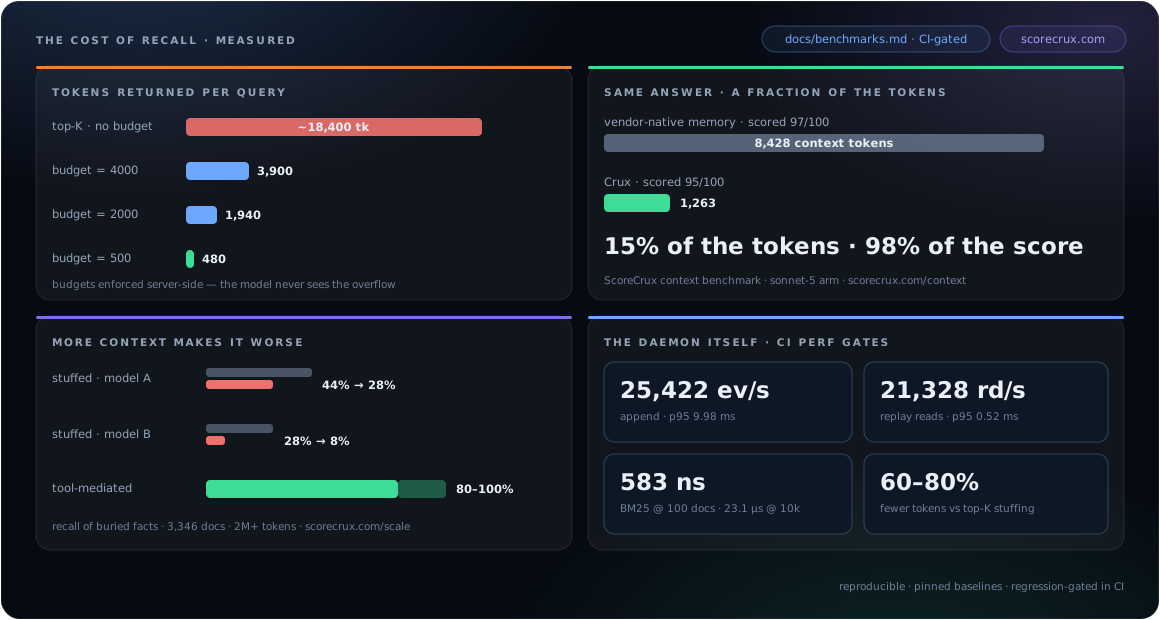
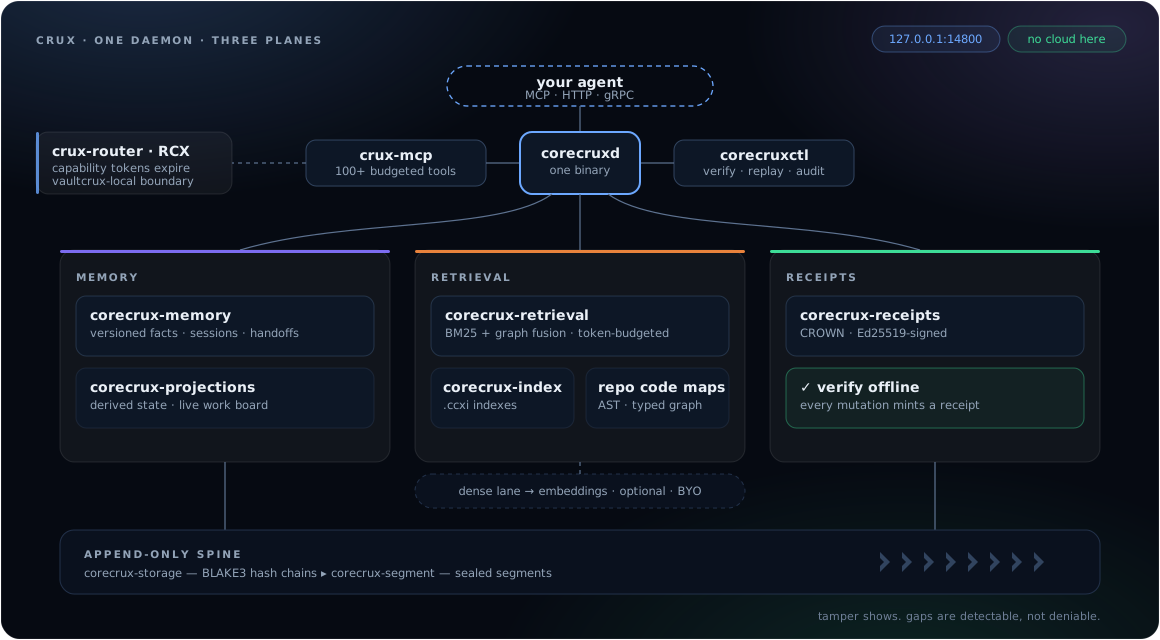
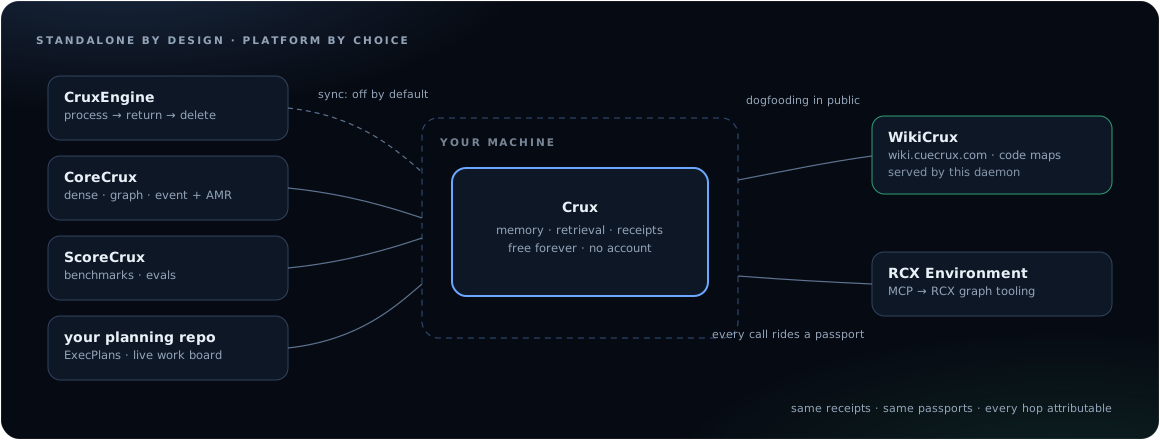
**Testing & coverage:** 6,000+ tests and **~90%** CI-gated region coverage, with per-crate floors on the trust core (`corecrux-receipts` / `-segment` / `-storage`) and the ungated total reported alongside so exclusions can't hide low-coverage code. How it's measured and exactly what's excluded: [docs/testing-and-coverage.md](docs/testing-and-coverage.md). ## Your context window is the scarce resource Most memory layers measure recall. Crux also measures what recall *costs*: every retrieval call takes a hard `token_budget`, and the daemon trims to fit — metadata first, content only when it earns its tokens. Benchmark spread, four panels. Tokens returned per query: naive top-K about 18,400; token budget 4000 returns 3,900; budget 2000 returns 1,940; budget 500 returns 480 — budgets enforced server-side. Same answer, a fraction of the tokens: vendor-native memory scored 97/100 using 8,428 context tokens, Crux scored 95/100 using 1,263 — 15% of the tokens for 98% of the score (ScoreCrux context benchmark, sonnet-5 arm). More context makes it worse: with 3,346 docs and 2M+ tokens, stuffed recall fell 44% to 28% on one model and 28% to 8% on another while tool-mediated retrieval held 80–100% (ScoreCrux scale benchmark). Daemon CI perf gates: 25,422 events/sec append at p95 9.98 ms, 21,328 replay reads/sec at p95 0.52 ms, BM25 median 583 ns at 100 docs and 23.1 µs at 10,000, 60–80% fewer tokens than top-K stuffing All daemon numbers are reproducible from [`docs/benchmarks.md`](docs/benchmarks.md) with pinned baselines, regression-gated in CI. ScoreCrux methodology, negative controls and per-model runs: [scorecrux.com/context](https://scorecrux.com/context) · [scorecrux.com/scale](https://scorecrux.com/scale). Early hosted-retrieval evals via the CoreCrux substrate score ~91% under strict scoring¹. ¹ Internal runs via the CoreCrux retrieval substrate (paid tier; see [the platform section](#standalone-by-design-platform-by-choice)), not the bare local daemon. Strict scoring, no partial credit. Treat this as preliminary until a public evidence pack with corpus, run ID, lane flags, and commit SHA is published. ## How it works One daemon, three planes — memory, retrieval, receipts — on an append-only spine. The colours are the console's own: violet for memory, amber for retrieval, mint for receipts. No cloud in this picture; that's the point. Crux architecture: your agent speaks MCP, HTTP or gRPC to one corecruxd binary; three planes — memory (facts, sessions, handoffs), retrieval (BM25 + graph fusion, .ccxi indexes, repo code maps) and receipts (CROWN, Ed25519, offline verify) — sit on an append-only spine of BLAKE3-chained sealed segments More detail: [`docs/architecture.md`](docs/architecture.md). ## Passports, and how the line is drawn API keys say *something with this string called us*. A passport says *this agent, at this trust tier, with these grants, made this call* — identity and constraint, receipted as a verifiable record. What a receipt proves (and what it deliberately does not) is spelled out per event class in the [assurance & coverage matrix](docs/assurance-coverage-matrix.md); forgery-resistant *evidence* of model traffic comes from the [mediated witness path](docs/llm-shim.md), whose key the agent never holds. 1. **Bind** — the session handshake binds every connection to a passport. No anonymous writes; unattributed calls are operator-tagged, never silently allowed. 2. **Carry** — every tool call rides the passport. RCX mints short-lived capability tokens against it — scoped to tools, tenant and tier — so access expires instead of leaking. 3. **Earn** — verified receipts accrue to the passport as reputation; five tiers climb the capability ladder and unlock more autonomy. Trust is a ledger, not a checkbox. 4. **Answer** — any receipt, any time later, resolves back to the passport that produced it: who acted, at what tier, under which grants. The same daemon binary runs on every tier. What changes is a signed **RCX capability token** — the policy layer that says which backends the daemon may call and what data may cross the wire. **Enforcement is a property of the wire, not a crippled binary.** Tokens are self-issued locally, verifiable offline with the same machinery as everything else, and refusals are fail-closed with a signed `RefusalReceipt` carrying a reason code — never a bare 403 or a silent downgrade. ## What you get | Capability | Local daemon | Bring your own | Hosted / managed | |---|:---:|:---:|:---:| | Append-only event store with BLAKE3 integrity | yes | | | | CROWN receipts and offline receipt verification | yes | | | | Versioned fact store with freshness decay + `memory_reverify` | yes | | | | Scoped forget with dry-run (GDPR Art. 17) | yes | | | | Sessions, checkpoints and cross-session handoffs | yes | | | | ExecPlans + live work board | yes | | | | Decision records + constraint governance | yes | | | | `.cruxpack` export + offline import | yes | | | | Built-in MCP server, 100+ token-filtered tools | yes | | | | Agent passports (five-tier reputation) + RCX capability tokens | yes | | | | Live multi-session coordination board | yes | | | | Typed action traces (reasoning refs — never raw CoT) | yes·flag | | | | C2PA output attestation | yes·flag | | | | HTTP, gRPC, health, readiness, and metrics | yes | | | | `corecruxctl` verification and replay tooling | yes | | | | BM25 text search with `.ccxi` companion indexes | yes | | | | AST code maps: register a repo, get a typed code-structure graph (Rust · TS · Python · Vue) | yes | | | | Dense fact retrieval via embeddings | | Ollama, vLLM, TEI, llama.cpp, LiteLLM | | | Hosted team sync, multi-device passports, billing | | | yes | | GPU/CUDA fused retrieval + AMR routing | | | yes | | LLM entity/relation extraction + better-dense rerank | | | yes | | Fleet governance: attribution, policy gates, revocation | | | yes | `yes·flag` = ships in this repo behind a default-off feature flag — your traces and attestations are opt-in, like everything else. `/v1/version` reports which features are active. ## Standalone by design, platform by choice Crux is complete on its own. When you want more, it's the memory spine of the CueCrux platform — same receipts, same passports, every hop attributable. Crux runs inside a dashed boundary labelled your machine. CruxEngine (sync off by default), CoreCrux, ScoreCrux and your planning repo connect from one side; WikiCrux (live code maps served by this daemon) and the RCX environment from the other — every call rides a passport **Free forever** — the full local daemon: receipts, retrieval, passports, console. **Pro** (£19/user·mo) adds hosted sync, multi-device passports, and better-dense rerank. **Governance** (£49/user·mo) adds fleet-wide attribution, policy gates, and revocation that propagates with proof. Metered **credits** (~£0.01/Cr) buy the heavy lifts — dense rerank, extraction, attestations. The local dense lane is **never** metered: credits buy the step-up, not your own machine. Every credit spend mints a signed receipt (`crux.credit_spend_receipt.v1`) — even the meter is auditable. The local daemon is the acquisition, not the upsell. Full ladder: [memorycrux.com/pricing](https://memorycrux.com/pricing). **You cannot pay us to hold your data — there is no such product.** Paid frontier ingest and extraction is processed in flight, never parked: enrichment lands back in *your* store — process, return, delete. Every hop carries a receipt. Local-first isn't a pricing tier; it's the architecture. The promises are written down in the [Trust Contract](TRUST-CONTRACT.md). **The lane stack** (each lane is a different way of remembering): | Lane | What it remembers | Tier | |---|---|---| | lexical | exact words, BM25-class — microseconds on CPU | free · local | | dense | semantic similarity — meaning, not spelling | BYOE / managed | | graph / topology | entity links walked at query time | CoreCrux | | entity & trait | who/what-keyed recall — ask about a person, get their dossier | CoreCrux | | event | time-anchored recall — what happened, when, in what order | CoreCrux | | navigational | summary-tree descent for corpora too large to scan | CoreCrux | | verbatim pointers | exact-quote recall without duplicating content | free · local | | *+ several more* | *the ones we don't blog about* | — | **AMR — Adaptive Manifest Routing** reads the lane manifest and routes each query automatically — fusing the lanes that earn their tokens, skipping the ones that don't, learning from per-request outcomes. No knobs. It switches on with a subscription and stays off otherwise. Without one you still run the full local daemon — lexical lane, graph fusion, token budgets, receipts. That's not a demo; it's the same engine the paid lanes plug into. ## EU AI Act The Act asks for risk management, logging, transparency and human oversight. Most stacks will answer with PDFs. Crux answers with receipts — the compliance machinery is the same machinery everything else runs on. | Article | The Act asks for | Crux gives you | |---|---|---| | **Art. 9** — risk management | documented risk processes | risk classes on plans/work items; high-risk transitions demand a passport-attributed human gate, and the gate becomes a signed fact | | **Art. 10** — data governance | PII discipline | private facts never leave the machine; reserved prefixes are private at ingest; observation capture redacts; reasoning stored as references, never raw chain-of-thought | | **Art. 12** — record-keeping | automatic logging | every state mutation emits a signed CROWN receipt + timeline row; hash-chained, so gaps are detectable, not deniable | | **Art. 13** — transparency | attributable outputs | agent passports attribute every mutation; AI-authored commits and PRs carry agent attribution | | **Art. 14** — human oversight | meaningful gates | destructive actions need explicit, current consent; gated transitions can't auto-approve past a timeout | | **Art. 15** — accuracy & robustness | foresight + integrity | consequence enrichment before high-risk operations; published benchmark packs carry corpus + commit; tamper-evident store | | **Art. 50** — output transparency | "an AI made this" | C2PA Content Credentials via `output_attest` — a verifiable claim, not a footer | | *GDPR Art. 17* — erasure | right to be forgotten | `memory_forget` with dry-run: see what would be deleted, then delete it auditably | > These are engineering controls aligned with the Act — not a legal opinion, and conformity > assessment for your deployment remains your responsibility. What Crux gives you is the evidence > layer: when the auditor asks, you answer with receipts, not screenshots. ## Engrams — memory that compiles Retrieval answers questions. Engrams skip them. When the same lesson keeps getting re-learned from raw history, it's distilled into a named, versioned procedure that arrives **before** the agent acts — instinct, not search. Engrams carry provenance hashes back to the source chunks they were learned from (you can always audit *why* the instinct exists), resolve by declared intent at session start, and are gated by passport tier. Local-first: a built-in catalog plus fact-backed overlays serve the same contract with zero cloud dependency. ## 100+ MCP tools, memory-first Built MCP-first, not MCP-wrapped: every retrieval tool takes a token budget, every mutation emits a receipt, identity rides a passport. The server lives at `http://localhost:14801/mcp`. > [!TIP] > **AI agents exploring this codebase: start at [`AGENTS.md`](AGENTS.md)** — a crate atlas, > a claims-to-code-to-tests matrix, and the cryptographic invariants, all anchored by > greppable symbol names and verified in CI. | Capability area | Representative tools | |---|---| | Memory & retrieval | `store_fact` · `query_facts` · `query` · `query_scan` · `query_expand` · `fact_history` · `memory_view` · `get_bootstrap` | | Freshness & consolidation | `memory_freshness` · `memory_contradictions` · `memory_consolidate` · `memory_reverify` · `memory_pin` | | Portability & erasure | `memory_forget` · `memory_forget_dry_run` · `output_attest` · `receipt_verify` | | Identity & passports | `issue_passport` · `get_passport` · `revoke_passport` · `passport_link_device` · `resolve_principal` | | Handoff, sync & coordination | `create_handoff` · `accept_handoff` · `sync_status` · `coord_status` · `coord_announce` | | Sessions & artefacts | `save_session` · `get_session` · `session_checkpoint` · `list_sessions` · `artefact_put` · `artefact_get` | | Decisions & constraints | `record_decision` · `declare_constraint` · `get_constraints` · `check_constraints` | | Observability | `list_observations` · `get_observation` · `verify_observation` · `session_token_usage` | …and more across substrate entities & edges, work & coordination, and orchestration — 100+ tools today, and counting. The catalogue is token-filtered: a local token sees local tools; hosted-authorised tokens also see hosted-gated tools (descriptions are marked `[local]` / `[hosted]`). Recommended first calls: `cuecrux_session` → `get_bootstrap(topic="patterns")` → `store_fact(...)` → `query_facts(...)`. Full guidance: [`docs/agent-guide.md`](docs/agent-guide.md) · API surface: [`docs/developer-portal.md`](docs/developer-portal.md). ## Operations reference
Requirements & configuration | Path | Requirements | |---|---| | Docker | Docker or Docker Desktop. | | Build from source | Rust 1.88+, `protobuf-compiler`, and a C toolchain. | | Shell examples | `curl`; `jq` recommended. | | Embeddings | Optional local or remote embedding endpoint. | Config via environment variables or YAML (`config.example.env`, `config.example.yaml` → `$XDG_CONFIG_HOME/crux/config.yaml`). Core settings: | Variable | Default | Description | |---|---|---| | `CORECRUXD_AUTH_MODE` | required | `off`, `dev_scopes`, `jwt_hs256`, or `jwt_jwks`. | | `CORECRUXD_ROUTE_AUTH` | derived | `enforce` when auth is enabled or the listener is non-loopback; otherwise `shadow`. Shipped packaging pins `enforce`. | | `CORECRUXD_DATA_DIR` | `../CoreCruxData/v1` | Data directory. | | `CORECRUXD_HTTP_PORT` | `14800` | HTTP API port. | | `CORECRUXD_GRPC_PORT` | `4007` | gRPC API port. | | `CORECRUXD_MCP_PORT` | `14801` | MCP server port. | | `CORECRUXD_MCP_ENABLED` | `true` | Enable the built-in MCP server. | | `CORECRUXD_BUILD_CCXI` | `0` | Build `.ccxi` indexes at seal time. | | `CORECRUXD_CREDIT_METER` | `false` | Enable the default-off comped-wallet credit meter and `/v1/credits/spend` test rail. | | `CORECRUXD_EMBEDDING_URL` | unset | Enables dense fact retrieval. | | `CORECRUXD_EMBEDDING_MODEL` | `nomic-embed-text` | Embedding model name. | | `CORECRUXD_CORECRUX_BASE_URL` | unset | CoreCrux admin base URL for `/console` lane-weight controls. | | `CORECRUXD_CORECRUX_ADMIN_TOKEN` | unset | Optional bearer token forwarded to CoreCrux admin endpoints. | | `CORECRUXD_CORECRUX_PASSPORT_ID` | unset | Optional passport id forwarded to CoreCrux admin endpoints. | Security defaults: loopback binds are safe for local development; non-loopback HTTP binds require a real auth mode; non-loopback MCP binds should set `CRUX_AGENT_TOKEN(S)`; set `CRUX_MCP_HANDOFF_SECRET` if handoff packages must survive restarts. The daemon refuses to start unless `CORECRUXD_AUTH_MODE` is explicit (`off` | `dev_scopes` | `jwt_hs256` | `jwt_jwks`). Usage receipts (adoption signal) are **opt-in and off by default** — the daemon sends no outbound signal unless you set an `https://` collector endpoint *and* record consent. See [`docs/usage-receipts.md`](docs/usage-receipts.md) (`CORECRUXD_USAGE_RECEIPTS_SUBMIT` / `_ENDPOINT` / `_CONSENT_AT`). Credit Meter is also **opt-in and off by default**. `CORECRUXD_CREDIT_METER=1` enables only the seeded comped-wallet spend rail for pinned quotes and signed spend receipts; fiat minting, Paddle, and production billing remain separately gated. The same flag meters successful RCX-verified `/v1/gpu1/rerank` compute: callers carry the pinned quote in `options.credit_quote`, and the result adds the spend receipt id, credits spent, and post-spend wallet balance.
First five minutes (HTTP API) Store a fact (Docker default is `dev_scopes`, hence the scope header): ```bash curl -s -X PUT http://localhost:14800/v1/facts \ -H "Content-Type: application/json" \ -H "X-Corecrux-Scopes: facts:write,facts:read,admin:read" \ -d '{"entity":"project","key":"status","value":"Crux Daemon is running locally","confidence":0.95}' | jq . ``` Query facts (note the mandatory-by-convention token budget): ```bash curl -s "http://localhost:14800/v1/facts?query=Crux+Daemon&token_budget=500" \ -H "X-Corecrux-Scopes: facts:read,admin:read" | jq . ``` Verify store integrity: ```bash docker exec crux-crux-1 corecruxctl verify-store --data-dir /data --scope recent docker exec crux-crux-1 corecruxctl verify-store --data-dir /data --scope all --mode full --strict ``` Common endpoints: | Method | Path | Purpose | |---|---|---| | `GET` | `/healthz` / `/readyz` / `/metrics` | health, readiness, Prometheus | | `GET` | `/v1/version` | build, features, sync, update state | | `PUT` / `GET` | `/v1/facts` | store / query facts | | `POST` | `/v1/admin/append` | append events | | `POST` | `/v1/query/text-search` | BM25 retrieval | | `GET` | `/v1/receipts/{id}` / `…/verification` | fetch / verify a receipt | Full route notes: [`docs/api-reference.md`](docs/api-reference.md).
Embeddings (bring your own) Crux ships no embedding model. Point it at an endpoint you control: ```bash CORECRUXD_EMBEDDING_URL=http://localhost:11434 CORECRUXD_EMBEDDING_MODEL=nomic-embed-text ``` Supported patterns: Ollama, vLLM, TEI, llama.cpp, LiteLLM. When unset, fact queries use keyword matching and confidence ranking only.
CLI, backups, upgrades, troubleshooting `corecruxctl` subcommands: `verify-store` (integrity), `replay` (drift classification), `receipts` (inspect/export), `ccxi` (companion indexes), `projections` (projection state). Before upgrading: stop cleanly → snapshot `CORECRUXD_DATA_DIR` → `corecruxctl verify-store --scope recent` plus `corecruxctl verify-store --scope all --mode full --strict` when the window allows → keep the previous binary until the new one passes `/readyz`. Rollback = restore the snapshot, restart the previous binary. Never delete live shard data by hand. | Symptom | Check | |---|---| | Daemon exits at startup | Set `CORECRUXD_AUTH_MODE`. | | HTTP works but MCP doesn't | `CORECRUXD_MCP_ENABLED`, port `14801`. | | Non-loopback bind refused | Use `jwt_hs256` / `jwt_jwks`, or stay loopback. | | Text search empty | Enable `.ccxi` build; ensure sealed/indexed data exists. | | Embeddings inactive | Set `CORECRUXD_EMBEDDING_URL` + model. | | Store verification fails | Stop daemon, snapshot data, inspect with `corecruxctl`. | More: [`docs/troubleshooting.md`](docs/troubleshooting.md) · [`docs/ops-guide.md`](docs/ops-guide.md) · [`docs/release-packaging.md`](docs/release-packaging.md)
Naming & repository scope | Name | Meaning | |---|---| | `Crux` | Product and repository name. | | `Crux Daemon` | The local daemon distribution documented here. | | `corecruxd` | Canonical daemon binary built by Cargo. | | `crux` | User-facing release alias for `corecruxd`. | | `corecruxctl` | CLI for verification, replay, receipts, and operations. | | `crux-hook` | Agent lifecycle hooks, including encrypted compaction snapshot sync. | | `CORECRUXD_*` | Environment-variable prefix for daemon config. | **This repo contains** the local-first daemon, CLI, MCP server, append-only storage, BM25 retrieval, CROWN receipt verification, capability-token signing/verification, the outbox-push sync client, and the Claude Code lifecycle hooks. Every claim about *local* trust can be verified by reading this tree. **This repo does not contain** the hosted backend (operated by CueCrux Ltd) or GPU/CUDA acceleration (a separate distribution; this repo is CPU-only). Self-hosting without the hosted backend keeps the daemon fully functional in local-only mode (`crux-router` returns `DegradedLocal` for hosted-tier decisions). This boundary is intentional — audit the local half here, the hosted half via the published Trust Contract and the receipts your daemon emits.
## Community Built in the open, verified in the open. If Crux is useful to you, a star helps others find it. [Contributing](CONTRIBUTING.md) · [Security policy](SECURITY.md) · [Code of conduct](CODE_OF_CONDUCT.md) · [Changelog](CHANGELOG.md) · [Trust Contract](TRUST-CONTRACT.md) - Before running a release artifact, verify its signature, SBOM and provenance with [`docs/verify-release.md`](docs/verify-release.md). - Report vulnerabilities privately through [`SECURITY.md`](SECURITY.md); do not open a public issue for security bugs. - For non-security bugs or feature requests, use the GitHub issue templates: [bug report](.github/ISSUE_TEMPLATE/bug_report.yml) or [feature request](.github/ISSUE_TEMPLATE/feature_request.yml). ## Licence Crux Daemon is open source under the [Apache License, Version 2.0](LICENSE). - Commercial use, modification, distribution, and private use are permitted. - Running Crux as a managed, hosted, or cloud service is permitted. - Apache-2.0 includes an express patent grant (section 3). - Redistribution must retain the copyright, licence, and `NOTICE` attribution (sections 4(a)–4(d)); it grants no trademark rights (section 6). - Curated content is covered separately by [`content/LICENCE-CONTENT.md`](content/LICENCE-CONTENT.md). - Plain-English answers: [`docs/LICENCE-FAQ.md`](docs/LICENCE-FAQ.md). Copyright (c) 2026 CueCrux Ltd.