
 [**🧭 The Tiers of Context Engines — Tier 3 → Tier 2 → Tier 1.5 → Tier 1**](https://denis2054.github.io/Context-Engineering-for-Multi-Agent-Systems/media/three_tier_context_engines.html)
[**⚖️ Compliance & Risk Management — GDPR · HIPAA · SOC 2 · ISO · FedRAMP**](https://denis2054.github.io/Context-Engineering-for-Multi-Agent-Systems/media/compliance_risk_management.html)
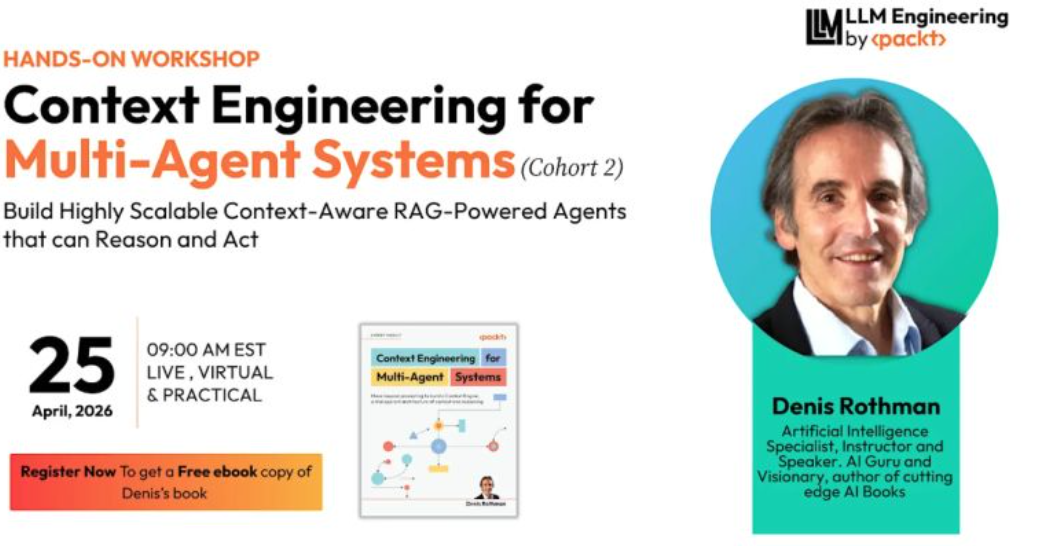
## [April 11, 2026] Resource preparation for April 25, 2026 workshop
📣 Upcoming Live Workshop Session — Cohort 2
Stop tinkering with prompts. Start engineering context.
## [March 14, 2026] OpenAI gpt-5.4 implementation
Update of the January 24, 2026 Release: **OpenAI gpt-5.4** implemented in the Universal Context Engine Sovereign Universal Context Engine: A new Glass Box Context Engine implementation - ``` Chapter10/Universal_Context_Engine.ipynb ``` and ``` Chapter10/Universal_Context_Engine_UI.ipynb```- demonstrating domain-agnostic architecture by running cross-domain use cases on the same core. Token Analytics: engine.py and the Dashboard provide rigorous transparency into token usage (Input, Output, Difference) for cost and verbosity analysis.
Here is what GPT-5.4 brings to the notebook:
😎Massive 1.05M Context Window: We can now ingest entire codebases or massive legal repositories in a single pass, rather than relying solely on small vector chunks.
😎Unified Reasoning & Coding: The model absorbs specialized coding capabilities directly, making the Planner agent significantly more stable and reducing "NoneType" errors in complex JSON schemas.
😎Deferred Tool Loading: GPT-5.4 introduces optimized tool searching, which can reduce token consumption in the AGENT_TOOLKIT by up to 30%—a major win for the new Token Analytics dashboard.
😎Reduced Hallucinations: Factual accuracy has seen a 33% improvement, which is critical for the "High-Fidelity RAG" required in legal and marketing domains.
🎇The Stats:
GPT-5.4 scores 83.0% on agentic capability benchmarks (GDPval), up from 70.9% in previous versions. This isn't just a model swap. It's a fundamental shift in how sovereign, domain-agnostic AI agents handle verifiable data!
## [February 12,2026] Universal Context Engine Hardware Benchmarking
The following benchmark is a comparison of the **CPU** and **H100** execution environments for the Universal Context Engine.
**The Takeaway**
Benchmarking confirms that the **Universal Context Engine**’s *performance and output quality are decoupled from local compute power (CPU vs. H100)*. Because *the architecture offloads heavy reasoning* and retrieval to *cloud-based APIs (OpenAI/Pinecone)* and utilizes a Glass Box multi-agent orchestration, the system delivers identical high-fidelity results and consistent execution latencies *regardless of the local hardware tier*. This validates the engine as a truly **sovereign, domain-agnostic system** that maintains operational excellence without requiring expensive local GPU infrastructure if GPU infrastructure is a constraint. If GPU isn't the primary constraint but open source sovereignty is, then it is possible to use an open-source model such as DeepSeek R1 as shared in this repository: ➡️ **[DeepSeek‑R1 Sovereign AI Guide](https://github.com/Denis2054/Context-Engineering-for-Multi-Agent-Systems/blob/main/sovereign_ai/README.md)**
### Comparison Summary
The execution times across both notebooks are nearly identical, with most steps falling within a 29–86 second range depending on query complexity rather than hardware. This occurs because the "CPU" and "H100" labels refer to the **local environment** where the notebook runs, while the heavy lifting—specifically LLM generation and vector search—is offloaded to **cloud-based APIs** (OpenAI and Pinecone). Consequently, the local processor's speed has a negligible impact on total latency. In terms of quality, both environments produced high-fidelity, citation-backed results across Legal and Marketing domains. The "H100" environment did not show superior reasoning, as both used the same "gpt-5.1" model configuration and identical multi-agent orchestration logic.
### Performance and Quality Comparison
| Metric | CPU Notebook (Universal Context Engine) | H100 Notebook (Universal Context Engine) |
| --- | --- | --- |
| **Average Execution Time** | ~29.69s (Simple) to ~86.22s (Complex) | Identical (~29s to ~86s) |
| **Output Quality** | High: Consistent branding ("Innovate Forward") and factual accuracy. | High: Identical reasoning and structure. |
| **Token Efficiency** | Active: Summarizer saved ~1016 tokens in Marketing tasks. | Identical: Same token-saving logic applied. |
| **Agent Performance** | Reliable: Successfully chained Librarian, Researcher, and Writer. | Reliable: Exact same orchestration results. |
| **Safety Guardrails** | Functional: Pre/Post-flight moderation active. | Functional: Identical moderation report logic. |
The primary takeaway is that the architecture is **infrastructure-agnostic**; the quality and speed are governed by the **Context Engineering** (blueprints and retrieved data) and the **API performance** rather than the local compute instance.
## ⚡ **Note on Performance: Efficiency vs. Complexity**
### **The 29s Mark (Optimized Flow)**
For simple tasks, the engine orchestrates **3–4 agents** with minimal reasoning effort.
This demonstrates that the `engine.py` orchestration layer adds **near‑zero overhead**, with latency driven almost entirely by underlying API response times.
### **The 86s Mark (High‑Reasoning Depth)**
This is where the **Glass Box** value becomes most visible.
In this window, the engine performs:
- **Multi‑document cross‑referencing**
- **Semantic alignment** with blueprints
- **Rigorous fact‑checking**
### **The Productivity Delta**
While **86 seconds** may seem high compared to a single‑prompt chat, a human expert would require **15–30 minutes** to achieve the same level of **citation‑backed, brand‑aligned output**.
The Context Engine delivers an **industrial‑grade result ~20× faster** than manual professional analysis.
### HARDWARE H100 Sovereign Pretraining Benchmark: H100 vs. A100
**Achievement:** Successfully benchmarked domain-specific pretraining for a Customer Support agent on X (Twitter) data using the NVIDIA H100.
**Performance Leap:** Achieved 1,740.55 samples/sec, representing a 4.35x throughput increase over previous A100 baselines.
**Sovereign Implications:** Demonstrates that high-fidelity, domain-specific models can be trained from scratch in under 4 minutes, reinforcing the capability for fully independent, sovereign AI ecosystems.
👉 **Access the guide here:** **https://github.com/Denis2054/Context-Engineering-for-Multi-Agent-Systems/edit/main/README.md**
## [February 10, 2026]
Upgraded the README with state-of-the art approaches to be educational bridge between the book, *Context Engineering for Multi-Agent Systems* that containts the architecture and code
and the hands-on repository. Also, the README now contains links to the media folder of the repository.
## [February 5, 2026]
**README UPDATE**
[**🛰️ View Software Evolution Timeline has been updated**](https://denis2054.github.io/Context-Engineering-for-Multi-Agent-Systems/media/index.html)
Software Evolution Timeline: Integrated an interactive narrative tracing journey from Latent Semantic Structures in the 1980s to the 2026 Agentic Era.
APS-Engine_V7 Blueprint added as a link in the timeline: Deployed the 1997 industrial "Physics-Agnostic" Multi-Agent System (MAS) architecture as the cognitive precursor to the Universal Context Engine (Chapter 10).
Structural Invariance Framework: Added a theoretical breakdown of *P* (Probabilistic) vs. *1-P* (Deterministic) ecosystems, detailing the **algorithmic invariants** that bridge C++ legacy systems with modern Natural Language agents.
**Educational Bridge**: Established cross-linked navigation between modern agentic implementations and industrial MAS heritage.Industrial Heritage Context: Documented the transition from millions of lines of C++ to Software 3.0 emergent reasoning, grounded in strategic corporate AI projects (Aerospace, SCM).
LinkedIn Integration: Added a direct link to professional milestones and technical breakthroughs for evidence and enhanced credibility for deep-dive research.
### Added
- **AI Discovery Manifest (`llms.txt`):** Deployed a machine-readable `llms.txt` in the root directory. This manifest is optimized for AI agents and search engines to accurately index the Context Engine's capabilities, technical stack, and domain-agnostic architecture.
- **Keyword Optimization:** Updated repository metadata with high-impact keywords: `mcp`, `agentic-rag`, `universal-context-engine`, and `deterministic-ai` to improve visibility within the agentic AI ecosystem.
## [February 2, 2026]
1.Download path tweaked during Quality Control.
2.Live event announcement:
[**🧭 The Tiers of Context Engines — Tier 3 → Tier 2 → Tier 1.5 → Tier 1**](https://denis2054.github.io/Context-Engineering-for-Multi-Agent-Systems/media/three_tier_context_engines.html)
[**⚖️ Compliance & Risk Management — GDPR · HIPAA · SOC 2 · ISO · FedRAMP**](https://denis2054.github.io/Context-Engineering-for-Multi-Agent-Systems/media/compliance_risk_management.html)
## [April 11, 2026] Resource preparation for April 25, 2026 workshop
📣 Upcoming Live Workshop Session — Cohort 2
Stop tinkering with prompts. Start engineering context.
## [March 14, 2026] OpenAI gpt-5.4 implementation
Update of the January 24, 2026 Release: **OpenAI gpt-5.4** implemented in the Universal Context Engine Sovereign Universal Context Engine: A new Glass Box Context Engine implementation - ``` Chapter10/Universal_Context_Engine.ipynb ``` and ``` Chapter10/Universal_Context_Engine_UI.ipynb```- demonstrating domain-agnostic architecture by running cross-domain use cases on the same core. Token Analytics: engine.py and the Dashboard provide rigorous transparency into token usage (Input, Output, Difference) for cost and verbosity analysis.
Here is what GPT-5.4 brings to the notebook:
😎Massive 1.05M Context Window: We can now ingest entire codebases or massive legal repositories in a single pass, rather than relying solely on small vector chunks.
😎Unified Reasoning & Coding: The model absorbs specialized coding capabilities directly, making the Planner agent significantly more stable and reducing "NoneType" errors in complex JSON schemas.
😎Deferred Tool Loading: GPT-5.4 introduces optimized tool searching, which can reduce token consumption in the AGENT_TOOLKIT by up to 30%—a major win for the new Token Analytics dashboard.
😎Reduced Hallucinations: Factual accuracy has seen a 33% improvement, which is critical for the "High-Fidelity RAG" required in legal and marketing domains.
🎇The Stats:
GPT-5.4 scores 83.0% on agentic capability benchmarks (GDPval), up from 70.9% in previous versions. This isn't just a model swap. It's a fundamental shift in how sovereign, domain-agnostic AI agents handle verifiable data!
## [February 12,2026] Universal Context Engine Hardware Benchmarking
The following benchmark is a comparison of the **CPU** and **H100** execution environments for the Universal Context Engine.
**The Takeaway**
Benchmarking confirms that the **Universal Context Engine**’s *performance and output quality are decoupled from local compute power (CPU vs. H100)*. Because *the architecture offloads heavy reasoning* and retrieval to *cloud-based APIs (OpenAI/Pinecone)* and utilizes a Glass Box multi-agent orchestration, the system delivers identical high-fidelity results and consistent execution latencies *regardless of the local hardware tier*. This validates the engine as a truly **sovereign, domain-agnostic system** that maintains operational excellence without requiring expensive local GPU infrastructure if GPU infrastructure is a constraint. If GPU isn't the primary constraint but open source sovereignty is, then it is possible to use an open-source model such as DeepSeek R1 as shared in this repository: ➡️ **[DeepSeek‑R1 Sovereign AI Guide](https://github.com/Denis2054/Context-Engineering-for-Multi-Agent-Systems/blob/main/sovereign_ai/README.md)**
### Comparison Summary
The execution times across both notebooks are nearly identical, with most steps falling within a 29–86 second range depending on query complexity rather than hardware. This occurs because the "CPU" and "H100" labels refer to the **local environment** where the notebook runs, while the heavy lifting—specifically LLM generation and vector search—is offloaded to **cloud-based APIs** (OpenAI and Pinecone). Consequently, the local processor's speed has a negligible impact on total latency. In terms of quality, both environments produced high-fidelity, citation-backed results across Legal and Marketing domains. The "H100" environment did not show superior reasoning, as both used the same "gpt-5.1" model configuration and identical multi-agent orchestration logic.
### Performance and Quality Comparison
| Metric | CPU Notebook (Universal Context Engine) | H100 Notebook (Universal Context Engine) |
| --- | --- | --- |
| **Average Execution Time** | ~29.69s (Simple) to ~86.22s (Complex) | Identical (~29s to ~86s) |
| **Output Quality** | High: Consistent branding ("Innovate Forward") and factual accuracy. | High: Identical reasoning and structure. |
| **Token Efficiency** | Active: Summarizer saved ~1016 tokens in Marketing tasks. | Identical: Same token-saving logic applied. |
| **Agent Performance** | Reliable: Successfully chained Librarian, Researcher, and Writer. | Reliable: Exact same orchestration results. |
| **Safety Guardrails** | Functional: Pre/Post-flight moderation active. | Functional: Identical moderation report logic. |
The primary takeaway is that the architecture is **infrastructure-agnostic**; the quality and speed are governed by the **Context Engineering** (blueprints and retrieved data) and the **API performance** rather than the local compute instance.
## ⚡ **Note on Performance: Efficiency vs. Complexity**
### **The 29s Mark (Optimized Flow)**
For simple tasks, the engine orchestrates **3–4 agents** with minimal reasoning effort.
This demonstrates that the `engine.py` orchestration layer adds **near‑zero overhead**, with latency driven almost entirely by underlying API response times.
### **The 86s Mark (High‑Reasoning Depth)**
This is where the **Glass Box** value becomes most visible.
In this window, the engine performs:
- **Multi‑document cross‑referencing**
- **Semantic alignment** with blueprints
- **Rigorous fact‑checking**
### **The Productivity Delta**
While **86 seconds** may seem high compared to a single‑prompt chat, a human expert would require **15–30 minutes** to achieve the same level of **citation‑backed, brand‑aligned output**.
The Context Engine delivers an **industrial‑grade result ~20× faster** than manual professional analysis.
### HARDWARE H100 Sovereign Pretraining Benchmark: H100 vs. A100
**Achievement:** Successfully benchmarked domain-specific pretraining for a Customer Support agent on X (Twitter) data using the NVIDIA H100.
**Performance Leap:** Achieved 1,740.55 samples/sec, representing a 4.35x throughput increase over previous A100 baselines.
**Sovereign Implications:** Demonstrates that high-fidelity, domain-specific models can be trained from scratch in under 4 minutes, reinforcing the capability for fully independent, sovereign AI ecosystems.
👉 **Access the guide here:** **https://github.com/Denis2054/Context-Engineering-for-Multi-Agent-Systems/edit/main/README.md**
## [February 10, 2026]
Upgraded the README with state-of-the art approaches to be educational bridge between the book, *Context Engineering for Multi-Agent Systems* that containts the architecture and code
and the hands-on repository. Also, the README now contains links to the media folder of the repository.
## [February 5, 2026]
**README UPDATE**
[**🛰️ View Software Evolution Timeline has been updated**](https://denis2054.github.io/Context-Engineering-for-Multi-Agent-Systems/media/index.html)
Software Evolution Timeline: Integrated an interactive narrative tracing journey from Latent Semantic Structures in the 1980s to the 2026 Agentic Era.
APS-Engine_V7 Blueprint added as a link in the timeline: Deployed the 1997 industrial "Physics-Agnostic" Multi-Agent System (MAS) architecture as the cognitive precursor to the Universal Context Engine (Chapter 10).
Structural Invariance Framework: Added a theoretical breakdown of *P* (Probabilistic) vs. *1-P* (Deterministic) ecosystems, detailing the **algorithmic invariants** that bridge C++ legacy systems with modern Natural Language agents.
**Educational Bridge**: Established cross-linked navigation between modern agentic implementations and industrial MAS heritage.Industrial Heritage Context: Documented the transition from millions of lines of C++ to Software 3.0 emergent reasoning, grounded in strategic corporate AI projects (Aerospace, SCM).
LinkedIn Integration: Added a direct link to professional milestones and technical breakthroughs for evidence and enhanced credibility for deep-dive research.
### Added
- **AI Discovery Manifest (`llms.txt`):** Deployed a machine-readable `llms.txt` in the root directory. This manifest is optimized for AI agents and search engines to accurately index the Context Engine's capabilities, technical stack, and domain-agnostic architecture.
- **Keyword Optimization:** Updated repository metadata with high-impact keywords: `mcp`, `agentic-rag`, `universal-context-engine`, and `deterministic-ai` to improve visibility within the agentic AI ecosystem.
## [February 2, 2026]
1.Download path tweaked during Quality Control.
2.Live event announcement:
📣 Upcoming Free Live Event — February 2026
Join the live LinkedIn session on Context Engineering and Multi‑Agent Systems.
👉 Click here to view the event on LinkedIn
 ### Upgrade
`Data_Ingestion_Marketing.ipynb` has been updated to clear or append data.
In section *2.Initialize Clients*, we can clear the index of its content or append it:
```python
clear_index = True # If True, empties the index namespaces. If False, appends to the existing index.
```
## [November 18, 2025]
### List of notebooks upgraded
`Chapter01/Use_Case.ipynb`
`Chapter01MAS_MCP_control.ipynb`
`Chapter03/Context_Aware_MAS.ipynb`
`Chapter05/Context_Engine_MAS_MCP.ipynb`
`Chapter05/Context_Engine_Pre_Production.ipynb`
`Chapter06/Context_Engine_Content_Reduction.ipynb`
`Chapter07/NASA_Research_Assistant_and_Retrocompatibility.ipynb`
### List of notebooks upgraded and fixed 1 and 2
`Chapter04/Context_Engine.ipynb` (fixed 1)
`Chapter08/Legal_assistant_Explorer.ipynb` (fixed 2)
`Chapter09/Marketing_Assistant.ipynb` (fixed 2
### Upgraded
**OpenAI API GPT-5.1:**
GPT-5 has been upgraded to GPT-5.1, which improves API response time.
OpenAI API library has been upgraded to 2.8.1 in `commons/utils.py,` which is now the reference installation file for all notebooks in the repository.
OpenAI provided the following release notes that address, among other issues, latency for reasoning, which is important for MAS programs such as MAS Context Engine.
"We’ve released GPT-5.1 in the API, the next model in the GPT-5 series built to balance intelligence and speed across agentic and coding tasks.
Here’s what’s new in GPT 5.1:
Adaptive reasoning that adjusts thinking time by task complexity—spending more time on complex tasks and responding faster on simple tasks.
New reasoning_effort = 'none' mode, offers a fast, accurate non-reasoning path for **latency sensitive use cases**. *Defaults to none when unspecified.*
Extended prompt caching with retention up to 24 hours to reduce latency for long-running conversations.
Upgrades to coding: more communicative, highly steerable, better code quality, improved frontend UI generation.
New tools: apply_patch (structured diffs) and shell (controlled local CLI).
Pricing: Same pricing and rate limits as GPT-5."
### Fixed 1
Resolved an issue in the Context Engine where the Planner failed to parse valid JSON plans. Added support for the steps key in the LLM response schema to prevent execution errors.
### Fixed 2
- **Moderation API Type:** Resolved a critical formatting issue in `Marketing_Assistant.ipynb` (Cell 4) where the OpenAI Moderation API failed with `Error code: 400` when agents returned structured data (dictionaries or lists). Added logic to serialize these outputs into strings before submission.
### Added
- **JSON Support:** Added `import json` to the execution cell to support data serialization.
### Changed
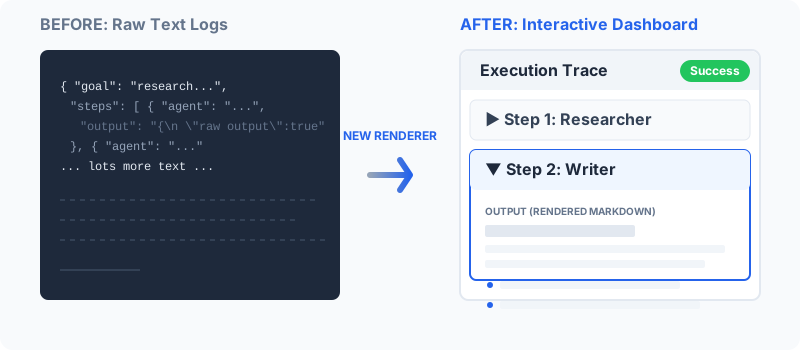
- **Output Rendering:** Updated the `execute_and_display` function to detect JSON outputs and render them as formatted Markdown code blocks for improved readability in the notebook.
## [November 7, 2025]
Repository made public.
### Upgrade
`Data_Ingestion_Marketing.ipynb` has been updated to clear or append data.
In section *2.Initialize Clients*, we can clear the index of its content or append it:
```python
clear_index = True # If True, empties the index namespaces. If False, appends to the existing index.
```
## [November 18, 2025]
### List of notebooks upgraded
`Chapter01/Use_Case.ipynb`
`Chapter01MAS_MCP_control.ipynb`
`Chapter03/Context_Aware_MAS.ipynb`
`Chapter05/Context_Engine_MAS_MCP.ipynb`
`Chapter05/Context_Engine_Pre_Production.ipynb`
`Chapter06/Context_Engine_Content_Reduction.ipynb`
`Chapter07/NASA_Research_Assistant_and_Retrocompatibility.ipynb`
### List of notebooks upgraded and fixed 1 and 2
`Chapter04/Context_Engine.ipynb` (fixed 1)
`Chapter08/Legal_assistant_Explorer.ipynb` (fixed 2)
`Chapter09/Marketing_Assistant.ipynb` (fixed 2
### Upgraded
**OpenAI API GPT-5.1:**
GPT-5 has been upgraded to GPT-5.1, which improves API response time.
OpenAI API library has been upgraded to 2.8.1 in `commons/utils.py,` which is now the reference installation file for all notebooks in the repository.
OpenAI provided the following release notes that address, among other issues, latency for reasoning, which is important for MAS programs such as MAS Context Engine.
"We’ve released GPT-5.1 in the API, the next model in the GPT-5 series built to balance intelligence and speed across agentic and coding tasks.
Here’s what’s new in GPT 5.1:
Adaptive reasoning that adjusts thinking time by task complexity—spending more time on complex tasks and responding faster on simple tasks.
New reasoning_effort = 'none' mode, offers a fast, accurate non-reasoning path for **latency sensitive use cases**. *Defaults to none when unspecified.*
Extended prompt caching with retention up to 24 hours to reduce latency for long-running conversations.
Upgrades to coding: more communicative, highly steerable, better code quality, improved frontend UI generation.
New tools: apply_patch (structured diffs) and shell (controlled local CLI).
Pricing: Same pricing and rate limits as GPT-5."
### Fixed 1
Resolved an issue in the Context Engine where the Planner failed to parse valid JSON plans. Added support for the steps key in the LLM response schema to prevent execution errors.
### Fixed 2
- **Moderation API Type:** Resolved a critical formatting issue in `Marketing_Assistant.ipynb` (Cell 4) where the OpenAI Moderation API failed with `Error code: 400` when agents returned structured data (dictionaries or lists). Added logic to serialize these outputs into strings before submission.
### Added
- **JSON Support:** Added `import json` to the execution cell to support data serialization.
### Changed
- **Output Rendering:** Updated the `execute_and_display` function to detect JSON outputs and render them as formatted Markdown code blocks for improved readability in the notebook.
## [November 7, 2025]
Repository made public.