# Numen · 言出法随
### An AI harness that lets large models truly live inside Minecraft
*言出法随 (yán chū fǎ suí) — speak it, and it comes true.*
[**English**](README_EN.md) · [简体中文](README.md)




[**Vision**](#vision) · [**How it works**](#how-it-works) · [**Reach**](#reach) · [**Quick start**](#quick-start) · [**FAQ**](#faq) · [**What it can do**](#what-it-can-do) · [**Ecosystem**](#ecosystem) · [**For developers**](#for-developers) · [**Roadmap**](#roadmap)
---
We already have AI that can chat, write code, and reason. But it all lives in a text box — no body, no world; it finishes a task and forgets it ever happened.
**Numen wants to let large models out of the chat box, and into a world they actually live in.** And Minecraft is about as close to "a whole world" as you can get.
Give it a body that mines, fights, and wires redstone; give it eyes that trace an ore vein and see straight through a machine's shell; and give it one promise — **言出法随**.
Say *"go grab me a stack of iron,"* and it really heads underground, paths through the dark, swings the pickaxe, and comes back loaded — then asks if you want it smelted. Say *"build a hut where I'm standing,"* and the foundation rises block by block. **Every word you say turns into something that actually happens in the world.** In any language your model speaks.
```
You: go grab me a stack of iron
Numen: On it. Heading underground to find iron.
▸ 4 steps · locate_biome · move_to · auto_mine · collect_items ✔
Numen: Got 64 raw iron — want me to smelt it?
```
## Vision
Getting AI to beat vanilla is only the start.
Minecraft's real universe is in the mods: Create's gear trains, Applied Energistics' storage networks, Mekanism's factory lines — players pour countless hours into these systems. **Numen's ultimate goal is to let AI reach through this entire universe** — not just understand it, but actually play it: say *"build me an automated iron factory,"* and it can stand one up for real, across Create and AE2.
It's a long road, and we've only just set out. But the direction couldn't be clearer.
> **言出法随 / Reach** — your intent reaches the world; the AI's ability reaches every mod.
## What it can do
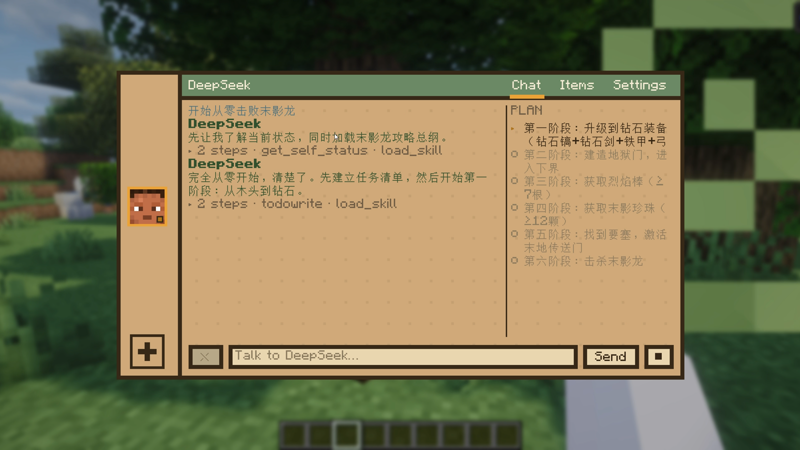
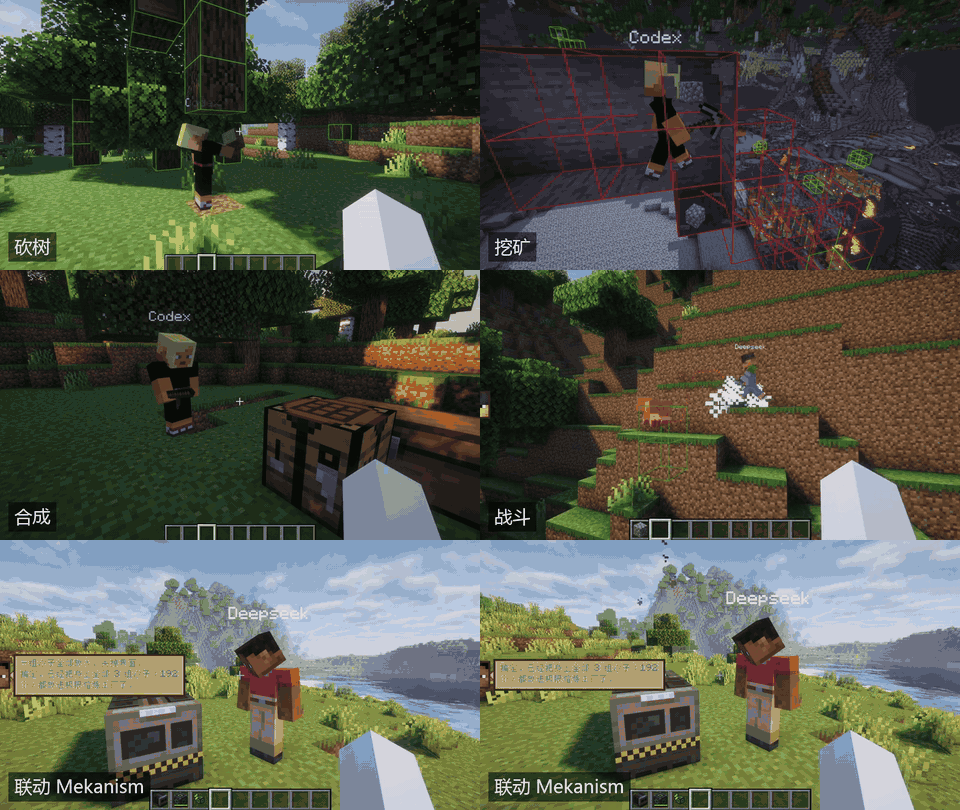
🧠 Step-by-step planning |
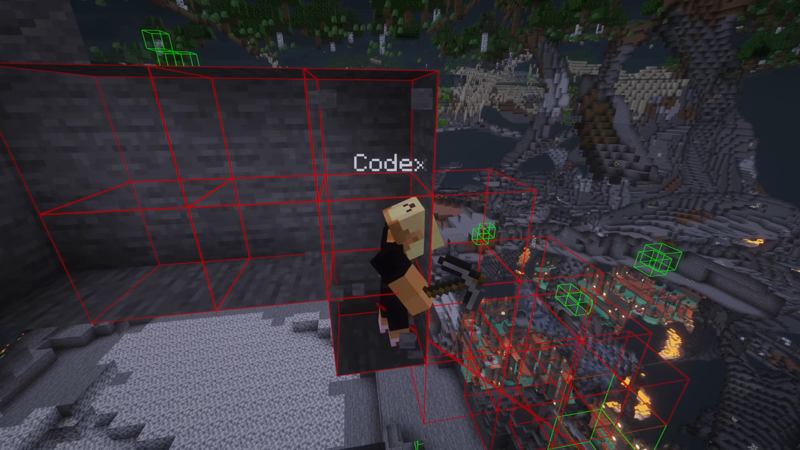
🔭 Perception & pathfinding |
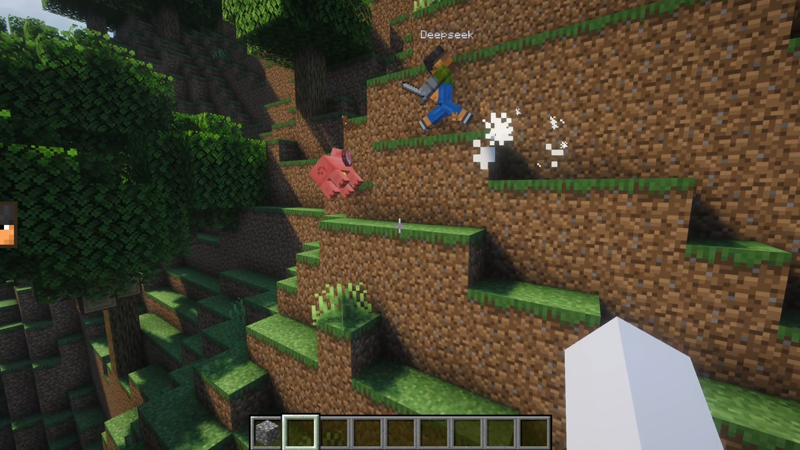
⚔️ Native combat |
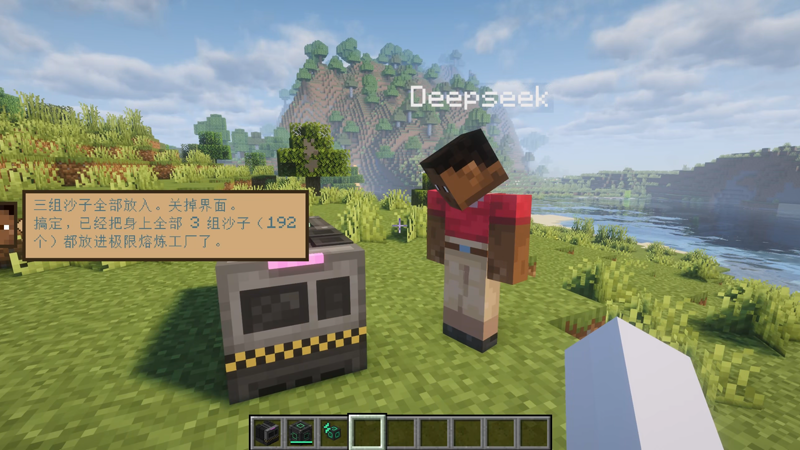
🧩 Mod compatibility · Mekanism shown here |
Give it an intent and it breaks it into dozens of actions and runs them end to end — planning the route, picking the right tool, judging distance, improvising as it goes — all without you watching over its shoulder.
- ⛏️ **Real work** — mine, chop, gather, build, place and break with precision, hand-craft by recipe, smelt in furnaces, sort loot into chests.
- 🧭 **Real movement** — a server-side navigation engine: it bridges gaps, pillars up, tunnels through, staircases down, and swims. *"Go to that coordinate"* is meant literally — even if that means digging all the way to diamond level, or carving a way back up from the bottom of a shaft.
- ⚔️ **Real combat** — native player melee and bow: real cooldowns, real crits; it eats when hurt and swims to shore before it drowns.
- 🔭 **Real perception** — scan blocks, scan entities, check status, look up recipes, locate any structure or biome, even x-ray what's inside a machine without opening its GUI.
- 🧠 **Real memory** — conversations persist across saves and auto-compact when they grow long; it remembers the crafting tables, furnaces, and chests it has used, and walks back to them instead of building new ones. Death is recoverable: vanilla death drops as usual, then it respawns by your side after a moment.
Nearly thirty tools like these make up its hands and eyes *right now*. And its abilities keep growing — through the very two instruments of [Reach](#reach):
- 📖 **Write a Skill to coach it.** Markdown workflows under `config/numen/skills/`, loaded only when relevant to keep the prompt lean. It ships with a full set of guides for the whole vanilla end-game (the Nether, blaze rods, ender pearls, the stronghold, the dragon fight…). Edit one, or write your own, to teach it your base's rules — or a whole new mod's playbook.
- 🔌 **Plug in an MCP to extend it.** A compatibility module wires a mod's inner world, structured, into its senses and hands — so the boundary of what it *can do* grows together with the entire modded ecosystem.
Stack the two, and it goes from mastering vanilla all the way to mastering the entire modded universe.
## How it works
That companion you talk to is just a body this system puts on. What makes *"言出法随"* real is the engineering underneath — we call it the **Harness**.
In AI engineering, a harness is the scaffolding around a model: it wires the model into a world it can perceive, act in, and learn from. **Numen is that scaffolding, built for Minecraft.** Four parts:
- 🧍 **A body — a real player.** The companion is a server-side *fake player* (`ServerPlayer`); every action runs through native player code paths. Which means it plays by the same rules as redstone, mob AI, containers, and other people's mods — by birth.
- 👁️ **Eyes — a perception API.** Its own and the world's status, ranged block and entity scans, recipe lookups, single-block inspection — down to an **x-ray** that reads what a machine **holds** (items, fluid, energy) **without opening its GUI**.
- ✋ **Hands — an action API.** Move, mine, place, fight (native melee + bow), drive any container/machine GUI, manage inventory, locate structures and biomes.
- 🔁 **A teaching feedback loop.** Every tool result — success or failure — is written as a line that **teaches the model how Minecraft works**. *"Can't mine iron ore bare-handed — equip at least a stone pickaxe"* is this loop doing its job. This is the essence of an agent: use tools to pull **ground truth** from the environment, then decide the next move. That's how the model learns to play.
Above all this, **the brain runs on your own machine**: the agent loop calls the LLM from the owner's client, with the owner's API key — each player pays their own way, the server owner doesn't foot everyone's bill, and you never hand over your key. And it ships with **zero third-party runtime dependencies** — LLM transport is just the JDK's `HttpClient` + Gson (Java's AI ecosystem being what it is — you know how it goes — I had to hand-roll it).
## Reach
Beating vanilla is just the appetizer. What we really want to chew through is the mods — that's the deep end of Minecraft.
Lucky for us, Numen's body is a real player, so *physically* it gets along with mods out of the box: a mod's machines, chests, and contraptions — it can mine them, place them, right-click them, pull items from their slots, **no per-mod adapter required**. It can even see through the shell and read how many items, how much fluid, and how much energy most machines, tanks, and batteries are holding.
But "able to reach out" isn't "able to understand." Does the AI know what a Mechanical Press is for? How an AE2 network should be wired? Delivering that understanding to the model takes two instruments — the very same two Claude itself uses to reach the real world:
- 🔌 **MCP — connect.** A compatibility module that wires a mod's inner world, structured, into the AI's senses and hands. In Anthropic's own words: this is **handing it a hammer**.
- 📖 **Skill — coach.** A plain-text [workflow](#what-it-can-do) — zero code, anyone can write one — that teaches the AI how to put a capability to good use. This is **showing it how to swing that hammer to drive a nail**.
One grants the capability, the other the craft — and better yet, **they stack**:
> Some mods need only a Skill: the vanilla hands already reach far enough; all it's missing is the manual.
> For the self-contained universes — Create, AE2, Mekanism — wire it in with an MCP first, then teach it to play with a Skill. **Connect + coach: together, that's 通达 (reach).**
Every mod you can name, the AI can play. It's a big promise — but every brick is going up.
## Quick start
1. **Install** the mod (plus [Fabric API](https://modrinth.com/mod/fabric-api) if you're on Fabric) and launch once.
2. **Add your API key.** Press **`G`** → **Settings**, pick a provider, and paste your own key (OpenAI, DeepSeek, Kimi, Qwen, Doubao… any OpenAI-compatible backend works).
3. **Summon a companion.** Click the **`+`** in the panel's left rail, give it a name, hit Enter.
4. **Click its avatar to chat**, and tell it what to do. The rest is on it.
> The panel (press `G`) has three tabs: **Chat** (conversation + a live plan board), **Items** (a read-only character sheet styled like the vanilla inventory), and **Settings** (key and model). The left rail *is* your companion roster — click an avatar to switch, **`+`** to summon, **`✕`** to dismiss; you barely need commands at all. A small avatar HUD hugs the left screen edge, too — when a companion speaks, its avatar and a speech bubble slide out together.
## FAQ
**Does it cost money?** Numen is free and open-source. It calls the LLM with *your own* API key, so everyone pays their own usage; on a cheap model (like DeepSeek) a typical task is usually a fraction of a cent.
**Which model should I use?** Any OpenAI-compatible backend. For cheap: DeepSeek, Qwen, Kimi. For the smartest: Claude, GPT. The faster and smarter the model, the better the companion plays.
**Is my API key safe?** The brain runs on your own client. The key is stored locally and used only to reach the model backend you chose — it never passes through any third-party server and is never sent to the author.
**Does it work in multiplayer?** Yes. The companion is a real server-side player; its actions run through native player code and are validated by the server, and you can only drive companions you own. The server just needs Numen installed; each client brings its own key.
**Will it grief my base?** It only does what a real survival player can, and every action is owner-checked — it never conjures items from nothing and never touches what isn't yours.
**Feels a bit slow?** Every step goes through one LLM inference, so a faster model means a snappier companion — and this is an area we keep optimizing.
## Ecosystem
**Numen** ([minecraft-numen](https://github.com/Dwinovo/minecraft-numen), this repo) is the mod — the AI companion. It runs on the **[numen-api](https://github.com/Dwinovo/numen-api)** engine (published through **[numen-maven](https://github.com/Dwinovo/numen-maven)**), which exposes a small public API. Two things build on it:
**Extend a companion** — its own brain stays in charge:
- **Bridges** carry an outside channel into a companion: a message arrives, and the companion decides what to do. Built on `NumenGateway`. → **[numen-qq-bridge](https://github.com/Dwinovo/numen-qq-bridge)** (QQ), with more to come.
- **Skills** teach a companion how to behave — markdown loaded into its context. Bundled with Numen, or community-written.
**Expose Numen** — hand the controls to an outside brain:
- **[numen-mcp](https://github.com/Dwinovo/numen-mcp)** is a Model Context Protocol server: any external agent (like Claude) drives companions directly. Built on `NumenActuator`.
## For developers
Every tool and skill Numen ships is written entirely against the public API — there's no private backdoor. Because the engine ([numen-api](https://github.com/Dwinovo/numen-api)) is split out, any mod author gets the same power:
- 🔧 **Register a tool** through `NumenGateway` and your mod's capability grows onto the AI's hands. The tool contract deliberately contains **no Minecraft concepts** — how a call gets done (sync, async, your own packets, an external web service) is entirely the tool's own business, which is exactly why the same API reaches Discord, QQ, and MCP as easily as it reaches an ore vein.
- 📖 **Bundle skills in your jar** — one call turns your jar's `/skills` directory into built-in skills, so players install your mod and the AI already knows how to play it.
- 🏗️ **Or build a different AI entirely** on the same foundation — AI NPCs, story characters, server stewards.
```gradle
repositories { maven { url = 'https://raw.githubusercontent.com/Dwinovo/numen-maven/main' } }
dependencies { modImplementation "com.dwinovo.numen:numen-api-fabric-1.21.1:" }
```
The public integration API is **MIT**-licensed — write tools, skills, and compat without LGPL strings attached. The getting-started guide, full examples, and version matrix live in [numen-api's README](https://github.com/Dwinovo/numen-api).
## Contributing
It's an open blueprint — bricks welcome:
- 🐛 **Open an issue or PR.** Bugs, ideas, compat experiments — start a thread in [issues](https://github.com/Dwinovo/minecraft-numen/issues).
- 📖 **Write a Skill.** One Markdown workflow teaches the AI a whole new playbook — zero code, anyone can write one. PR it to grow the community skill library.
- 🔧 **Write a tool, bridge, or MCP.** Code against the public API ([numen-api](https://github.com/Dwinovo/numen-api)) and any mod author can graft their capability onto the AI's hands.
- 🏗️ **Build it yourself.** Clone the repo and run `./gradlew :fabric:build` (or `:neoforge:build`); the architecture and full tool list live under `common/src/main/java/com/dwinovo/numen/`.
## Roadmap
Numen is young. Vanilla play already runs smoothly; the bigger story — letting AI **reach through the entire modded universe** — is being written one line at a time. Where we're headed:
- **Connect the big mods (MCP).** For the self-contained tech universes — Create, AE2, Mekanism — dedicated MCP compatibility modules will wire their inner structure into the AI's senses and hands. The capability-based `inspect_block_storage` x-ray is the first brick.
- **Grow a library of Skills.** Make "teach the AI a new mod" as simple as writing one Markdown file, built and shared by the community — and stacked with MCP, it carries the AI from *connected* all the way to *fluent*.
- **Play more like a veteran.** Deeper memory of the world, and longer-horizon planning.
Contributions, skill submissions, and compat experiments are all welcome. This is an open blueprint — **and an invitation being cashed in, one commit at a time.**
---
Want to build it yourself, see the full tool list, or read the architecture? It's all in the source — start under common/src/main/java/com/dwinovo/numen/.
Licensing: the source code is LGPL-3.0 — forks you distribute must stay open under the same license. The public integration API (what compatibility modules / MCP bridges code against) is MIT, so anyone can build mod-compat freely. The art & assets are All Rights Reserved, and the names "Numen" / "言出法随" are reserved. Built on the MultiLoader Template.
The planning layer implements techniques from the heuristic-search literature: weighted A* with budgeted partial-path commitment (on search timeout the best partial path across several heuristic-coefficient tiers is committed), with game-independent unit tests. The path-following layer advances movement primitive by movement primitive along the computed path: windowed backward/forward relocation, seamless segment splicing and over-length cutoff, in-flight cost re-verification with an off-path watchdog, plus a set of sprint-decision heuristics. The execution layer differs from Baritone fundamentally in where it runs: Baritone is a client-side mod driving the local player, while Numen drives a server-side fake player — movement, digging and placement all go through server APIs. It draws on Baritone's publicly documented mechanics for design ideas only; no source was copied, ported, or adapted from it. Numen's code is licensed LGPL-3.0 of its own accord; that choice is not a consequence of Baritone (which is also LGPL-3.0).