
LayerFS
Ephemeral Workspaces. Durable Shared History.
LayerFS is the substrate under your agents. Each one mounts a complete, writable
Workspace over shared committed history, does its work, commits what it changed,
and goes away.
Get started ·
Website ·
Docs ·
Benchmarks ·
Video ·
LayerFS × DSH ·
Community




https://github.com/user-attachments/assets/70c25887-86a1-4d81-bd78-571cf1c09a18
> **Status:** [LayerFS 1.1.0](https://github.com/Ephemeral-AI-Lab/layerfs/releases/tag/v1.1.0),
> released as source: the JavaScript API split into `@layerfs/agent`, `@layerfs/backend`
> and `@layerfs/runtime` under [`api/`](api/README.md), plus the `layerfs` command. It breaks
> code written for 1.0.0; see the [release record](docs/release-notes/1.1.0/README.md).
> The results below are 1.0.0's, measured on `main` at `e5c7aaae05`. The Store runs in its Disposable profile only, with no
> crash or power-loss durability: use LayerFS for agent work and its history, not
> as the only copy of data you cannot rebuild.
Since 1.1.0, LayerFS also supports native Windows dsh Live through WSL2 and its own Linux Docker Engine; see the [Windows setup](https://github.com/Ephemeral-AI-Lab/dsh-layerfs#windows-live).
## Try it with LayerFS × DSH
LayerFS runs today through **LayerFS × DSH**, the `dsh-layerfs` plugin for
[DeepSeek Harness](https://github.com/deepseek-ai/deepseek-harness). Agents in a dsh
session fork Branches, test them in Sandboxes, merge and publish, and the **Work** and
**History** tabs show every agent's Branch, live.

## Core ideas
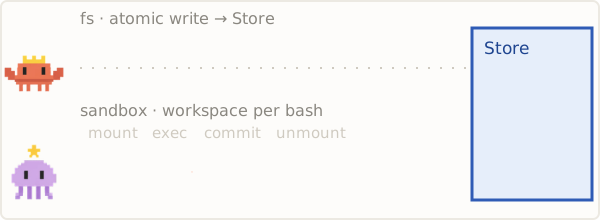
 01 · Ephemeral Computing
Compute exists only while a command runs.
|
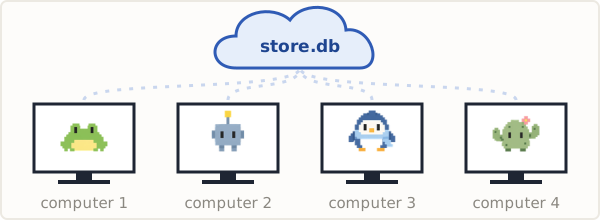
 02 · Decentralized Agents
Agents on different computers share one serverless Store.
|
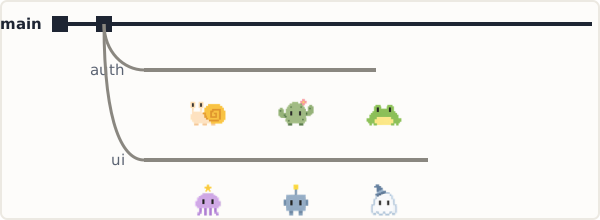
 03 · Multiagent Coordination
One project, many Branches. One Branch, many agents.
|
 04 · Recursive Filesystem
Fork recursively any Commit, at any depth.
|
 05 · Ultra Storage Optimization
157 snapshots of a real project in 100 MB, 19.9× smaller than Btrfs + zstd.
|

 06 · Instant Bootstrap
Dependencies come with every mount. No time lost reinstalling.
|
**And underneath them**
| | Supporting idea | In one line |
| --- | --- | --- |
|  | **[07 · Auto Checkpoints](https://layerfs.ai/docs/core-ideas/#idea-checkpoints)** | Every step an agent takes is a checkpoint to return to. |
|
 | **[08 · Append-only Objects](https://layerfs.ai/docs/core-ideas/#idea-immutable)** | Saved objects are never rewritten. The Store only grows. |
|
 | **[09 · Conflict Rules (`.lww`)](https://layerfs.ai/docs/core-ideas/#idea-lww)** | Name the files that should never conflict. The newest edit wins. |
|
 | **[10 · Big File, Small Edit](https://layerfs.ai/docs/core-ideas/#idea-bigfile)** | An edit costs the size of the edit, not the size of the file. |
## See it run
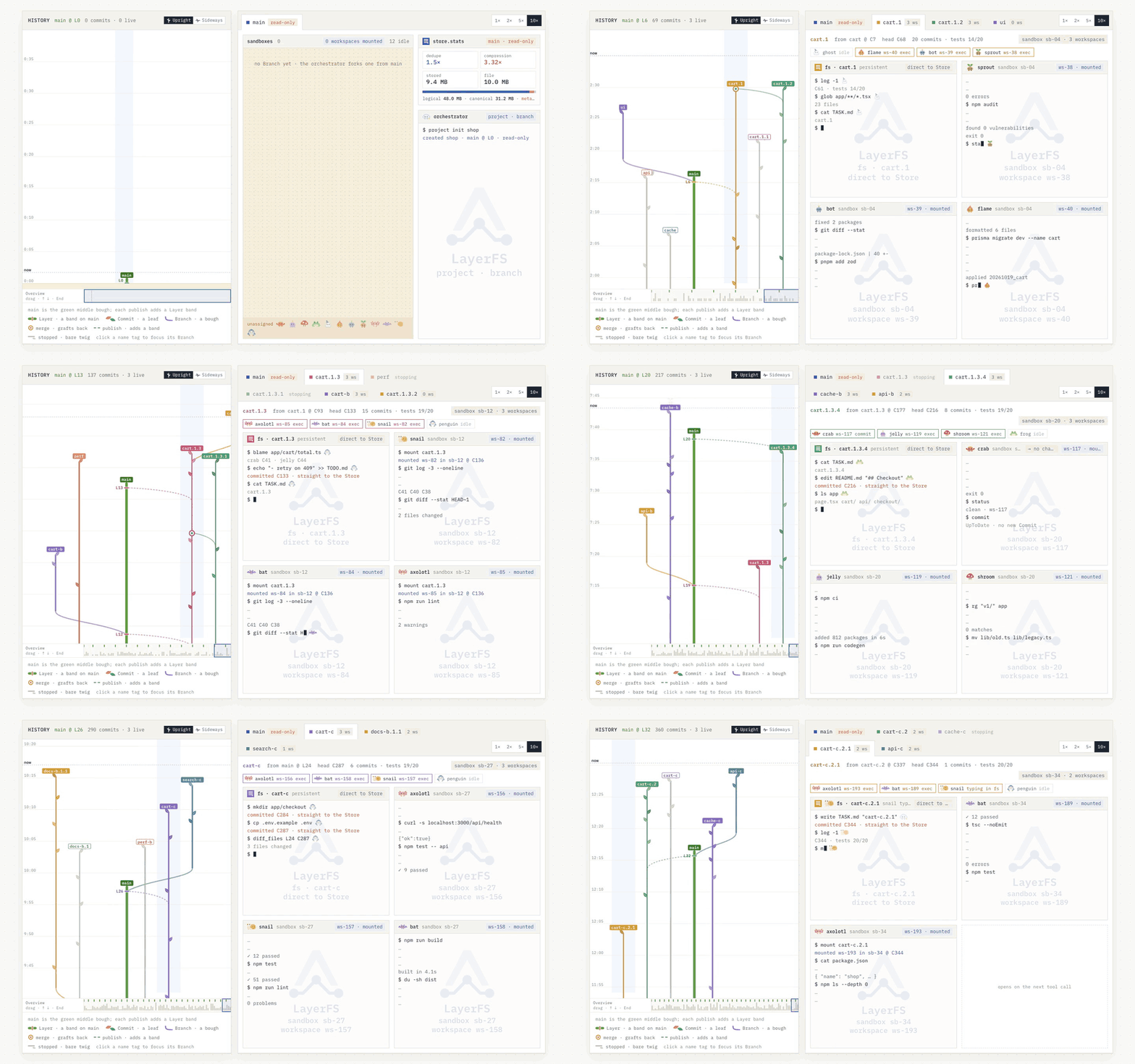
Agents fork Branches, work in Workspaces inside Sandboxes, commit, merge and publish to main. The history grows as they go.
## Results
Every suite ran once on `main` at `e5c7aaae05` through the JavaScript SDK. Each
row links to its method, environment and receipts.
| Suite | What it measures | LayerFS 1.0.0 |
| --- | --- | --- |
| [fs-bench](https://layerfs.ai/benchmarks/fs-bench/) | Cloudflare Computer's own twelve-scenario filesystem benchmark, unchanged, same image | **5.20 s vs 8.88 s, 1.71× faster**; faster in 10 of 12 scenarios |
| [dsh-dedup](https://layerfs.ai/benchmarks/dsh-dedup/) | A real project's history, 157 snapshots (4.94 GB of trees), kept as mountable Commits | **100.1 MB vs 1,994.6 MB, 19.9× smaller** than Btrfs + zstd; 156/156 read back |
| [pjdfstest](https://layerfs.ai/benchmarks/pjdfstest/) | POSIX conformance, 8,798 assertions, against kernel overlayfs | **0 unexpected failures**; keeps 76% of overlayfs's passes, every other failure a deliberate format limit |
| [fsx](https://layerfs.ai/benchmarks/fsx/) | Random reads, writes, mapped I/O and truncates, every byte checked | **14/14 pass**, 3.06 M ops, 0 miscompares |
| [fsstress](https://layerfs.ai/benchmarks/fsstress/) | Four concurrent processes, then Commit, remount and compare | **3,755/3,755 entries identical**; 5.21 GB captured by one Commit in 4.9 s |
| [smallfile](https://layerfs.ai/benchmarks/smallfile/) | 100,000 files of 4 KiB, four threads, against libfuse passthrough | **Faster in 9 of 9 operations**, 1.27×–10.71× |
| [mdtest](https://layerfs.ai/benchmarks/mdtest/) | Metadata create, rename and remove, against libfuse passthrough | 0.86–1.28× with 1 process, 1.21–4.22× with 4 |
| [fio](https://layerfs.ai/benchmarks/fio/) | Data I/O bandwidth, against libfuse passthrough | Random read/write mixes 1.49–2.23×; **slower** on sequential write (0.31×), sequential read (0.81×) and random write (0.40×) |
One sample per case, seed 1, no best-of. Host: arm64 Mac, Docker Desktop
linux/arm64, 8 CPUs, 8.3 GB; host load is recorded per suite. These are release
measurements, not a guarantee for your workload. Earlier fs-bench-pro results:
[v0.1.4](docs/release-notes/0.1.4/benchmark-closeout.md) ·
[v0.1.5](docs/release-notes/0.1.5/benchmark-closeout.md) ·
[v0.1.6](docs/release-notes/0.1.6/benchmark-closeout.md).
## How it works
```text
agent tool call
├─ file tool (read, write, edit, grep …) ── SDK, in process ──────► Store
└─ Bash ── mount ─► exec ─► commit ─► unmount ▲
└─ Workspace: FUSE view in a Sandbox's daemon ───────────┘
(committed root + its own overlay)
```
- **Store.** One SQLite file holds every Branch, Commit and content object. Each
daemon and SDK process opens it directly; there is no database server.
- **Branch, Commit, Layer.** A Branch is a writable line of Commits. Publishing a
Branch to `main` adds a Layer. Content is chunked and stored once.
- **Workspace.** A mount binds the whole committed tree without copying it. Writes
go to the Workspace's own overlay until a Commit saves them. Unmount deletes
the overlay, never history.
- **Conflict.** Two Commits that change the same file are refused with
`Conflict`, unless a `.lww` rule says the newest edit wins. Publishing a
stale Branch is different: it may skip newer `main` Layers; merge `main` into
the Branch first ([publish semantics](.agents/skills/layerfs-js-sdk/references/methods/branch.md)).
## Prior art
LayerFS builds on well-known ideas: layered and union filesystems, copy-on-write
snapshots, content-addressed storage and throwaway execution environments. What
it adds is putting them together for agents: every tool call gets a full
writable tree, and every result becomes a Commit on a Branch in one shared Store.
| Prior work | What it shares with LayerFS | Where LayerFS differs |
| --- | --- | --- |
| **overlayfs, UnionFS, container image layers** | A read-only lower tree with a writable upper layer, which is also where the "layer" name comes from | The upper layer is not just thrown away or kept as a directory: Commit turns it into an immutable snapshot on a Branch, with history, merge and `Conflict`. overlayfs is in the kernel and more complete; LayerFS's FUSE view deliberately omits FIFOs, sockets, device nodes, set-id bits and separate atime/ctime ([pjdfstest](https://github.com/Ephemeral-AI-Lab/layerfs-benchmark/blob/main/data/pjdfstest/README.md)) |
| **Btrfs and ZFS snapshots, reflinks** | Cheap copy-on-write snapshots that share unchanged data | Sharing is by content, not by extent, so a file that is rewritten in full still stores only its new chunks. On a small-file history of 157 snapshots that gives [19.9× less space than Btrfs + zstd](https://github.com/Ephemeral-AI-Lab/layerfs-benchmark/blob/main/data/dsh-dedup/README.md). Btrfs and ZFS also stay cheap for in-place edits of large files, and they are durable, mature kernel filesystems; LayerFS is not ([why Btrfs used more space here](docs/research/layerfs-vs-btrfs-157/REPORT.md#3-why-btrfs-used-more-storage-in-this-workload)) |
| **Git worktrees** | One repository, many working copies and branches | A Workspace holds the whole tree, including `.git`, ignored files, dependencies and build output, so a new mount needs no reinstall. Commits happen per tool call, not when someone runs `git commit` |
| **[try](https://github.com/binpash/try)** | Run a command against an overlay of your system, then inspect, apply or discard what it changed | `try` works on one machine with one overlay at a time. LayerFS keeps every result as a Commit, and lets many agents branch from any of them and share one Store |
| **Apiary and virtual layered file systems** (Potter and Nieh, [USENIX ATC 2010](https://www.usenix.org/conference/usenix-atc-10/apiary-easy-use-desktop-application-fault-containment-commodity-operating), [LISA 2011](https://www.usenix.org/legacy/event/lisa11/tech/full_papers/Potter.pdf)) | Ephemeral containers that start instantly over shared layered filesystems | Apiary isolates desktop applications. LayerFS's target is agent tool calls whose results are kept, branched and merged as history |
**Use something else** if you need crash or power-loss durability (the Store runs
in its Disposable profile only), full POSIX node types, or top sequential I/O
bandwidth ([fio](https://layerfs.ai/benchmarks/fio/)). For a few long-lived
checkouts on one machine, Btrfs snapshots or Git worktrees may be all you need.
## Learn more
| | |
| --- | --- |
| Docs | [LayerFS × DSH guide](https://github.com/Ephemeral-AI-Lab/dsh-layerfs#readme) · [layerfs.ai/docs](https://layerfs.ai/docs/) · [Core ideas](https://layerfs.ai/docs/core-ideas/) · [JavaScript SDK guide](api/README.md) |
| Concepts | [Core concepts](docs/general/concepts.md) · [Documentation index](docs/README.md) |
| Benchmarks | [layerfs.ai/benchmarks](https://layerfs.ai/benchmarks/) |
| Release | [1.1.0 release record](docs/release-notes/1.1.0/README.md) · Previous: [1.0.0 release](https://github.com/Ephemeral-AI-Lab/layerfs/releases/tag/v1.0.0) and its [plan](https://github.com/Ephemeral-AI-Lab/layerfs/blob/792715f00a2dbfcf0cb8435ae84862cce972dc90/docs/roadmap/1.0/README.md); [0.1.7 release record](docs/release-notes/0.1.7/README.md) and its [manual](docs/versioned/0.1.7/README.md) |
## Community
Questions, ideas and show-and-tell are welcome in either place.
## License
LayerFS is licensed under the [MIT License](LICENSE).