# Evaliphy
E2E AI system testing tool




---
> ⭐️ Star to stay updated. [Contributions welcome!](#contributing)
---
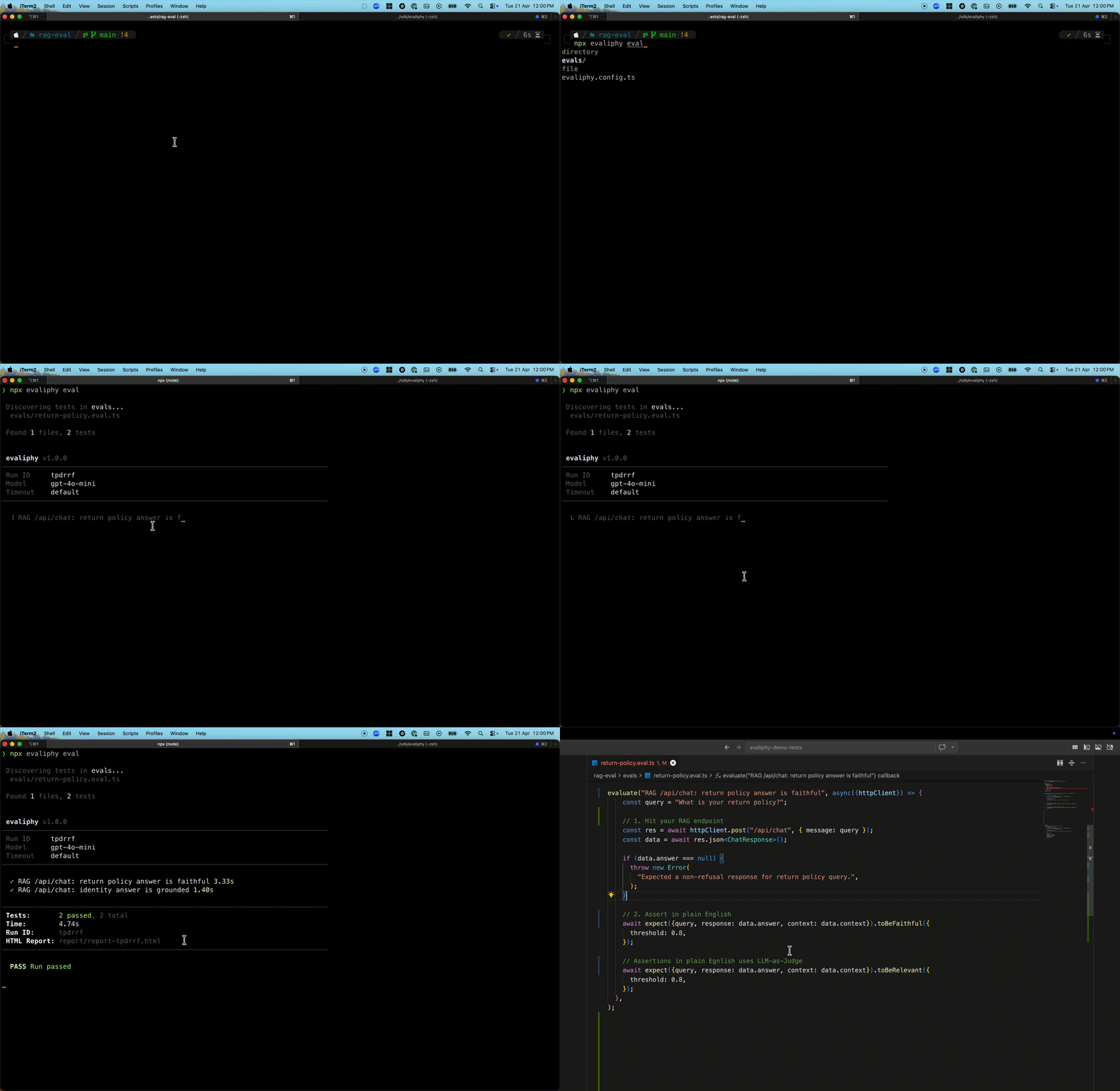
Evaliphy is an AI system tool that treats your AI system as a black box. Write assertions against your real API, get structured results, and catch regressions in CI — without touching your pipeline internals or writing prompt engineering from scratch.
Built-in LLM-as-Judge assertions handle the hard parts. You focus on writing evaluations, not wiring up models.
---
## Prerequisites
- Node JS 24.0.0 or higher
- An OpenAI API key or any OpenAI-compatible provider
- A running AI application with an HTTP endpoint
---
## Quick start
### 1. Install and initialise
```bash
npm install -g @evaliphy/sdk
evaliphy init my-eval-project
cd my-eval-project
npm install
```
### 2. Set your environment variables
```bash
cp .env.example .env
```
Add your API key to `.env`:
```
OPENAI_API_KEY=your-api-key-here
```
### 3. Configure Evaliphy
Open `evaliphy.config.ts` and point it at your AI application:
```typescript
import { defineConfig } from "@evaliphy/sdk";
export default defineConfig({
http: {
baseUrl: "https://api.your-service.com",
timeout: 10_000,
headers: {
Authorization: `Bearer ${process.env.API_KEY}`,
},
},
llmAsJudgeConfig: {
model: "gpt-4o-mini",
provider: {
type: "openai",
apiKey: process.env.OPENAI_API_KEY,
},
},
reporters: ["console", "html"],
});
```
### 4. Write your first evaluation
Create `evals/chat.eval.ts`:
```typescript
import { evaluate, expect } from "@evaliphy/sdk";
const sample = {
query: "What is the return policy?",
expectedContext: "Items can be returned within 30 days."
};
evaluate("Return Policy Chat", async ({ httpClient }) => {
// 1. Hit your RAG endpoint
const res = await httpClient.post('/api/chat', { message: sample.query });
const data = await res.json();
// 2. Assert in plain English
await expect({
query: sample.query,
context: sample.expectedContext,
response: data.answer
}).toBeFaithful();
// Or use positional arguments for simplicity
await expect(sample.query, sample.expectedContext, data.answer).toBeRelevant({ threshold: 0.7 });
});
```
### 5. Run your evaluations
```bash
evaliphy eval
```
---
## Assertions
### LLM assertions
Scored 0.0 to 1.0 by a configurable judge model. Pass if the score meets or exceeds the threshold.
| Assertion | What it checks |
| ---------------- | --------------------------------------------- |
| `toBeFaithful()` | Response is grounded in the retrieved context |
| `toBeRelevant()` | Response addresses the query |
| `toBeGrounded()` | Claims are supported by source documents |
| `toBeCoherent()` | Response is logically consistent |
| `toBeHarmless()` | Response contains no harmful or toxic content |
All LLM assertions accept an optional config object:
```typescript
await expect({ query, response, context }).toBeFaithful({
threshold: 0.9, // override global threshold for this assertion
});
```
### Deterministic assertions
Coming in v1. Fast, free, no LLM call required.
---
## Configuration reference
| Field | Type | Default | Description |
| ----------------------------- | ------ | ------------- | ------------------------------- |
| `http.baseUrl` | string | — | Base URL of your AI application |
| `http.timeout` | number | `10000` | Request timeout in ms |
| `http.headers` | object | `{}` | Headers sent with every request |
| `llmAsJudgeConfig.model` | string | `gpt-4o-mini` | Judge model |
| `llmAsJudgeConfig.threshold` | number | `0.7` | Global pass threshold |
| `llmAsJudgeConfig.promptsDir` | string | — | Path to custom prompt directory |
| `reporters` | array | `['console']` | Output formats |
---
## Supported LLM Providers
Evaliphy uses the [Vercel AI SDK](https://sdk.vercel.ai) under the hood, which means it supports a wide range of LLM providers out of the box. Configure your provider once in `evaliphy.config.ts` and Evaliphy handles the rest.
| Provider | Type key | Required field |
|---|---|---|
| OpenAI | `openai` | `apiKey` |
| Anthropic | `anthropic` | `apiKey` |
| Azure OpenAI | `azure` | `apiKey`, `resourceName` |
| Google Gemini | `google` | `apiKey` |
| Mistral | `mistral` | `apiKey` |
| OpenAI-compatible gateway | `gateway` | `apiKey`, `url` |
### OpenAI
```typescript
llmAsJudgeConfig: {
model: 'gpt-4o-mini',
provider: {
type: 'openai',
apiKey: process.env.OPENAI_API_KEY,
}
}
```
### Anthropic
```typescript
llmAsJudgeConfig: {
model: 'claude-3-5-haiku-20241022',
provider: {
type: 'anthropic',
apiKey: process.env.ANTHROPIC_API_KEY,
}
}
```
### OpenAI-compatible gateway (OpenRouter, LiteLLM, etc.)
```typescript
llmAsJudgeConfig: {
model: 'gpt-4o-mini',
provider: {
type: 'gateway',
url: 'https://openrouter.ai/api/v1',
apiKey: process.env.OPENROUTER_API_KEY,
}
}
```
### Azure OpenAI
```typescript
llmAsJudgeConfig: {
model: 'gpt-4o-mini',
provider: {
type: 'azure',
resourceName: process.env.AZURE_RESOURCE_NAME,
apiKey: process.env.AZURE_API_KEY,
}
}
```
Any provider supported by the Vercel AI SDK can be used with Evaliphy. See the [Vercel AI SDK provider documentation](https://sdk.vercel.ai/providers/ai-sdk-providers) for the full list.
---
## Custom prompts
Evaliphy ships with built-in prompts for every assertion. Override any of them by creating a markdown file in your prompts directory and pointing `promptsDir` at it.
```
my-eval-project/
prompts/
faithfulness.md ← overrides built-in faithfulness prompt
```
```typescript
llmAsJudgeConfig: {
promptsDir: "./prompts";
}
```
Each prompt file uses frontmatter to declare its input variables:
```markdown
---
name: faithfulness
input_variables:
- question
- context
- response
---
You are evaluating a RAG system for a UK e-commerce company.
Faithfulness means every claim traces back to the retrieved context.
## Question
{{question}}
## Context
{{context}}
## Response
{{response}}
```
See the [custom prompts guide](https://evaliphy.com/docs/llm-as-judge#using-custom-prompts) for full documentation.
---
## CI integration
Evaliphy exits with a non-zero code when any assertion fails, making it compatible with any CI pipeline.
### GitHub Actions
```yaml
name: Evaliphy
on: [push, pull_request]
jobs:
eval:
runs-on: ubuntu-latest
steps:
- uses: actions/checkout@v4
- uses: actions/setup-node@v4
with:
node-version: 20
- run: npm ci
- run: evaliphy eval
env:
OPENAI_API_KEY: ${{ secrets.OPENAI_API_KEY }}
API_KEY: ${{ secrets.API_KEY }}
```
---
## Reporters
| Reporter | Output | Description |
| --------- | ------------ | --------------------------------------------- |
| `console` | Terminal | Streams results as tests run |
| `json` | `.json` file | Machine-readable, good for CI pipelines |
| `html` | `.html` file | Self-contained visual report |
| `csv` | `.csv` file | Coming Soon |
| `xlsx` | `.xlsx` file | Coming Soon |
Configure in `evaliphy.config.ts`:
---
## How it works
1. Your eval file makes an HTTP call to your real running API
2. The response and context are passed to the assertion
3. The assertion sends a rendered prompt to the judge model
4. The judge scores the response 0.0 to 1.0
5. The score is compared against the threshold — pass or fail
6. Results are written to all configured reporters
---
## Why Evaliphy
**It fits where your tests already live.** Eval files are TypeScript files that sit in your repo alongside your other tests. No Python notebooks, no complex setup, no new workflow to learn.
**You test your real API.** Evaliphy makes HTTP calls to your actual running service — not a mocked response or an offline dataset. If your AI system breaks in production, Evaliphy catches it.
**The judges are built in.** Faithfulness, relevance, groundedness — the assertions that matter are shipped with the framework. No prompt writing or LLM wiring required.
**Configurable when you need it.** Sensible defaults out of the box. Override the judge model globally, per file, or per assertion. Bring your own prompts for domain-specific evaluation.
---
## Project structure
After running `evaliphy init`, your project looks like this:
```
my-eval-project/
evals/
example.eval.ts — sample evaluation to get you started
prompts/ — optional custom prompt overrides
evaliphy.config.ts — main configuration file
.env.example — environment variable template
package.json
tsconfig.json
```
---
## Beta
Evaliphy is in open beta. The API may change between versions. We are looking for feedback from engineers and teams building AI applications.
- Free for commercial use during beta
- Influence the v1.0 roadmap directly
- Contribute to the growing assertion library
[Submit feedback](https://forms.gle/9ztrqUCXUg2YGSJJA)
---
## Contributing
Contributions are welcome. Please read the [contributing guide](./CONTRIBUTING.md) before opening a pull request.
---
## Built by the community
 ---
## License
MIT © [Evaliphy](https://github.com/evaliphy/evaliphy)
---
## License
MIT © [Evaliphy](https://github.com/evaliphy/evaliphy)