
FylloCode
The governance layer for Coding Agents
One evolving ruleset for every agent on your team, end to end traceable.
中文 ·
Download
---
## Background
When each Agent session ends, the code stays. The decisions don't.
- **Three days later, you don't know why this line changed.** The Agent touched 100+ files, and `git blame` only tells
you who committed — not the reasoning behind it.
- **Two months later, no one knows the design rationale.** The Agent picked an architecture direction, and why the
alternatives were rejected vanished with the chat window.
- **Every new session starts from scratch.** Same questions, same constraints, same history — re-explained to a new
Agent instance every single time.
- **Every team member's Agent runs on its own rules.** No shared engineering standards, no consistency across agents or
sessions. The conventions held together by personal habits are accelerating toward collapse.
These problems share one root cause: **Agents lack a persistent, structured governance layer.** FylloCode is that layer.
---
## Core Mechanism
FylloCode sits on top of your existing codebase and toolchain — not replacing your IDE, CI/CD, or project management
system, but adding a layer above them dedicated to the problem of sustainably using Agents as a team.
```
Dev Systems (GitHub / Yunxiao / Jira ...)
↑ writes back results
┌──────────────────────────────┐
│ FylloCode │ ← governance layer
│ fyllo-specs · fyllo-skills │
└──────────────────────────────┘
↓ constraints & context injection
Coding Agent (any)
↓
your codebase
```
| Capability | Description |
| ------------------------------ | ----------------------------------------------------------------------------------------------------------------------------------------------------- |
| **Unified standards** | The `fyllo-specs` MCP server exposes project-level specs to all agents, persisting across sessions and agent instances |
| **Decision archiving** | Every proposal's rationale and rejected alternatives are persisted as structured data, not lost in chat history |
| **Full traceability** | Task → Proposal → Apply → Archive — every change recorded from intent to execution |
| **Self-evolving rules** | `fyllo-skills` currently ships the `guidelines` tool, which auto-updates project conventions after each task so agents always work from current rules |
| **Writes back to dev systems** | Task results sync back to your existing project management tools — no new silos |
---
## Workflow
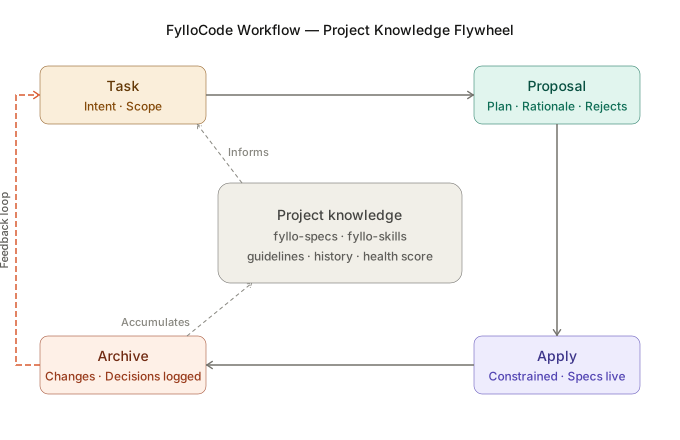
FylloCode structures every coding task into four mandatory phases, each with defined inputs, outputs, and constraints.
```
Task ──────▶ Proposal ──────▶ Apply ──────▶ Archive
Intent Plan review Constrained Results
structuring execution archived
```
### Task
Before the Agent writes a single line, the task intent is fully structured: constraints, scope, assumptions, and
measurable acceptance criteria. `fyllo-specs` automatically injects the current project spec state, ensuring the Agent
is thinking within the right boundaries from the start — not discovering violations halfway through execution.
### Proposal
The Agent generates candidate approaches, each with its rationale and the reasons alternatives were rejected. Output is
driven by OpenSpec and customizable per project. The default is four structured artifacts:
- `proposal.md` — background, new capabilities, changed capabilities, affected modules
- `design.md` — Goals and Non-Goals, final decisions on open questions with justifications for rejected alternatives,
change risks
- `specs` — spec entries extracted from this change, written back to the project knowledge base
- `tasks.md` — detailed task breakdown by file and function, with acceptance criteria, triggering guidelines
auto-evolution
These four artifacts are the substance of the Proposal review — and the record that remains two months later when
someone asks why the system was designed this way.
### Apply
The Agent executes under `fyllo-specs` constraints. Architecture boundaries, naming conventions, restricted operations —
all enforced in real time during coding, not caught later in code review. Execution is strictly scoped to what
`tasks.md` approved: changes outside that boundary are blocked, ensuring the actual diff matches the reviewed plan.
Each task runs in an isolated Git worktree by default. All code changes during Apply happen in that worktree, keeping
the main branch clean until the task is reviewed and merged. Multiple tasks can run in parallel at different stages
without blocking each other.
### Archive
The complete record of the change is automatically archived: code change scope, decision context, spec updates,
guidelines evolution, and a refreshed project health score. Part of this feeds back into `fyllo-specs` and
`fyllo-skills` as background knowledge for the next Task. The rest syncs to your existing dev systems — no new tool
silos.
---
## Model Selection
FylloCode works with any API-compatible model. Different phases make different demands on model capability. From
practical experience:
- **Proposal** benefits from stronger reasoning models — Claude Opus or GPT-4.5 are good choices. The Agent needs to
deeply understand the project context, weigh tradeoffs across multiple approaches, and make defensible design
decisions. Model reasoning quality directly affects how credible and reviewable the output is.
- **Apply** can run on smaller, faster models. By this point, task boundaries are precisely defined by `tasks.md`, and
the Agent's job is closer to structured execution than open-ended reasoning — smaller models work well here, with the
added benefit of lower cost.
A common pairing: Opus for Proposal, Sonnet or Haiku for Apply.
---
## What an Agent Knows Before It Changes Your Code
A typical Agent session has two inputs: the current code and this session's prompt.
Before Apply, a FylloCode Agent has access to:
- **The current code** (from your repository)
- **Project specs** (from `fyllo-specs`: architecture constraints, naming conventions, restricted operations)
- **Historical decision context** (why this module was designed this way, which directions were ruled out)
- **Change history** (what problem was being solved the last time this area was touched)
- **Evolving guidelines** (from `fyllo-skills`, auto-updated after each task)
It knows **why** the project became what it is today — not just **what** it is.
---
## Team Knowledge Accumulation
Sustaining a project over time means turning what the team learns in practice — mistakes made, conventions reached,
recurring patterns — into structured context that agents can use directly in the next Apply.
This is currently implemented through the `fyllo-skills.guidelines` tool: during each Proposal, the Agent considers
whether the guidelines need updating; during Apply, project conventions are automatically updated based on the task
details — so agents always work from current rules, not a manually maintained document that drifts over time.
This mechanism addresses one core problem: **how team engineering knowledge accumulates through Agent collaboration
instead of being reset at the end of every session.**
Sustained maintenance of complex projects requires that every change leaves behind not just modified code, but decision
traces that future Agents and engineers can understand. FylloCode's architecture is built around this.
We're actively expanding knowledge accumulation across more dimensions — guidelines are just the starting point.
---
## Integrations
Task results can be written back to existing dev systems to maintain toolchain continuity.
| System | Status |
| ------------- | -------------------- |
| Yunxiao | ✅ First integration |
| TAPD | 🔄 Planned |
| GitHub | 🔄 Planned |
| GitLab | 🔄 Planned |
| Linear | 🔄 Planned |
| Jira | 🔄 Planned |
| PingCode | 🔄 Planned |
| Coding DevOps | 🔄 Planned |
---
## Architecture
| Layer | Technology |
| -------------- | ------------------------------------------------------ |
| Client | Electron · Vue 3 · TypeScript |
| Agent protocol | Agent Client Protocol (ACP) |
| Spec server | `fyllo-specs` (MCP Server enhanced on top of OpenSpec) |
| Skills server | `fyllo-skills` MCP Server |
---
## Installation
Download the installer for your platform from the [Releases](https://github.com/Fioooooooo/FylloCode/releases) page.
## Contributing
FylloCode is licensed under AGPL-3.0. PRs are welcome — please read [CONTRIBUTING.md](CONTRIBUTING.md) before
submitting.
## Acknowledgements
FylloCode is built on top of these open source projects and protocols:
[Electron](https://www.electronjs.org) · [Vue 3](https://vuejs.org) · [TypeScript](https://www.typescriptlang.org) · [Nuxt UI](https://ui.nuxt.com) · [Tailwind CSS](https://tailwindcss.com) · [ACP](https://agentclientprotocol.com) · [MCP](https://modelcontextprotocol.io) · [OpenSpec](https://github.com/Fission-AI/OpenSpec) · [markstream-vue](https://github.com/Simon-He95/markstream-vue)
## License
[AGPL-3.0](LICENSE)
## Community
[LinuxDO](https://linux.do/) — Sincere · Friendly · United · Professional