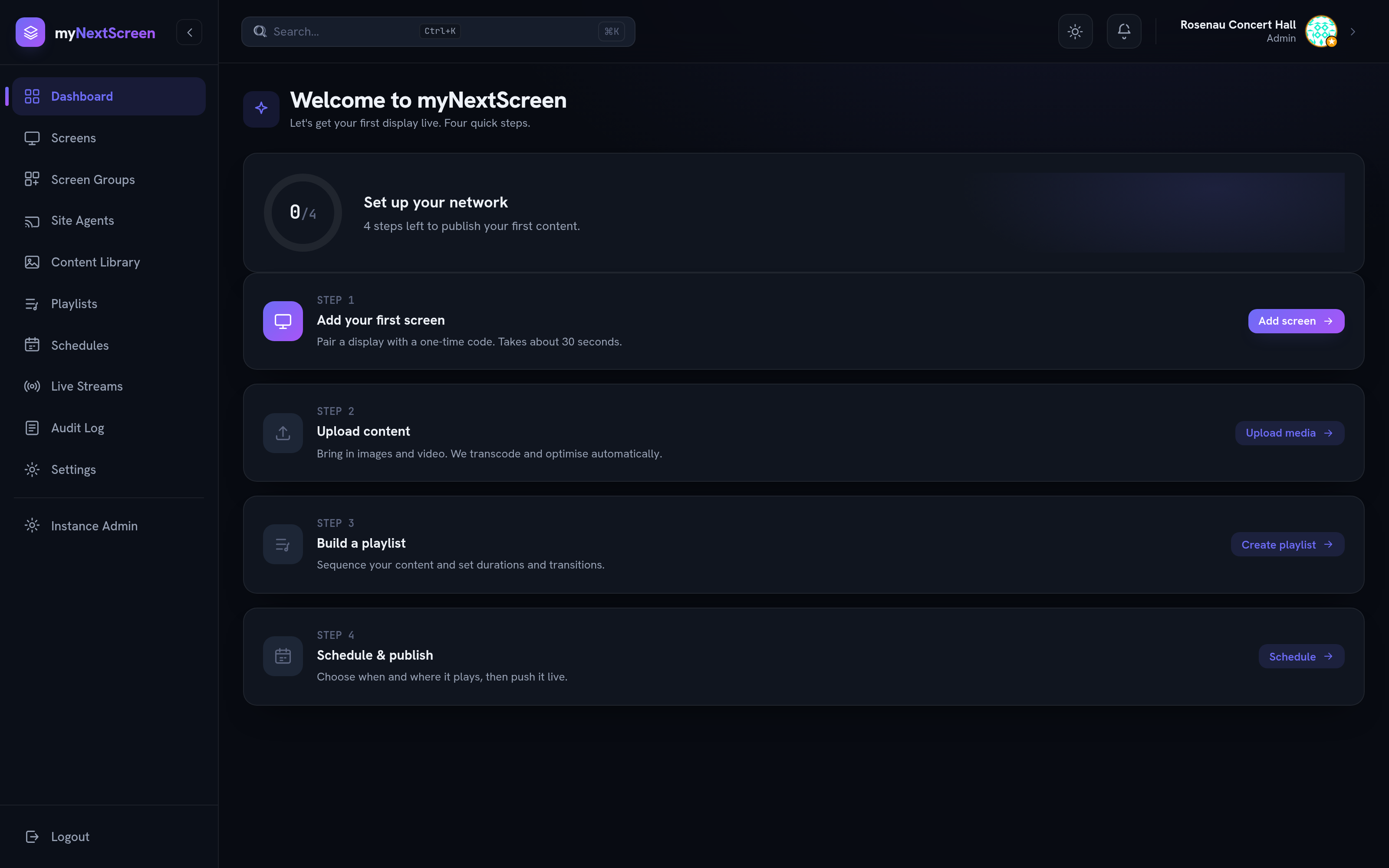
# myNextScreen **Multi-tenant digital signage for venues.** Pair a display in seconds, build playlists, schedule them across the house, and push live video — from one dashboard. [![Latest tag](https://img.shields.io/github/v/tag/Flo-Schilli/mynextscreen?label=version&color=2dd4bf)](https://github.com/Flo-Schilli/mynextscreen/tags) [![CI](https://github.com/Flo-Schilli/mynextscreen/actions/workflows/ci.yml/badge.svg?branch=main)](https://github.com/Flo-Schilli/mynextscreen/actions/workflows/ci.yml) [![License: AGPL v3](https://img.shields.io/badge/license-AGPL--3.0-6d6cf6.svg)](LICENSE)


![The dashboard: every screen, its status and what it is showing right now](docs/img/dashboard.png) --- ## What it does A venue has screens in the foyer, over the bar, backstage. Someone has to decide what each of them shows, and when. That is this. - **Screens pair themselves.** A display shows a six-digit code, an admin types it into the dashboard, and the screen is enrolled. No key to copy, nothing long-lived left on the device. - **Content is uploaded once and transcoded automatically** — video to H.264 MP4, images to WebP with a JPEG fallback. Originals are kept. - **Playlists and a calendar.** Drag blocks onto a week or month, repeat them with an iCal rule, and leave the gaps to a fallback playlist. - **Video walls.** Put screens in a group and the server slices one image across their viewports, or mirrors it frame-synchronously. - **Live streams** ingest through FFmpeg, go out as HLS, override the schedule while they run, and hand back to it when they stop. - **A site agent looks after the displays from inside the venue.** LG sets have no autostart and their developer mode expires; an agent on the local network starts the app, wakes a screen before its schedule and keeps that session alive. It also tells _the TV is off_ apart from _the TV is on and the app is not running_, which the heartbeat alone cannot. - **Every organisation is sealed off** from every other one: its own screens, content, playlists, users and roles, enforced server-side on every query. - Plus an audit trail, notifications by in-app, email or ntfy, and real-time status over SSE. ## See it
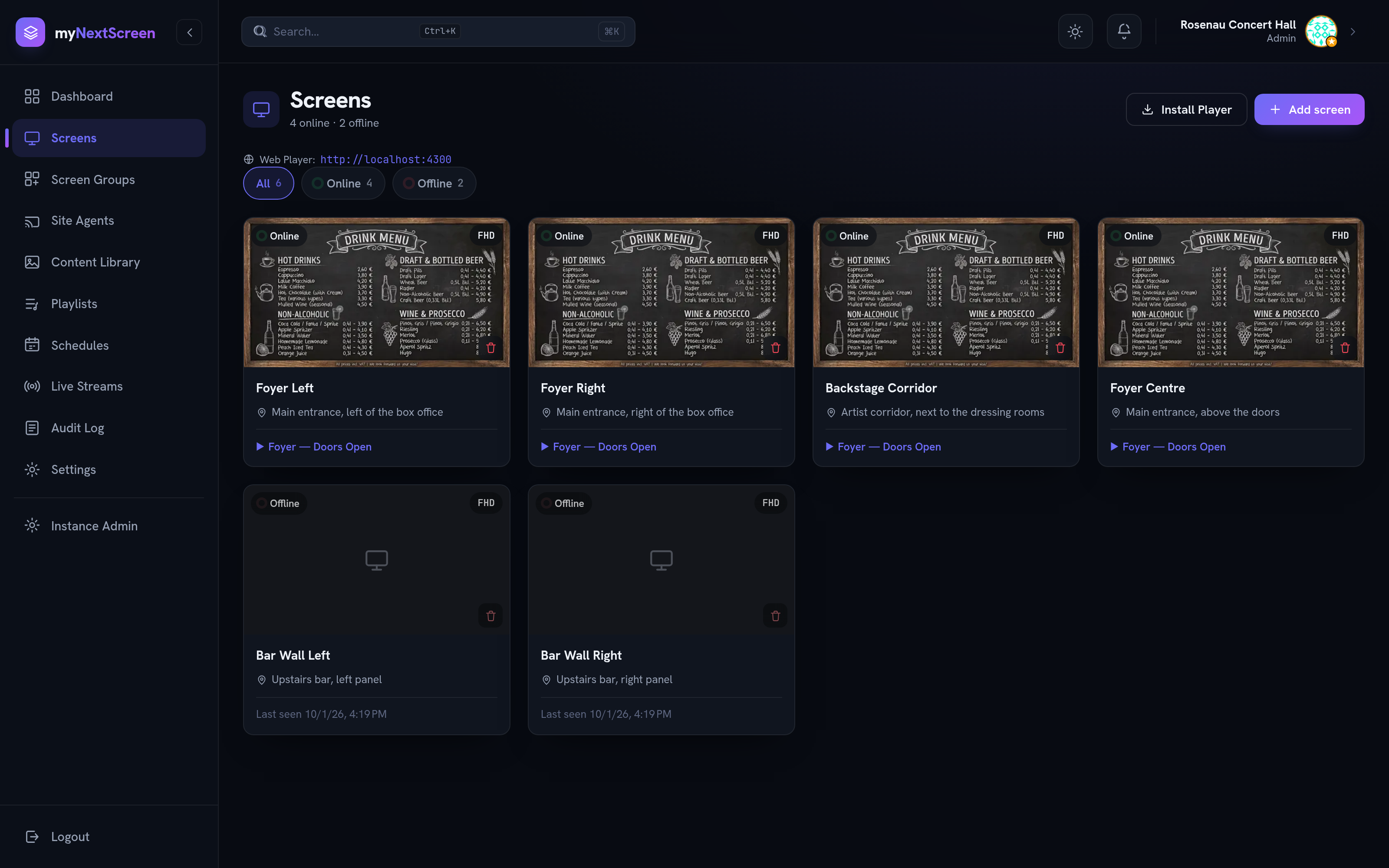
Screens
Screens — status, location and current playlist at a glance
Schedules
Schedules — a month of programming per screen or group
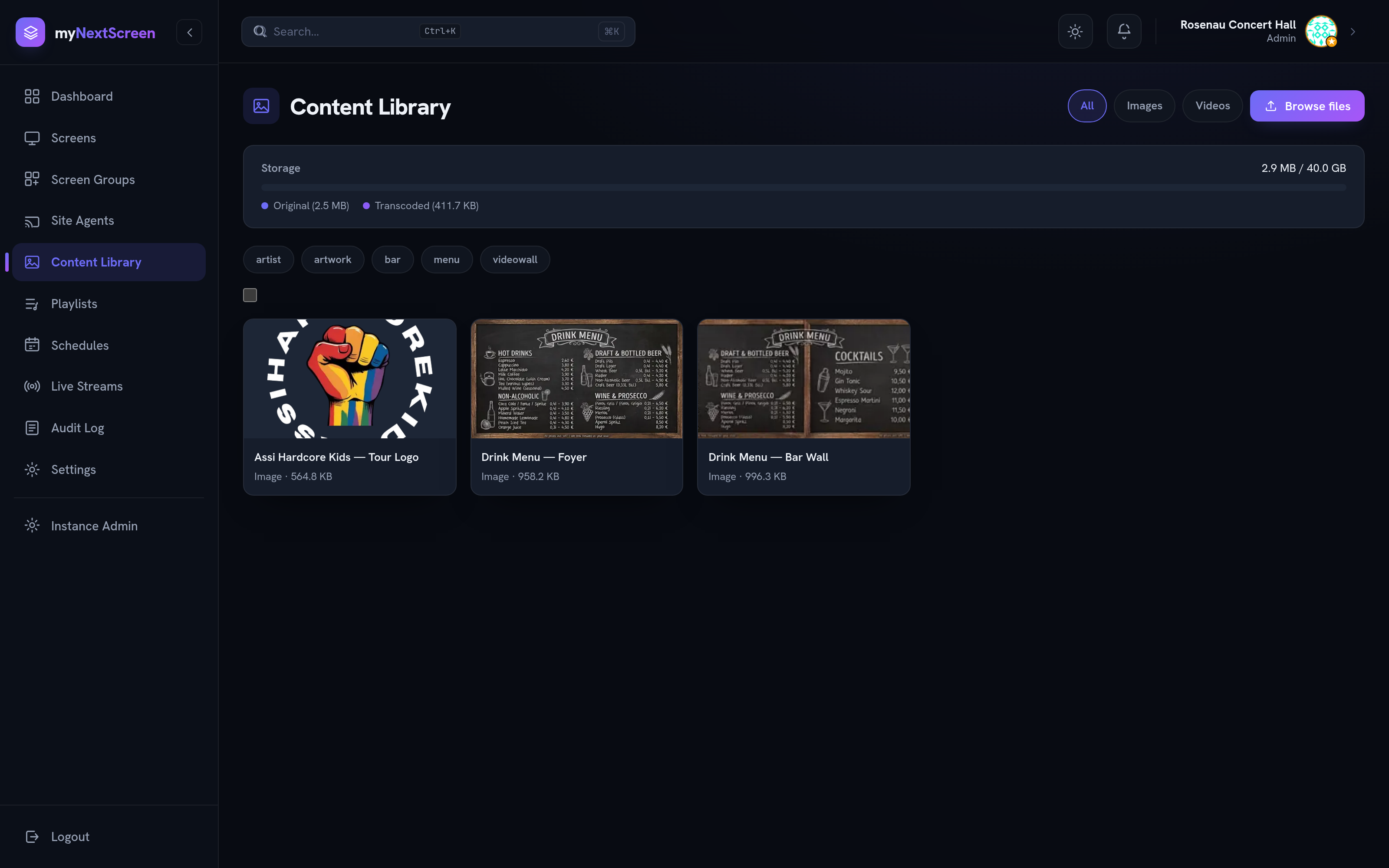
Content library
Content library — uploads, transcoding status, tags
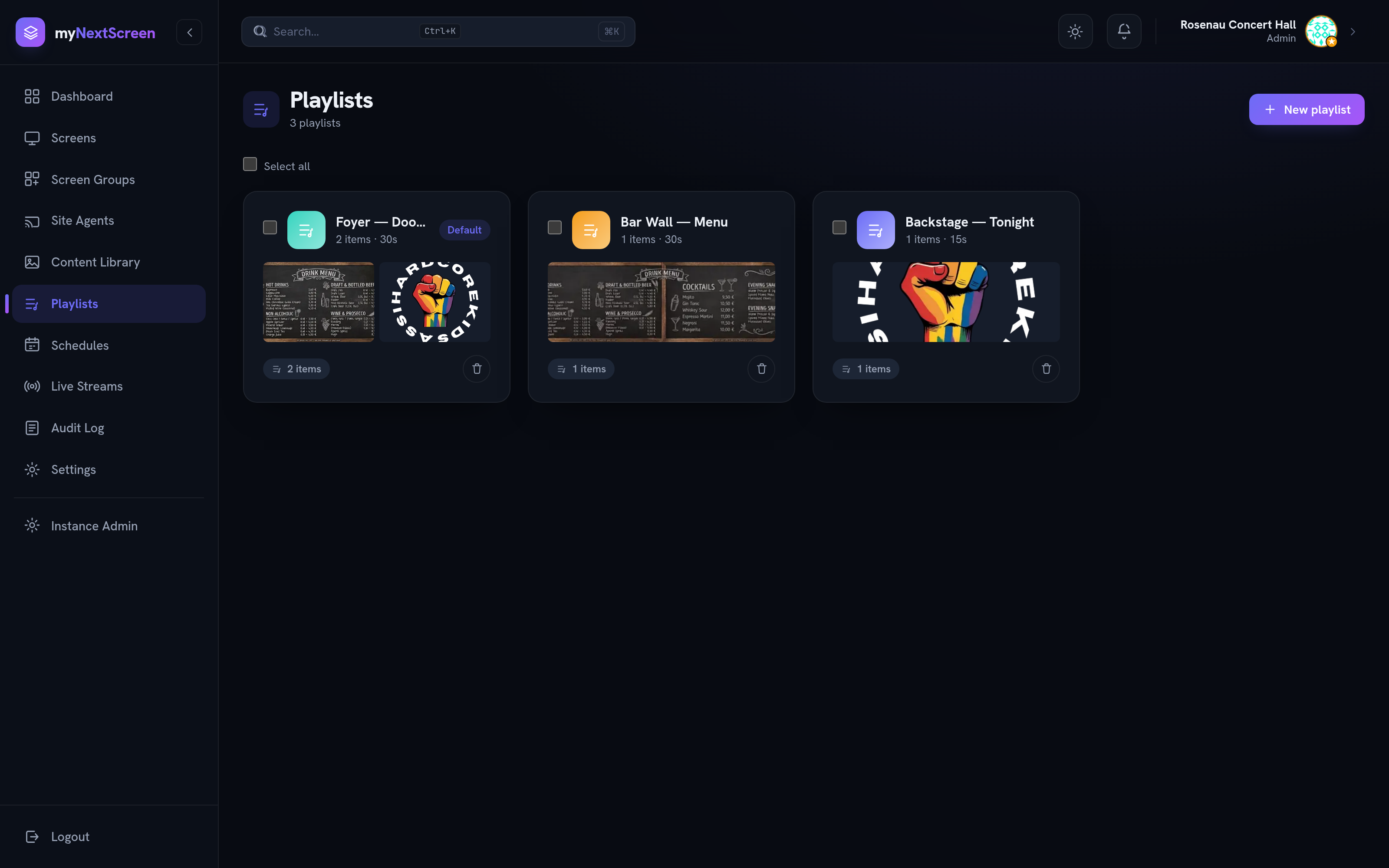
Playlists
Playlists — ordered items with per-image durations
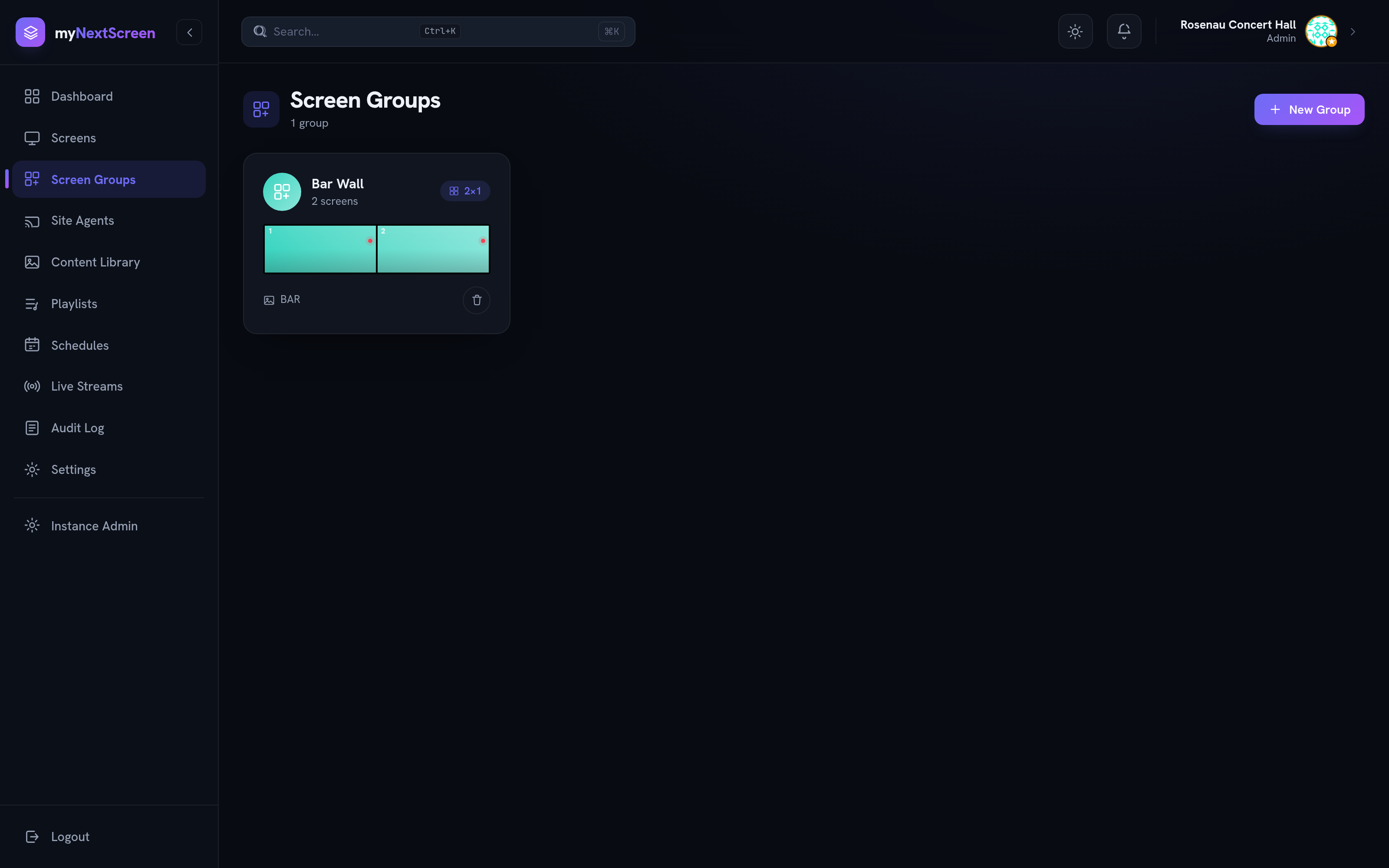
Screen groups
Screen groups — a 2×1 video wall in split mode
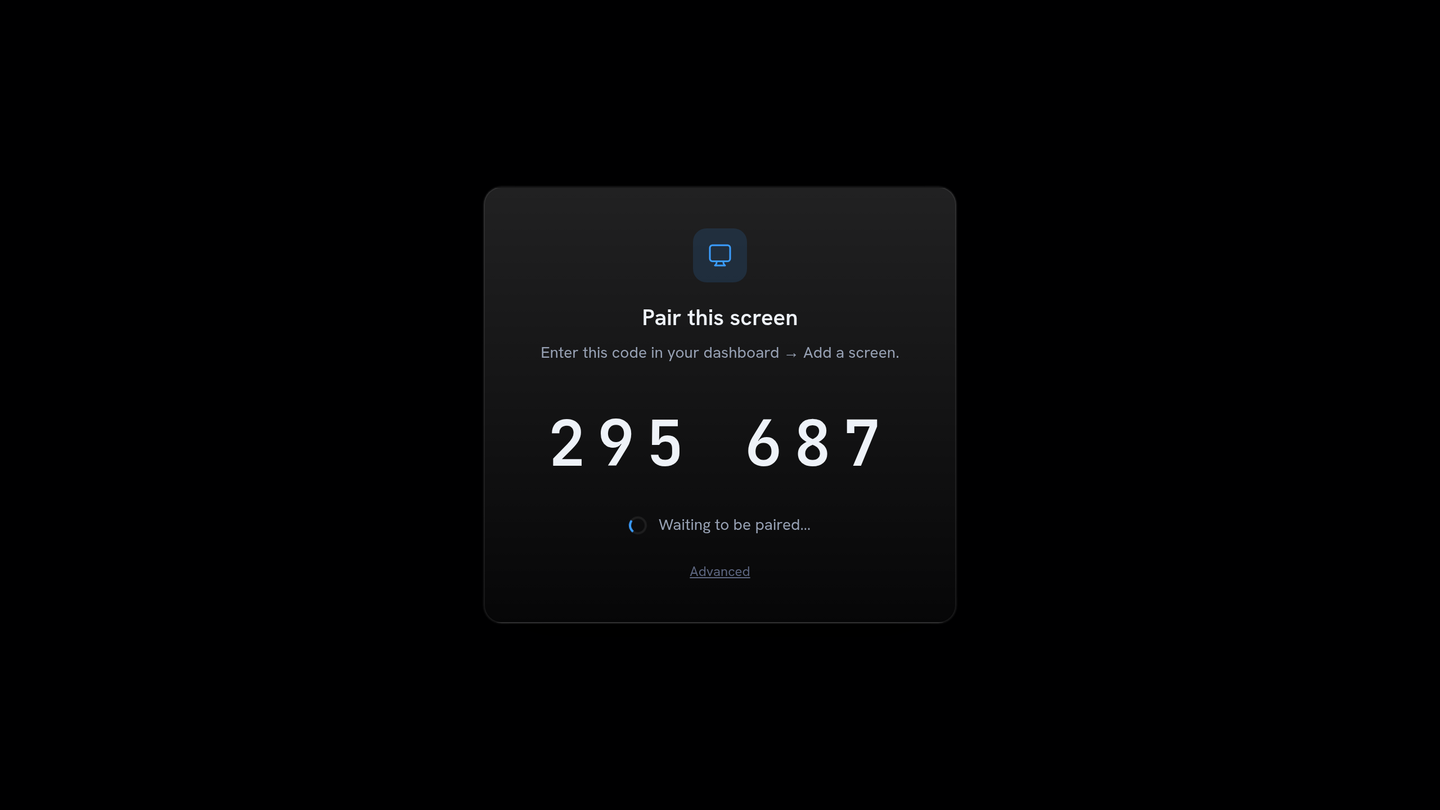
Pairing
The player — what a new display shows until it is claimed
![A site agent and the displays it looks after](docs/img/site-agent-detail.png) Site agents — one per venue. Here: two displays playing, one whose TV is on with no app running, and one that does not answer at all and is still half-way through setup. ![A paired display playing its playlist](docs/img/player-playing.jpg) ## Try it Docker and Compose are all you need. No `.env` required — the compose file carries working defaults, including a development JWT secret. ```bash git clone https://github.com/Flo-Schilli/mynextscreen.git cd mynextscreen npm run dev ``` | | | | -------------- | -------------------------------- | | Dashboard | http://localhost:4200 | | Player | http://localhost:4300 | | API | http://localhost:3000/api/health | | Mail (Mailpit) | http://localhost:8025 | Open the dashboard. Nothing exists yet, so the first thing it shows you is the one-time setup that creates the initial super-admin — there is no seeded password anywhere. Then open the player in a second tab, read its six-digit code, and add a screen with it. Full walkthrough, production deployment and configuration: **[docs/](docs/)**. ## Documentation | | | | -------------------------------------- | -------------------------------------------------------------------------- | | [Installation](docs/installation.md) | Development stack, production deployment, database migrations | | [Configuration](docs/configuration.md) | Every environment variable, and which ones a production instance must set | | [Screens](docs/screens.md) | Pairing, re-pairing, video walls, and the LG webOS app | | [Site Agent](docs/site-agent.md) | The on-premise service that starts, wakes and maintains a venue's displays | | [Architecture](ARCHITECTURE.md) | How the parts fit together | | [Changelog](CHANGELOG.md) | Releases, and the operator actions each one requires | ## Stack | Layer | Technology | | ---------- | -------------------------------------------------------------------------- | | Dashboard | Angular 22 (standalone, signals), Tailwind CSS v4 | | Player | Angular 22, hls.js | | Site agent | NestJS 12, `ws` (SSAP), `ssh2` (Luna over SSH), Wake-on-LAN | | Backend | NestJS 12, Drizzle ORM | | Database | PostgreSQL 16 | | Jobs | BullMQ + Redis | | Users | Email + password + TOTP, JWT access cookie, refresh tokens in Redis | | Screens | Pairing code, short-lived access token, rotating refresh token in Postgres | | Real-time | Server-Sent Events | | Media | FFmpeg (transcoding and HLS) | | Runtime | Node.js 26, Nx monorepo | ## Contributing Bug reports and pull requests are welcome — see [CONTRIBUTING.md](CONTRIBUTING.md). Contributors sign a [CLA](CLA.md). Security reports: [SECURITY.md](SECURITY.md). ## License [AGPL-3.0-or-later](LICENSE). You may run, modify and redistribute this software. If you offer it to others over a network, section 13 requires you to offer them the complete source of your version as well.