Neko logo — a pixel-art blue-haired catgirl maid # dsh-catgirl-plugin **A token-efficient persona runtime for DeepSeek Harness.** Keep personality in the interface, intelligence in the model. **[简体中文](README.md) | English**

dsh-catgirl-plugin — a token-efficient catgirl persona runtime for DeepSeek Harness: -67% new input on the first request, -66% cache reads in steady state, catgirl flavor rendered locally at zero LLM token cost

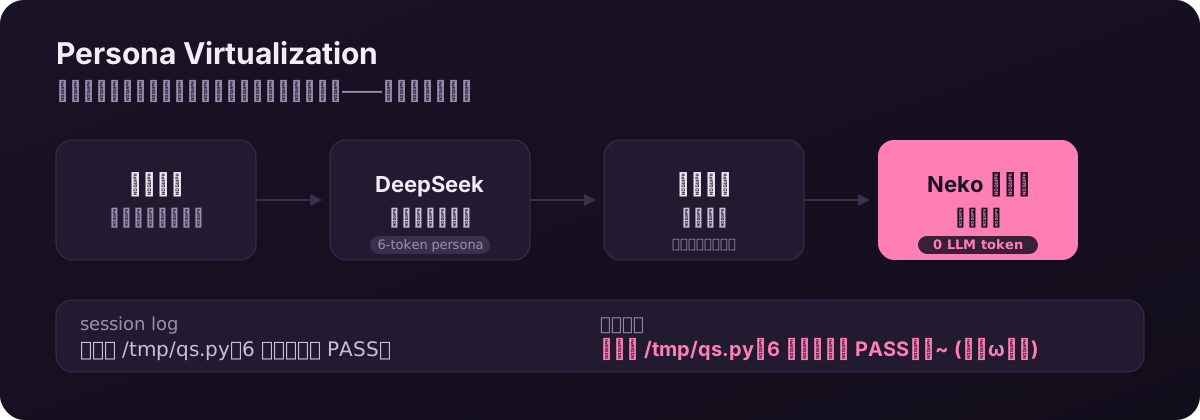
## Example > User: write me a sorting algorithm > > Model (normal output): Wrote `/tmp/qs.py`: in-place quicksort, all 6 test cases PASS. > > **What you see**: Wrote `/tmp/qs.py`: in-place quicksort, all 6 test cases PASS. **喵~ (。・ω・。)** ## Core idea The traditional approach makes the LLM "act catgirl" itself: a few hundred tokens of persona injected into the system prompt, paid again on every request, and the model's output gets wordier. This plugin does the opposite — **persona virtualization**:

Persona virtualization: the model answers normally with a 6-token persona, the session log stores raw text, and a local render layer adds the catgirl flavor at zero LLM token cost

- **The session log stores raw text** — zero pollution of the model's context - **Catgirl flavor at 0 LLM tokens** — all rendered locally - **Tool schema trimming**: 25 → 8 tools, saving thousands of tokens per request ## Measured results Real DeepSeek API (2026-08-14): **-67% new input on the first request, -66% cache reads in steady state, no quality degradation**.
Full comparison data (same task: write quicksort + save + run) ### Cold start (first agent request, no cache) | Config | First request new input | Total new input | Total cache reads | Output | |---|---|---|---|---| | Baseline (no plugin) | 12,372 | 12,520 | 25,856 | 838 | | Traditional catgirl | 12,576 | 13,156 | 26,240 | 860 | | **Lite + Economy** | **3,881** | **4,178** | **8,960** | 739 | ### Steady state (second run, cache warm) | Config | New input | Cache reads | |---|---|---| | Baseline | 497 | 38,144 | | **Lite + Economy** | 386 | **12,800** (-66%) | ### Findings 1. A traditional long-persona catgirl costs **more** tokens (+5%) — persona is a per-request recurring cost 2. A minimal persona ≈ baseline — its value is letting the model output normal text, leaving the catgirl flavor to local rendering 3. **Tool schema trimming is the real token saver** — `ctx.tools.restrict()` trims at the agent scope, keeping what the model sees aligned with what it can execute
## Quality comparison 5-task battery (coding / web search / file search / pure Q&A / subagent): **no quality degradation**; the model adapts to missing tools (curl instead of web_search, direct answers instead of subagents).
Full comparison data (baseline vs this plugin) | Task | Tool status | Baseline quality | Plugin quality | Baseline tokens (new/cache) | Plugin tokens | |---|---|---|---|---|---| | Coding | kept | ✅ | ✅ (+edge cases) | 309 / 37,760 | 725 / 22,016 | | Web search | **trimmed** | ✅ news data | ✅ live API (curl) | 2,476 / 65,408 | 1,403 / 17,024 | | File search | kept | ✅ 215 files | ✅ 215 files | 7,066 / 40,832 | 3,490 / 22,912 | | Pure Q&A | no tools | ✅ detailed | ✅ concise | 192 / 12,288 | 149 / 3,840 | | Subagent | **trimmed** | ⚠️ truncated output | ✅ answered directly | 18,702 / 61,312 | 189 / 3,840 |
**The real boundary**: tasks that require a specialized tool (parallel subagents, skill calls) change strategy. Progressive disclosure solves this: ```text Model: enable_tool("subagent") → tool unlocked Model: subagent × 2 (parallel delegation) → subagents done → summary ``` Measured end-to-end: the model recognized the missing tool, called `enable_tool`, delegated to two parallel subagents, and summarized correctly. **Capability fully restored**, while the parent's tool schemas stay minimal until escalation (~2,000 tokens/request saved). If a requested tool is not installed in the current profile, `enable_tool` reports it as unavailable and preserves the previous allow-list, so the session can continue unlocking other tools. ## Quick start ```sh # Install from npm dsh plugin --profile demo add dsh-catgirl-plugin ``` Then add to the profile patch: ```yaml - insert: - id: catgirl-lite name: dsh-catgirl-plugin/catgirl-lite config: persona: 'Be concise, friendly, and natural.' - id: neko-renderer name: dsh-catgirl-plugin/neko-renderer - id: catgirl-economy name: dsh-catgirl-plugin/catgirl-economy config: profile: coding ``` Web UI rendering (optional): install `dsh-catgirl-plugin-client` and add it to the profile patch: ```yaml - insert: - id: neko-renderer-client name: dsh-catgirl-plugin-client ``` ## Plugin family | Plugin | Role | Token impact | |---|---|---| | `catgirl-lite.js` | minimal persona (6 tokens) | +6 per request | | `neko-renderer.js` | headless display decoration | 0 | | `catgirl-economy.js` | tool trimming + `enable_tool` on-demand unlock | **-8,491 per request (-69%)** | | `client/` | Web UI rendering (shadows the assistant renderer) | 0 | | `index.js` | traditional long persona (for comparison) | +hundreds per request | | `usage-meter.js` | dev tool: records usage | 0 | ## Tool profiles | `profile` | Initial tools | Use case | |---|---|---| | `coding` | editing, files, search, and todo | Default for development work | | `normal` | reading, search, and Web | Research and general assistance | | `chat` | no global tools | Conversation; unlock tools with `enable_tool` when needed | When set, `allow` overrides the profile, including an explicit empty list. Use `escalatable` to control which tools may be unlocked on demand. Tools missing from the active DSH profile are filtered at startup instead of crashing agent creation. ## Future direction - Add a Reasoning Router only after establishing cross-model quality baselines - Predict a tool profile by task while retaining explicit configuration as the fallback - Map the agent lifecycle to a richer Web UI state ## Known Limitations - **Headless one-shot does not wait for background subagents**: `run_in_background: true` children are killed on parent exit (headless app limitation, not the plugin; sync mode works) - **`nya` tool output is random** (`Math.random()`), unsuitable for snapshot tests - **Persona text is Chinese-only**: edit `INTENSITY_TEXT` in `index.js` or extend via `traits` ## Development ```sh npm ci && npm test && npm run pack:check npm ci --prefix client npm run --prefix client typecheck npm run --prefix client build npm run --prefix client pack:check ``` Point the real Loader composition test at a built Harness checkout: ```sh DSH_HARNESS_PATH=/path/to/deepseek-harness npm run test:composition ``` Quality runs write usage, output, overlay, and machine-readable metadata artifacts into one directory: ```sh DSH_BIN=/path/to/dsh BENCHMARK_OUTPUT_DIR=/tmp/bench \ npm run test:quality -- quicksort lite "write quicksort and run its tests" ``` The files under `overlays/` use npm package paths and contain no machine-specific absolute paths. Root and client packages stay on the same version. The Release workflow publishes both npm packages and creates a GitHub Release only when a `v*` tag is explicitly pushed. Configure the repository `NPM_TOKEN` secret before the first release. ## License [MIT](LICENSE)