Fuck OpusClip.
... because good video clips shouldn't come with ugly watermarks or platform lock-in.





---
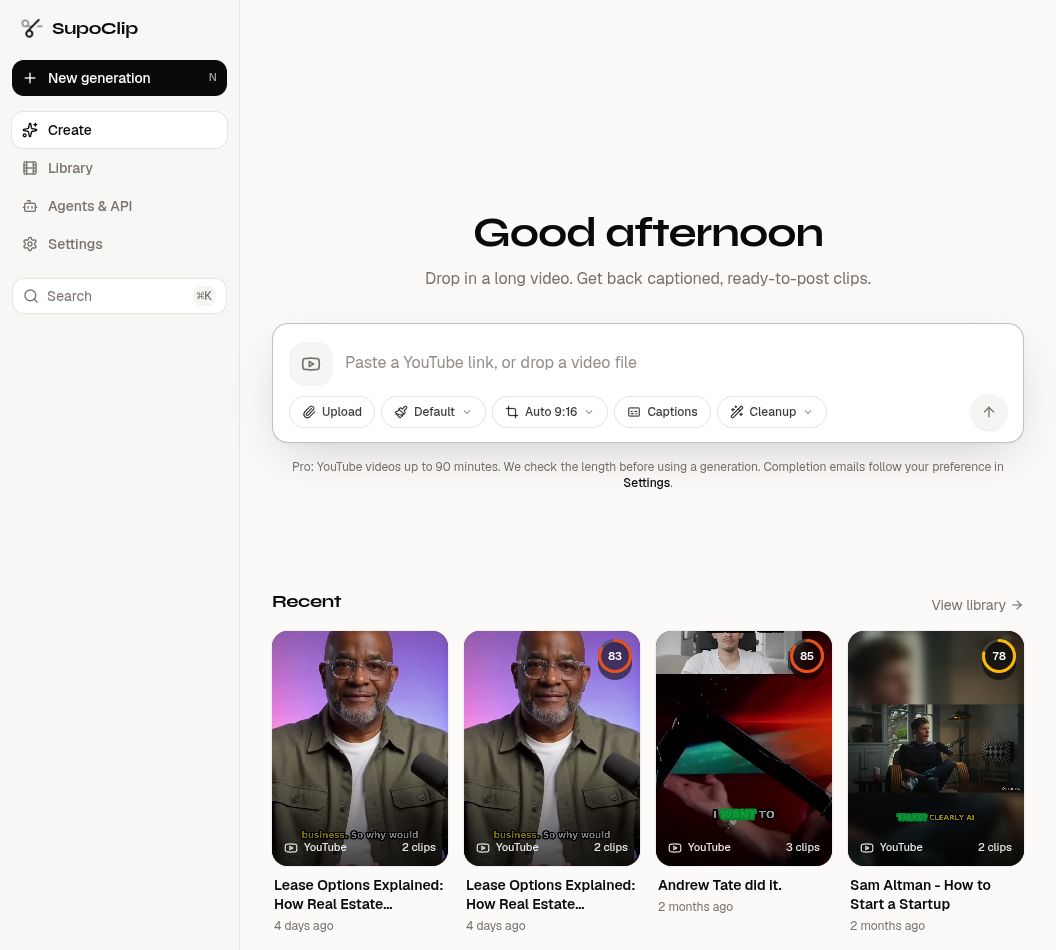
SupoClip is an open-source, AI-powered video clipping tool. Give it a long video — a podcast, a talk, a stream VOD — and it finds the most viral-worthy moments, scores them, and renders them as vertical 9:16 clips with face-centered cropping, word-synced subtitles, hook titles, and optional B-roll. Run it yourself, customize it, inspect it — or use the hosted version and skip the setup.
**See it first:** [watch real clips SupoClip generated](https://www.supoclip.com/demo) from a long-form interview, or follow the [self-hosting tutorial](https://www.supoclip.com/blog/self-host-supoclip-docker) to run it on your own machine.
## Ways to Use SupoClip
| Option | Details |
|---|---|
| **Hosted web app** | [www.supoclip.com](https://www.supoclip.com) — no infrastructure to run |
| **iOS app** | [SupoClip on the App Store](https://apps.apple.com/us/app/supoclip/id6784760040) — the same hosted pipeline, from your iPhone |
| **Self-host** | Docker Compose setup below, or the step-by-step [self-hosting tutorial](https://www.supoclip.com/blog/self-host-supoclip-docker) — AGPL-3.0, unlimited usage on your own hardware |
| **MCP server** | [`mcp/`](mcp/) — use SupoClip from Claude, Cursor, and other MCP clients |
| **REST API** | API keys from `/settings/api-keys` authenticate the backend directly — see the [API reference](docs/api-reference.md) |
## Why SupoClip Exists
OpusClip is genuinely good at what it does — AI clip selection, accurate captions, virality scoring. But your usage is metered by plan, some exports carry platform branding, and your content and workflows live on their servers under their terms.
SupoClip gives you the same core pipeline without the leash:
- **Self-hostable** — run it on your own hardware, process as much as it can handle
- **No watermarks** — your content stays yours
- **Open source** — AGPL-3.0, full transparency, fork and extend it however you like
- **Hosted option** — when you'd rather not manage servers, the cloud version is there
## Features
- **AI clip selection** — an LLM (Gemini, GPT, Claude, or a local Ollama model) picks the 3–7 most clip-worthy segments from the transcript
- **Virality scoring** — every clip gets hook, engagement, value, and shareability scores
- **Smart vertical cropping** — face detection keeps the speaker centered in the 9:16 frame
- **Word-synced subtitles** — AssemblyAI word-level timestamps, custom fonts, caption templates with animation styles
- **Hook titles** — an AI-written headline burned into the top of each clip's opening seconds
- **B-roll & transitions** — optional Pexels stock footage overlays and transition effects
- **Built-in editor** — trim, split, and merge clips, then export with platform presets (TikTok, Reels, Shorts)
- **Real-time progress** — live pipeline updates streamed to the browser while your video processes
## Quick Start
You need Docker, an [AssemblyAI](https://www.assemblyai.com/) API key for transcription, and one LLM provider key (Google, OpenAI, Anthropic, or a local Ollama).
```bash
git clone https://github.com/FujiwaraChoki/supoclip.git
cd supoclip
```
Create a `.env` in the root with your keys:
```env
ASSEMBLY_AI_API_KEY=your_assemblyai_api_key
LLM=google-gla:gemini-3-flash-preview
GOOGLE_API_KEY=your_google_api_key
```
Then start everything:
```bash
docker-compose up -d
```
First startup takes a few minutes; watch it with `docker-compose logs -f`. Once healthy, open [http://localhost:3107](http://localhost:3107), create an account, and start clipping. The backend API lives at [http://localhost:8000](http://localhost:8000) with interactive docs at `/docs`.
The template sets `FRONTEND_PORT=3107`. Existing deployments without this setting keep port `3001`; preserve that port if your production reverse proxy uses it. See the [setup guide](docs/setup.md) for custom ports and public URLs.
To run fully local with Whisper and Ollama (including the Docker networking Ollama needs), see the [self-hosting tutorial](https://www.supoclip.com/blog/self-host-supoclip-docker#local). To use a different LLM provider or configure the optional pieces (B-roll, analytics, emails, YouTube metadata), see the [configuration guide](docs/configuration.md). If something misbehaves, the [troubleshooting guide](docs/troubleshooting.md) covers the common failure modes.
## Documentation
Everything beyond this page lives in [`docs/`](docs/README.md):
| Guide | What it covers |
|---|---|
| [Setup](docs/setup.md) | Docker-first install, local development, first-run checklist |
| [Configuration](docs/configuration.md) | Every environment variable, operating modes, provider options |
| [App Guide](docs/app-guide.md) | Screens, workflows, admin features, hosted vs self-host |
| [Architecture](docs/architecture.md) | How the frontend, API, worker, queue, and pipeline fit together |
| [API Reference](docs/api-reference.md) | Backend endpoints, API keys, admin and billing routes |
| [Development](docs/development.md) | Running locally without Docker, testing, contributing workflow |
| [Troubleshooting](docs/troubleshooting.md) | Fixes for the common ways things go wrong |
## Development & Testing
The stack runs locally without Docker too — see [development](docs/development.md) for the backend (`uv` + FastAPI + ARQ worker) and frontend (Next.js + pnpm) commands. The test suite spans pytest, Vitest, and Playwright, all reachable from the repo root:
```bash
make test
```
## License
SupoClip is released under the [AGPL-3.0 License](LICENSE).
Contributions are accepted under the terms in [CONTRIBUTING.md](CONTRIBUTING.md), including a license grant that allows the project owner to sublicense and relicense contributed code.