## Letter from the Project Leads
Stop trying to build a model that cannot be fooled. Build the system around it, so that when the model is fooled, and it will be, nothing important breaks. That posture runs through all ten entries here. This year, for the first time, we can show you the evidence instead of asking you to take it on faith.
Every version of this list before now was built on judgment. Hundreds of practitioners weighed in on what matters most. That vote is still the spine of the list, and it belongs there. This year, we did something the project has never done. We tested the vote against a record of what has actually gone wrong. We pulled together a corpus of 7,714 real incidents from public vulnerability databases and an AI-harm database, and we built classifiers that read them and placed the 6,639 that carried enough detail to sort. Then we asked one blunt question. Does what practitioners fear match what the incident record shows?
The answer was no, not always, and that was the surprise. The vote and the data parted ways in specific, useful places, and those disagreements taught us more than the agreements did.
Prompt injection is the clearest case. Practitioners rank it the number one risk. Rank the categories by the raw incident record instead, and it falls out of the top 10 entirely. That gap is a defense effect. Teams fight injection hard, so fewer clean exploits reach a public database, and the public count understates the risk that mature teams already spend real money holding off. The surface still sits everywhere a model reads untrusted input, which is to say everywhere. It stays at number one. Since you cannot close that surface, you build for the day it is used against you.
Misinformation runs the other direction, and it is the entry I want you to slow down on. Voters placed it near the bottom. The incident record placed it near the top, the widest gap in the direction that actually hurts, where the vote sits low and the evidence sits high. The list still seats Misinformation in the middle: the vote holds the greater weight, but the evidence pulled it up. The disagreement is the point. When a model's fluent, confident output drives a decision or a tool call, a wrong answer turns into a wrong action, and the record says that failure lands more often than the vote assumes.
The community vote carries three-quarters of the weight. The incident data covers the remaining quarter. We deliberately weighed the vote heavily. This list is a consensus product, and one noisy year of data does not get to overturn the judgment of the people doing the work. A quarter weight is enough to move an entry a tier when the gap between belief and evidence runs wide. It is not enough to let imperfect data rewrite the list on its own. That balance decided every final slot in the Top 10.
### What's New in the 2026 Top 10
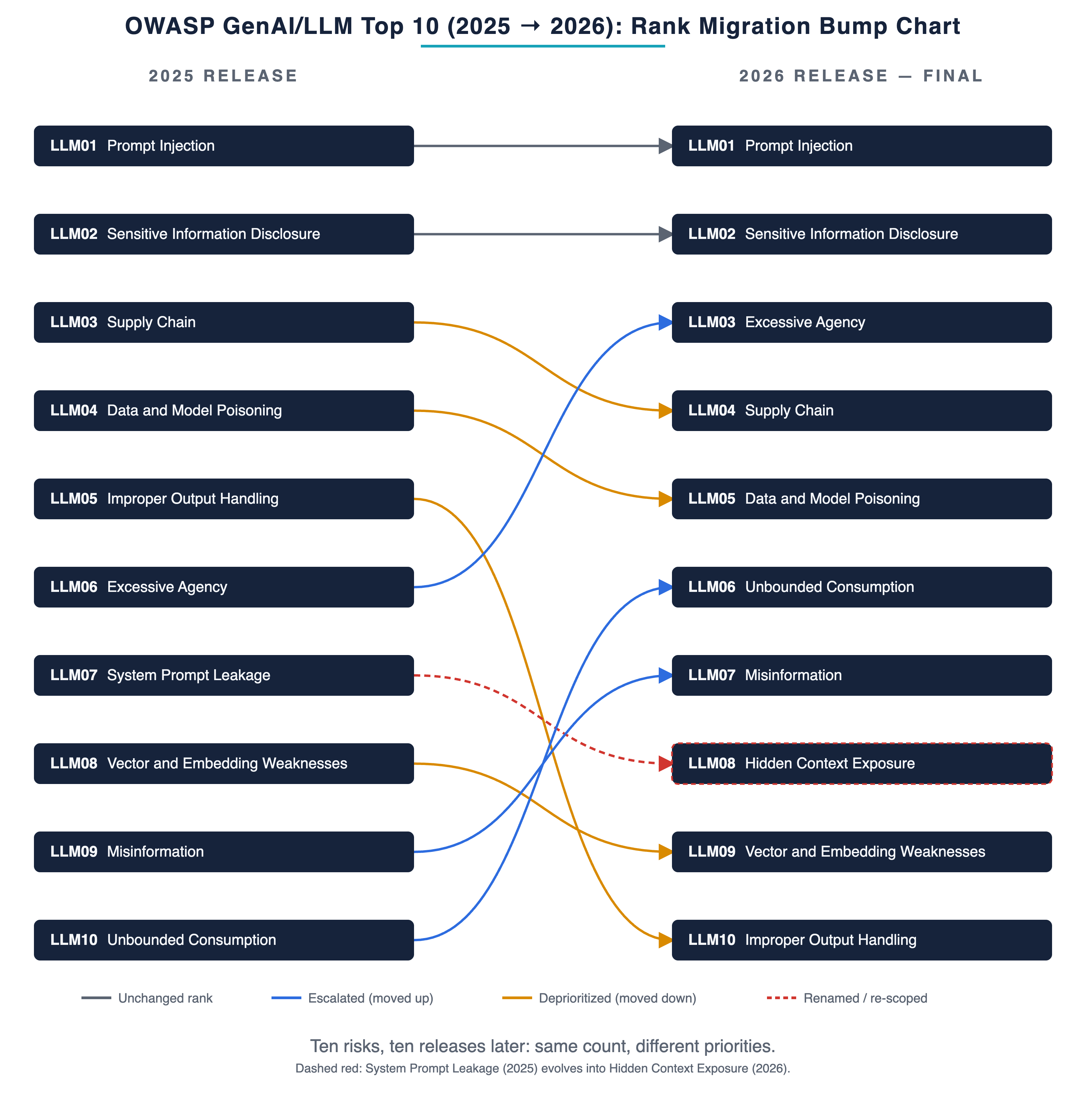
*Figure 1: Rank migration from the 2025 to the final 2026 OWASP GenAI/LLM Top 10, color-coded by movement (steady, escalated, deprioritized, or renamed/re-scoped).*
The order moved more than in past years, and the moves track that gap between belief and evidence. Excessive Agency climbed to third, the most consequential move on the list, because the vote and the record agree that agentic deployments are where the damage is landing. Unbounded Consumption rose four places, carried by practitioners who weigh resource and cost exhaustion higher than in its old rank. Improper Output Handling fell the furthest, from fifth to tenth. Prompt Injection held the top spot on the strength of the vote and the defense effect behind it. Sensitive Information Disclosure held second, the one place at the top where belief and evidence simply agree, and where our confidence is highest. What used to be System Prompt Leakage is now Hidden Context Exposure, a broader framework for the same failure to trust information that should have stayed out of reach.
Several entries also grew. We folded newer, sharper risks into the entries that already own them. Standing up thin new categories would have splintered the list for no gain. Prompt Injection now covers cross-modal attacks, the kind that hide instructions inside an image or an audio track. Supply Chain now accounts for the trust failure when a promoted model artifact is not what it claims to be. Data and Model Poisoning now absorbs fine-tuning subversion. Improper Output Handling now spans the insecure code that assistants generate at scale. The incidents behind those risks were always real. Now they count where they belong.
One boundary matters more every year. This list owns the risk when the model is a component inside your application. The moment that model becomes an actor, with tools it can call, memory it carries between sessions, and consequences it sets in motion downstream, the risk moves to the OWASP Agentic Top 10. Many of the incidents we read sit right on that boundary. Read an entry here for the model-as-component failure. When your model starts acting on its own, pair it with the Agentic list, because neither one covers that ground alone.
### Moving Forward
You can trust this list and act on it today. It brings together the judgment of the practitioners who attack and defend these systems along with the record of what has actually gone wrong in the field, each checked against the other. That grounding is what earlier versions could only promise. Work all ten, start at the top, and build each of them for the day the model is turned against you. Do that, and you are covering both what the field fears most and what it has already been burned by.
Like the technology it covers, this list is a product of the community. It has been shaped by developers, data scientists, and security practitioners who brought their judgment and, this year, their incident records to the work. We are grateful to everyone who contributed, argued, and pushed us to check our beliefs against the evidence. We hope it helps you defend what you are building.
#### Steve Wilson
Project Lead, OWASP Top 10 for LLM Applications
LinkedIn:
#### Rock Lambros
Co-Lead, OWASP Top 10 for LLM Applications
LinkedIn: