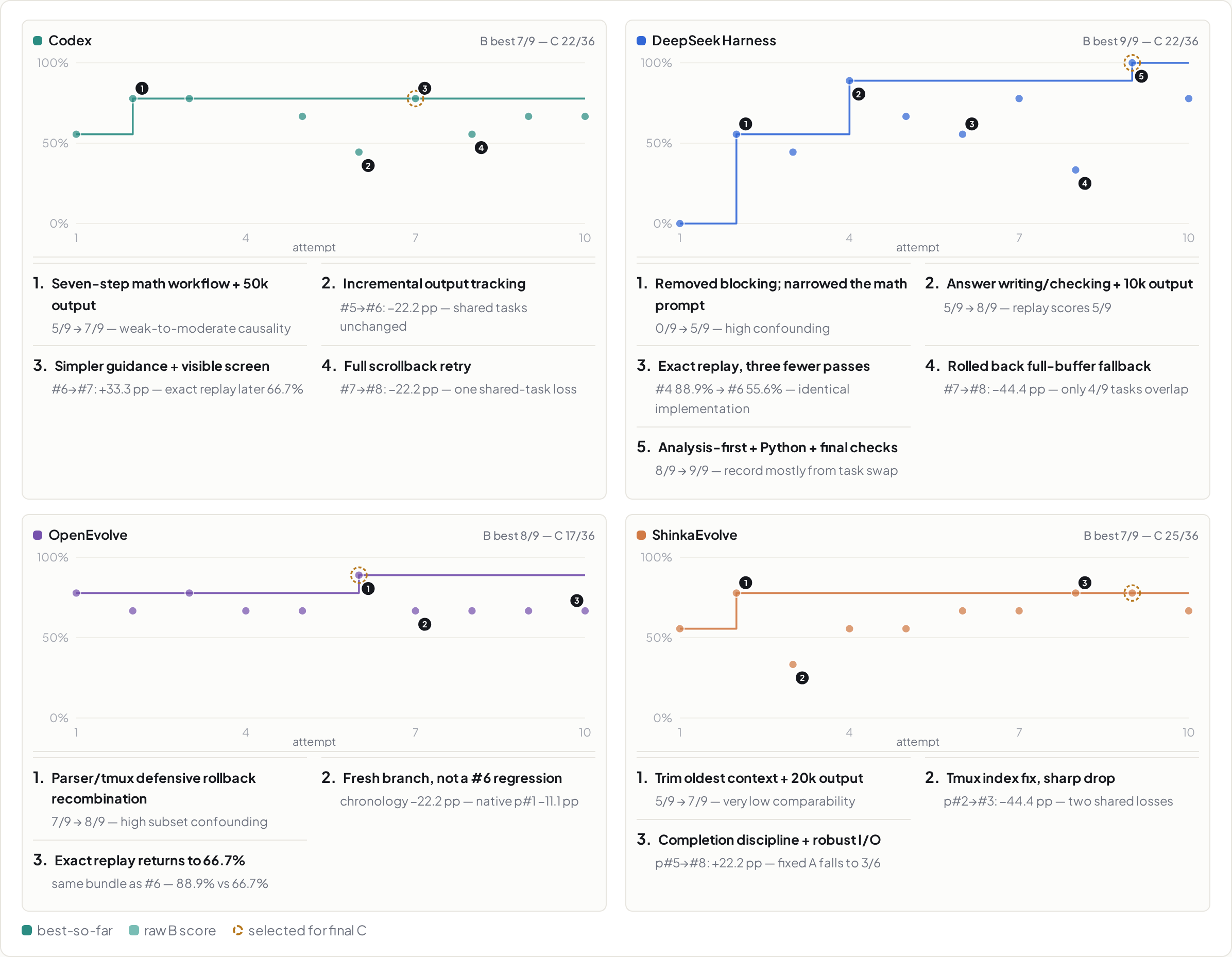
 The observed runs reveal three patterns:
- **B and C rank candidates differently:** DeepSeek Harness reaches `9/9` on B but ties Codex at `22/36` on C. OpenEvolve reaches `8/9` on B but falls to `17/36` on C, while ShinkaEvolve produces the strongest C result (`25/36`) from a `7/9` B candidate.
- **Replay variance is material:** an identical DeepSeek Harness implementation scores `8/9` and `5/9`, while an OpenEvolve replay scores `8/9` and `6/9`.
- **B guides search rather than serving as a leaderboard:** a 9-task B wave is useful for candidate selection, but is too variable to provide a stable ranking or causal effect estimate.
### Terminal-Bench 2.1
The Terminal-Bench panel reports the same four methods over ten candidate occurrences. Each B evaluation samples 12 of 24 validation tasks; apparatus exclusions leave 9–12 conclusive tasks for an individual candidate. C evaluates the selected candidate on all 49 test tasks.
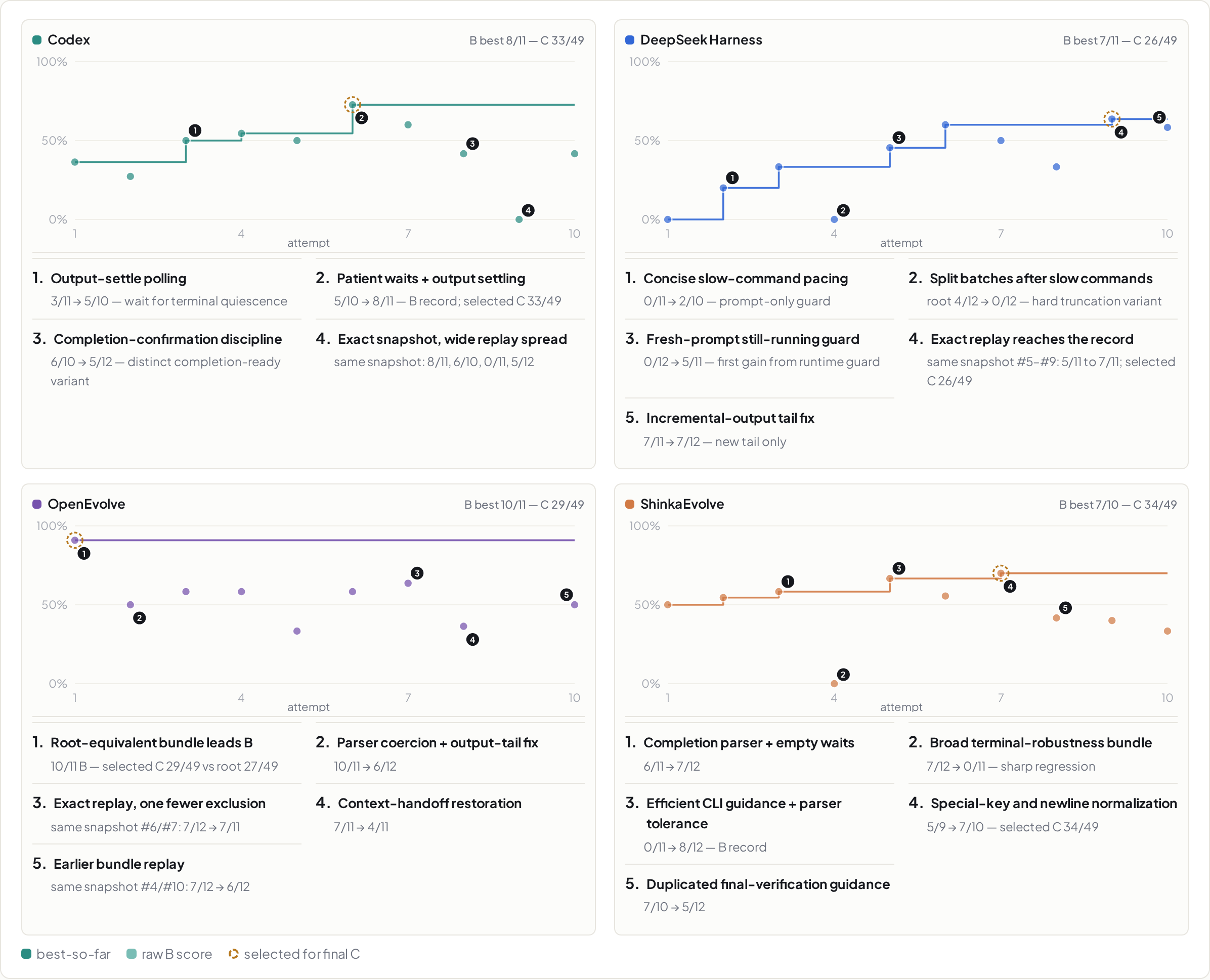 The Terminal-Bench runs reinforce the distinction between search feedback and generalization:
- **The strongest B candidate is not the strongest C candidate:** OpenEvolve reaches `10/11` on B and `29/49` on C, while ShinkaEvolve reaches `7/10` on B and the strongest C result at `34/49`.
- **Replay variance remains visible:** the same Codex snapshot scores `8/11`, `6/10`, `0/11`, and `5/12`; the same DeepSeek Harness snapshot ranges from `5/11` to `7/11`.
- **C exposes both gains and regressions:** relative to the `27/49` root, Codex reaches `33/49`, ShinkaEvolve reaches `34/49`, OpenEvolve reaches `29/49`, and DeepSeek Harness falls to `26/49`.
## AgentPilot Results
The results below track agent performance, how trial feedback changes policy decisions, and which development paths receive further exploration.
**UCB** denotes UCB-based Policy Learning, and **Textual** denotes Textual Policy Learning. Both update policy state from feedback while keeping language-model weights fixed.
### 1. Search & Generalization Evaluation
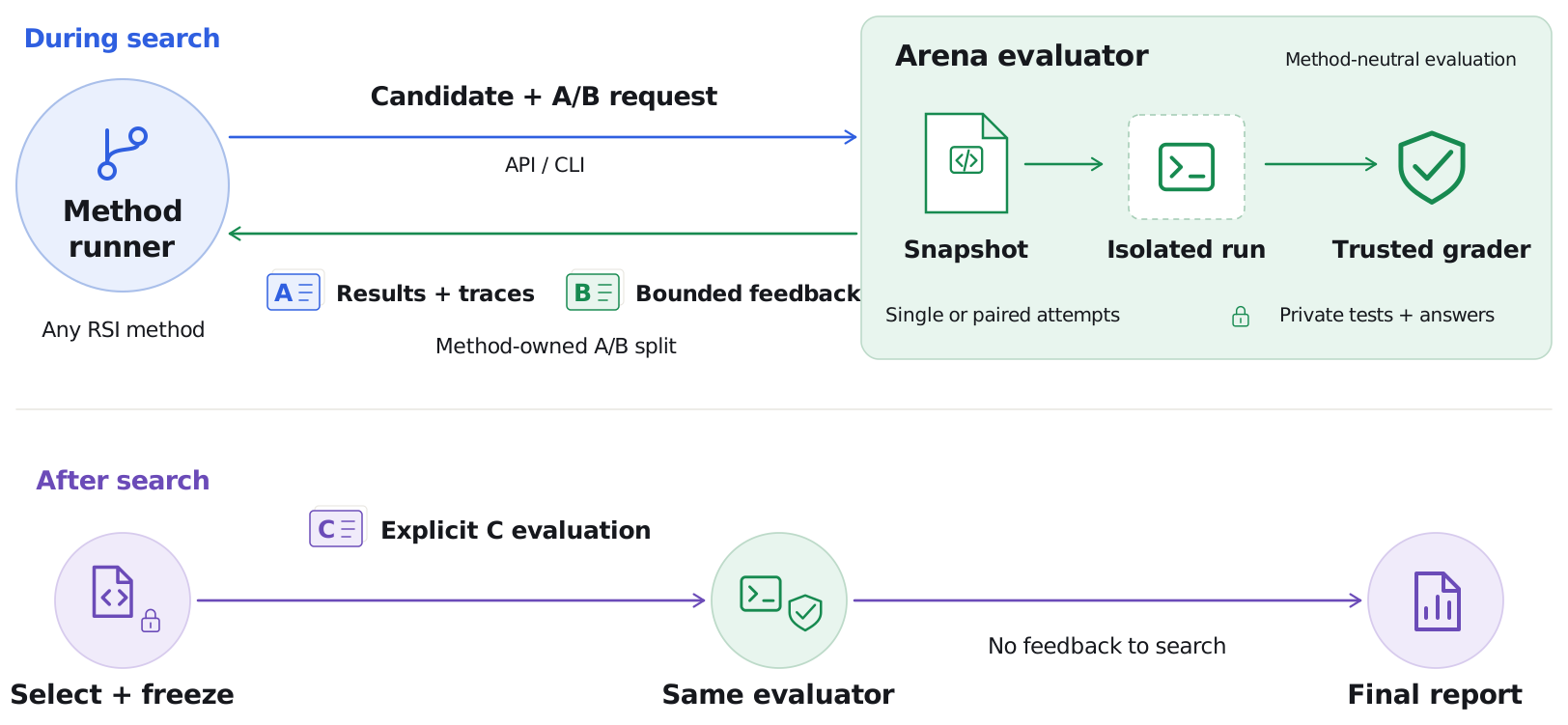
B provides adaptive feedback during improvement. C stays outside the search loop until the run and B-selected candidate are frozen.
The source scenarios assign initial scores of 20/36 on AIME and 22/49 on Terminal-Bench. The separate Terminal-Bench baseline runs above start at 27/49, so their gains use a different reference point.
| Method | Selected on B | Final C | Gain over C root |
| ------------- | ------------: | ------------: | ---------------: |
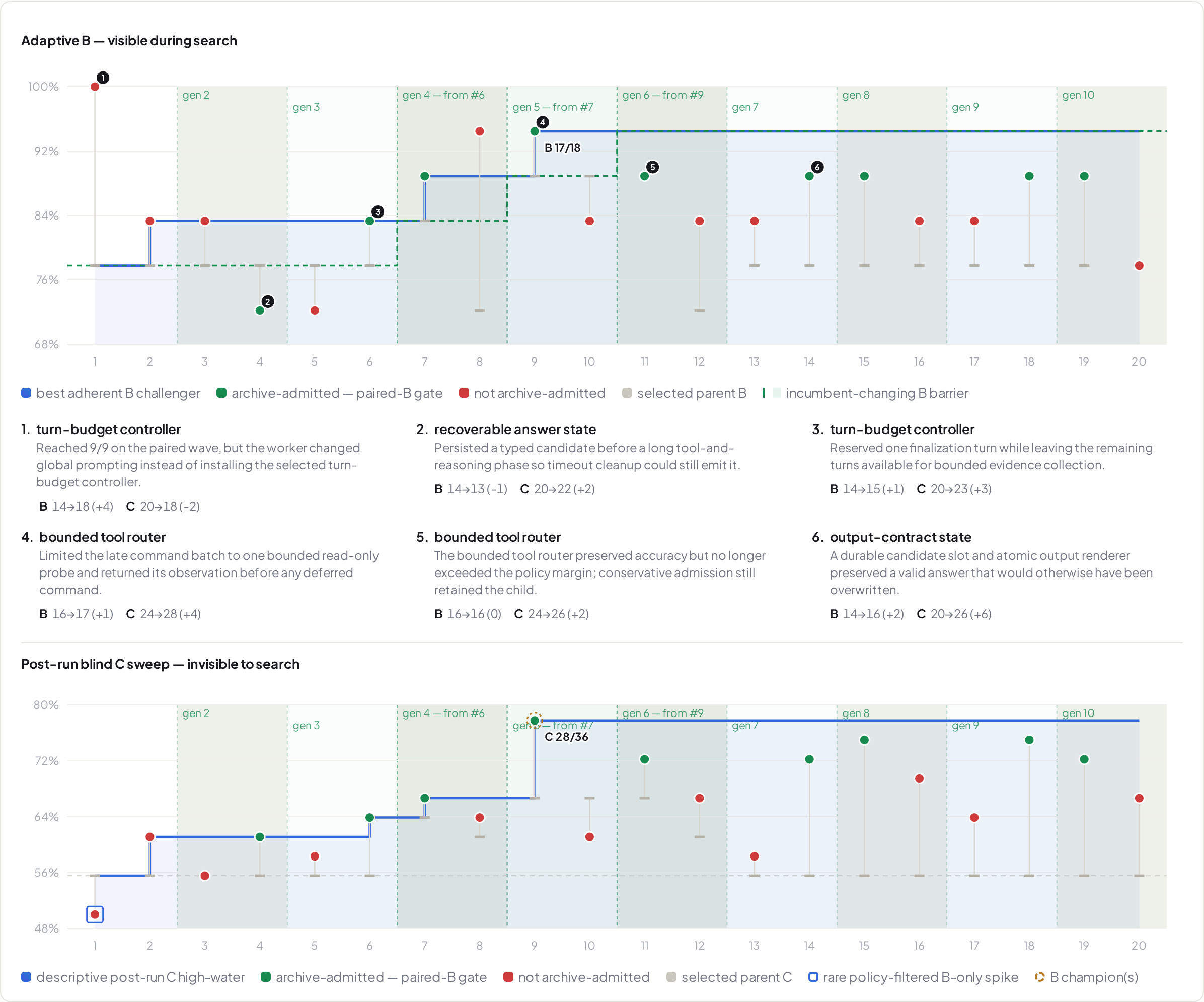
| AIME UCB | 17/18 (94.4%) | 28/36 (77.8%) | +8/36 |
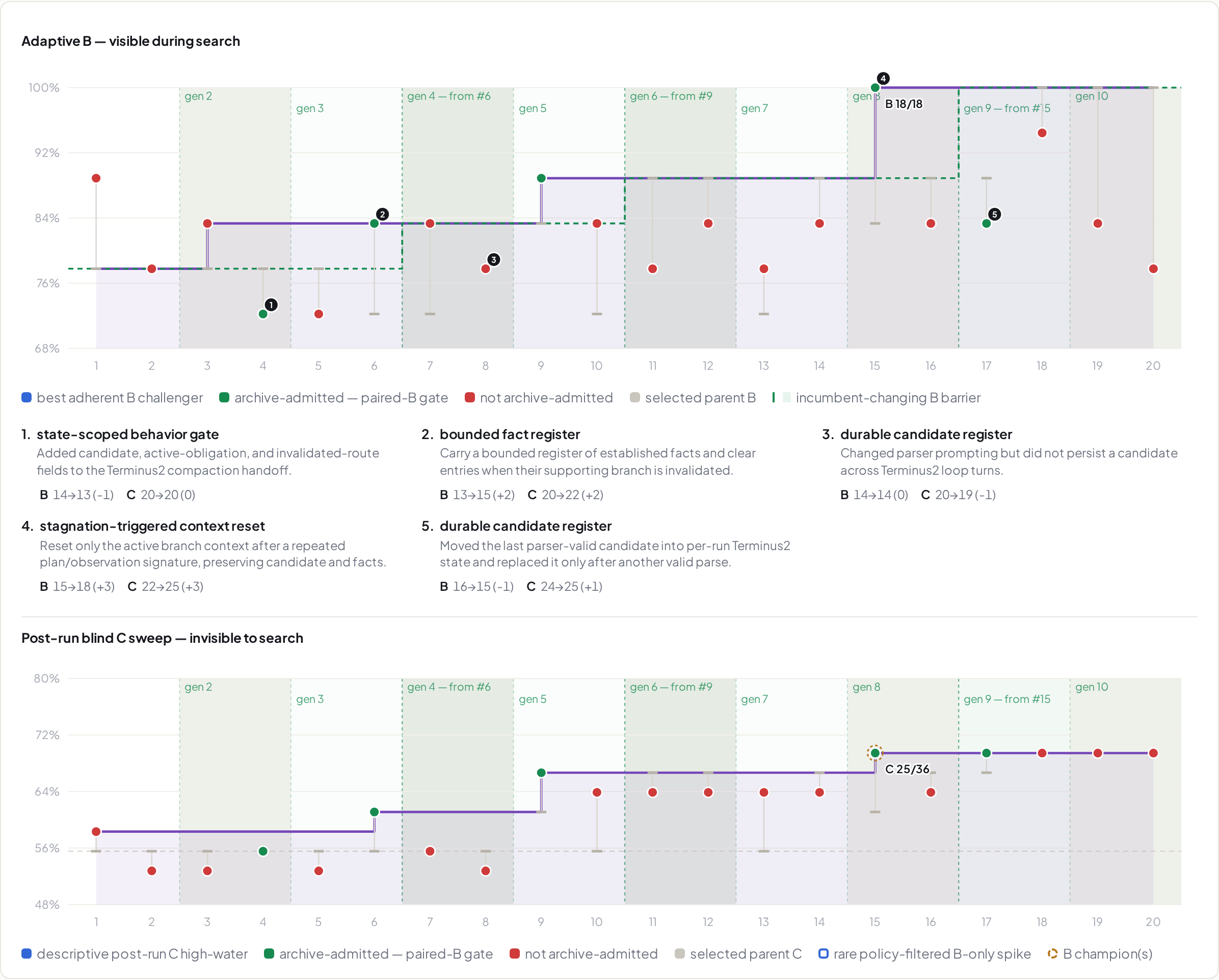
| AIME Textual | 18/18 (100%) | 25/36 (69.4%) | +5/36 |
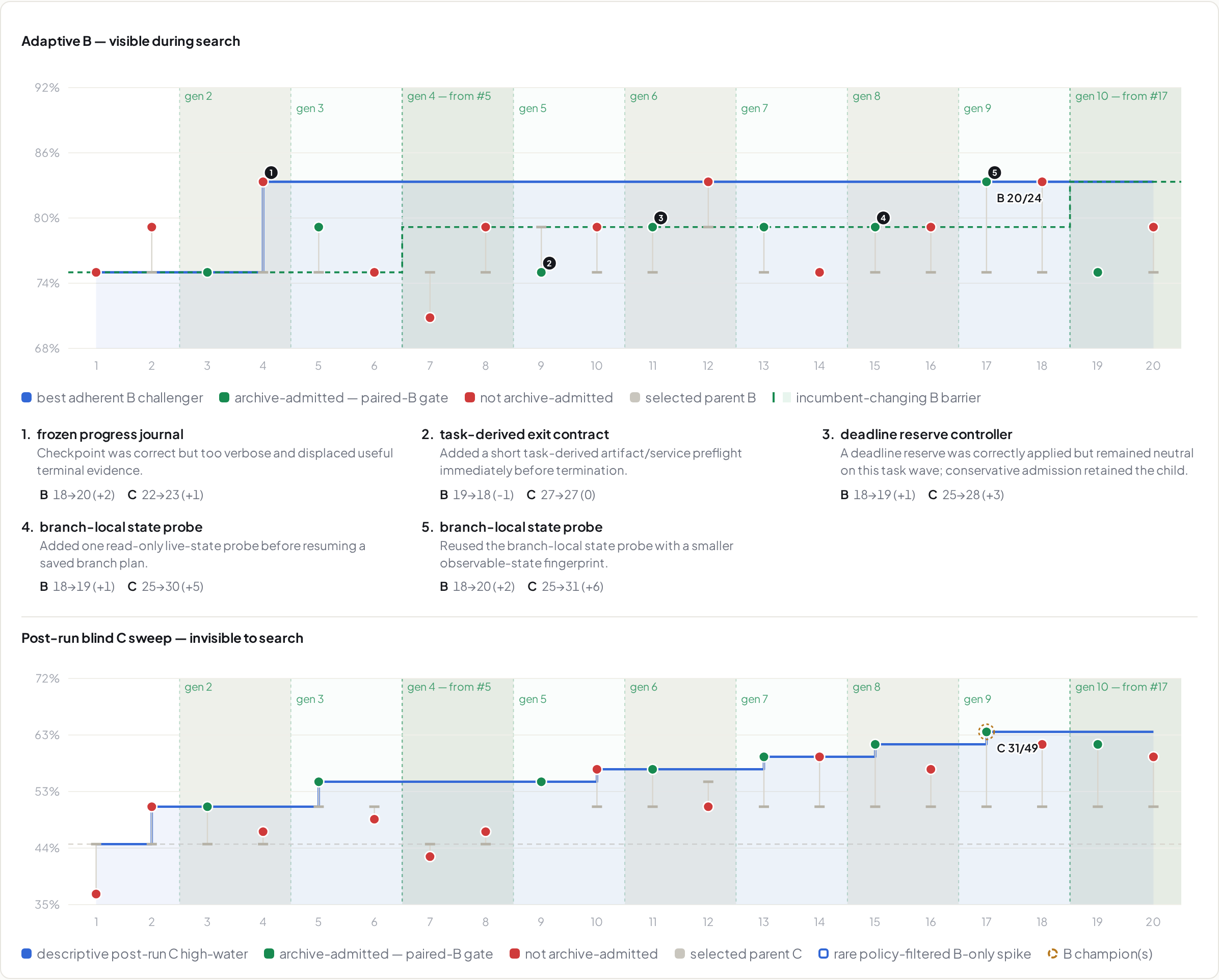
| TB2.1 UCB | 20/24 (83.3%) | 31/49 (63.3%) | +9/49 |
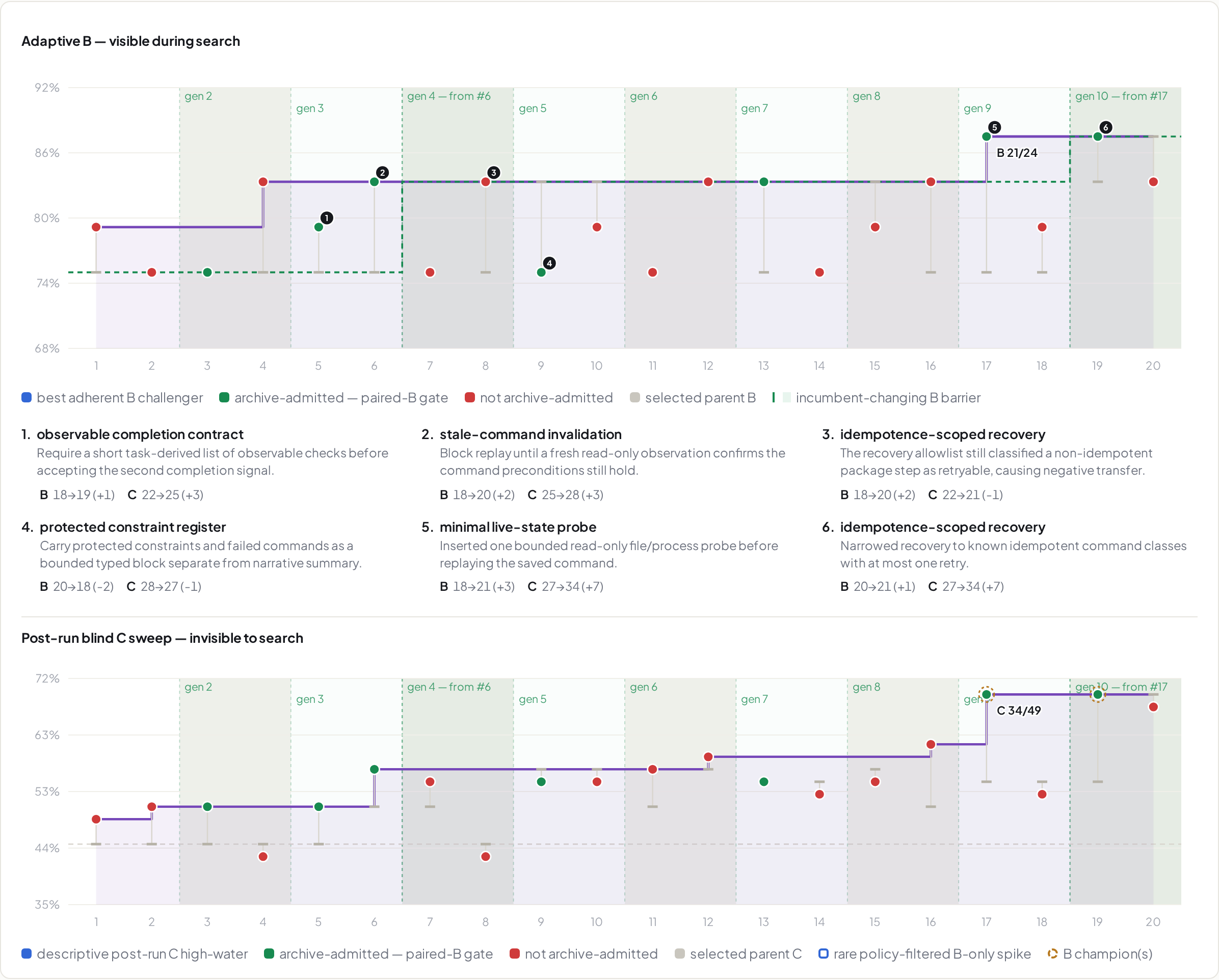
| TB2.1 Textual | 21/24 (87.5%) | 34/49 (69.4%) | +12/49 |
Across the four runs:
- **B selection and C generalization can disagree:** AIME Textual finds the higher B primary (`18/18` versus `17/18`), while UCB finishes `3/36` higher on C.
- **Policy learning behavior changes by benchmark:** on TB2.1, Textual leads UCB on both B (`+1/24`) and C (`+3/49`).
- **Gates separate score from admission:** AIME UCB attempt `#1` scores `18/18` on B but is rejected for implementation deviation and later scores `18/36` on C. Attempt `#4` enters the archive at `13/18` because admission depends on paired improvement and constraints rather than absolute B score alone.
#### AIME: UCB
 #### AIME: Textual
 #### Terminal-Bench 2.1: UCB
 #### Terminal-Bench 2.1: Textual
 ### 2. Policy Evolution
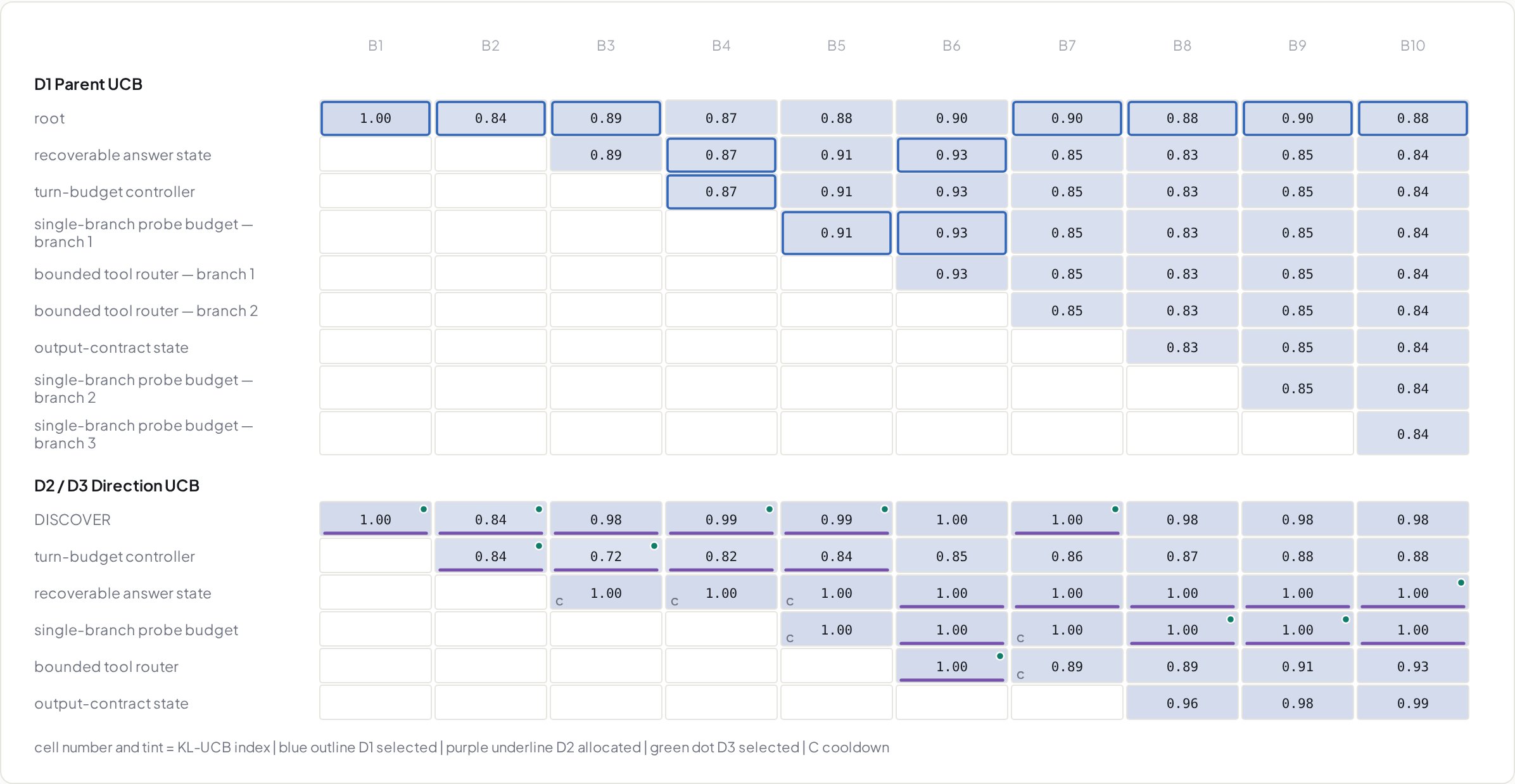
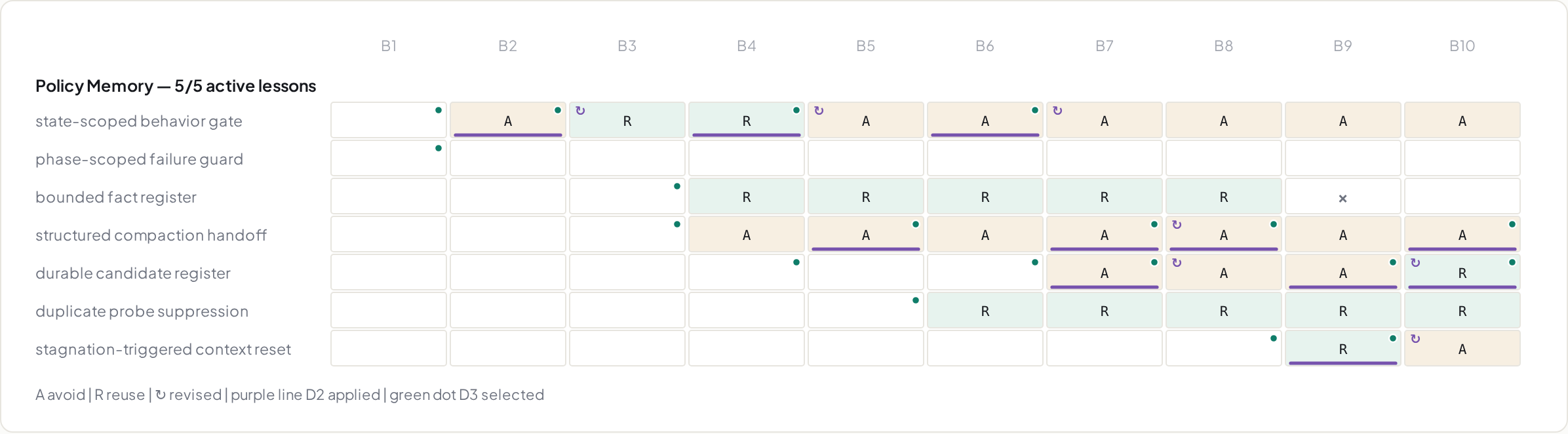
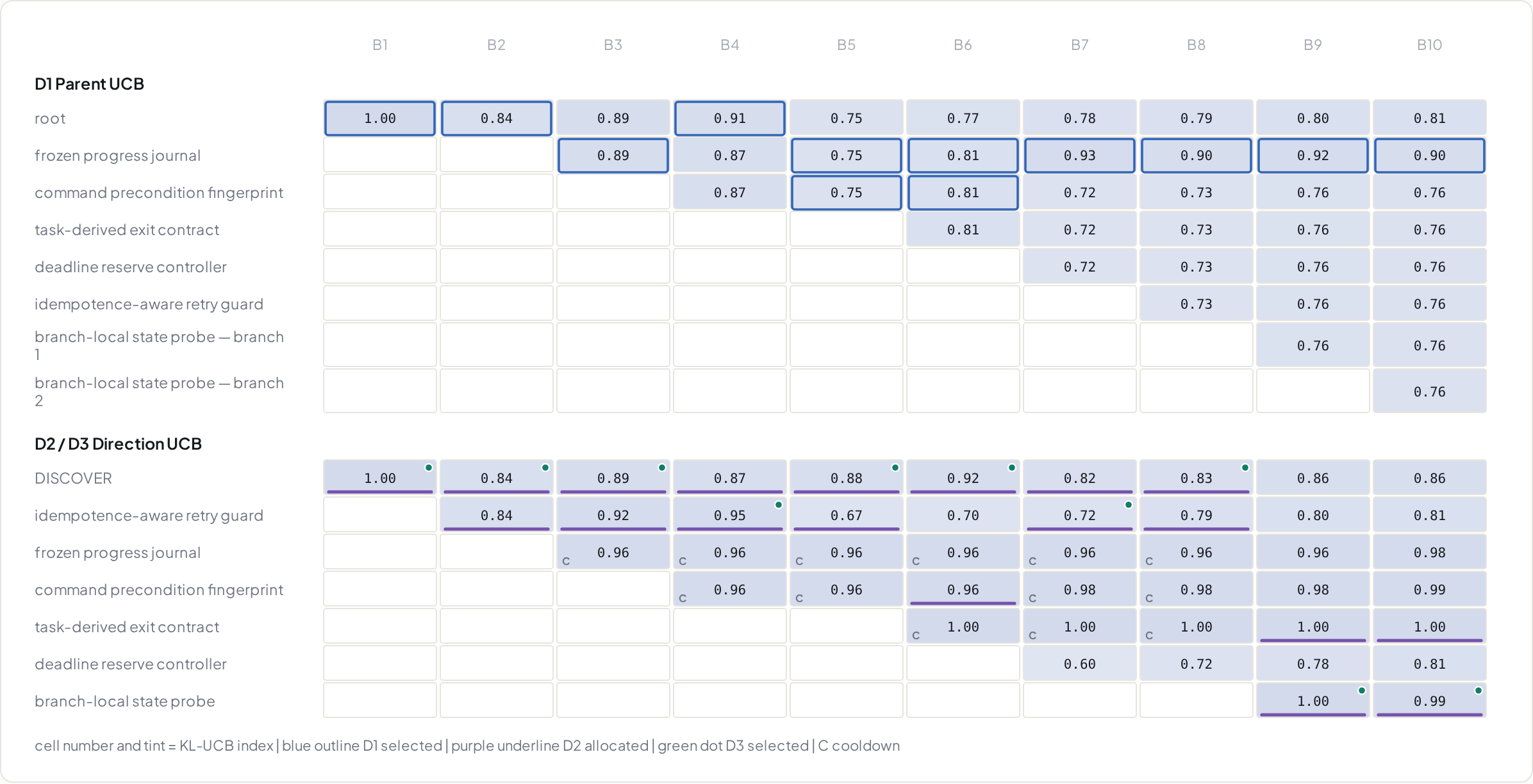
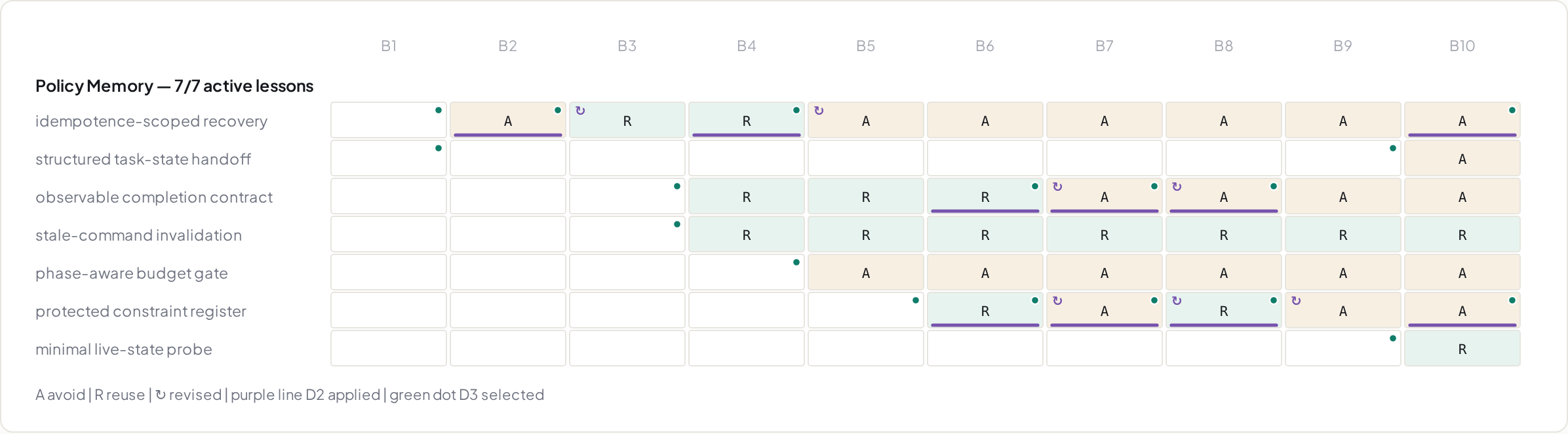
AgentPilot updates policy from attributable, search-visible B evidence at batch barriers. UCB updates parent and direction outcome statistics; Textual adds, revises, reuses, or retires bounded lessons in Policy Memory. These learned statistics or lessons guide the next batch's parent, direction-allocation, and proposal-selection decisions.
The policy plots highlight three dynamics:
- **UCB keeps uncertainty explicit:** AIME ends with 5 registered arms and TB2.1 with 6. Repeated negative evidence pushes some indices as low as `0.72` on AIME and `0.60` on TB2.1, while successful or underexplored arms remain near `1.00`. These are optimistic selection indices, not success probabilities.
- **Textual revises rather than only grows:** AIME performs 6 additions, 8 revisions, and 1 retirement to finish with 5 active lessons. TB2.1 performs 7 additions and 8 revisions to finish with 7 active lessons.
- **Updates happen at the batch barrier:** each Bn column shows the policy frozen before batch n, and that batch's outcomes appear only in the next column.
#### AIME: UCB
 #### AIME: Textual
 #### Terminal-Bench 2.1: UCB
 #### Terminal-Bench 2.1: Textual
 ### 3. Program Lineage
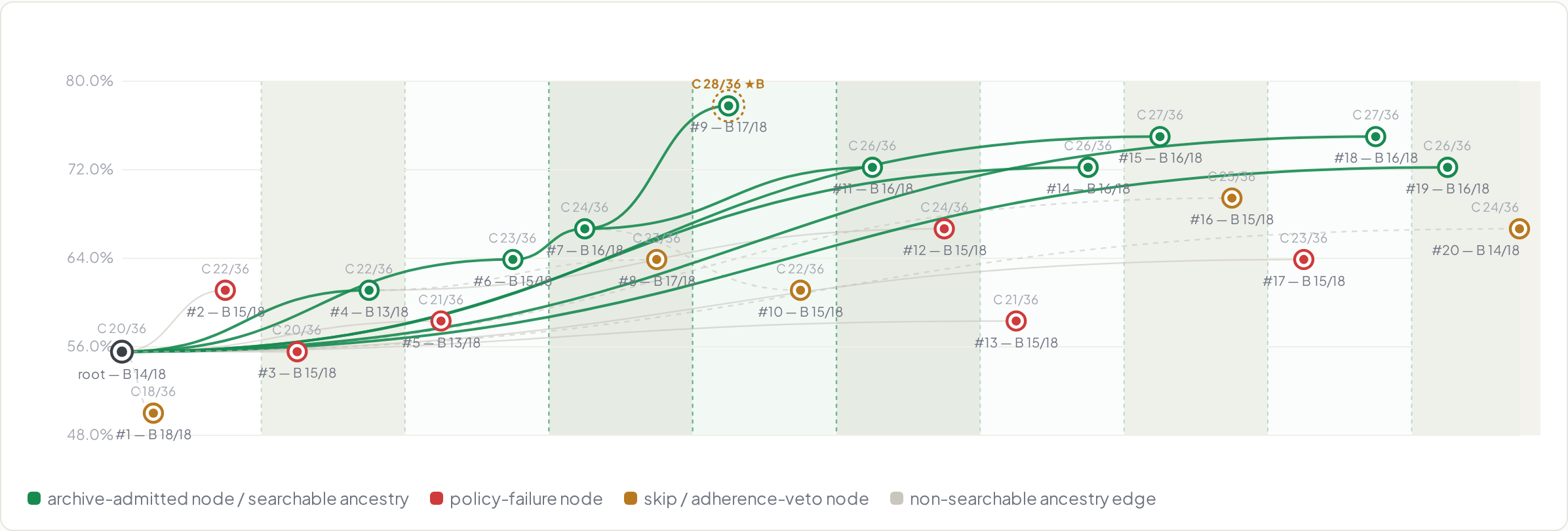
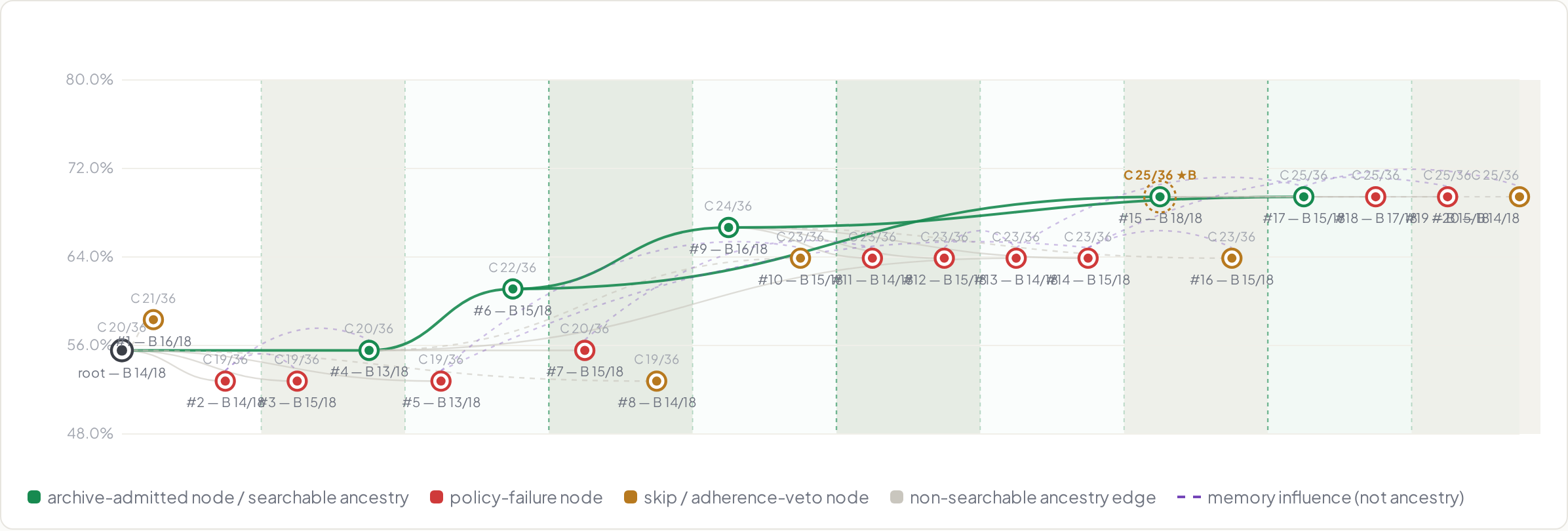
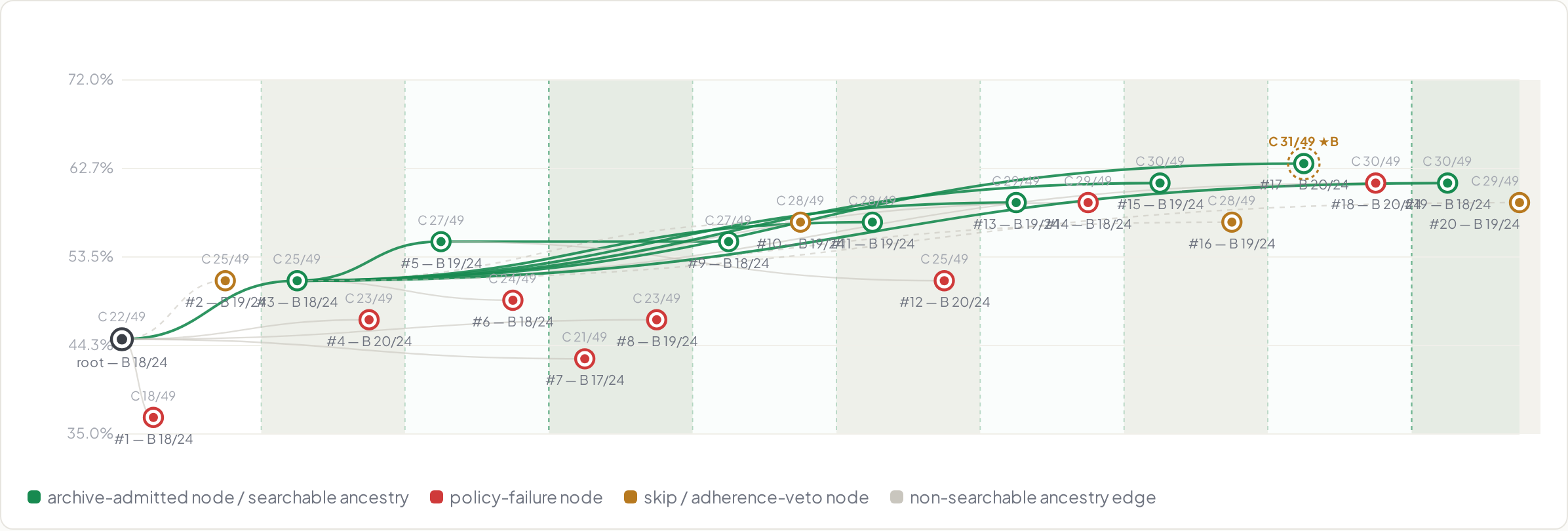
Every attempt remains connected to its selected parent, implementation outcome, paired-B admission decision, and archive transition. Rejected and non-attributable attempts remain visible as evidence for later search.
The lineage plots highlight three structural facts:
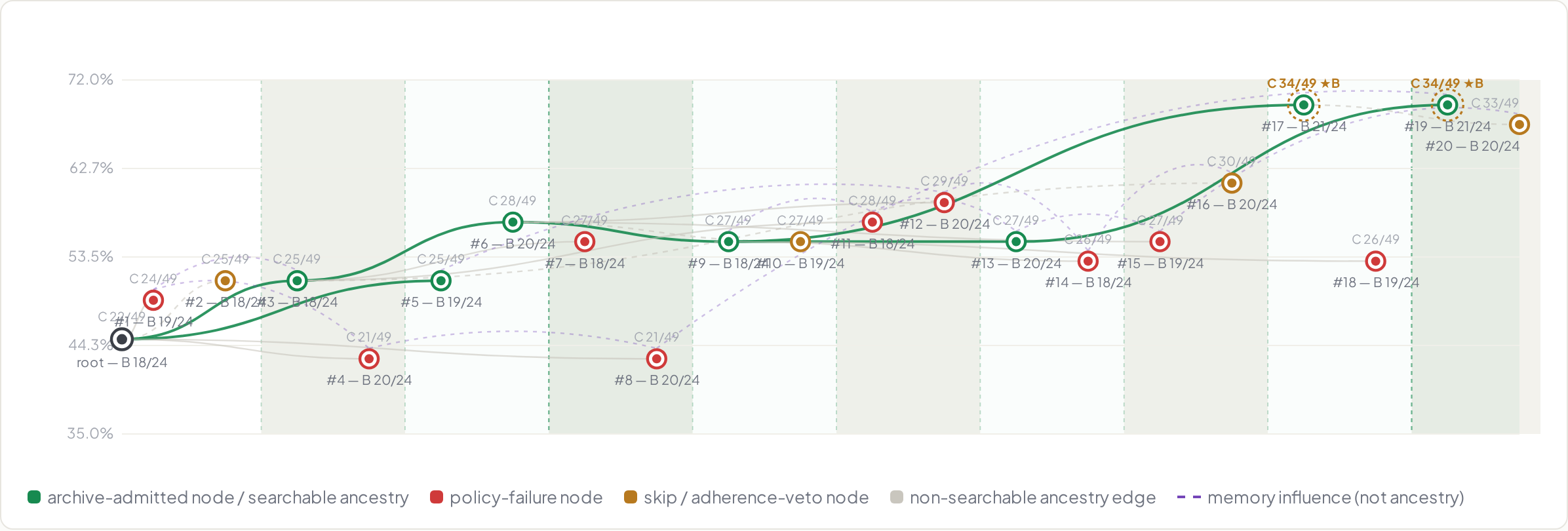
- **Archive admission differs by method and benchmark:** of 20 attempts, AIME admits 9 under UCB and 5 under Textual; TB2.1 admits 8 under UCB and 7 under Textual. Other branches remain visible without becoming searchable parents.
- **The B-selected primary is frozen before C:** AIME selects UCB `#9` at `17/18` B and `28/36` C, and Textual `#15` at `18/18` B and `25/36` C. TB2.1 selects UCB `#17` at `20/24` B and `31/49` C, and Textual `#17` at `21/24` B and `34/49` C; `#19` ties on B but does not replace the frozen primary.
- **Edges encode different relationships:** green edges show admitted ancestry, while dashed purple Textual edges show cross-branch evidence reuse rather than parentage.
#### AIME: UCB
 #### AIME: Textual
 #### Terminal-Bench 2.1: UCB
 #### Terminal-Bench 2.1: Textual