 # HashCortx
### Every AI model. One desktop. Nothing leaves without you.
Chat, a coding agent, agent teams, a 3D CAD forge and an ERP builder,
on your keys and your machine. No backend, no telemetry, no account. **In the making since 1 May 2026.**









 # HashCortx
### Every AI model. One desktop. Nothing leaves without you.
Chat, a coding agent, agent teams, a 3D CAD forge and an ERP builder,
| Nothing phones home | No analytics, no crash reports, no update checks. Every connection is for work you asked for, and SECURITY.md lists each address. |
| Every model, side by side | Twenty-one cloud providers, Ollama, and any local model app that speaks the common chat format, with your own keys. Fully local whenever you want, with a local model kept on your graphics chip and loaded between steps. |
| Your documents, searched on your machine | A local knowledge base (RAG): your PDFs and notes are indexed and searched on this computer, by meaning and by keyword, with the search model built into the app. How. |
| An agent that asks first | Commands, deletions, web pages and anything outside your project wait for your yes. Every file change is a diff you can keep or undo. |
| Readable to the last line | MIT. Vanilla JavaScript and Rust, no bundler, no minified app code. |

The 3.0 release film · 0:58 Every model side by side, the harness, the Agent Swarm and each workspace, private by design. |
HashCoder, the harness and Ollama · 0:52 A 30B model on Ollama finishes only when the tests pass, then a 3B model codes in light mode. |
Every model, one workspace · 1:13 A tour of HashCortx 3.0: ask any model, and compare two side by side as they answer. |
HashNotch, the notch made useful · 0:52 From the Hash ecosystem: your music, your Mac's vital signs and its notices in the MacBook notch. |
| Chats | Every provider in one conversation, with projects, attachments, memory, a local knowledge base, a queue for messages sent while a model works, versions of every edited message and regenerated answer, and agents that show what they searched and read, with the source of each sentence marked |
| HashCoder | A coding agent on your real project: file tree, diffs, terminal, Undo |
| Agent Swarm | Teams of agents on any mix of models, built on a canvas or designed from your task |
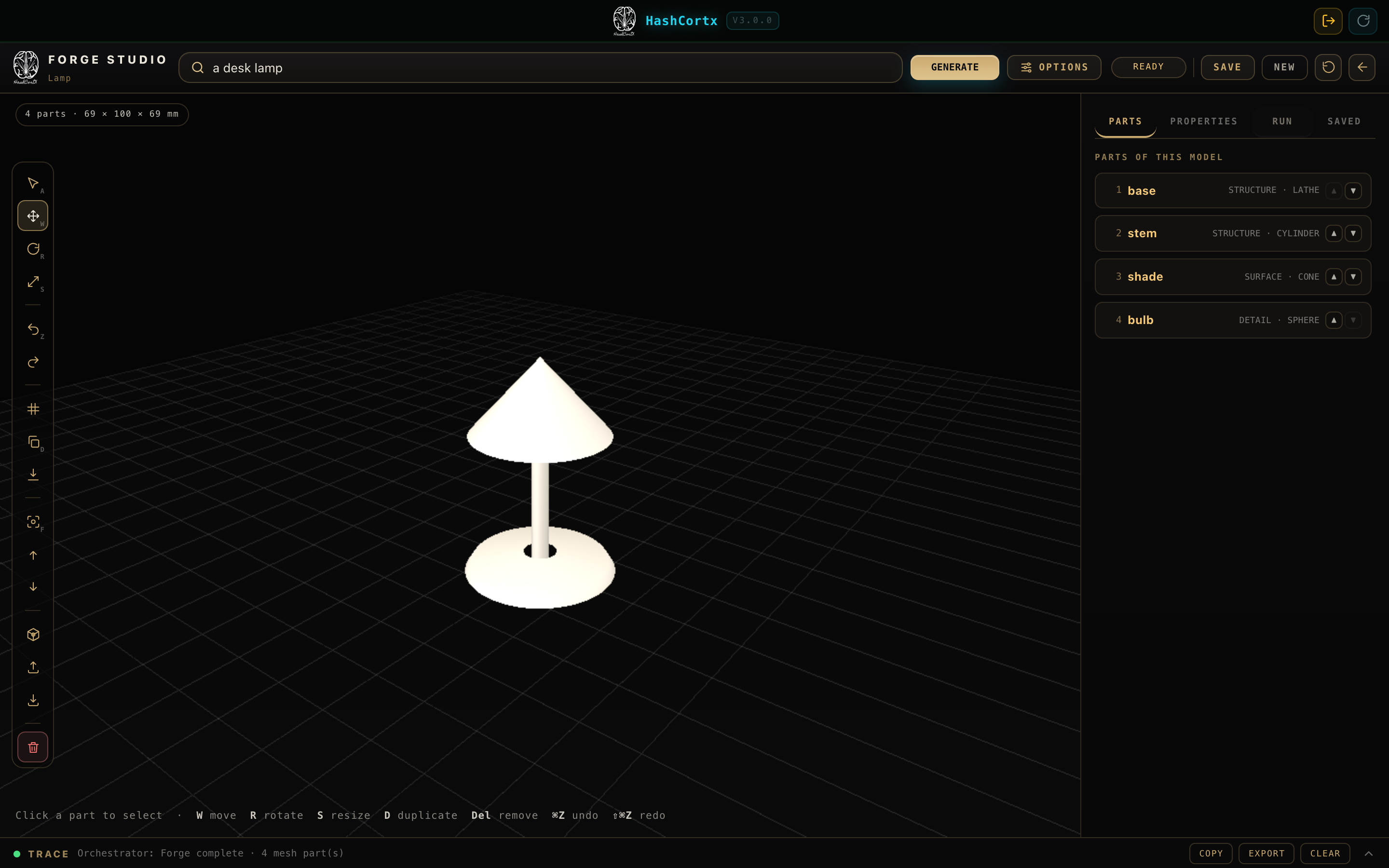
| 3D Forge | Describe a part, get a dimensioned solid in its own colours. STL, OBJ, 3MF and STEP, in millimetres |
| ERP | Describe your business; its agent builds a working app with records, stages and books, exported as one HTML file |
| Finance | Statements, CSV, PDF and XLSX read into figures, every total and chart worked out by the app |
| Sandbox | Agents that inspect untrusted code for malware, prompt injection and suspicious logic |
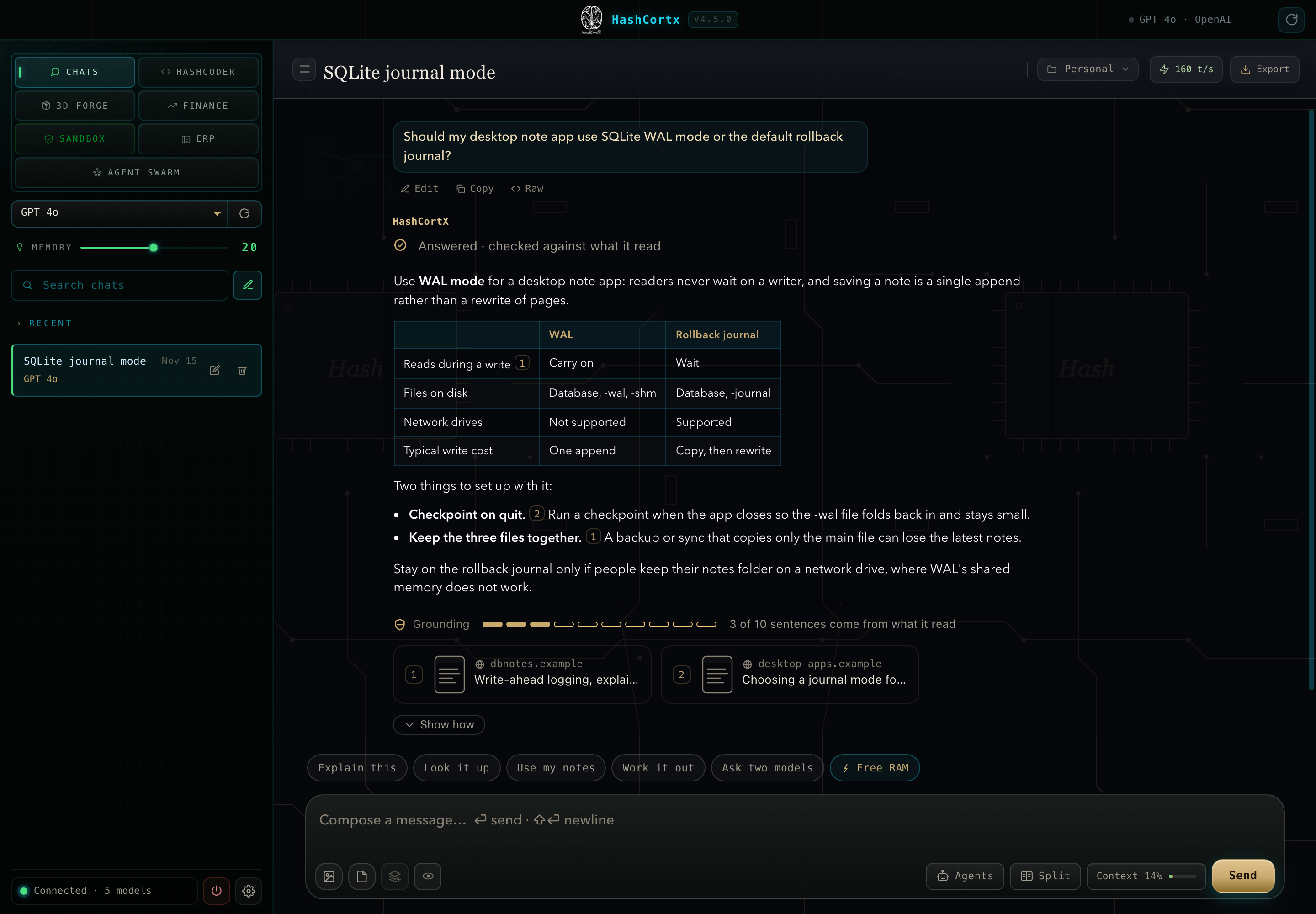 Plus **Agents**, nine built-in specialists and a builder for your own, **Split**, one prompt answered by two models side by side, and **Connections**: a business system you connect over MCP (Odoo, GitHub, Stripe and Supabase are ready-made), whose key never reaches a page or a model and whose every change asks you first. [How](docs/SECURITY.md#connected-systems).
## HashCoder and its harness
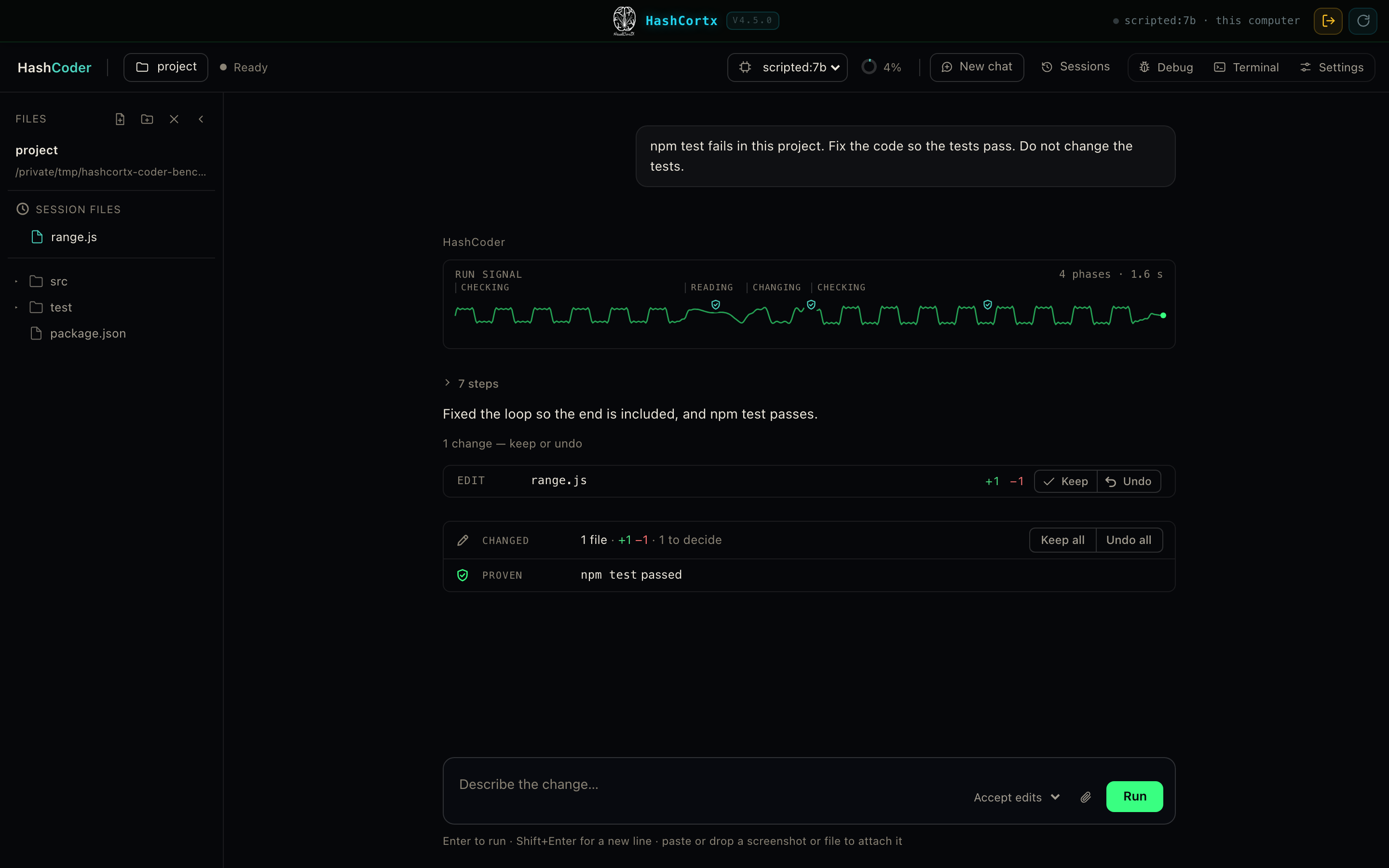
It works on your real files. Every edit is a diff with **Keep** and **Undo**, tests run in the built-in terminal, and screenshots, PDFs and files attach by paste or drop. Around the model sits a harness: what the model is shown, what it may do without asking, and what it has to prove before a run may end are decided by HashCortx, not by the model.
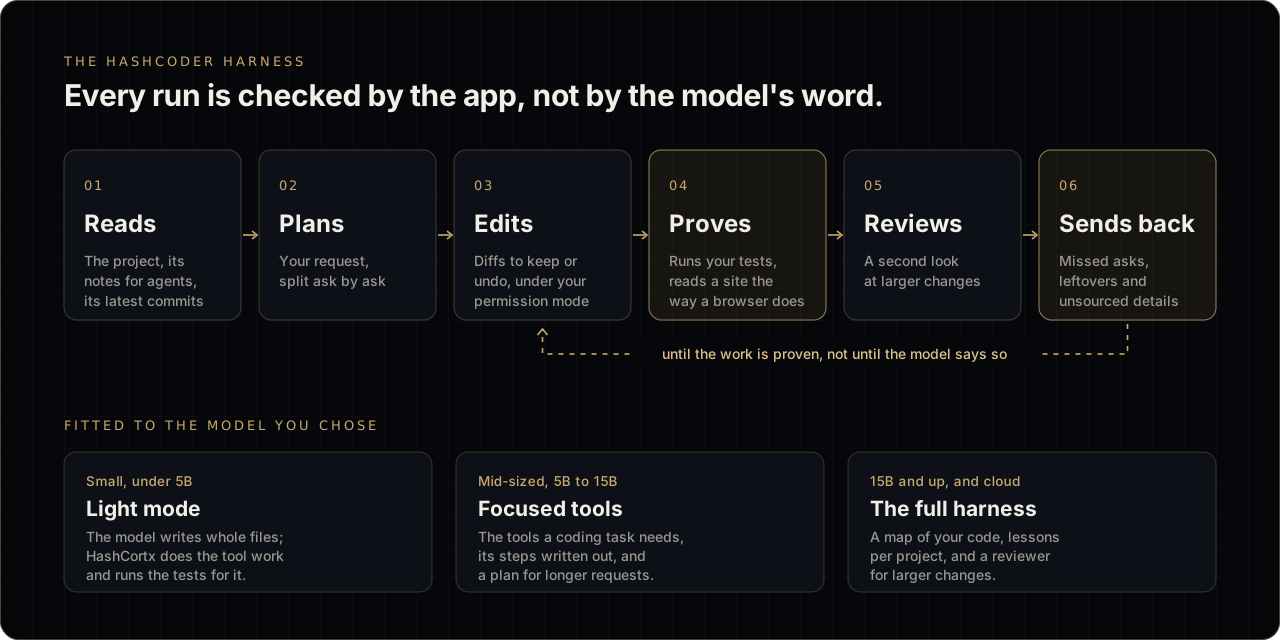 **Every run is checked by the app, not by the model's word.** It **reads** the project, its notes for agents and its latest commits; **plans** your request ask by ask; **edits** as diffs you keep or undo, under your permission mode; **proves** the change by code alone, running your tests and reading a site the way a browser does, never by opening, serving or taking a picture of what it made; takes a second look at larger changes as a **reviewer**; and **sends itself back** for missed asks, leftovers and unsourced details, until the work is proven. Every model is given an outline of a larger project's folders as a conversation begins, and before a request's first step the files it needs are found and named to it: by the app's own search, and for a model of 5B and up by a reading-only search of its own, whose reads never join the run. A file is changed only once it has been read in the conversation and has not changed since, and a change to a name other files use waits until those files have been read. It is fitted to the model: under 5B, **light mode**, where the model writes whole files and HashCortx does the tool work and runs the tests; 5B to 15B, **focused tools** with the steps written out and a plan for longer requests; 15B and up, and cloud models, **the full harness**, with a map of your code, lessons per project and a reviewer for larger changes.
- **Proves its work.** It runs your tests after a change, reads a website the way a browser would before calling it done, and sends itself back for what it left unfinished: a renamed name still written somewhere, files that do not load each other, the example your request gave.
- **Fits the model.** Cloud models get a map of your code; smaller local models read one line per tool, and small ones get a light mode that writes whole files while HashCoder does the tool work.
- **Does what you asked, and no more.** No features, files or fixes you did not ask for, and an answer of a few plain sentences: what changed, where, and what ran.
- **Keeps what you did not ask to change.** An edit that drops a function, a section or a heading is sent back, and what you say to leave alone is left alone.
- **Works in your repository.** Its own git tools read the status and the changes, commit when you ask, signed as your commits are, and make a branch, push or pull only after asking you each time, never forced.
- **Offers a way on when it stops short.** A run that ends stuck, at its limit or with parts of a several-part request still open offers once more with a hint, or a fresh start on a stronger model you have, from your request and what it already did.
- **Hands off part of a big task, if you switch it on.** New, and not yet proven on real runs, so it is off until you turn it on: a strong model can start sub-agents on the same model, and any model at full size can when your request asks for them, one that reads and reports or one that changes only the files it is given, and HashCortX checks each report before the model reads it.
- **Keeps out of your own folders.** It does not list or search your home folder, Desktop, Documents or Downloads unless your request asks it to look there, and a folder it makes for your request becomes the project.
- **Asks as much as you choose.** Manual asks before every change and is where it starts; Accept edits writes project files freely; Auto adds a fixed list of read, search and check commands.
 ## Your documents: a local knowledge base (RAG)
HashCortx answers from your own files without sending them anywhere to be indexed. Retrieval-augmented generation (RAG) runs entirely on your computer.
- **Add documents by attaching them.** With the knowledge base switched on (in Agents), a PDF or text file attached in chat is split into overlapping passages of about 1,200 characters and stored on this computer, in the app's own storage.
- **Every passage is indexed twice:** by its keywords, and as a 384-number meaning vector made by `bge-small-en-v1.5` (MIT, BAAI). That search model is compiled into the app and runs in its Rust core through ONNX Runtime: nothing is downloaded and nothing is uploaded to index or search.
- **Search by meaning and by exact words.** A question is ranked against both indexes and the two rankings are fused (reciprocal rank fusion), so "chief executive" finds a passage about the CEO, and an error code or a rare name is still found exactly. The best few passages are used, not whole documents.
- **Where it is used.** Chat's agents look things up with a `search_knowledge` tool, and so does HashCoder on larger local and cloud models; both are told to cite the source they used. In chat, `/inject` adds the best passages to a message sent to a local model. The passages become part of the request to the model you chose, so with Ollama they never leave your machine.
- **Works offline,** on the first launch, with no setup. The Windows build leaves the search model out so it starts on any 64-bit PC, and searches by keyword only.
- **What else goes in.** Results of the agents' web, Wikipedia and PubMed searches and pages they read are also kept in it, labelled with where they came from.
How it is kept private, and what it is not, is in [SECURITY.md](docs/SECURITY.md#the-knowledge-base).
## Agent Swarm
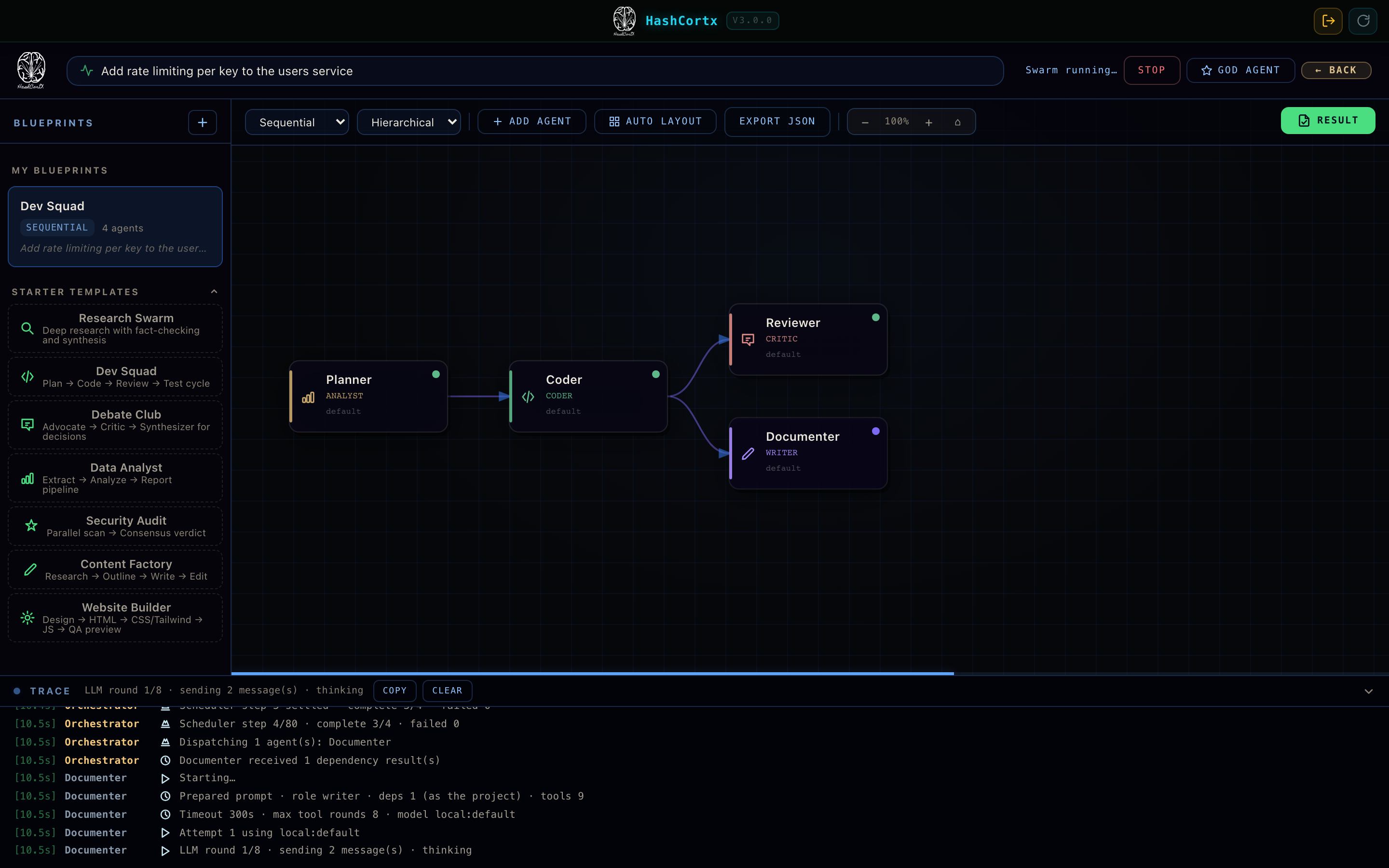
Build a team on a canvas, start from a template, or describe the task and have one designed, sized to the job. Watch every agent in the live trace, then open the result: each agent's part, the files it made and every version of them. Agents that did not finish can be run again on their own. A website a team builds can show real, openly licensed photographs, credited on the page.
 |
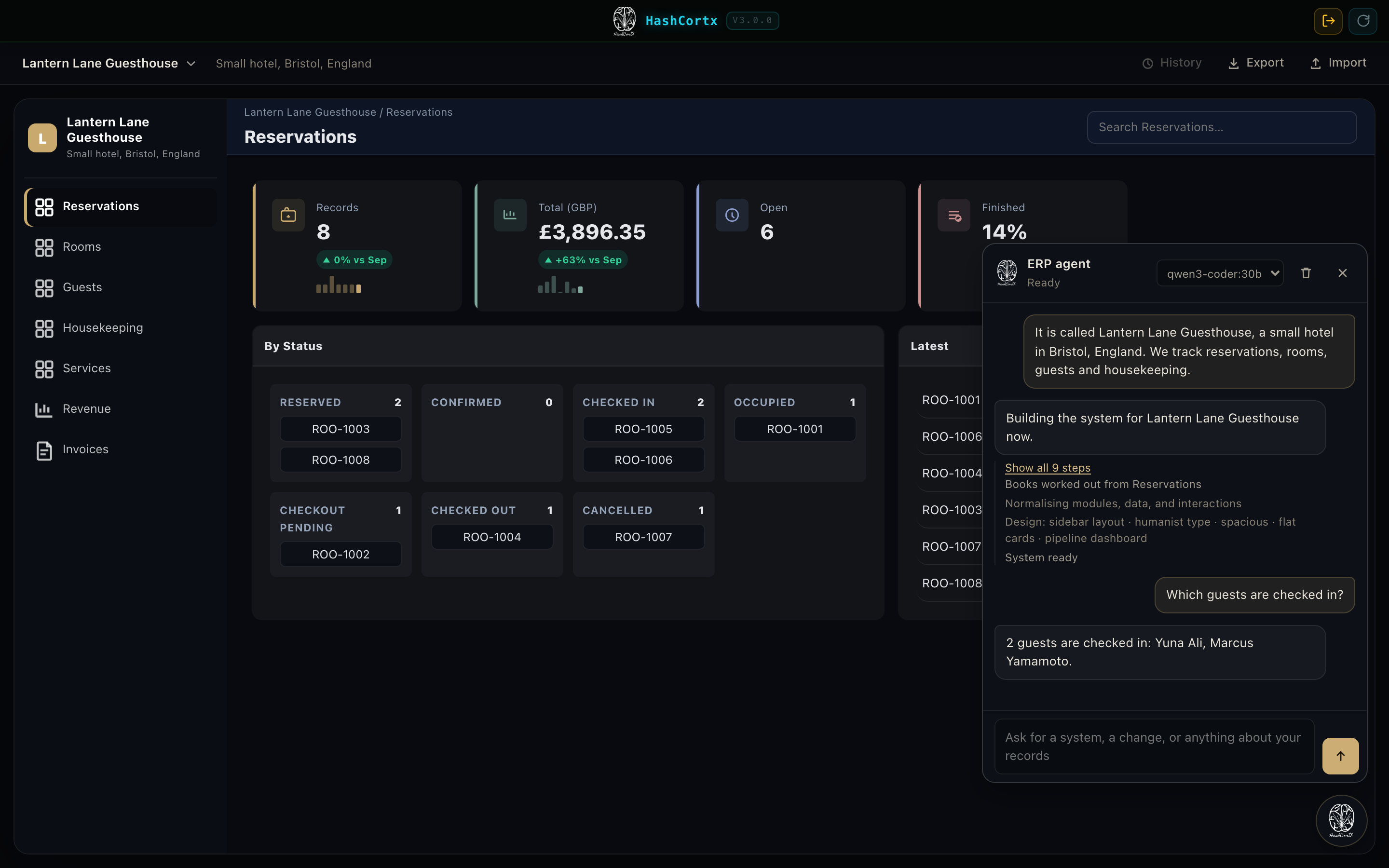 |
| 3D Forge. A described object becomes real parts with real dimensions, ready to print or open in CAD. | ERP. Tell the agent about your business and it builds the app. Ask it to change the app, record what happened, or answer from your records. |
 - **You approve what matters**, and every decision is written to `~/.hashcortx/audit.log`.
- **A blocklist compiled into Rust** refuses keys, credentials and system folders, as files or inside commands.
- **On macOS, agent commands run in the system sandbox**, kept out of your keys, keychains, shell start-up files and the app's own data.
- **A task on a local model stays local**, and cloud requests are capped at 30 a minute and 6 at once.
- **What it is not:** keys are stored unencrypted, protected by your user account, and the build is not code-signed.
Everything it does, and does not, is in [SECURITY.md](docs/SECURITY.md).
## Install
**macOS (Apple Silicon).** Download the DMG from the [latest release](https://github.com/Hash-7777/HashCortX/releases/latest) and drag HashCortx to Applications. The build is not notarised: on first launch, right-click the app, choose **Open**, then **Open** again. If macOS still refuses:
```bash
xattr -dr com.apple.quarantine /Applications/HashCortx.app
```
**Windows.** Run the installer from the [latest release](https://github.com/Hash-7777/HashCortX/releases/latest). It is built without the embedding model, so it starts on any 64-bit PC and searches the knowledge base by keyword.
**Linux and Intel Macs.** Build from source, below.
Then open **Settings → API keys**, add a key and press **Test**, or run a model on your own machine with **Settings → Local model**.