### Your AI assistant wastes thousands of tokens every conversation just figuring out your project. codesight fixes that in one command.
**4,000+ downloads and counting.**
**Zero dependencies. AST precision. 30+ framework detectors. 14 ORM parsers. 14 MCP tools. One `npx` call.**
**Works with TypeScript, JavaScript, Python, Go, Ruby, Elixir, Java, Kotlin, Rust, PHP, Dart, Swift, C#, and BrightScript/BrighterScript (
Roku).** TypeScript projects get full AST precision. Everything else uses battle-tested regex detection across the same 30+ frameworks.
[](https://www.npmjs.com/package/codesight)
[](https://www.npmjs.com/package/codesight)
[](https://www.npmjs.com/package/codesight)
[](https://github.com/Houseofmvps/codesight/stargazers)
[](LICENSE)
---
[](https://x.com/kaileskkhumar)
[](https://www.linkedin.com/in/kailesk-khumar)
[](https://houseofmvps.com)
[](https://www.kailxlabs.co)
**Built by [Kailesk Khumar](https://www.linkedin.com/in/kailesk-khumar), founder of [HouseofMVPs](https://houseofmvps.com)
and [Kailxlabs](https://www.kailxlabs.co)**
*Also: [ultraship](https://github.com/Houseofmvps/ultraship) (39 expert skills for Claude
Code) · [claude-rank](https://github.com/Houseofmvps/claude-rank) (SEO/GEO/AEO plugin for Claude Code)*
---
```
0 dependencies · Node.js >= 18 · 145 tests · 14 MCP tools · MIT · tested on 25+ OSS projects across 14 languages
```
## Works With
**Claude Code, Cursor, GitHub Copilot, OpenAI Codex, Windsurf, Cline, Aider**, and anything that reads markdown.
## Install
```bash
npx codesight
```
That's it. Run it in any project root. No config, no setup, no API keys.
```bash
npx codesight --wiki # Generate wiki knowledge base (.codesight/wiki/)
npx codesight --init # Generate CLAUDE.md, .cursorrules, codex.md, AGENTS.md
npx codesight --open # Open interactive HTML report in browser
npx codesight --mcp # Start as MCP server (14 tools) for Claude Code / Cursor
npx codesight --blast src/lib/db.ts # Show blast radius for a file
npx codesight --profile claude-code # Generate optimized config for a specific AI tool
npx codesight --benchmark # Show detailed token savings breakdown
npx codesight --native-ast # Opt-in: AST plugins for more languages (see docs/wasm-plugins.md)
npx codesight --mode knowledge # Map knowledge base (.md notes → KNOWLEDGE.md)
npx codesight --mode knowledge ~/vault # Map Obsidian vault, ADRs, meeting notes, retros
```
## Wiki Knowledge Base (v1.6.2)
Inspired by [Karpathy's LLM wiki pattern](https://gist.github.com/karpathy/442a6bf555914893e9891c11519de94f) — but compiled from AST, not an
LLM. Zero API calls. 200ms.
```bash
npx codesight --wiki
```
Generates `.codesight/wiki/` — a persistent knowledge base of your codebase that survives across every session:
```
.codesight/wiki/
index.md — catalog of all articles (~200 tokens) — read this at session start
overview.md — architecture, subsystems, high-impact files (~500 tokens)
auth.md — auth routes, middleware, session flow
payments.md — payment routes, webhook handling, billing flow
database.md — all models, fields, relations, high-impact DB files
users.md — user management routes and related models
ui.md — UI components with props
log.md — append-only record of every wiki operation
```
**Why this cuts token usage further:**
Instead of loading the full 5K token context map every conversation, your AI reads one targeted article:
| Question | Without wiki | With wiki |
|-----------------------|------------------------------|-----------------------------|
| "How does auth work?" | ~12K tokens (reads 8+ files) | ~300 tokens (`auth.md`) |
| "What models exist?" | ~5K tokens (CODESIGHT.md) | ~400 tokens (`database.md`) |
| New session start | ~5K tokens (full reload) | ~200 tokens (`index.md`) |
**Persistent across sessions.** The wiki lives in `.codesight/wiki/`, committed to git. Every new Claude Code, Cursor, or Codex session
starts with full codebase knowledge from the first message.
**Auto-regenerates.** Use `--watch` to keep the wiki current as you code. Use `--hook` to regenerate on every commit.
**3 new MCP tools** for wiki access:
| Tool | What it does |
|------------------------------|-------------------------------------------------------------------|
| `codesight_get_wiki_index` | Get the wiki catalog (~200 tokens) at session start |
| `codesight_get_wiki_article` | Read one article by name: `auth`, `database`, `payments`, etc. |
| `codesight_lint_wiki` | Health check: orphan articles, missing cross-links, stale content |
The key difference from general-purpose wiki tools: codesight already knows your routes, schema, blast radius, and middleware from AST — no
LLM needed to extract code structure. The wiki is a narrative layer on top of data your codebase already contains.
## Knowledge Mode (v1.9.3)
Not just code — your decisions, meeting notes, ADRs, and retrospectives carry as much context as the codebase itself. `--mode knowledge` maps
them the same way codesight maps code.
```bash
npx codesight --mode knowledge # Scan current directory for .md files
npx codesight --mode knowledge ~/vault # Scan an Obsidian vault
npx codesight --mode knowledge ./docs # Scan a project docs folder
```
Outputs `.codesight/KNOWLEDGE.md` — a compact AI context primer:
```markdown
# Knowledge Map — my-project
> 47 notes · 12 decisions · 8 open questions · 2025-09-01 → 2026-04-01
## Key Decisions (12)
- [2026-03-20] Going with Polar.sh over Stripe Connect — simpler global payments
- [2026-03-15] Decided to use PostgreSQL — better JSON support and Drizzle compatibility
- [2026-02-10] Will use Redis for rate limiting — BullMQ already in stack
## Open Questions (8)
- Should we support PayPal later?
- When do we start the Stripe marketplace application?
## Note Index (47)
### Decision Records (8)
- `decisions/adr-002-payments.md` — 2026-03-20 — Going with Polar.sh over Stripe Connect
- `decisions/adr-001-database.md` — 2026-03-15 — We need a relational database...
### Meeting Notes (14)
### Retrospectives (6)
### Specs & PRDs (5)
### Research (4)
```
**What it detects automatically:**
| Note type | Signals |
|------------------|--------------------------------------------------------------------------|
| Decision records | ADR format (`## Decision`), "decided to", "going with", "chose X over Y" |
| Meeting notes | `Attendees:`, `Action items:`, filename: `standup`, `sync`, `1on1` |
| Retrospectives | "What went well", "Stop doing", filename: `retro`, `retrospective` |
| Specs / PRDs | `## Goals`, `## Requirements`, filename: `prd`, `spec`, `roadmap` |
| Research | filename: `research`, `analysis`, `benchmark`, `comparison` |
| Session logs | filename: `session`, `daily`, `weekly` |
**Supports:**
- Obsidian vaults (YAML frontmatter, `[[backlinks]]`, `#tags`)
- Notion exports (`.md` files with frontmatter)
- ADR tooling (`adr-tools`, `Log4brains`, raw markdown)
- Any folder of markdown files
**Used together:**
```
Read .codesight/CODESIGHT.md → what the code does
Read .codesight/KNOWLEDGE.md → why decisions were made
```
CI: add `npx codesight --mode knowledge` alongside your existing codesight step. Both files stay current on every push.
## Benchmarks (Real Projects)
Every number below comes from running codesight on real production codebases — both small SaaS projects (v1.6.2) and large open-source
platforms with 4K–10K+ files (v1.6.4). Output tokens are measured from actual file size (chars / 4). Exploration tokens are estimated from
what was extracted — routes × 400, models × 300, components × 250, etc. Route counts and model counts are cross-checked against actual
source files.
### Three-Level Token Reduction
codesight saves tokens at two distinct layers. The wiki (v1.6.2) adds a second layer on top of the base savings:
| Project | Manual exploration | codesight scan | codesight --wiki (targeted) | **Total reduction** |
|------------|--------------------|----------------------|-----------------------------|---------------------|
| **SaaS A** | 46,020 tokens | 3,936 tokens (11.7x) | ~550 tokens | **83.7x** |
| **SaaS B** | 26,130 tokens | 3,629 tokens (7.2x) | ~440 tokens | **59.4x** |
| **SaaS C** | 47,450 tokens | 4,162 tokens (11.4x) | ~360 tokens | **131.8x** |
**Average combined reduction: 91x.** The wiki's "targeted" number = reading `index.md` at session start (~200 tokens) + one relevant
article (~160-350 tokens depending on project). Your AI never loads the full context map for targeted questions.
The two savings layers are independent and compound:
**Layer 1 — codesight scan** eliminates manual file exploration. Instead of your AI running glob/grep/read across 40-138 files to understand
the project, it reads one pre-compiled map.
**Layer 2 — `--wiki`** eliminates loading the full map for every question. Instead of loading 3K-5K tokens of full context at session start,
your AI reads a 200-token index and pulls the one relevant article (~160-350 tokens) for each question.
```
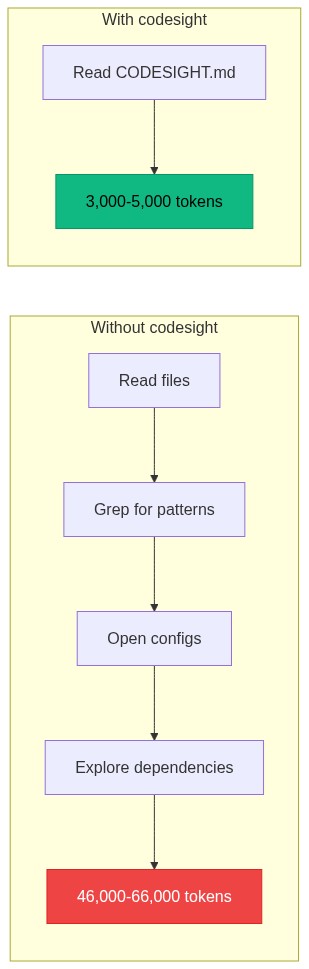
Without codesight: AI reads 26K-47K tokens per session exploring files
With codesight: AI reads ~3K-5K tokens (the compiled map)
With --wiki: AI reads ~200 tokens at start + ~300 per targeted question
```
### Base Scan Results
| Project | Stack | Files | Routes | Models | Components | Output Tokens | Exploration Tokens | Savings | Scan Time |
|------------|------------------------------|-------|--------|--------|------------|---------------|--------------------|-----------|-----------|
| **SaaS A** | Hono + Drizzle | 138 | 38 | 12 | 0 | 3,936 | 46,020 | **11.7x** | 186ms |
| **SaaS B** | Hono + Drizzle, 3 workspaces | 53 | 17 | 8 | 10 | 3,629 | 26,130 | **7.2x** | 201ms |
| **SaaS C** | FastAPI + MongoDB | 40 | 56 | 0 | 0 | 4,162 | 47,450 | **11.4x** | 890ms |
SaaS C has 0 models because it uses MongoDB — no SQL ORM declarations for codesight to parse. This is correct detection, not a false
negative.
### Multi-Language OSS Benchmark (v1.6.7)
Tested against real open-source codebases spanning every supported language and framework. Output tokens are measured from actual file size.
Exploration tokens are estimated (routes×400 + models×300 + components×250 + revisit multiplier). Zero false positives across all tests.
| Language | Stack | Files | Routes | Models | Components | Output tokens | Est. exploration | Savings |
|----------------------------|-------------------------------------------|-------|--------|--------|------------|---------------|------------------|------------|
| **TypeScript · Next.js** | Next.js + tRPC + Prisma · 110+ workspaces | 7,509 | 479 | 173 | 1,309 | 158,660 | ~1,485,000 | **~9x** |
| **TypeScript · NestJS** | NestJS + TypeORM + Mongoose | 162 | 19 | 8 | 0 | 5,300 | ~67,500 | **~12.7x** |
| **TypeScript · Hono** | Hono | — | 8 | 0 | 0 | — | — | ✓ |
| **TypeScript · Remix** | Remix + Prisma | 36 | 11 | 0 | 9 | — | — | ✓ |
| **TypeScript · SvelteKit** | SvelteKit | — | 0³ | 0 | 23 | — | — | ✓ |
| **TypeScript · Nuxt** | Nuxt | 141 | 8 | 0 | 64 | — | — | ✓ |
| **JavaScript · Express** | Express + Mongoose | 51 | 10 | 5 | 0 | 1,241 | ~20,800 | **~17x** |
| **Ruby · Rails** | Rails + ActiveRecord | 4,172 | 607 | 116 | 0 | 21,711 | ~386,100 | **~17.8x** |
| **PHP · Laravel** | Laravel + Eloquent | 3,896 | 652 | 59 | 0 | 30,739 | ~493,285 | **~16x** |
| **Python · Django** | Django + pyproject.toml | 4,232 | 7¹ | 56 | 0 | 83,842 | ~631,020 | **~7.5x** |
| **Python · Flask** | Flask + SQLAlchemy | 30 | 12 | 5 | 0 | 1,148 | ~16,705 | **~14.5x** |
| **Python · FastAPI** | FastAPI + SQLModel (monorepo) | 143 | 21 | 2 | 36 | 2,487 | ~38,090 | **~15.3x** |
| **Elixir · Phoenix** | Phoenix + Ecto | 1,406 | 198 | 54 | 0 | 9,589 | ~152,100 | **~15.9x** |
| **Go · Gin** | Gin + GORM (enterprise app) | 388 | 202 | 169 | 0 | 15,266 | ~262,730 | **~17.2x** |
| **Go · Echo** | Echo | — | 7 | 0 | 0 | — | — | ✓ |
| **Go · Fiber** | Fiber | — | 5 | 0 | 0 | — | — | ✓ |
| **Rust · Actix** | actix-web | 528 | 30 | 0 | 0 | 1,355 | ~27,170 | **~20x** |
| **Rust · Axum** | Axum | — | 6 | 0 | 0 | — | — | ✓ |
| **C# · ASP.NET** | ASP.NET Core + Entity Framework Core | 256 | 13 | 7 | 0 | 5,126 | ~63,570 | **~12.4x** |
| **Java · Spring** | Spring Boot + Java (Maven) | 47 | 16 | 0 | 0 | 319 | ~13,208 | **~41x**² |
| **Swift · SwiftUI** | SwiftUI | 388 | 0 | 0 | 62 | 7,499 | ~76,830 | **~10.2x** |
| **Swift · Vapor** | Vapor backend | 294 | 81 | 0 | 0 | 6,146 | ~95,160 | **~15.5x** |
| **Dart · Flutter** | Flutter + go_router | 204 | 10 | 0 | 89 | 8,500 | ~86,125 | **~10.1x** |
¹ Django project is GraphQL-first — 7 REST utility endpoints detected accurately, 0 false positives.
² High ratio on small boilerplate: Spring Boot route metadata compresses very well.
³ SvelteKit RealWorld app uses page routes (`+page.svelte`), not JSON API endpoints (`+server.ts`). 0 routes is correct.
**How exploration tokens are estimated:** `routes×400 + models×300 + components×250 + hot_files×150 + env_vars×30`, times a 1.3 revisit
multiplier, minus the output size. This approximates what an AI would spend asking "what routes exist?", "show me the schema", etc. in a
manual exploration session. Output token count is the actual measured file size.
### Wiki Breakdown (v1.6.2)
| Project | Full CODESIGHT.md | Wiki index only | Index + 1 article | Wiki articles generated |
|------------|-------------------|-----------------|-------------------|-------------------------|
| **SaaS A** | 3,936 tokens | ~200 tokens | ~550 tokens | 9 |
| **SaaS B** | 3,629 tokens | ~200 tokens | ~440 tokens | 11 |
| **SaaS C** | 4,162 tokens | ~200 tokens | ~360 tokens | 17 |
"How does auth work?" — without wiki: loads 3,945 tokens. With wiki: reads `auth.md` (~350 tokens). **11x improvement per targeted question,
84x total vs manual.**
### Detection Accuracy
Verified against actual source files. Route counts cross-checked against route definitions; schema models cross-checked against ORM table
declarations.
| Project | Route Recall | Schema Recall | False Positives | Detection Method |
|------------|--------------|---------------|-----------------|-------------------------------------------|
| **SaaS A** | 38/43 (88%) | 12/12 (100%) | 0 | Schema: AST (Drizzle), Routes: AST (Hono) |
| **SaaS B** | 17/17 (100%) | 8/8 (100%) | 0 | Full AST (Hono + Drizzle + React) |
| **SaaS C** | 56/59 (~95%) | 0/0 (correct) | 0 | AST (FastAPI + MongoDB) |
SaaS A's 5 missed routes use dynamic `url.match(/pattern/)` inside request handlers — a developer pattern that static analysis cannot
resolve at scan time. This is an inherent limit of static analysis, not a framework gap. SaaS C missed an estimated 3 of 59 FastAPI routes.
Zero false positives across all three projects.
### Blast Radius Accuracy
Tested on a production SaaS: changing the database module correctly identified:
- **5 affected files** across API, auth, and server layers
- **All routes** that touch the database
- **12 affected models** (complete schema)
- **BFS depth:** 3 hops through the import graph
### What Gets Detected
Measured across the three benchmark projects:
| Detector | SaaS A (138 files) | SaaS B (53 files) | SaaS C (40 files) |
|-------------------|--------------------|-------------------|-------------------|
| **Routes** | 38 | 17 | 56 |
| **Schema models** | 12 | 8 | 0 |
| **Components** | 0 | 10 | 0 |
| **Env vars** | 12 | 7 | 15 |
| **Hot files** | 20 | 20 | 20 |
---
## How It Works
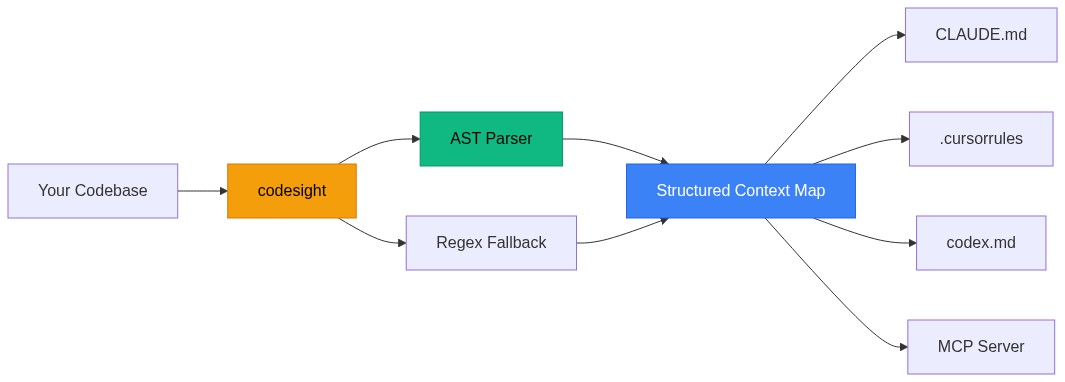
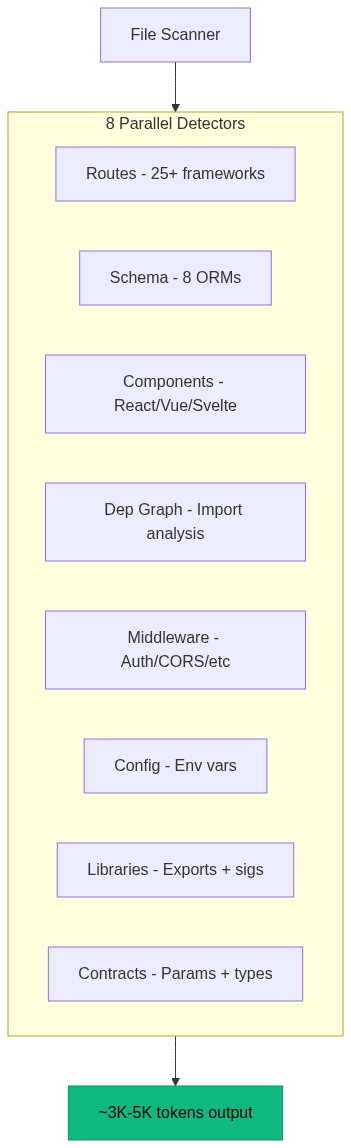
codesight runs all 8 detectors in parallel, then writes the results as structured markdown. The output is designed to be read by an AI in a
single file load.
## What It Generates
```
.codesight/
CODESIGHT.md Combined context map (one file, full project understanding)
routes.md Every API route with method, path, params, and what it touches
schema.md Every database model with fields, types, keys, and relations
components.md Every UI component with its props
libs.md Every library export with function signatures
config.md Every env var (required vs default), config files, key deps
middleware.md Auth, rate limiting, CORS, validation, logging, error handlers
graph.md Which files import what and which break the most things if changed
cicd.md GitHub Actions / CircleCI pipelines (when present)
githooks.md lefthook / husky / raw .git/hooks (when present)
skills.md .claude/commands + .claude/skills (when present)
report.html Interactive visual dashboard (with --html or --open)
```
The last three come from **built-in plugins** that scan the dotfile directories
(`.github/`, `.husky/`, `.claude/`) the main pass skips. They run automatically
and stay silent on projects without those files — so they only ever add a
section when there's something to report.
## AST Precision
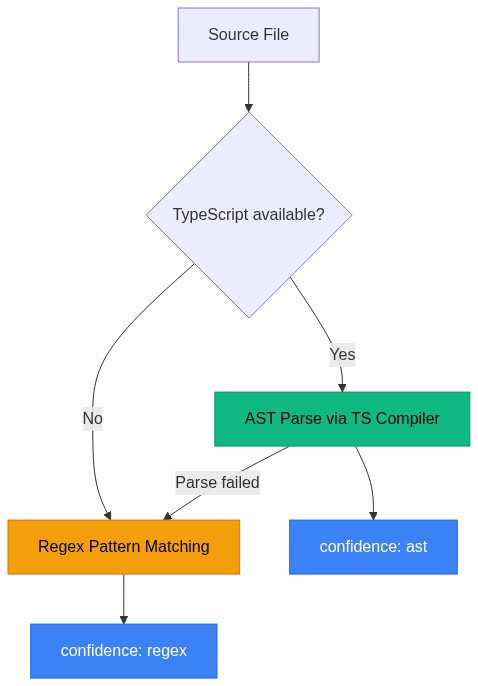
When TypeScript is installed in the project being scanned, codesight uses the actual TypeScript compiler API to parse your code
structurally. No regex guessing.
| What AST enables | Regex alone |
|--------------------------------------------------------------------------|-----------------------|
| Follows `router.use('/prefix', subRouter)` chains | Misses nested routers |
| Combines `@Controller('users')` + `@Get(':id')` into `/users/:id` | May miss prefix |
| Parses `router({ users: userRouter })` tRPC nesting | Line-by-line matching |
| Extracts exact Drizzle field types from `.primaryKey().notNull()` chains | Pattern matching |
| Gets React props from TypeScript interfaces and destructuring | Regex on `{ prop }` |
| Detects middleware in route chains: `app.get('/path', auth, handler)` | Not captured |
| Filters out non-route calls like `c.get('userId')` | May false-positive |
AST detection is reported in the output:
```
Analyzing... done (AST: 60 routes, 18 models, 16 components)
```
No configuration needed. If TypeScript is in your `node_modules`, AST kicks in automatically. Works with npm, yarn, and pnpm (including
strict mode). Falls back to regex for non-TypeScript projects or frameworks without AST support.
**AST-supported frameworks:** Express, Hono, Fastify, Koa, Elysia (route chains + middleware), NestJS (decorator combining + guards), tRPC (
router nesting + procedure types), Drizzle (field chains + relations), TypeORM (entity decorators), React (props from interfaces +
destructuring + forwardRef/memo).
### Native-AST WASM plugins (opt-in)
By default codesight uses its built-in extractors (AST for TypeScript, regex for everything else). Opt in with `--native-ast` to specify
that **WebAssembly plugins** should be used to acquire full-AST precision for non-TypeScript source files:
```bash
npx codesight --native-ast # use every discovered plugin (additive)
npx codesight --native-ast=rust,go # only these languages (authoritative for their files)
npx codesight --native-ast=none # force off (overrides config)
npx codesight --native-ast-strict # like --native-ast, but fail if a named plugin is missing
npx codesight --plugin-dir ./wasm # extra directory to search for plugins
```
Dispatch to WASM plugins is **language-driven**: each plugin self-describes (via a `describe()` export) the file extensions it handles, so
*any* language works — not just the ones with built-in detectors. Where no plugin handles a file, built-in extraction stands; with
`--native-ast` unset, behavior is byte-identical to existing `codesight` behavior.
**codesight's npm package ships no plugins** — they are separate, opt-in artifacts. The project publishes prebuilt reference plugins (Rust/
`syn`, Python/`ruff`, Go/`go/parser`) as checksummed GitHub release assets; drop the ones you want to use into `~/.codesight/plugins/` (or
point `--plugin-dir` at them), then enable them with `--native-ast`. Alternately, you may build your own plugin for *any language* against
the contract.
→ Full contract, discovery rules, and download/install steps: [`docs/wasm-plugins.md`](docs/wasm-plugins.md).
## Built-in plugins
Three first-party plugins run on every scan and surface context the main pass
misses because it lives in skipped dotfile directories. Each is inert until its
target files exist, so they cost nothing on projects that don't use them:
| Plugin | Reads | Output |
|------------|----------------------------------------|--------------------------------------------------------|
| `cicd` | `.github/workflows/`, `.circleci/` | Pipeline triggers, jobs, secrets, deploy targets |
| `githooks` | lefthook / husky config, `.git/hooks/` | Which commands run on which git lifecycle |
| `skills` | `.claude/commands/`, `.claude/skills/` | Available slash commands / agent skills + descriptions |
Opt out of any of them per project:
```js
// codesight.config.js
export default {disableDetectors: ["cicd", "githooks", "skills"]};
```
**Terraform is opt-in**, not auto-loaded — it deliberately reaches outside the
scanned directory (sibling `../infrastructure` repos) and is most useful with an
explicit service name, so it stays off until you ask for it:
```js
// codesight.config.js
import {createTerraformPlugin} from "codesight/plugins/terraform";
export default {plugins: [createTerraformPlugin({infraPath: "../infra"})]};
```
## Routes
Not just paths. Methods, URL parameters, what each route touches (auth, database, cache, payments, AI, email, queues), and where the handler
lives. Detects routes across 30+ frameworks automatically.
Example output:
```markdown
- `GET` `/api/users/me` [auth, db, cache]
- `PUT` `/api/users/me` [auth, db]
- `POST` `/api/projects` [auth, db, payment]
- `GET` `/api/projects/:id` params(id) [auth, db]
- `POST` `/webhooks/stripe` [db, payment]
- `GET` `/health`
```
## Schema
Models, fields, types, primary keys, foreign keys, unique constraints, relations. Parsed directly from your ORM definitions via AST. No need
to open migration files.
Example output:
```markdown
### user
- id: text (pk)
- name: text (required)
- email: text (unique, required)
- role: text (default, required)
- stripeCustomerId: text (fk)
### project
- id: uuid (default, pk)
- ownerId: text (fk, required)
- name: text (required)
- settings: jsonb (required)
- _relations_: ownerId -> user.id
```
## Dependency Graph
The files imported the most are the ones that break the most things when changed. codesight finds them and tells your AI to be careful.
Example output:
```markdown
## Most Imported Files (change these carefully)
- `src/types/index.ts` — imported by **20** files
- `src/db/index.ts` — imported by **12** files
- `src/lib/auth.ts` — imported by **8** files
- `src/lib/cache.ts` — imported by **6** files
- `src/lib/env.ts` — imported by **5** files
```
## Blast Radius
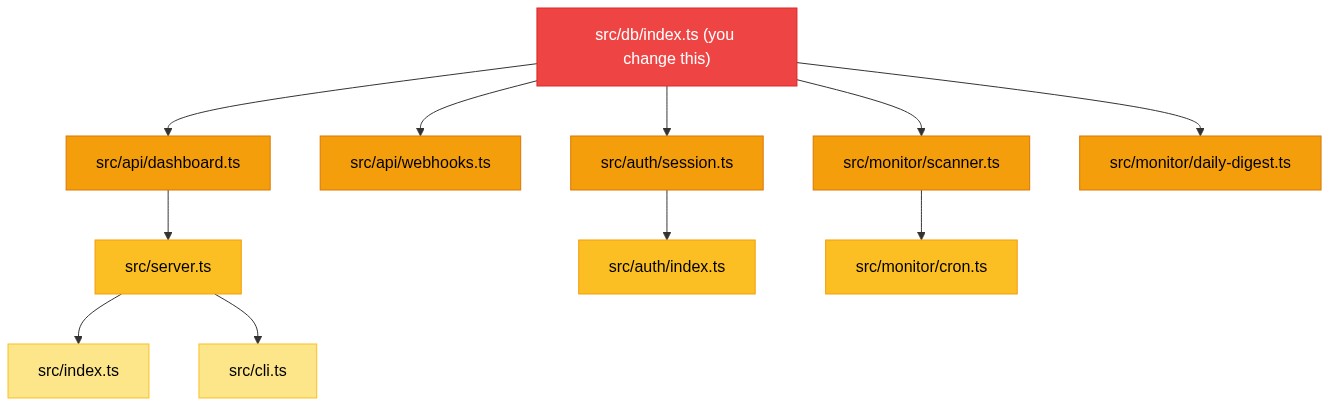
BFS through the import graph finds all transitively affected files, routes, models, and middleware.
```bash
npx codesight --blast src/db/index.ts
```
Example output:
```
Blast Radius: src/db/index.ts
Depth: 3 hops
Affected files (10):
src/api/users.ts
src/api/projects.ts
src/api/webhooks.ts
src/auth/session.ts
src/jobs/notifications.ts
src/server.ts
src/auth/index.ts
src/jobs/cron.ts
src/cli.ts
src/index.ts
Affected routes (33):
GET /api/users/me — src/api/users.ts
POST /api/projects — src/api/projects.ts
POST /webhooks/stripe — src/api/webhooks.ts
...
Affected models: user, session, account, project,
subscription, notification, audit_log
```
Your AI can also query blast radius through the MCP server before making changes.
## Environment Audit
Every env var across your codebase, flagged as required or has default, with the exact file where it is referenced.
Example output:
```markdown
- `DATABASE_URL` **required** — .env.example
- `REDIS_URL` (has default) — .env.example
- `STRIPE_SECRET_KEY` **required** — src/lib/payments.ts
- `STRIPE_WEBHOOK_SECRET` **required** — .env.example
- `RESEND_API_KEY` **required** — .env.example
- `JWT_SECRET` **required** — src/lib/auth.ts
```
## Token Benchmark
See exactly where your token savings come from:
```bash
npx codesight --benchmark
```
Example output (SaaS A — 138 files, Hono + Drizzle):
```
Token Savings Breakdown:
┌──────────────────────────────────────────────────┐
│ What codesight found │ Exploration cost │
├──────────────────────────────┼────────────────────┤
│ 38 routes │ ~15,200 tokens │
│ 12 schema models │ ~ 3,600 tokens │
│ 0 components │ 0 tokens │
│ 30 library files │ ~ 6,000 tokens │
│ 12 env vars │ ~ 1,200 tokens │
│ 5 middleware │ ~ 1,000 tokens │
│ 20 hot files │ ~ 3,000 tokens │
│ 138 files (search overhead) │ ~11,040 tokens │
├──────────────────────────────┼────────────────────┤
│ codesight output │ ~ 3,936 tokens │
│ Manual exploration (1.3x) │ ~46,020 tokens │
│ SAVED PER CONVERSATION │ ~42,084 tokens │
└──────────────────────────────┴────────────────────┘
```
### How Token Savings Are Calculated
Each detector type maps to a measured token cost that an AI would spend to discover the same information manually:
| What codesight finds | Tokens saved per item | Why |
|----------------------|-----------------------|-----------------------------------------------------------------|
| Each route | ~400 tokens | AI reads the handler file, greps for the path, reads middleware |
| Each schema model | ~300 tokens | AI opens migration/ORM files, parses fields manually |
| Each component | ~250 tokens | AI opens component files, reads prop types |
| Each library export | ~200 tokens | AI greps for exports, reads signatures |
| Each env var | ~100 tokens | AI greps for `process.env`, reads .env files |
| Each file scanned | ~80 tokens | AI runs glob/grep operations to find relevant files |
The 1.3x multiplier accounts for AI revisiting files during multi-turn conversations. These estimates are conservative. A developer manually
verified that Claude Code spends 40-70K tokens exploring the same projects that codesight summarizes in 3-5K tokens.
## Roku / BrightScript / SceneGraph
codesight treats Roku channels as first-class projects. The `manifest` file at the channel root anchors detection — the same file Roku
itself uses to identify a channel, so zero configuration is needed for the common case.
**Standard single-channel layout** (about 90% of Roku repos, matches the Roku docs' getting-started template and projects like
`rokucommunity/brighterscript-template`):
```
/
manifest
source/ # Main.brs + shared .brs libraries
components/ # *.xml + paired *.brs component handlers
images/
```
codesight also recognizes the `rokucommunity/brighterscript-template` layout where the channel lives under `src/` and the root carries a
`bsconfig.json` for BrighterScript tooling.
**Multi-channel monorepo layout** (less common — used by larger codebases that ship several branded channels from one repo with
`roku-deploy` + `gulp` to merge a shared `common/` layer with per-channel assets at build time):
```
/
package.json # depends on roku-deploy, gulp
gulpfile.js
src/apps/
common/ # shared layer, merged into every channel at build
creatorA/
manifest
creatorB/
manifest
```
This is detected via a strict structural signal: no manifest at root, `roku-deploy` in deps, and a `common/` directory with at least 2
sibling directories that each have their own `manifest`. When the signal matches, each channel (plus `common/`) is registered as a
workspace.
### Mappings to codesight's data model
| codesight concept | Roku equivalent |
|-------------------|----------------------------------------------------------------------------------------------------------------------------------------------------------------------------------------------------------------|
| Routes | Screens — every child element with an `id` declared in the Scene XML's ``. `method = VIEW` by default, upgraded to `MODAL` if a navigation call-site passes a literal `true` as the second argument. |
| Schema | Every SceneGraph component XML whose `` has at least one `` — the typed contract is the model. |
| Components | Every `` XML (views, tasks, scenes, modals). Props = interface fields. |
| Libraries | `.brs` / `.bs` files outside `components/` — top-level `function`/`sub` plus BrighterScript `class` / `namespace` / `enum` / `interface`. |
| Middleware | `observeField` subscriptions, `m.global.AddField` registrations. BugsnagTask / RudderstackTask recognized when present. |
| Dependencies | `` includes in component XML + `import "pkg:/..."` in `.bs`. |
| Events | Observed fields (`system: scenegraph-observer`) and Rudderstack event names (`system: rudderstack`). |
| Config | The Roku `manifest` key/value lines surfaced as `manifest.` pseudo env-vars. |
### Configurable navigation helpers
Many Roku projects use a custom helper to switch the visible screen (names vary: `ShowScreen`, `pushScreen`, `NavigateTo`, `showView`,
etc.). These are used as optional enrichment to tag routes as `MODAL`. Defaults cover the common conventions; override with
`rokuScreenHelpers` in your codesight config if your project uses a different name:
```json
{
"rokuScreenHelpers": [
"Router.push",
"openScreen"
]
}
```
Routes are still detected from `` even when no helper is present or when no call-site matches.
### Example output
```markdown
- `VIEW` `/homeView` — components/views/HomeView.xml
- `VIEW` `/detailView` — components/views/DetailView.xml
- `MODAL` `/errorModal` — components/modals/ErrorModal.xml
### DataTask
- requestUrl: string
- response: object
```
## Supported Stacks
| Category | Supported |
|------------------|--------------------------------------------------------------------------------------------------------------------------------------------------------------------------------------------------------------------------------------------------------------------------------------------------------------------------------------------------------------------------|
| **Routes** | Hono, Express, Fastify, Next.js (App + Pages), Koa, NestJS, tRPC, Elysia, AdonisJS, SvelteKit, Remix, Nuxt, FastAPI, Flask, Django, Go (net/http, Gin, Fiber, Echo, Chi), Rails, Phoenix, Spring Boot, Ktor, Actix, Axum, Laravel, ASP.NET Core (controllers + minimal API), Vapor, Flutter (go_router), Roku SceneGraph (screens via ShowScreen), raw http.createServer |
| **Events** | BullMQ queues, Celery tasks, Kafka topics, Redis pub/sub, Socket.io, EventEmitter, SceneGraph observers, Rudderstack |
| **Schema** | Drizzle, Prisma, TypeORM, Mongoose, Sequelize, SQLAlchemy, Django ORM, ActiveRecord, Ecto, Eloquent, Entity Framework, Exposed, Room, SceneGraph `` contracts (14 ORMs) |
| **Components** | React, Vue, Svelte, Flutter widgets (StatelessWidget, StatefulWidget, ConsumerWidget), SwiftUI views (auto-filters shadcn/ui and Radix primitives), Roku SceneGraph components |
| **Libraries** | TypeScript, JavaScript, Python, Go, Dart, Swift, C#, PHP, BrightScript, BrighterScript (exports with function signatures) |
| **Middleware** | Auth, rate limiting, CORS, validation, logging, error handlers, SceneGraph observers + `m.global` fields |
| **Dependencies** | Import graph with hot file detection (most imported = highest blast radius); SceneGraph `