



A quota forecast widget for OpenCode Go inside DeepSeek Harness — it tells you when the monthly allowance runs out, and whether that happens before the renewal date.
English · 简体中文

The shipped context ring (54%) and the Go capsule (18%) share the same 14 px / 2 px specification; the capsule stays a text-only trigger, expanding nothing until clicked.
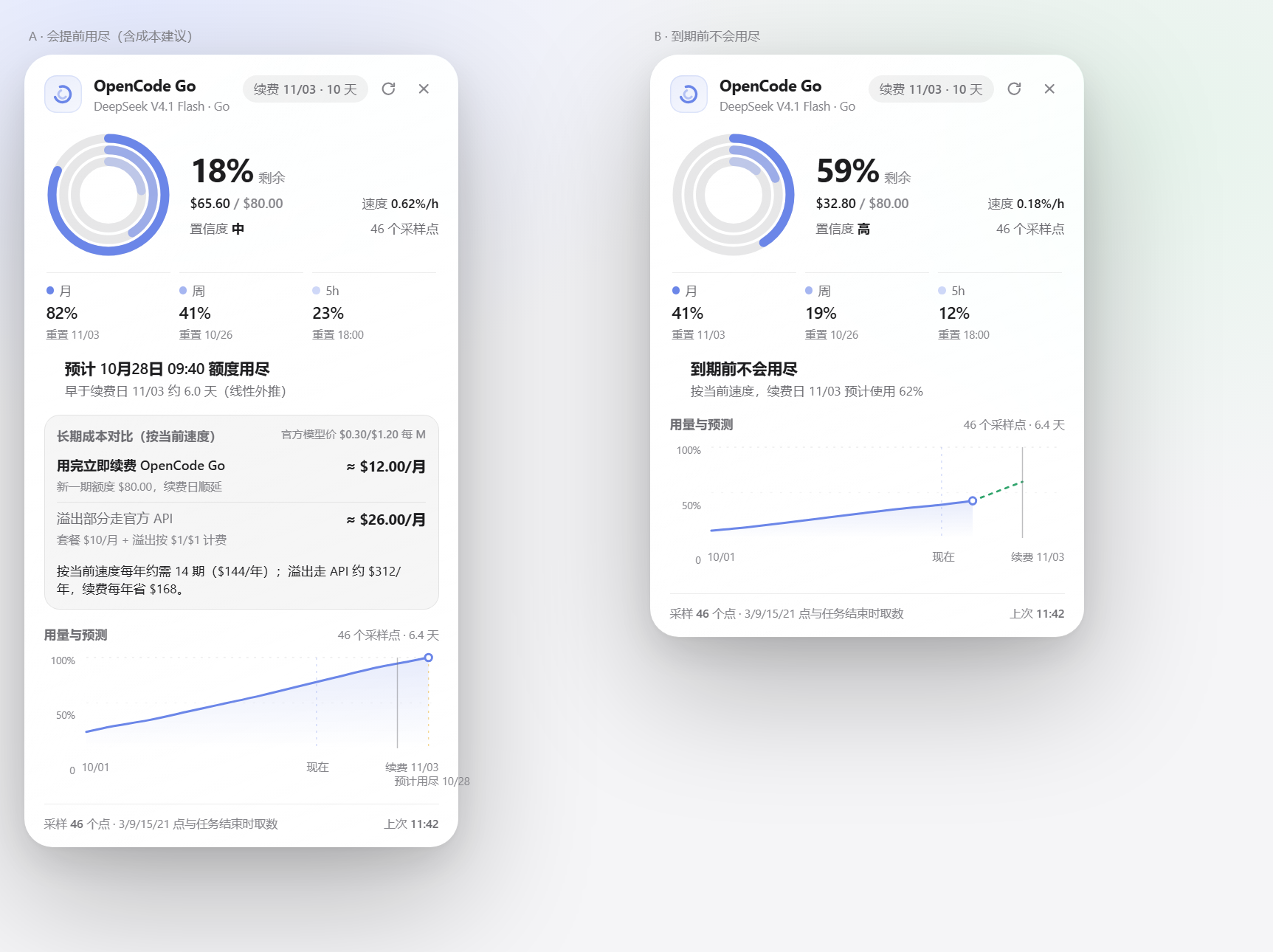
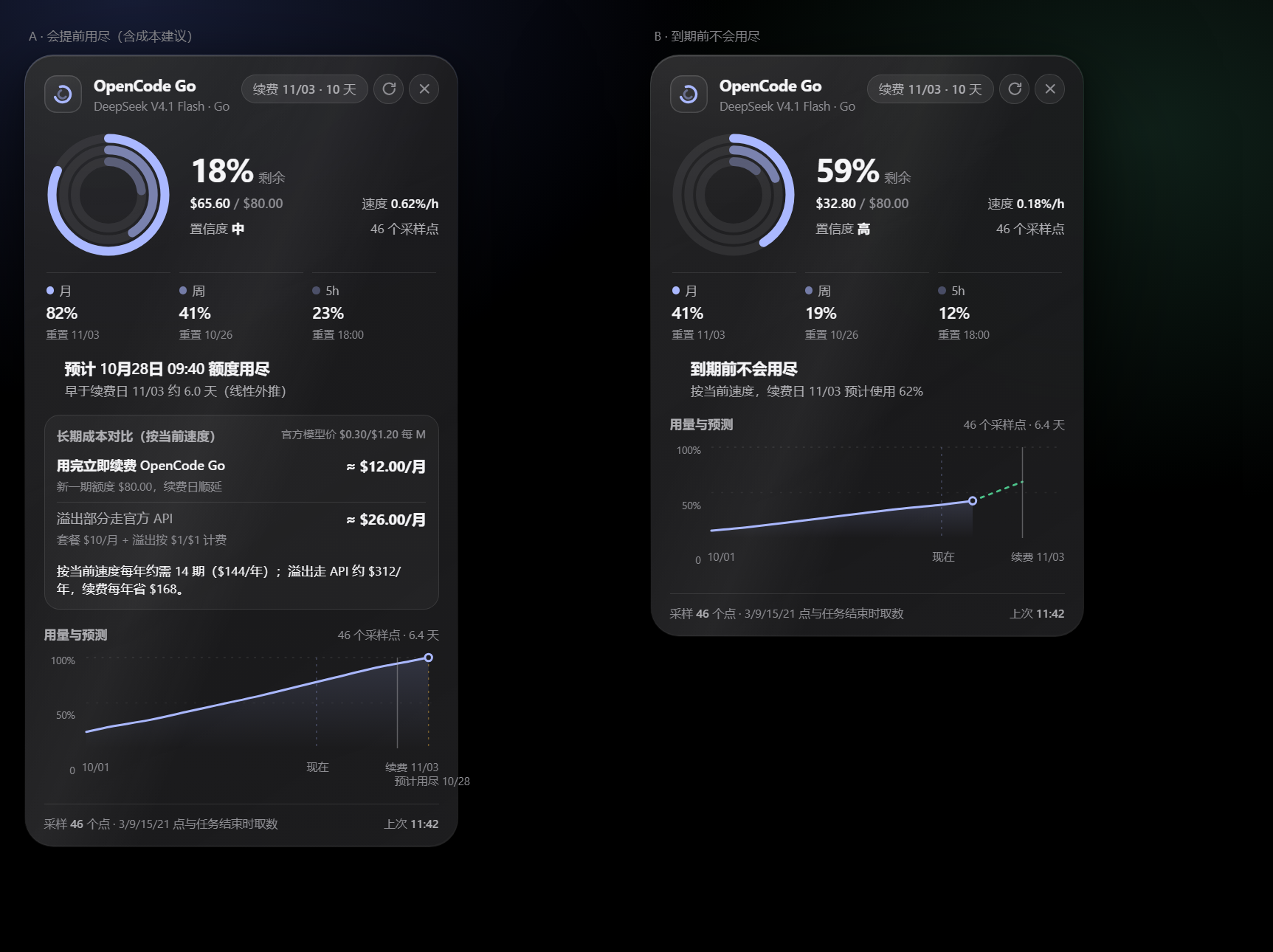
## Why OpenCode Go is a flat monthly subscription, but its console only shows *used percentages* and a reset time. It does not tell you whether your current pace will exhaust the allowance before the renewal date — the one question that decides whether you need to top up, renew early, or switch to the pay-as-you-go API for the rest of the period. This plugin keeps a small local history of the official quota readings and answers that question in the composer dock. It never reads your session logs: the Go allowance is account-wide, so only the official percentage sees usage from every client. ## Features - **Projected exhaustion time** — a reset-aware Theil–Sen fit over the recorded quota samples gives an ETA per window, with a confidence tier. No guessing from a single reading. - **Renewal-date comparison** — says plainly whether the monthly allowance will run out *before* the renewal date, or leave headroom until then. - **Long-run cost advice** — when the quota will run out early, it compares two steady-state policies: renewing OpenCode Go (a prepayment of the next period, unit cost `planPrice ÷ allowance` per $1 of usage, about $0.125) versus paying the overflow on the official API ($1 per $1). Renewal is recommended unless the new allowance would largely expire unused. - **Merged usage & forecast chart** — history, projection, “now”, ETA and renewal markers on one time axis, with a 0–100 % axis. - **Native composer dock capsule** — the 14 px / 2 px ring matches the shipped context meter, so both rings read as peers; the card itself is a liquid-glass panel that dims its highlight layers in dark mode. - **Per-model allowance** — Go's monthly limit is *per model* (DeepSeek V4.1 Flash: $80 on Go, $160 on Go Plus; Kimi K3: $15). The card shows the model and its allowance, while percentages stay authoritative from the console. - **No polling storms** — samples at four local anchors a day, on task ends, on start-up and on demand. ## Install Requires DeepSeek Harness 0.2.x (Desktop or Web profile) and Node.js ≥ 22. ```powershell # from GitHub dsh plugin --profile desktop add github:HugoOu/dsh-opencode-go-eta # or from a local checkout dsh plugin --profile desktop add link:C:\path\to\dsh-opencode-go-eta ``` Restart DSH completely after installing. The capsule appears below the composer; click it for the card. > The plugin row is a bundle patch: `dsh plugin add` appends `dsh-opencode-go-eta` to > `dsh.profile.bundles` automatically, and the bundled `cordis.patch.yml` inserts the host row. ## Configuration Add to your profile's `cordis.patch.yml` to override the defaults: ```yaml - id: opencode-go-eta name: dsh-opencode-go-eta config: apiKeyRef: OPENCODE_GO_API_KEY # credential reference, not the key itself anchors: [3, 9, 15, 21] # local hours; [] disables timed sampling sampleIntervalMs: 1200000 # minimum gap between implicit samples staleAfterMs: 2700000 # a read this old triggers a fresh sample retentionDays: 45 planName: Go # shown in the card planPriceUsd: 10 # price of one period, used by the advice modelLabel: DeepSeek V4.1 Flash modelAllowancesUsd: deepseek-v4.1-flash: 80 # Go table; use 160 for Go Plus pricingModel: deepseek-v4.1-flash pricingUrl: https://models.dev/api.json pricingTtlMs: 43200000 ``` The API key is resolved through the Harness credentials service (`OPENCODE_GO_API_KEY`); it never reaches the browser. ## How it works | Stage | Behaviour | | --- | --- | | Sampling | `GET /zen/go/v1/usage` (percentages + resets) and `GET /console/api/go/status` (meters, period start/end) — at 03/09/15/21 local, on `turn/end`, at start-up, and on demand. | | History | Samples are kept for 45 days in `$DSH_HOME/opencode-go-eta/samples.json` (atomic writes). | | Projection | Samples from before the last reset are cut; the Theil–Sen slope of the current cycle gives the ETA. Fewer than 3 points or a span under 6 h is reported as *insufficient samples*. | | Verdict | ETA is compared with the window reset and the subscription's `endsAt`: *before expiry*, *after expiry*, *safe within the cycle*. | | Advice | Two steady-state policies: **renew** prices every $1 of usage at `planPriceUsd ÷ allowance` (≈ $0.125), **API overflow** costs $1 per $1 on top of the plan. Costs are annualised: at $96/month of usage the allowance lasts about 25 days, so renewal means ~14 periods/year (≈$144) while the API path costs ≈$312/year. Renewal wins whenever usage exceeds one allowance; the API only wins when the new allowance would expire unused. Official model prices come from models.dev (12 h cache) for display only. At $96/month of usage the allowance lasts about 25 days, so renewal means ~14 periods/year (≈$144) while the API path costs ≈$312/year. | The console meter is a plan-credit cap (observed $60), while the official Go table lists a per-model monthly allowance (DeepSeek V4.1 Flash: $80). Percentages always follow the console; money follows the model allowance so the two never contradict each other silently. ## Development ```bash node test/projection.test.mjs # 10 pure-math tests: slope, reset cutting, verdicts node test/host.test.mjs # 2 host tests: stubbed fetch, route payload node test/client.test.mjs # 4 client tests: slot registration, render, fetch ``` No network or real key is needed. `preview.html` reproduces the shipped styles with mock data (`#shot` hides the page chrome; `#shot-dark` renders the dark theme). ## Limitations - `/console/api/go/status` is an internal console endpoint; if it changes, the card falls back to percentages only. - Projections are linear extrapolations from your own sampling history, not vendor forecasts. - Cost advice assumes the quota-meter value and the official list price share the same scale; the token estimate is an approximation. - The plugin stores no prompts or session data — only quota readings and the pricing cache. ## License [MIT](LICENSE) © 2026 HugoOu