Private enquiry regarding property acquisition Elena Martín González Stavroula Konstantopoulou Carlos Candel Lozano “Dodona Travels to Ithaca. Artificial Intelligence Applied to the Edition of Greek Inscriptions”, NextGenerationEU, Consolidación Investigadora 2023 (CNS2023-144714). I.Dodone Online 6A

Creative Commons Attribution-NonCommercial-ShareAlike International License 4.0.

All citation, reuse or distribution of this work must contain a link to the URL https://dodonaonline.com/ and the filename, as well as the date of consultation.

n/a

Lead tablet with a hole at one end.

2.5 6.8 0.16

The tablet is inscribed on both sides. The same side also preserves another inscription (5A), inscribed upside down in relation to the present text, as well as traces of earlier inscriptions that remain discernible but are no longer legible. Two further inscriptions (7B and 8B) are preserved on the reverse of the tablet.

Doric

Corinthian

Letter height: ca. 0.3 cm; interlinear space: 0.2 cm. Irregular lettering.

5th century BC

Dodona
Dodona, Evangelidis’ excavation 1935. Archaeological Museum of Ioannina inv. M20; AMI 12209.

Encoded according to the EpiDoc Guidelines, version 9.

English Ancient Greek Latin French German Modern Greek Spanish Question Property Facsimile, photograph, and autopsy conducted by Carlos Candel Lozano (2024) Initial encoding by Stavroula Konstantopoulou

6A; 6A [last consulted 03/07/2026]).

Cf. , 303 nn. 65, 68 (on πεπαμένος); , 41 (on dialect mixture); , 84 n. 64 (on the use of the optative); , §7 (on πεπαμένος).

ἐ͂ πέπαται καὶ πεπαμένος λϊόν κα πράσοι;
ΠΕΠΑΤΑ on the lamella i.e. πράσσοι

Has he acquired it, and would he fare better for having acquired it?

¿Lo ha adquirido y le iría mejor habiéndolo adquirido?

On the productive lexical family of πάομαι (Att.-Ion. κτάομαι) in the oracular tablets, see , 302-304 and , §4.1. For misspellings in the oracular lamellae, see , 267-272.

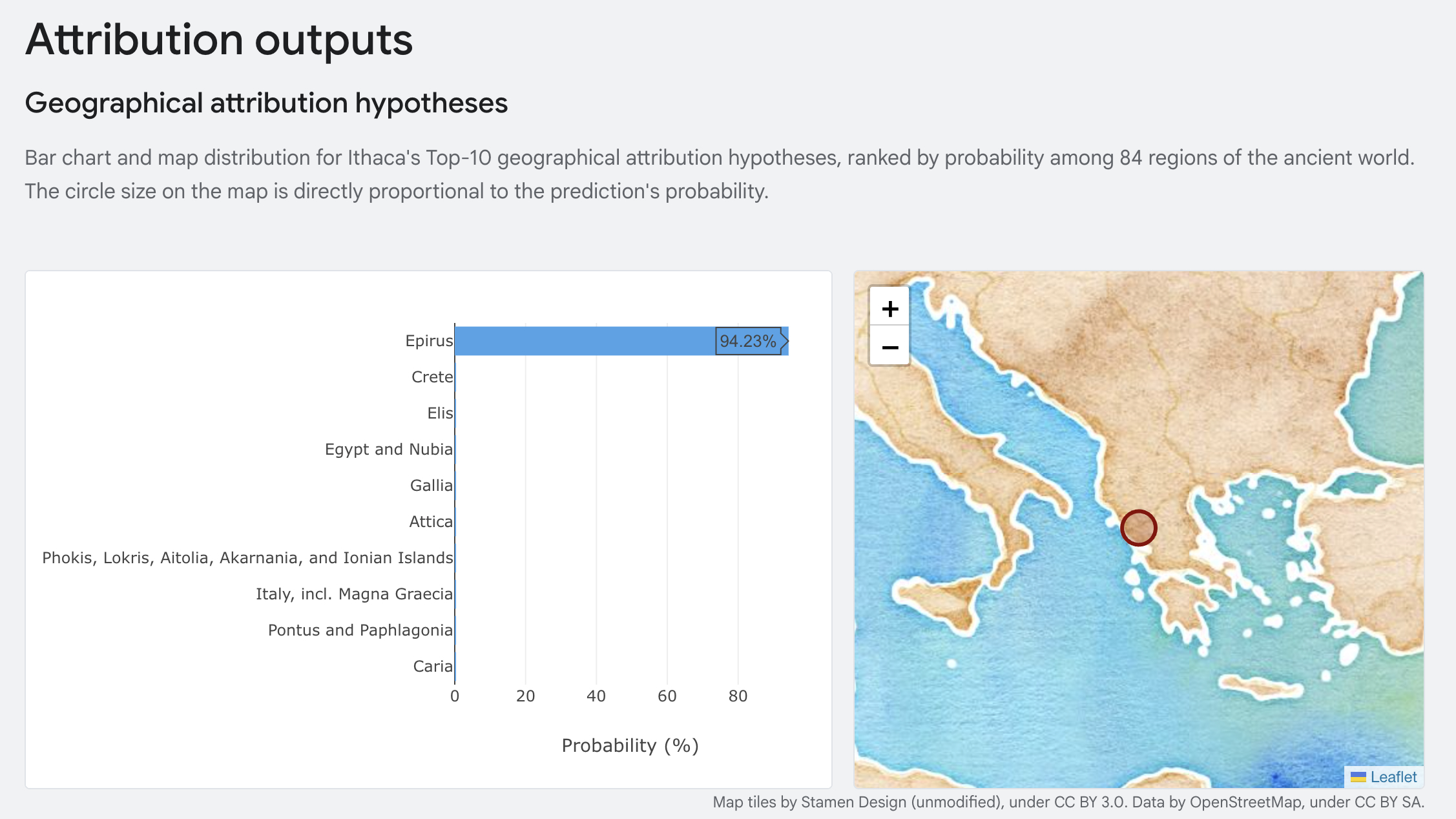
Ithaca attributes the inscription to Epirus with a confidence of 94.23% and dates it most probably to the beginning of the fourth century BC, with a peak probability for 400-390 BC. See Ithaca results and metadata, and a snapshot of the geographical attribution.
$$$