# viktor Benchmarks
We designed a series of [JMH](https://openjdk.java.net/projects/code-tools/jmh/) micro-benchmarks to compare `viktor`'s
SIMD efficiency to that of a simple Kotlin/Java loop.
The microbenchmark code can be found in `src/jmh` folder. To run the benchmarks, run
the following commands from `viktor`'s root folder:
```bash
$ ./gradlew jmh
```
This will create a file `build/jmh/results.csv`, copy it into `amd64.csv` or `aarch64.csv` for visualization.
Next, launch the command line:
```bash
$ python plot_benchmarks.py amd64.csv aarch64.csv
```
## Benchmark Environment
We conducted the benchmarking on two machines:
a laptop running on Apple MacBook Pro M4 Max
and a desktop running on Intel(R) Core(TM) i7-7700K.
The following table summarizes the main features of both:
machine | laptop | desktop
-------------------|-----------------------------------------------------|-------------------------------------------------------------------
architecture | `aarch64` | `amd64`
CPU | Apple M4 Max | Intel Core i7-7700K
cores1 | 16 | 8
OS | Sequoia 15.5 | Ubuntu 22.04 LTS
JVM | OpenJDK Runtime Environment Homebrew (build 21.0.7) | OpenJDK Runtime Environment (build 21.0.7+6-Ubuntu-0ubuntu122.04)
1 The number of cores shouldn't matter since all benchmarks ran in a single thread.
## Benchmark Results
The following data is provided for informational purposes only.
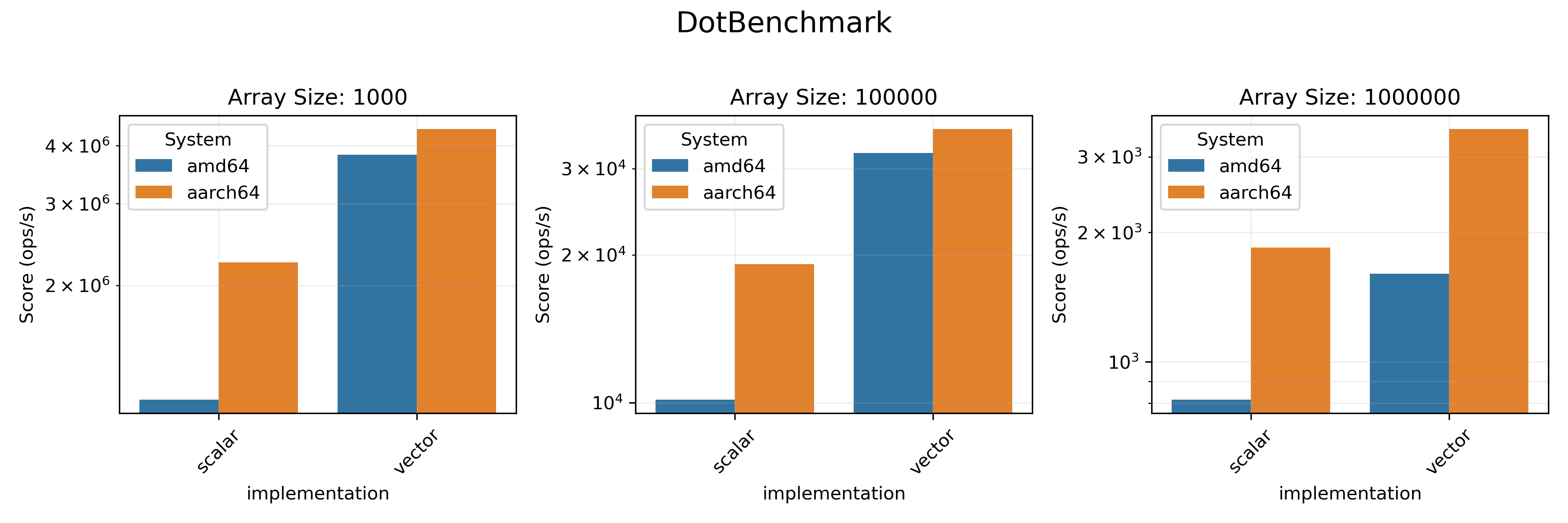
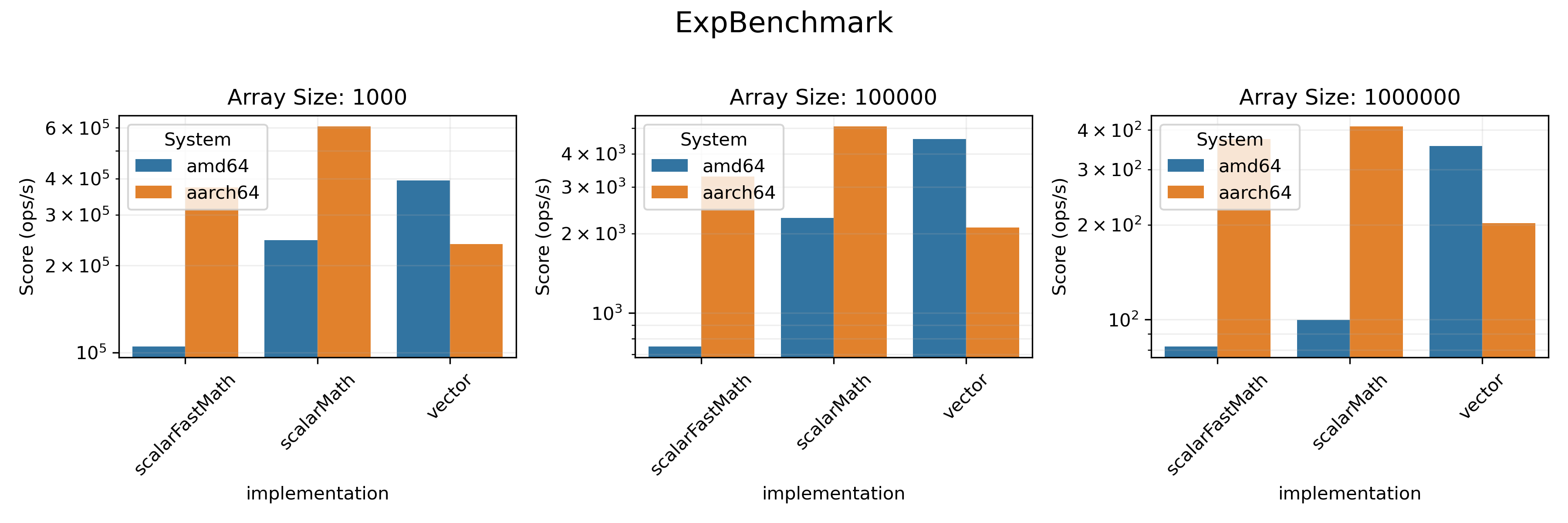
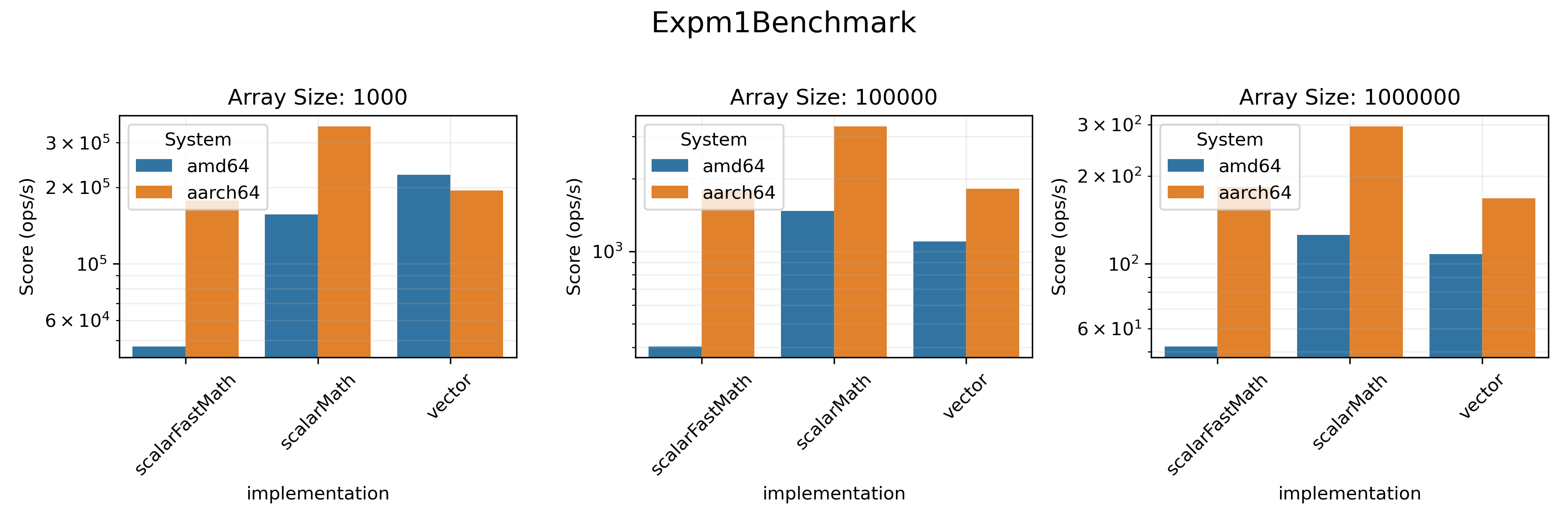
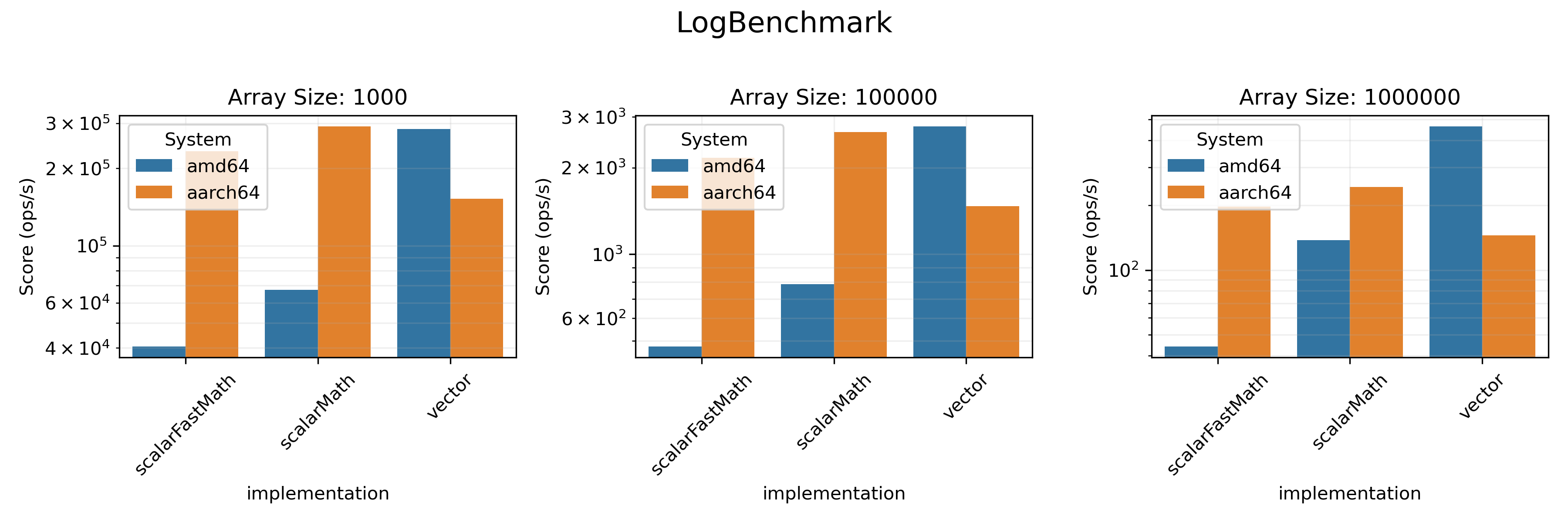
In each benchmark, we considered arrays of size `1000`, `100_000` and `1_000_000`.
We investigate two metrics:
* `Array ops/s` is the number of times the operation was performed on the entire array
per second. Shown on a logarithmic scale.
### Math Benchmarks
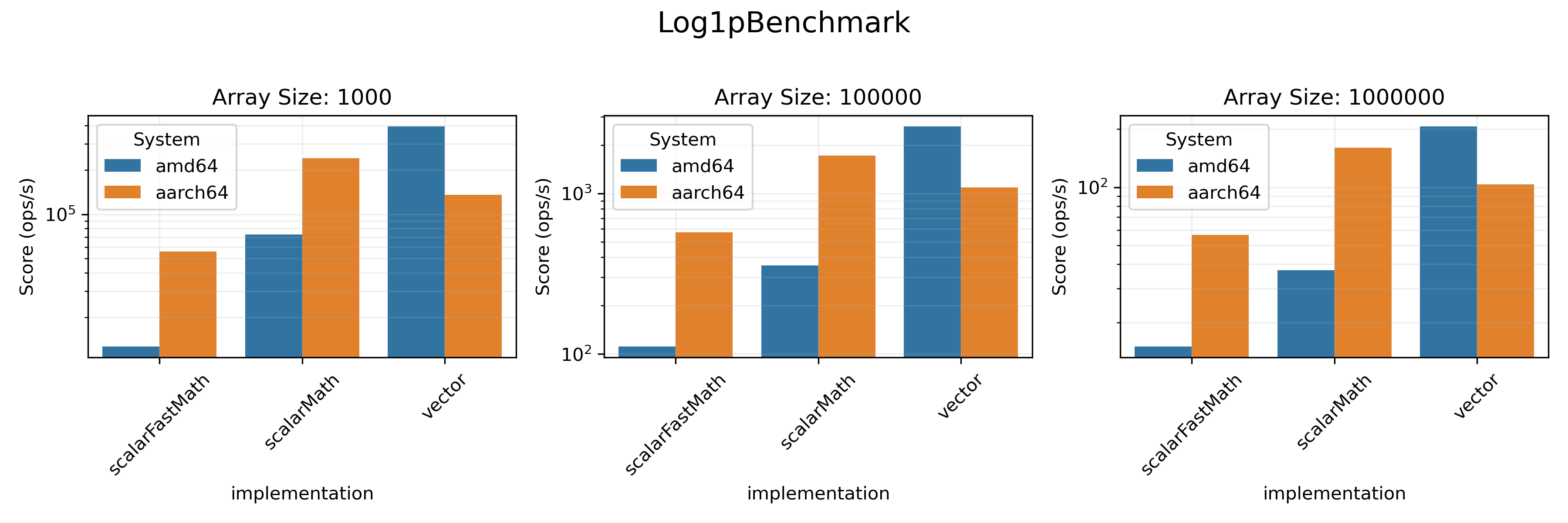
The task here was to calculate exponent (logarithm, `expm1`, `log1p` respectively)
of all the elements in a double array. It was done either with a simple loop,
or with a dedicated `viktor` array method (e.g. `expInPlace`). We also evaluated the
efficiency of
[
`FastMath`](https://commons.apache.org/proper/commons-math/javadocs/api-3.3/org/apache/commons/math3/util/FastMath.html)
methods compared to Java's built-in `Math`.
We also measured the performance of `logAddExp` method for adding
two logarithmically stored arrays. It was compared with the scalar `logAddExp`
defined in `viktor`.
### Statistics Benchmarks
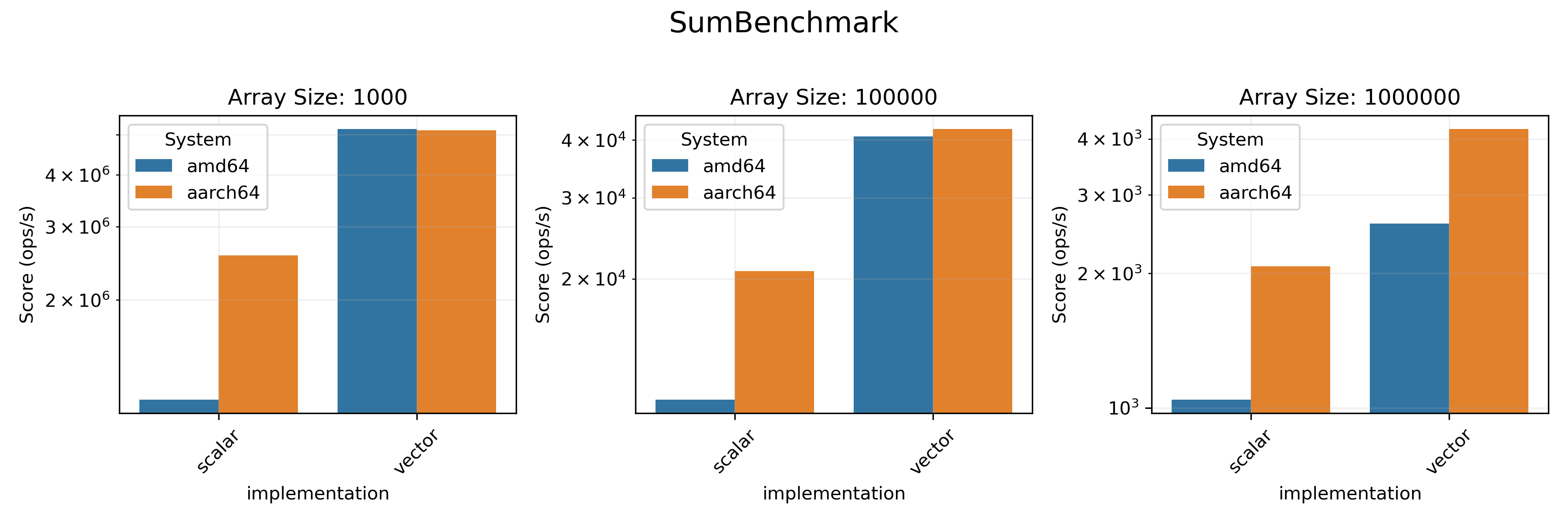
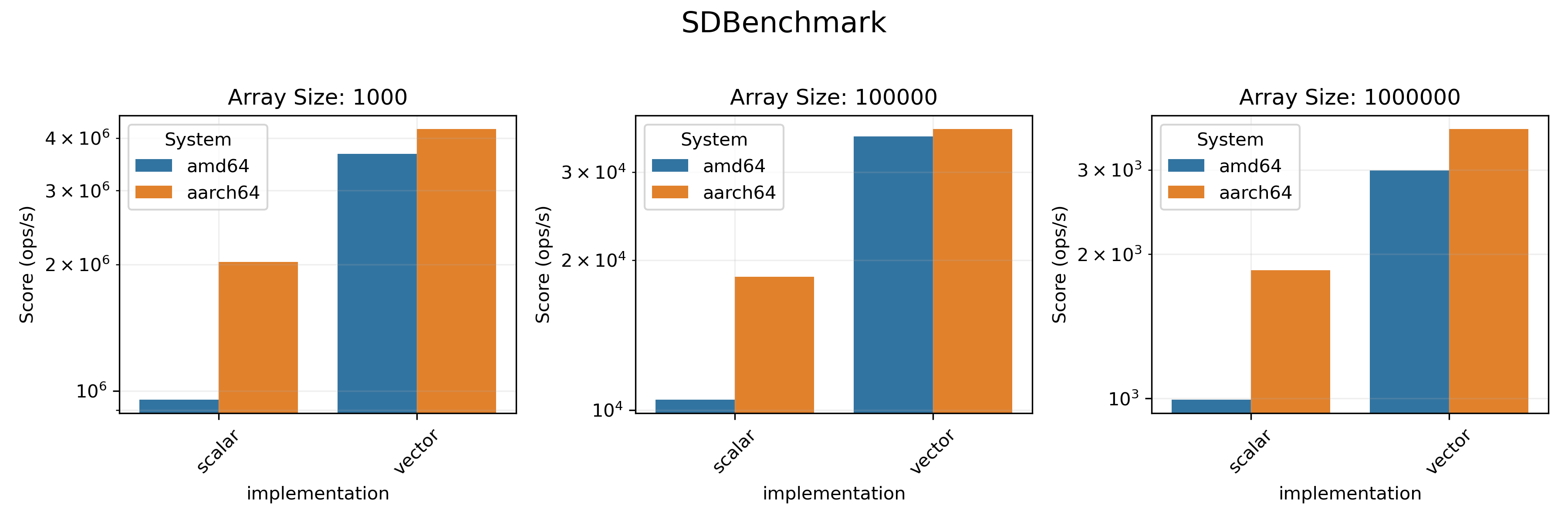
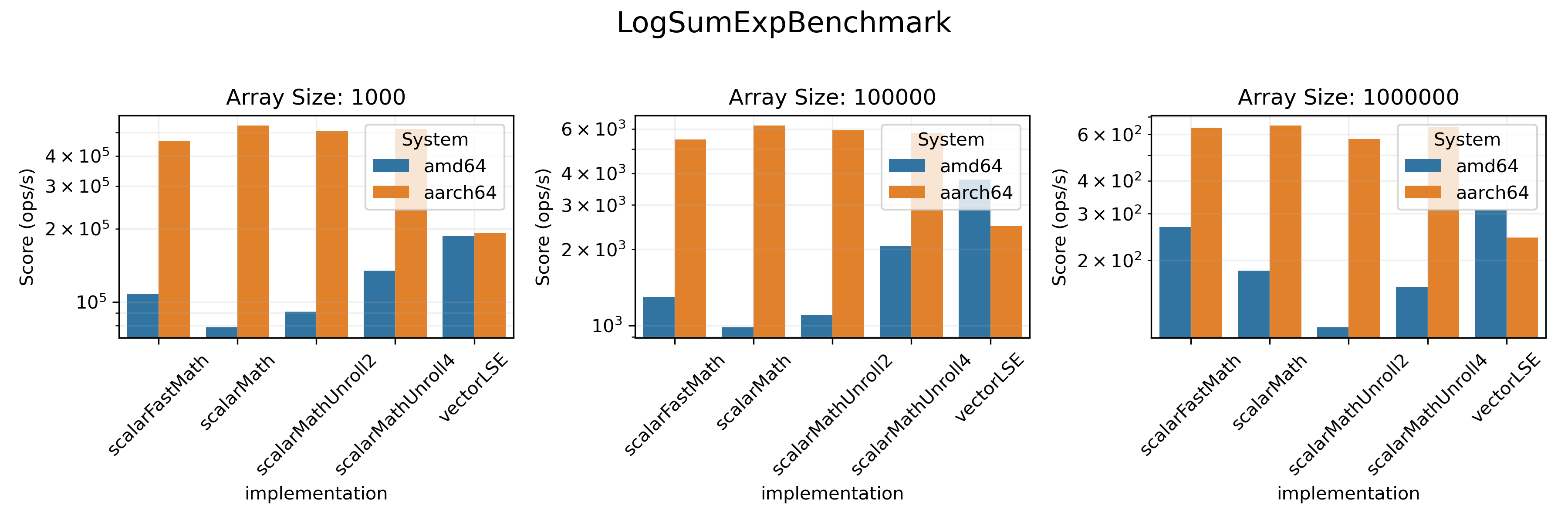
We tested the `sum()`, `sd()` and `logSumExp()` methods here. We also measured
the throughput of a dot product of two arrays (`dot()` method). All these benchmarks
(except for `logSumExp`) don't have a loop-based `FastMath` version since they only
use arithmetic operations in the loop.
## Conclusions
* On `amd64` architecture vectorized realisation provides a visible boost in performance in almost all benchmarks.
* On `aarch64`, only `SumBenchmark` and `SDBenchmark` benefit from vectorization.