


Website ·
Discord ·
English · 简体中文 · 繁體中文 · Italiano
**Tiny engine, immense model.** Explore **GLM-5.2 (744B-parameter MoE)** across
consumer and heterogeneous hardware — in pure C, with zero engine dependencies,
by treating storage, RAM, and VRAM as one inference hierarchy.
> **Colibrì is an experimental inference engine and research platform.** Its
> primary goal is to pursue inference-side performance across the entire
> software/hardware boundary — model formats, memory hierarchy, storage I/O,
> placement, scheduling, kernels, speculation, and CPU/GPU overlap — so large
> models depend less on scarce hardware and cost less to run.
Colibrì treats VRAM, RAM, and storage as one managed memory hierarchy. It is
deliberately a place to test aggressive systems ideas, not a production runtime
with an SLA. Experiments must earn their place through reproducible end-to-end
measurements, and the default policy **never silently changes model precision
or router semantics**. Insufficient fast memory may reduce speed; it must not
quietly redefine the model.
```
$ ./coli chat
🐦 colibri v1.1.0 — GLM-5.2 · 744B MoE · int4 · streaming CPU
✓ ready in 32s · resident 9.9 GB
› ciao!
◆ Ciao! 😊 Come posso aiutarti oggi?
```
## See it running
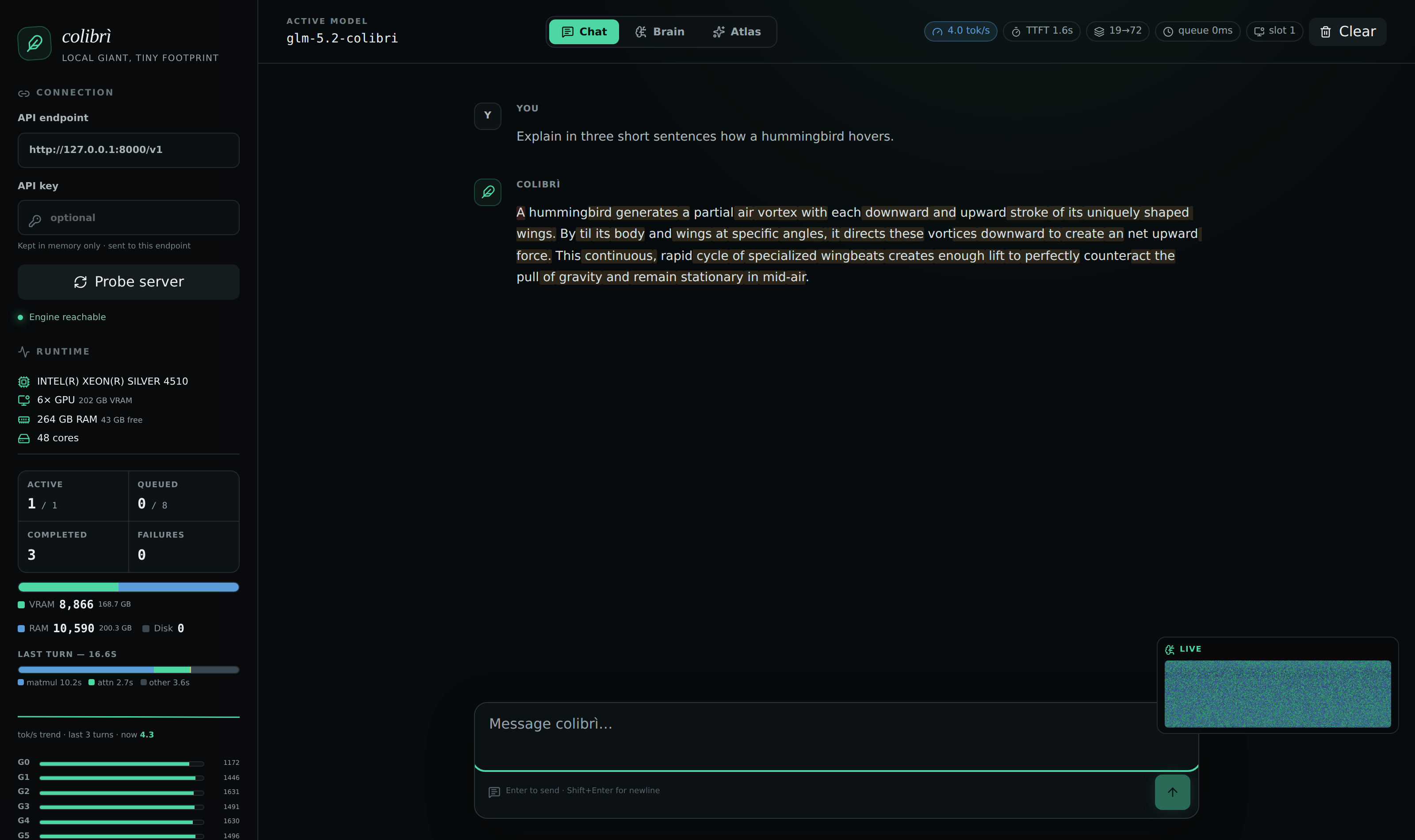
The web dashboard (./coli web): a 744B model at 4 tok/s, TTFT 1.6 s, disk 0 —
full expert residency on 6× RTX 5090, with live token metrics, the per-turn time breakdown,
the VRAM/RAM/disk tier bar and the live mini-brain in the corner.
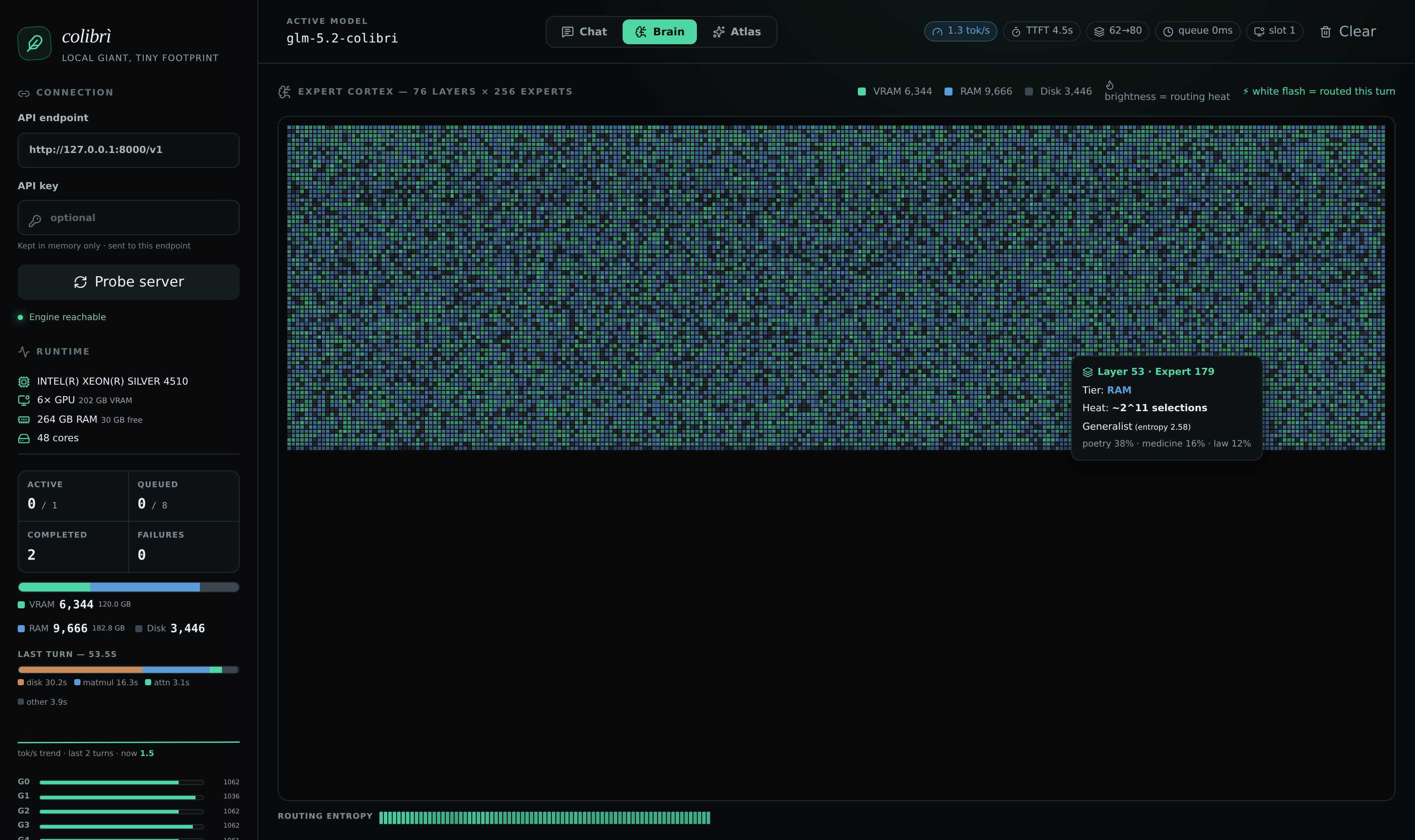
The Brain page: all 19,456 experts as a living cortex — colour is the storage tier,
brightness is routing heat, and every expert routed in a turn flashes white. Hovering shows the expert's
measured topic affinity.
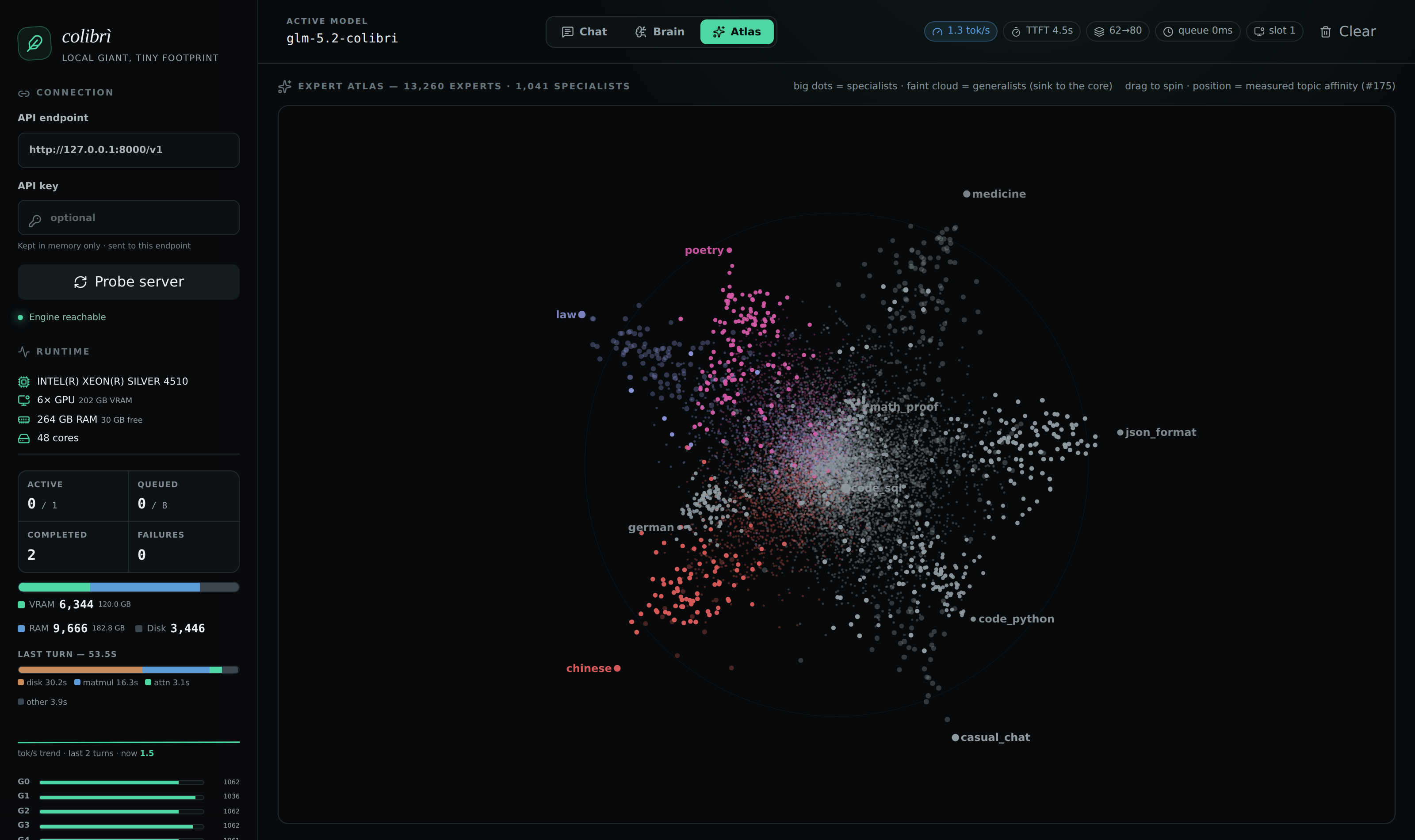
The Atlas page: the measured expert atlas
as a 3-D galaxy — 13,260 characterised experts, 1,041 replicated specialists clustering by topic
(poetry, law, Chinese, SQL…). Position is measured routing affinity, not a learned embedding. Drag to spin.
## The research mission
Frontier inference should not require datacenter-class hardware by default.
Colibrì's research target is simple: **reduce the hardware dependency and total
cost of inference by optimizing every part of the inference path that evidence
shows is limiting it**.
That includes changing how weights are represented and moved, deciding what
lives in VRAM, RAM, or storage, overlapping heterogeneous compute, reducing
launch and synchronization overhead, exploiting sparsity and reuse, and testing
new decoding algorithms. Nothing is protected merely because it is conventional;
nothing is adopted merely because a microbenchmark looks fast. The deciding
result is end-to-end inference on real machines, with correctness and quality
measured alongside throughput, latency, memory, and cost.
The practical consequence is accessibility: run a 744B-parameter model on
hardware you already own, watch every expert fire in real time, and change the
code that does it. Not renting intelligence behind an API — *holding* it:
probing it, measuring it, improving it. The engine is deliberately small enough
that the next useful optimization can come from anyone willing to measure it.
## Core techniques and measured findings
- **One hierarchy, not one memory threshold.** VRAM, RAM, and NVMe are placement
tiers for the same weights; limited fast memory changes speed, not model semantics.
- **A JIT for weights.** Measured routing heat drives a per-layer LRU, a learned
pinned hot-store, and one-layer-ahead prefetch instead of loading every expert.
It wins on repeatable workloads; history can overfit, and lookahead can lose on
some hosts, so both remain measurable policies rather than promises.
- **I/O is part of the engine.** Batched expert unions, overlapped reads and
compute, `O_DIRECT`, and weighted dual-SSD striping attack the streaming path
rather than pretending storage latency is free. `O_DIRECT` is drive-dependent,
and dual-SSD still needs broader end-to-end community A/Bs.
- **Heterogeneous execution.** CPU, CUDA, Metal, NUMA memory, and partial or full
expert residency share one runtime and can be combined according to the machine;
the profitable combination depends on compute, bandwidth, residency, and workload.
- **Compressed state without a different model.** Token-exact forward validation,
57× smaller MLA KV state, persistent warm conversations, and faithful DSA keep
optimization tied to correctness. These are memory, latency, and correctness
properties — not a blanket throughput claim.
- **Speculation that must earn its keep.** Native MTP and grammar-forced drafts
are measured end to end and can be disabled when acceptance does not repay verification.
## Open hypotheses, experiments, and how to help
Colibrì treats an optimization as a hypothesis until a controlled end-to-end A/B
shows otherwise. These are the main questions now:
| hypothesis | evidence so far | experiment still needed |
|---|---|---|
| Routing history can place experts better than plain LRU | learned pins improve repeated workloads, but can overfit a prompt | held-out, cross-session A/Bs across coding, chat, multilingual, and long-context workloads |
| Multiple SSDs can turn independent bandwidth into decode speed | weighted mirror/split routing is implemented and validated; the bandwidth model is sound | cold-cache one-drive vs two-drive GLM-5.2 runs on real, independent controllers |
| A hardware-aware planner can approach each machine's best configuration automatically | RAM/VRAM budgets and several backends are detected today | compare the generated plan with a controlled parameter sweep across laptops, workstations, NUMA hosts, and multi-GPU systems |
| Lossless or quality-bounded representations can reduce weight movement enough to matter | format and quantization ablations exist, with correctness/quality gates | reproduce quality, bytes moved, latency, and cost per useful token together — not compression ratio alone |
| Routing-aware speculation can pay before near-full residency | MTP and grammar drafts work, but MTP has also measured a 32% loss around 85% expert hit | map the break-even surface across acceptance, expert hit rate, batch union, and draft depth |
| CPU/GPU overlap can hide transfer and synchronization rather than merely move the bottleneck | CUDA and Metal wins exist, but fast CPUs and low residency can erase them | per-stage profiles and one-variable A/Bs across PCIe, unified-memory, and full-resident machines |
Want to help? Pick one row and publish the negative results too. Record the
hardware, commit, model/container, exact command, prompt, cache state, throughput,
TTFT, expert hit rate, bytes read, and quality check; change one variable, repeat
the run, and attach raw logs. Start with
[CONTRIBUTING.md](CONTRIBUTING.md), compare against
[the benchmark protocol](docs/benchmarks.md), then
[open an experiment issue](https://github.com/JustVugg/colibri/issues/new).
A well-controlled failure is more valuable here than an unexplained fast number.
## The idea
A 744B Mixture-of-Experts model activates only ~40B parameters per token — and
only ~11 GB of those change from token to token (the routed experts):
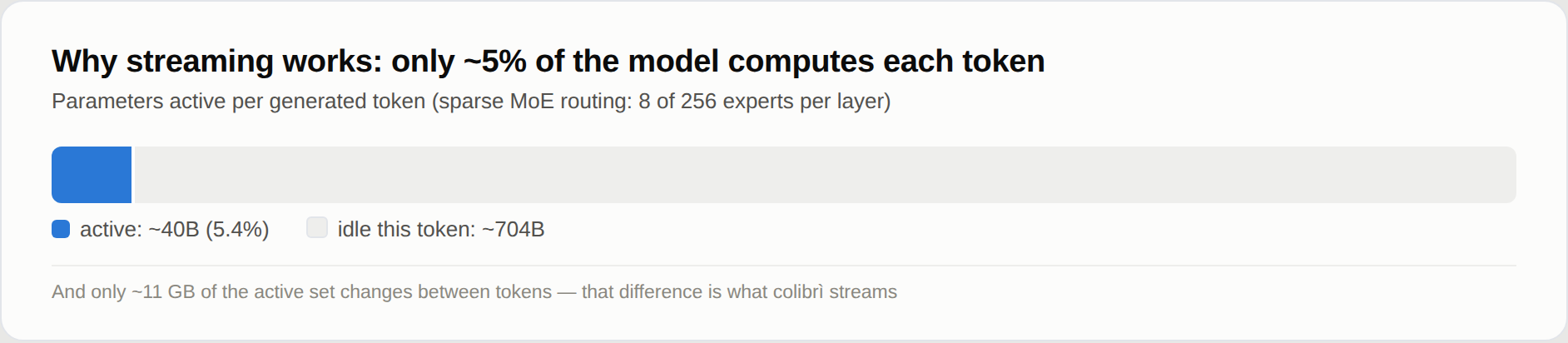
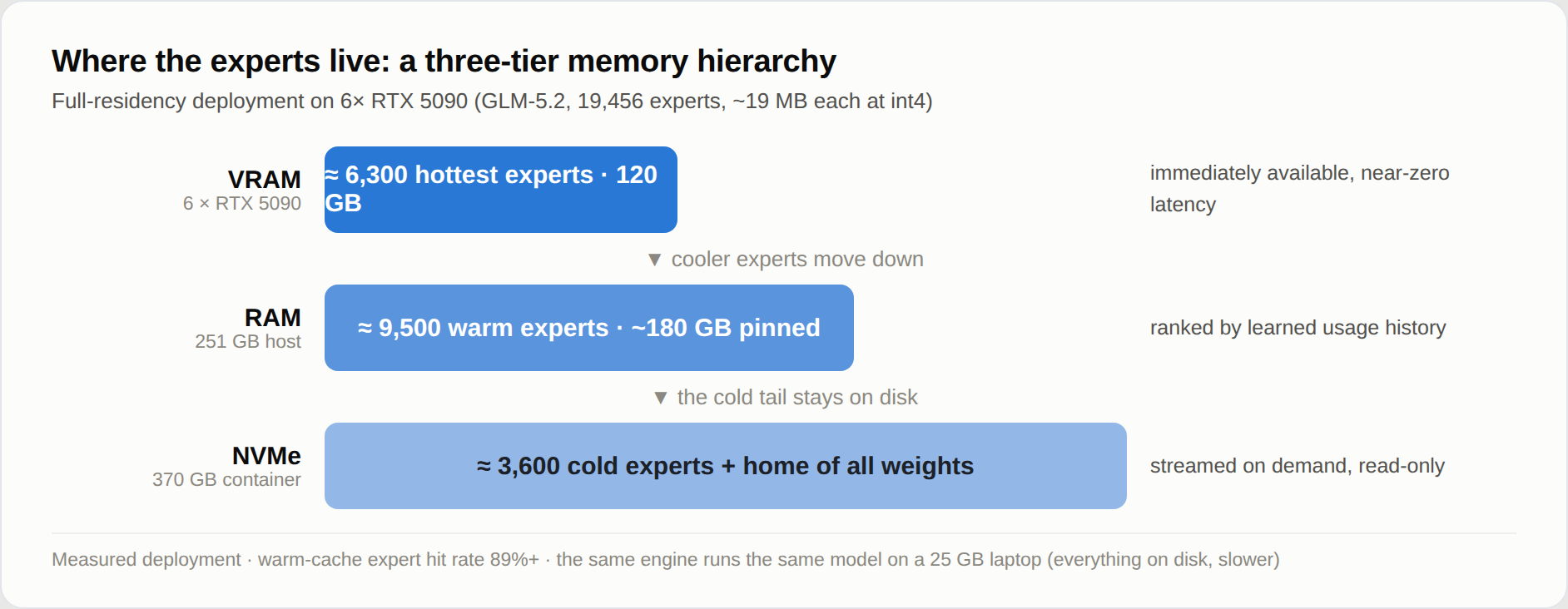
So the model doesn't need to *fit* in fast memory — it needs to be **placed**:
- the **dense part** (attention, shared experts, embeddings — ~17B params) stays
**resident in RAM at int4** (~9.9 GB);
- the **19,456 routed experts** (75 MoE layers × 256 + the MTP head, ~19 MB each
at int4) live **on disk** (~370 GB) and are **streamed on demand**, with a
per-layer LRU cache, a learned pinned hot-store, and an optional VRAM tier.
Think of the core algorithm as **a JIT, but for weights**. A compiler JIT never
compiles the whole program — it watches what actually runs and compiles the hot
paths, just in time. colibrì makes the same bet about a 744B parameter space:
parameters are not resident state to be held, they are **data to be staged**
across a heterogeneous storage hierarchy (VRAM / RAM / NVMe), exactly when the
router proves they are needed. Measured routing heat decides which experts earn
which tier, the router runs a layer ahead so prefetch hides the staging latency,
and — like a JIT — the engine learns your workload: the more you run, the hotter
the right experts get. It works because routing has measurable structure (see
the [expert atlas](https://github.com/JustVugg/colibri/issues/175)) — and
structure is cacheable.
The engine is a single C file (`c/glm.c`) plus small headers. No BLAS, no Python
at runtime, no GPU required.
## How it works
### The per-token path
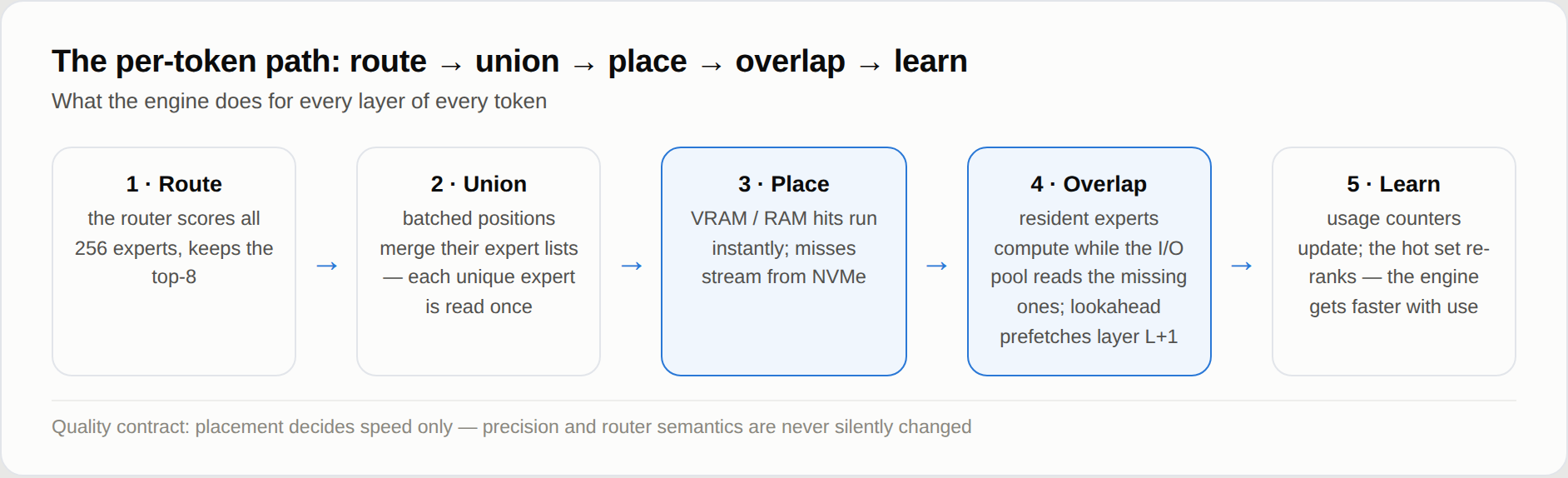
Every layer of every token walks the same five steps. The design goal is that
**placement only ever decides speed** — the router's decisions and the weights'
precision are the same whether an expert answered from VRAM or from disk.
### One memory hierarchy instead of one memory requirement
### Dual-SSD: two copies of the model, twice the read bandwidth
Decode is disk-bound on most machines, and expert reads are read-only — so if you have a **second SSD**, put a full copy of the model on it and let the engine stream from both drives at once:
```bash
COLI_MODEL=/fast/glm52_i4 COLI_MODEL_MIRROR=/second/glm52_i4 ./coli chat
COLI_DISK_WEIGHTS=9,3 ... # optional: primary,mirror bandwidth ratio (else measured at startup)
```
Each expert is routed to one drive by a deterministic hash, weighted by the two drives' measured (or declared) bandwidth, so readahead/PILOT prefetch and the demand read always hit the same drive and nothing is cached twice. The aggregate bandwidth is the sum of both drives — a 9 GB/s + 3 GB/s pair reads experts ~33% faster than the fast drive alone, and the OMP-parallel pin/warmup load streams from both. Details worth knowing:
- the mirror is **validated at startup** (per-file size + safetensors header must be byte-identical to the primary); divergent or missing files silently stay on the primary, so a **partial mirror is fine** — a smaller second SSD holding only some shards still helps;
- the mirror is **never written**: `.coli_usage`, `.coli_kv` and all sidecars stay on the primary;
- a read error on the mirror falls back to the primary (one warning, no crash), so unplugging the second drive mid-run degrades instead of killing the server;
- routing never changes tokens — both copies are byte-identical, and the per-run `MIRROR:` stats line shows GB served per drive.
The same engine spans the whole range: on a 25 GB laptop everything streams from
disk (slow but correct); on a large host the entire expert set becomes resident
(`CUDA_EXPERT_GB=auto PIN_GB=all`) and disk drops out of the decode path
entirely. Between the tiers sits a **learning cache**: the engine records which
experts *your* workload routes to (`.coli_usage`, updated every turn) and pins
the hottest ones automatically — colibrì literally gets faster the more you use
it. On multi-socket hosts, `COLI_NUMA=1` interleaves the resident weights across
memory controllers ([#82](https://github.com/JustVugg/colibri/issues/82)).
### Never wait for the disk twice
Misses are expensive, so the engine spends most of its cleverness avoiding and
overlapping them: each expert's three matrices are stored adjacent and read in
one `pread`; a bounded async I/O pool (`PIPE=1`, default) loads missing experts
while resident ones compute; batched positions read each unique expert once
(**batch-union**); and a router-lookahead thread (`PILOT=1`) prefetches the next
layer's experts — routing is measurably **71.6% predictable one layer ahead**.
On GPUs, the resident pipeline (`COLI_CUDA_PIPE=2`) keeps the residual stream
on-device across layers so the CPU expert loop runs uninterrupted; on Apple
Silicon an experimental [Metal backend](docs/metal.md) does the batched expert
math on the unified-memory GPU.
> **On real NVMe, measure `DIRECT=1`.** O_DIRECT bypasses the page cache and is
> often a large win on drives with DRAM cache and bandwidth headroom (+34%
> decode measured with `PIPE=1` on a Blackwell/Windows box; 4.25→9.69 GB/s in
> iobench on a GB10) — but it is drive-dependent: QLC/DRAM-less or virtualised
> disks can be neutral to negative. Try it first; keep what your hardware
> rewards.
### Faithful model, compressed state
The forward pass is validated **token-exact against a `transformers` oracle**
(teacher-forcing 32/32). MLA attention stores a compressed KV state — 576
floats/token instead of 32,768 (**57× smaller**) — and persists it across
restarts (`.coli_kv`): conversations reopen warm with zero re-prefill,
byte-identical to an uninterrupted session. DSA sparse attention (GLM-5.2's
lightning indexer) is implemented faithfully and validated by forcing full-key
selection to reproduce dense attention exactly.
### Speculative decoding, honestly
GLM-5.2's native MTP head drafts tokens that the main model verifies in one
batched forward — 2.2–2.8 tokens/forward when it pays. Two hard-won rules ship
as defaults: the MTP head must be **int8** (int4 heads collapse to 0–4%
acceptance, [#8](https://github.com/JustVugg/colibri/issues/8)), and draft and
verify must compute **the same function** — `SPEC_PIN=1` pins both to one
kernel family ([#163](https://github.com/JustVugg/colibri/issues/163) is the
full forensic story). Grammar-forced drafts
([`GRAMMAR=file.gbnf`](docs/grammar-draft.md)) add ~free acceptance on
constrained JSON output. Whether speculation is a net win depends on your
cache temperature — measure, and use `DRAFT=0` when it doesn't pay.
## What it achieves
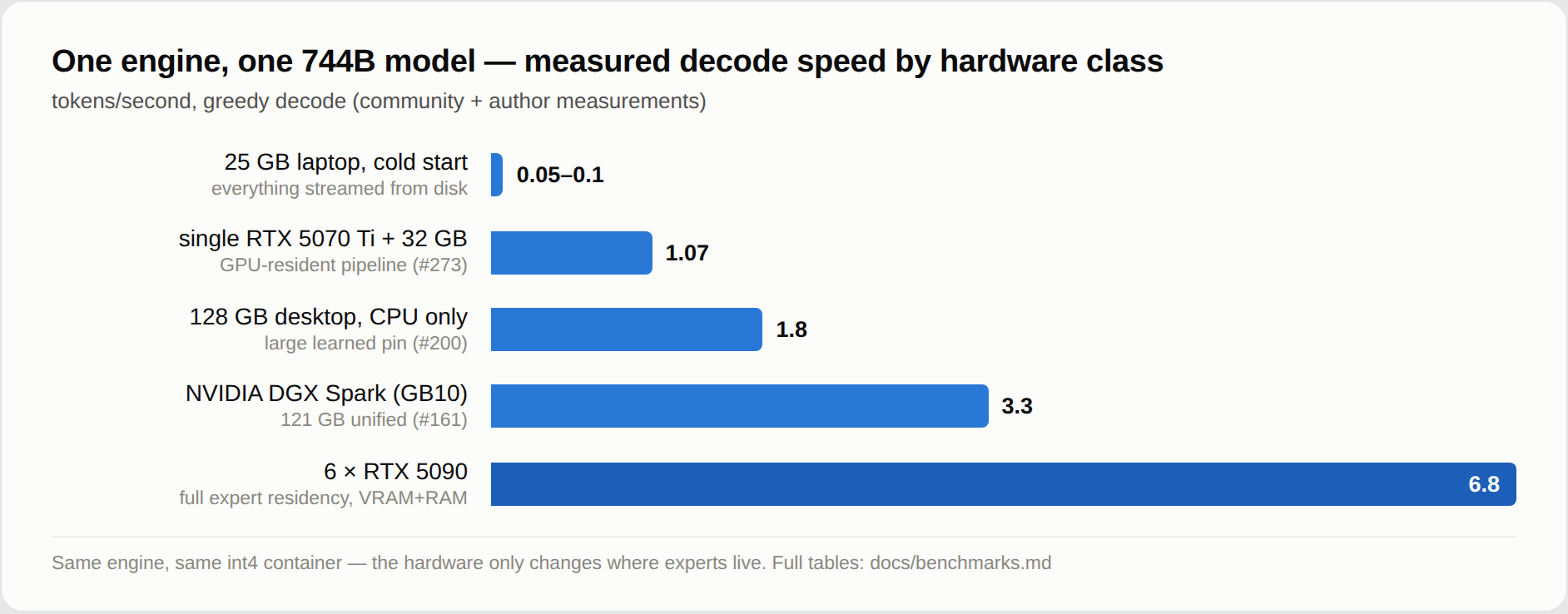
Same engine, same int4 container — the hardware only changes where the experts
live. Highlights from the [full benchmark tables](docs/benchmarks.md):
- **6× RTX 5090, full residency:** 5.8–6.8 tok/s decode, TTFT ~13 s
([experiment log](docs/experiments/glm52-6x5090-2026-07-12.md));
- **128 GB CPU-only desktop:** ~1.8 tok/s warm ([#200](https://github.com/JustVugg/colibri/issues/200));
- **single RTX 5070 Ti laptop-class box:** 1.07 tok/s via the GPU-resident
pipeline ([#273](https://github.com/JustVugg/colibri/issues/273));
- **25 GB dev box:** 0.05–0.1 tok/s cold — the proven floor where this project
started, and still the honest baseline.
Quality is measured, not assumed: the int4 container's quantization cost and the
scale-granularity/rotation ablations live in
[docs/benchmarks.md](docs/benchmarks.md#quality-benchmark) and
[#108](https://github.com/JustVugg/colibri/issues/108)/[#81](https://github.com/JustVugg/colibri/issues/81).
## Get started
You need two things: **the program** (a few hundred KB) and **the model**
(372 GB). Step-by-step for every platform in the
[Quick Start guide](docs/quickstart.md).
### 1. Get colibri
**Download a prebuilt release** — Linux, macOS and Windows, no compiler needed.
Take the archive for your platform from
[Releases](https://github.com/JustVugg/colibri/releases) and unpack it:
```bash
mkdir colibri && tar xzf colibri-v1.1.0-linux-x86_64.tar.gz -C colibri && cd colibri
python3 coli info # engine ready ✓
```
Inside you get the engine (`colibri`, `colibri.exe` on Windows), the `coli`
launcher and its Python helpers. Nothing to rename or configure — `coli` finds
the engine next to itself. You only need
[Python 3](https://www.python.org/downloads/) installed: the launcher and the
API gateway are Python scripts, while the engine itself is pure C with zero
dependencies.
**Or build from source** — needs `gcc` (or clang) with OpenMP:
```bash
git clone https://github.com/JustVugg/colibri && cd colibri/c
./setup.sh # checks gcc/OpenMP, builds, self-tests
```
Want `coli` on your PATH? From a checkout, `pip install -e .` registers it (the
engine still lives in `c/` — an editable install from the clone, not a wheel).
### 2. Get the model
A pre-converted **GLM-5.2 int4** container is on Hugging Face — use the
**group-scaled (gs64)** build with the **int8 MTP head**. It is about **372 GB**,
so put it on a disk with the room, ideally a fast one:
**https://huggingface.co/mastouri/GLM-5.2-colibri-int4-g64-with-int8-mtp**
> ⚠️ Use the **gs64** container above, not the older per-row int4 mirrors
> (`mateogrgic/…`, `jlnsrk/…`): those measure ~9pp worse on quality and are the
> root cause of the original think-mode loops and never-terminating generations
> in [#455](https://github.com/JustVugg/colibri/issues/455). The gs64 container
> fixed those controlled per-row A/Bs, but it is not a general repetition or
> EOS-starvation guard. The MTP head must also be **int8, not int4**
> (int4 → 0% draft acceptance, [#8](https://github.com/JustVugg/colibri/issues/8)):
> `ls -l /out-mtp-*` — int8 (correct) is `3527131672 / 5366238584 / 1065950496`.
Or convert from the FP8 source yourself — one resumable command that never needs
the full 756 GB on disk at once:
```bash
./coli convert --model /nvme/glm52_i4 # download+convert shard by shard (python, one-time)
```
#### Other supported models
GLM-5.2 is the reference model, but the same streaming approach runs three more
families. Each is a **sibling engine** — one C file, its own architecture, the same
`coli chat` / `coli serve` / `coli web` front end (the launcher picks the binary from
the model's `config.json`):
| Family | Total / active | Weights | Build | Docs |
|---|---|---|---|---|
| **GLM-5.2** | 744B / 40B | [`mastouri/…-int4-g64-with-int8-mtp`](https://huggingface.co/mastouri/GLM-5.2-colibri-int4-g64-with-int8-mtp) (372 GB) | `make -C c glm` | this page |
| **Inkling** (Thinking Machines) | 975B / 41B | [`nbeerbower/Inkling-colibri-int4`](https://huggingface.co/nbeerbower/Inkling-colibri-int4) (469 GB) | `make -C c inkling` | [inkling.md](docs/inkling.md) |
| **Kimi K3** (Moonshot) | 2.8T / 104B | [`moonshotai/Kimi-K3`](https://huggingface.co/moonshotai/Kimi-K3) — original checkpoint, routed experts stay **native MXFP4** | `make -C c kimi_k3` | [kimi_k3.md](docs/kimi_k3.md) |
| **OLMoE** (AI2) | 7B / 1B | converted with `c/tools/convert_olmoe_merged.py` | `make -C c olmoe` | — |
Kimi K3 needs no conversion: its QAT-trained MXFP4 experts are streamed straight from
the original Hugging Face shards, and the bf16 dense set is quantized at load time.
Inkling ships int4 experts but **bf16 dense weights** (49.4 GB resident); on a host
that cannot hold those, [inkling.md](docs/inkling.md) has a one-pass tool that brings
the dense set to 15.3 GB and lets the 975B run on a 25 GB box — with the honest
trade-off written down.
### 3. Run it
```bash
COLI_MODEL=/nvme/glm52_i4 ./coli chat # RAM budget, cache and MTP auto-detected
COLI_MODEL=/nvme/glm52_i4 ./coli plan # inspect the planned VRAM/RAM/disk placement
COLI_MODEL=/nvme/glm52_i4 ./coli doctor # read-only readiness check
COLI_MODEL=/nvme/glm52_i4 ./coli doctor --deep # strict tensors/shards/index/mirror preflight
./coli web --model /nvme/glm52_i4 # API + web dashboard on one port
./coli serve --model /nvme/glm52_i4 # OpenAI-compatible API only
```
On Windows the same commands work with `python coli chat --model D:\glm52_i4`.
The engine at runtime is pure C — python is only used by the one-time converter
and the optional API gateway.
#### The same commands run any of the models
`coli` reads the model's `config.json`, picks the matching engine binary, and
renders that family's chat template — so **nothing about the command line
changes between models**. Build the engine you want once, then just point
`COLI_MODEL` at the right directory:
```bash
make -C c glm # GLM-5.2
make -C c inkling # Inkling
make -C c kimi_k3 # Kimi K3
COLI_MODEL=/nvme/glm52_i4 ./coli chat # TUI
COLI_MODEL=/nvme/inkling_i4 ./coli chat
COLI_MODEL=/nvme/kimi_k3 ./coli chat
./coli web --model /nvme/inkling_i4 # API + dashboard, same port
./coli web --model /nvme/kimi_k3
./coli serve --model /nvme/inkling_i4 # API only
```
For the non-GLM engines `coli chat` starts the gateway locally and attaches the
TUI to it, so the TUI, the API and the dashboard all go through the same
arch-aware chat template — you never have to pass the template yourself.
Two things that differ per model, both documented in the per-model page:
- **Inkling on a RAM-tight host** needs the int4 dense container and a small
expert cache: `./coli chat --model /nvme/inkling_i4 --cap 2`
(see [inkling.md](docs/inkling.md) — the default `--cap 8` wants ~14 GB of
cache on top of the resident set).
- **Kimi K3** streams its MXFP4 experts from the original checkpoint, so there
is nothing to convert — but the snapshot is ~1.6 TB
(see [kimi_k3.md](docs/kimi_k3.md)).
### 4. Go deeper
| topic | doc |
|---|---|
| Benchmarks, community datapoints, quality measurements | [docs/benchmarks.md](docs/benchmarks.md) |
| Tuning knobs, policies, the learning cache, prefetch | [docs/tuning.md](docs/tuning.md) |
| Windows 11 native build (+ CUDA DLL) | [docs/windows.md](docs/windows.md) |
| CUDA backend, VRAM expert tier, full residency | [docs/cuda.md](docs/cuda.md) |
| Apple Silicon Metal backend | [docs/metal.md](docs/metal.md) |
| OpenAI-compatible API, KV slots, web dashboard | [docs/api.md](docs/api.md) |
| Grammar-forced drafts (structured output) | [docs/grammar-draft.md](docs/grammar-draft.md) |
| Environment variable inventory | [docs/ENVIRONMENT.md](docs/ENVIRONMENT.md) |
## What's next
- **Inference-systems research is the product.** The current hierarchy is LRU +
a learned pin set; active work spans model formats, compression, placement,
scheduling, I/O, CPU/GPU kernels, heterogeneous overlap, KV state, and
routing-aware speculation. The objective is lower hardware requirements and
lower cost per useful token. Everything lands the way this project works:
measured end to end, reviewed, and developed in the open.
- **More open models.** The tiering algorithm is model-agnostic: any MoE with
routed experts can be staged the same way. GLM-5.2 and OLMoE run today;
support for more open-weight families — **Kimi K2** (Moonshot AI),
**Qwen3 MoE** (Alibaba), **MiniMax** — is on the roadmap.
## Supporting the project
colibrì started as a one-person project on a 12-core laptop with 25 GB of RAM;
today its numbers come from a community of real machines. If it's useful to you:
- ⭐ star the repo and share it;
- 🐛 open issues with benchmark numbers from your hardware — datapoints move
this project more than anything else;
- 💬 join the [Discord community](https://discord.gg/fpQxKnRb) to discuss
experiments, hardware results, and research directions;
- 💬 reach out via GitHub issues to sponsor development or donate hardware.
## Repo layout
```
Makefile root build/check entry point
c/
├── glm.c single-file GLM engine
├── st.h, tok.h, json.h runtime headers
├── backend_cuda.* optional CUDA tier
├── Makefile build and local checks
├── coli user-facing CLI
├── openai_server.py OpenAI-compatible HTTP gateway
├── setup.sh one-command local setup
├── tools/ offline conversion, fixtures and benchmarks
├── scripts/ long-running conversion helpers
└── tests/ dependency-free C and Python tests
web/ browser UI (pure OpenAI-API client)
desktop/ Tauri v2 desktop shell wrapping the web UI
docs/ reference docs, experiments, media
```
The runtime path intentionally stays flat and readable: `glm.c` plus its small
headers. From the repository root, `make`, `make check`, and `make clean`
delegate to the engine Makefile.
## Why "colibrì"
The hummingbird weighs a few grams, hovers in place, and visits a thousand
flowers a day. This engine keeps a 744-billion-parameter giant alive on
hummingbird rations: 25 GB of RAM, twelve CPU cores, and a lot of disk patience.
## Acknowledgements
colibrì is an engine; the minds it runs are a gift. Thank you to the teams
releasing frontier-class weights in the open — **Z.ai** (GLM), **Moonshot AI**
(Kimi), **Alibaba Qwen**, **MiniMax**, and **Allen AI** (OLMoE) — and to every
contributor who benchmarked, bisected, replicated an atlas run, or sent a patch.
This project is proof of what open weights make possible.
## License
Apache 2.0. GLM-5.2 weights are released by Z.ai under MIT.