
🤗 Hugging Face | 📝 Blog | 📑 Documentation
## Introduction
We introduce EXAONE Deep, which exhibits superior capabilities in various reasoning tasks including math and coding benchmarks, ranging from 2.4B to 32B parameters developed and released by LG AI Research. Evaluation results show that 1) EXAONE Deep 2.4B outperforms other models of comparable size, 2) EXAONE Deep 7.8B outperforms not only open-weight models of comparable scale but also a proprietary reasoning model OpenAI o1-mini, and 3) EXAONE Deep 32B demonstrates competitive performance against leading open-weight models.
Our documentation consists of the following sections:
- [Performance](#performance): Experimental results of EXAONE Deep models.
- [Quickstart](#quickstart): A basic guide to using EXAONE Deep models with Transformers.
- [Quantized Models](#quantized-models): An explanation of quantized EXAONE Deep weights in `AWQ` and `GGUF` format.
- [Run Locally](#run-locally): A guide to running EXAONE Deep models locally with `llama.cpp` and `Ollama` frameworks.
- [Deployment](#deployment): A guide to running EXAONE Deep models with `TensorRT-LLM`, `vLLM`, and `SGLang` deployment frameworks.
- [Usage Guideline](#usage-guideline): A guide to utilizing EXAONE Deep models to achieve the expected performance.
## News
- 2025.03.18: We release the EXAONE Deep, reasoning enhanced language models, including 2.4B, 7.8B, and 32B. Check out the 📑 [Documentation](https://arxiv.org/abs/2503.12524)!
## Performance
Some experimental results are shown below. The full evaluation results can be found in the [Documentation](https://arxiv.org/abs/2503.12524).
| Models | MATH-500 (pass@1) | AIME 2024 (pass@1 / cons@64) | AIME 2025 (pass@1 / cons@64) | CSAT Math 2025 (pass@1) | GPQA Diamond (pass@1) | Live Code Bench (pass@1) |
|---|---|---|---|---|---|---|
| EXAONE Deep 32B | 95.7 | 72.1 / 90.0 | 65.8 / 80.0 | 94.5 | 66.1 | 59.5 |
| DeepSeek-R1-Distill-Qwen-32B | 94.3 | 72.6 / 83.3 | 55.2 / 73.3 | 84.1 | 62.1 | 57.2 |
| QwQ-32B | 95.5 | 79.5 / 86.7 | 67.1 / 76.7 | 94.4 | 63.3 | 63.4 |
| DeepSeek-R1-Distill-Llama-70B | 94.5 | 70.0 / 86.7 | 53.9 / 66.7 | 88.8 | 65.2 | 57.5 |
| DeepSeek-R1 (671B) | 97.3 | 79.8 / 86.7 | 66.8 / 80.0 | 89.9 | 71.5 | 65.9 |
| EXAONE Deep 7.8B | 94.8 | 70.0 / 83.3 | 59.6 / 76.7 | 89.9 | 62.6 | 55.2 |
| DeepSeek-R1-Distill-Qwen-7B | 92.8 | 55.5 / 83.3 | 38.5 / 56.7 | 79.7 | 49.1 | 37.6 |
| DeepSeek-R1-Distill-Llama-8B | 89.1 | 50.4 / 80.0 | 33.6 / 53.3 | 74.1 | 49.0 | 39.6 |
| OpenAI o1-mini | 90.0 | 63.6 / 80.0 | 54.8 / 66.7 | 84.4 | 60.0 | 53.8 |
| EXAONE Deep 2.4B | 92.3 | 52.5 / 76.7 | 47.9 / 73.3 | 79.2 | 54.3 | 46.6 |
| DeepSeek-R1-Distill-Qwen-1.5B | 83.9 | 28.9 / 52.7 | 23.9 / 36.7 | 65.6 | 33.8 | 16.9 |
 ## Deployment
EXAONE Deep models have been integrated into various deployment frameworks.
> [!Important]
> Before your deployment of EXAONE Deep models, we recommend following the [Usage Guideline](#usage-guideline) section to achieve the expected performance.
### TensorRT-LLM
TensorRT-LLM has supported EXAONE language models since EXAONE 3.0. We recommend using TensorRT-LLM for the best performance. You can run EXAONE Deep models with TensorRT-LLM by following the instructions on [TensorRT-LLM EXAONE Example](https://github.com/NVIDIA/TensorRT-LLM/tree/main/examples/models/core/exaone).
> [!Note]
> When you convert EXAONE Deep models to TensorRT-LLM format, you may need to set the environment variable `TRTLLM_DISABLE_UNIFIED_CONVERTER=1`.
> [!Note]
> TensorRT-LLM also supports AWQ on their own methods.
> If you want to use AWQ with TensorRT-LLM, please refer to the [AWQ section](https://github.com/NVIDIA/TensorRT-LLM/tree/main/examples/models/core/exaone#groupwise-quantization-awq) in TensorRT-LLM EXAONE Example.
### vLLM
You can easily run EXAONE Deep models with vLLM.
1. Install vLLM (`vllm>=0.6.0`). Please refer to the [vLLM quickstart guide](https://docs.vllm.ai/en/latest/getting_started/quickstart.html) for more details.
```bash
pip install vllm
```
2. Run the models with vLLM.
```bash
vllm serve LGAI-EXAONE/EXAONE-Deep-7.8B
```
3. Send a request with the following curl command after the server starts.
```bash
curl -X POST http://localhost:8000/v1/chat/completions \
-H "Content-Type: application/json" \
-d '{
"model": "LGAI-EXAONE/EXAONE-Deep-7.8B",
"messages": [
{"role": "user", "content": "How many golf balls can fit in a school bus?"}
],
"max_tokens": 30720,
"temperature": 0.6,
"top_p": 0.95
}'
```
> [!Note]
> If you want to serve GGUF quantized models with vLLM, please refer to the [vLLM GGUF documentation](https://docs.vllm.ai/en/latest/quantization/gguf.html).
### SGLang
You can also run EXAONE Deep models with SGLang.
1. Install SGLang. Please refer to the [SGLang documentation](https://sgl-project.github.io) for more details.
2. Run the server with the following command.
```bash
python -m sglang.launch_server --model-path LGAI-EXAONE/EXAONE-Deep-7.8B \
--port 30000 --host 0.0.0.0
```
> [!Note]
> In case of using EXAONE Deep 2.4B model, you need to install sglang>=0.3.6 and use `--attention-backend triton` option.
>
> Additionally, we are currently working on a PR to fix the incompatibility of flashinfer with EXAONE Deep 2.4B.
> Please refer to the [PR](https://github.com/sgl-project/sglang/pull/4064) for details.
3. Send a request with the following curl command after the server starts.
```bash
curl -s http://0.0.0.0:30000/v1/chat/completions \
-d '{
"model": "LGAI-EXAONE/EXAONE-Deep-7.8B",
"messages": [
{"role": "user", "content": "How many golf balls can fit in a school bus?"}
],
"max_tokens": 30720,
"temperature": 0.6,
"top_p": 0.95,
}'
```
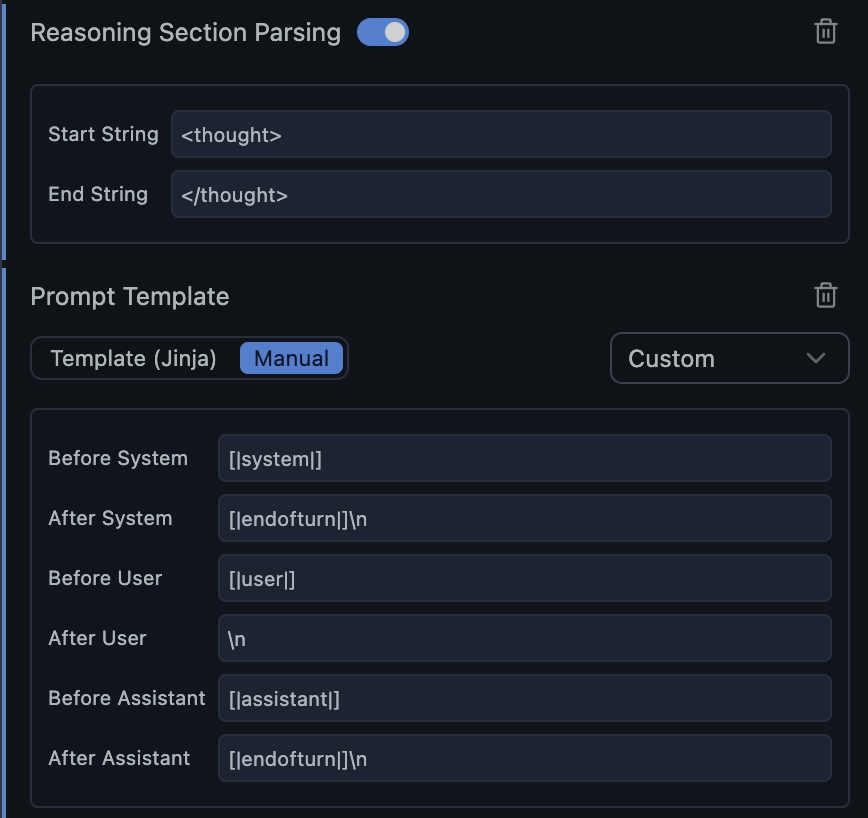
## Usage Guideline
To achieve the expected performance, we recommend using the following configurations:
1. Ensure the model starts with `
## Limitation
The EXAONE language model has certain limitations and may occasionally generate inappropriate responses. The language model generates responses based on the output probability of tokens, and it is determined during learning from training data. While we have made every effort to exclude personal, harmful, and biased information from the training data, some problematic content may still be included, potentially leading to undesirable responses. Please note that the text generated by EXAONE language model does not reflects the views of LG AI Research.
- Inappropriate answers may be generated, which contain personal, harmful or other inappropriate information.
- Biased responses may be generated, which are associated with age, gender, race, and so on.
- The generated responses rely heavily on statistics from the training data, which can result in the generation of
semantically or syntactically incorrect sentences.
- Since the model does not reflect the latest information, the responses may be false or contradictory.
LG AI Research strives to reduce potential risks that may arise from EXAONE language models. Users are not allowed
to engage in any malicious activities (e.g., keying in illegal information) that may induce the creation of inappropriate
outputs violating LG AI's ethical principles when using EXAONE language models.
## License
The model is licensed under [EXAONE AI Model License Agreement 1.1 - NC](./LICENSE)
## Citation
```
@article{exaone-deep,
title={EXAONE Deep: Reasoning Enhanced Language Models},
author={{LG AI Research}},
journal={arXiv preprint arXiv:2503.12524},
year={2025}
}
```
## Contact
LG AI Research Technical Support: contact_us@lgresearch.ai