

Transform Financial Knowledge into Actionable Intelligence


Knowledge Engineering •
The Vision •
Quick Start •
Evaluation •
In Production •
Roadmap •
Contributing
QuantMind is an information processor for quantitative finance: it refines raw financial information — papers, news, filings — into structured financial knowledge that downstream retrieval and reasoning can trust. Every piece of knowledge is typed, keeps its citation, and knows its timestamp, so it persists and time-queries standalone.
The people who build these refinement flows are increasingly agents — coding agents, with humans behind them. So the repository is designed agent-oriented: you open the checkout, describe the pipeline you want, and an agent builds it here against the repo's contracts, skills, and deterministic verification. It is also a perfectly good importable Python library.
### 📰 News
| 🗞️ News | 📝 Description |
|----------------|-------------------------------------------------------------------------------|
| 🛠️ 2026-07 | Rebuilding the repo **agent-native** — contexts, skills, hooks — so a coding agent can do QuantMind-quality work inside the checkout. |
| 🎉 Accepted at NeurIPS 2025 Workshop | Our paper **[Quant-Mind](#)** has been accepted to the **[NeurIPS 2025 GenAI in Finance Workshop](https://sites.google.com/view/neurips-25-gen-ai-in-finance/home)** !🚀 |
| 📢 First Release on GitHub | **Quant-Mind** is now live on GitHub — please check it out and join us! 🤗 |
### 🧩 Knowledge Engineering
**Any source → typed knowledge.**
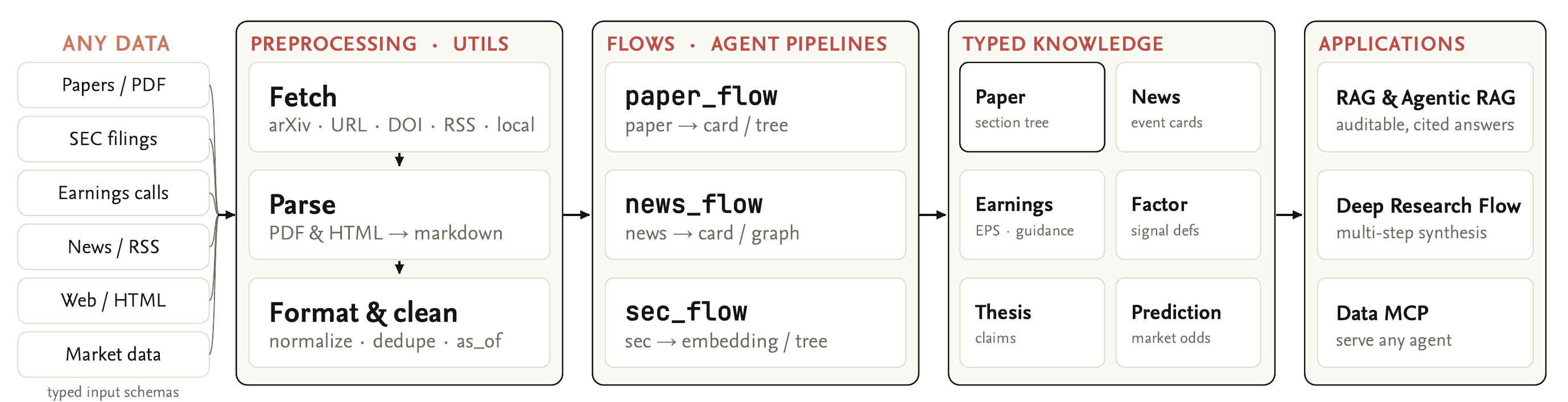
*The target surface — shipping today: `PaperFlow` · `collect_news`; see Roadmap.*
- **Deterministic preprocess** — `fetch` / parse / `format` + `clean` produce source-faithful values with no model in the loop, so provenance is exact and replayable.
- **Config-driven operations** — `PaperFlow(cfg).build(input)` binds an immutable build config once and applies it per input; `collect_news` collects a replayable source window; `batch_run` fans any operation across a list of inputs. You never write `asyncio.gather` boilerplate.
- **Typed knowledge shapes** — a `Paper` structure tree for whole documents, and flat cards for `News` / `Earnings` / `Factor` / `Thesis`. Every artifact is self-contained: it carries its own text, an `as_of` timestamp, and a light source ref, so it persists and time-queries standalone.
- **Retrieval over that knowledge** — `rag/` (chunking + BM25 / similarity), `library/` (local persistence + meaning-based search), and `mind/` (agentic, reasoning-based retrieval). Together they serve RAG and Agentic RAG, deep research, and data-MCP serving.
This is the substance shipped as the NeurIPS 2025 GenAI-in-Finance workshop paper (**arXiv:2509.21507**). The always-current statement lives in [`contexts/design/positioning.md`](contexts/design/positioning.md).
### 🧠 The Vision
**Harness engineering — any agent → domain specialist.**
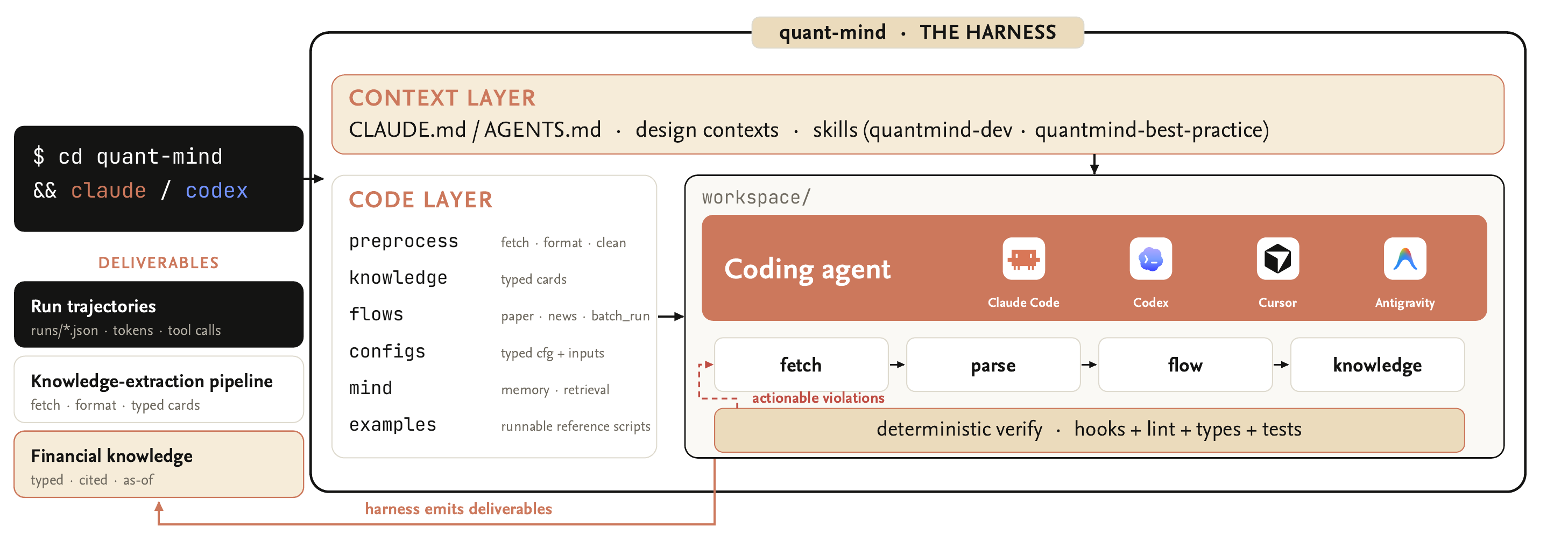
> **Don't import it. Open it.**
The repository itself is the product surface — we call this **harness engineering**. Its `AGENTS.md` / `CLAUDE.md` contracts, progressive-disclosure `contexts/`, portable skills, and Claude + Codex hooks, all gated by a deterministic verify, upgrade a general coding agent into one that reliably does QuantMind-quality work. The bet: **a weak model in a good harness beats a strong model running bare.**
- **Repo-level contracts** — `AGENTS.md` / `CLAUDE.md` state the always-on rules once, in one source, for every agent that opens the repo.
- **Progressive-disclosure `contexts/`** — agent-facing pages with a Quick Summary / Contents preview, so an agent loads only the one page a task needs.
- **Portable skills** — `quantmind-dev` ships today (contributor setup / commit / PR / component workflow), mirrored for Claude and Codex.
- **Claude + Codex hooks** — shared hook scripts give both agents identical hard guarantees without maintaining two copies of a rule.
- **Deterministic verify** — `scripts/verify.sh` runs lint + types + import boundaries + tests, fast-failing in a fixed order; CI runs the exact same script.
See [`contexts/dev/harness-engineering.md`](contexts/dev/harness-engineering.md) for the enforcement mechanics.
### 🚀 Quick Start
#### The agent path (recommended)
QuantMind is meant to be opened, not imported. Point a coding agent at the checkout and describe the pipeline you want:
```bash
git clone https://github.com/LLMQuant/quant-mind.git
cd quant-mind && claude # or: codex
```
Then, in the agent session:
> "Build me a source-first paper artifact for arXiv 1706.03762, then persist it and search the summary."
The agent reads the repo's contracts (`AGENTS.md`), loads the relevant `contexts/` pages, writes the pipeline, and runs `scripts/verify.sh` before it hands the change back.
#### The library path
QuantMind is still a normal Python package. We use [uv](https://github.com/astral-sh/uv) for package management.
```bash
uv venv && source .venv/bin/activate
uv pip install -e .
```
`PaperFlow` refines one arXiv PDF into a self-contained paper artifact. The cfg **type** selects the knowledge shape (`PaperStructureCfg` → `PaperStructureTree`, `PaperSemanticCfg` → `PaperSemanticResult`). Bind a `PaperStructureCfg` to build a source-native **structure tree** — a hierarchy of page-cited nodes:
```python
import asyncio
from quantmind.configs import PaperStructureCfg
from quantmind.configs.paper import ArxivIdentifier
from quantmind.flows import PaperFlow
async def main() -> None:
flow = PaperFlow(PaperStructureCfg(model="gpt-5.6-luna"))
tree = await flow.build(ArxivIdentifier(id="1706.03762v7"))
print(tree.id, len(tree.nodes))
asyncio.run(main())
```
Prefer the **semantic** shape — a page-aware chunk set plus one cited global summary you can embed and retrieve over? Bind a `PaperSemanticCfg` instead — same class, different cfg:
```python
import asyncio
from quantmind.configs import PaperSemanticCfg
from quantmind.configs.paper import ArxivIdentifier
from quantmind.flows import PaperFlow
async def main() -> None:
flow = PaperFlow(PaperSemanticCfg(model="gpt-5.6-luna", chunk_size=512))
result = await flow.build(ArxivIdentifier(id="1706.03762v7"))
print(result.global_summary.summary)
print(result.source_revision.id, result.chunk_set.id)
asyncio.run(main())
```
#### Fan out a batch with `batch_run`
```python
import asyncio
from datetime import datetime, timedelta, timezone
from quantmind.configs import NewsCollectionCfg, NewsWindow
from quantmind.flows import batch_run, collect_news
async def main() -> None:
end = datetime.now(timezone.utc)
windows = [
NewsWindow(
source="pr-newswire",
start=end - timedelta(days=day + 1),
end=end - timedelta(days=day),
)
for day in range(3)
]
result = await batch_run(
collect_news,
windows,
cfg=NewsCollectionCfg(retain_raw_html=False),
concurrency=3,
on_error="skip",
on_progress=lambda done, total: print(f"{done}/{total}"),
)
print(f"ok={result.success_count} failed={result.failure_count}")
asyncio.run(main())
```
#### Resolve free-form intent with `magic`
```python
import asyncio
from quantmind.flows import collect_news
from quantmind.magic import resolve_magic_input
async def main() -> None:
inp, cfg = await resolve_magic_input(
"Collect the last day of PR Newswire company news.",
target_flow=collect_news,
)
batch = await collect_news(inp, cfg=cfg)
print(f"documents={batch.success_count} complete={batch.complete}")
asyncio.run(main())
```
More examples live under [`examples/`](examples/); design contracts live under [`contexts/design/`](contexts/design/).
### 🔬 Evaluation (In Design)
> [!NOTE]
> Evaluation is in the **design phase** — no results are claimed yet. Our framing follows Anthropic's [Demystifying evals for AI agents](https://www.anthropic.com/engineering/demystifying-evals-for-ai-agents).
**quantmind-bench** measures the harness bet directly. Following the SWE-bench model, it runs **paired trials on the same model and the same task set**: once against a bare checkout, once against the QuantMind repo mounted with its contracts, contexts, skills, and hooks. The reported deltas are **cost-to-green, pass@1, pass^k across seeds, and wall-clock** — how much a good harness moves a fixed model. Run instrumentation (tokens / cost / duration / a verify oracle) already ships; the protocol that consumes it is being designed, and no numbers are published.
A separate **llmquant-data-bench** will score knowledge quality (correctness, citation precision/recall, point-in-time correctness); it is likewise in design.
### 🏭 In Production: LLMQuant Data
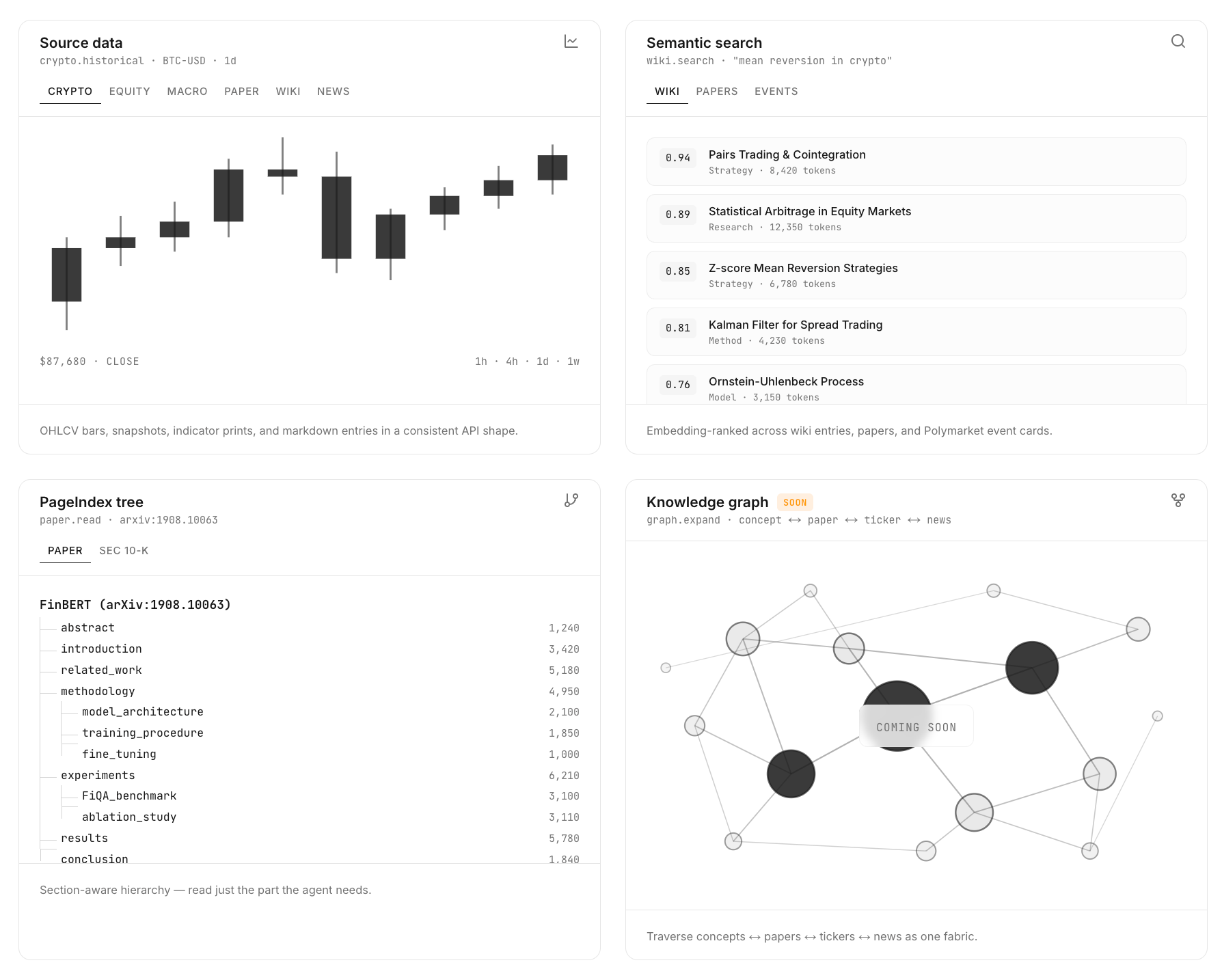
LLMQuant Data is QuantMind in production. The hosted data platform runs extraction pipelines powered by QuantMind: QuantMind is the open engine, LLMQuant Data is the operated product on top of it. The dependency direction is one-way — `llmquant-data` imports `quantmind`, never the reverse.
### 🗺️ Roadmap
Directions we are actively pushing on (not yet shipped):
- **More agent-native** — a `quantmind-best-practice` skill alongside the shipped `quantmind-dev`, and an agent-first contributing path.
- **Broader coverage** — a SEC / filings collection flow and a prediction-market knowledge type, beyond today's papers and news.
- **Evaluation** — land the `quantmind-bench` protocol and publish its first paired runs.
Development is moving fast. If you need a source, a knowledge type, or a flow we do not have yet, [open an issue](https://github.com/LLMQuant/quant-mind/issues) — we welcome the request.
### 🤝 Contributing
Prefer manual steps? See [`.claude/skills/quantmind-dev/references/setup.md`](.claude/skills/quantmind-dev/references/setup.md).
The fastest path is to let a coding agent drive. Inside the checkout, tell Claude Code:
```text
/quantmind-dev set me up as a contributor
/quantmind-dev file an issue:
/quantmind-dev I want to contribute
```
Codex users say the same thing in words — the skill is mirrored under `.agents/skills/quantmind-dev/`, so both agents follow one workflow: contributor setup, filing an issue, and developing a change with tests, verification, commit, and PR.
> [!IMPORTANT]
> **For Contributors**: [CONTRIBUTING.md](CONTRIBUTING.md) covers the same setup for humans — environment, pre-commit hooks, coding standards, and testing. `scripts/verify.sh` is the single deterministic check; CI runs the exact same script.
We welcome contributions of all forms, from bug reports to feature development. Open an [issue](https://github.com/LLMQuant/quant-mind/issues) to discuss significant changes before you start, and make sure `bash scripts/verify.sh` is green before you open a PR.
### License
QuantMind is released under the MIT License—see `LICENSE` for details.
### ❤️ Acknowledgements
- **arXiv** for providing open access to a world of research.
- The **open-source community** for the tools and libraries that make this project possible.