---
date: 2019-10-26
---
[toc]
# 公众号
coding 笔记、点滴记录,以后的文章也会同步到公众号(Coding Insight)中,大家关注 `^_^`
我的博客地址:[博客主页](https://yano-nankai.notion.site/yano-nankai/Yano-Space-ff42bde7acd1467eb3ae63dc0d4a9f8c)。

# Netty Demo 示例
首先通过一个示例来分析,创建一个 `NioServerSocketChannel` 监听本机端口 11111 的 `Socket` 连接,将收到的消息原样返回;然后再创建一个 `NioSocketChannel`,发起对本机的 11111 端口的 Socket 连接,发送字符串 ”Netty rocks!“。预期能收到服务端返回的 “Netty rocks!” 响应。
## Maven 依赖
本文使用的 Netty 版本是 **5.0.0.Alpha2**,与 4.x 版本相比变化还是挺大的。pom 文件添加:
```java
io.netty
netty-all
5.0.0.Alpha2
```
## 创建一个 Server
创建一个 NioServerSocketChannel,监听本机端口 11111 的 Socket 连接。
```java
public class EchoServer {
private final int port;
public EchoServer(int port) {
this.port = port;
}
public static void main(String[] args) throws InterruptedException {
new EchoServer(11111).start();
}
public void start() throws InterruptedException {
final EchoServerHandler serverHandler = new EchoServerHandler();
NioEventLoopGroup group = new NioEventLoopGroup();
try {
ServerBootstrap b = new ServerBootstrap();
b.group(group).channel(NioServerSocketChannel.class)
.localAddress(new InetSocketAddress(port))
.childHandler(new ChannelInitializer() {
@Override
protected void initChannel(SocketChannel socketChannel) throws Exception {
socketChannel.pipeline().addLast(serverHandler);
}
});
ChannelFuture channelFuture = b.bind().sync();
channelFuture.channel().closeFuture().sync();
} finally {
group.shutdownGracefully().sync();
}
}
}
```
EchoServerHandler 的实现如下,在 channelRead 时将数据写入 ChannelHandlerContext,并将数据输出到控制台。
```java
@ChannelHandler.Sharable
public class EchoServerHandler extends ChannelHandlerAdapter {
@Override
public void channelRead(ChannelHandlerContext ctx, Object msg) throws Exception {
ByteBuf in = (ByteBuf) msg;
System.out.println("Server received :" + in.toString(CharsetUtil.UTF_8));
ctx.write(in);
}
@Override
public void channelReadComplete(ChannelHandlerContext ctx) {
ctx.writeAndFlush(Unpooled.EMPTY_BUFFER) .addListener(ChannelFutureListener.CLOSE);
}
@Override
public void exceptionCaught(ChannelHandlerContext ctx,
Throwable cause) {
cause.printStackTrace();
ctx.close();
}
}
```
## 创建一个 Client
创建一个 NioSocketChannel,发起对本机的 11111 端口的 Socket 连接。
```java
public class EchoClient {
private final String host;
private final int port;
public EchoClient(String host, int port) { this.host = host;
this.port = port;
}
public static void main(String[] args) throws InterruptedException {
new EchoClient("localhost", 11111).start();
}
public void start() throws InterruptedException {
NioEventLoopGroup group = new NioEventLoopGroup();
try {
Bootstrap bootstrap = new Bootstrap();
bootstrap.group(group).channel(NioSocketChannel.class)
.remoteAddress(new InetSocketAddress(host, port))
.handler(new ChannelInitializer() {
@Override
protected void initChannel(SocketChannel socketChannel) throws Exception {
socketChannel.pipeline().addLast(new EchoClientHandler());
}
});
ChannelFuture channelFuture = bootstrap.connect().sync();
channelFuture.channel().closeFuture().sync();
}finally {
group.shutdownGracefully().sync();
}
}
}
```
EchoClientHandler 的实现如下,messageReceived(在 Netty 4.x 为 channelRead0)对于泛型 I(本例中是 ByteBuf)进行处理,将数据输出到控制台。
```java
@ChannelHandler.Sharable
public class EchoClientHandler extends SimpleChannelInboundHandler {
@Override
public void channelActive(ChannelHandlerContext ctx) {
ctx.writeAndFlush(Unpooled.copiedBuffer("Netty rocks!",
CharsetUtil.UTF_8));
}
@Override
public void exceptionCaught(ChannelHandlerContext ctx, Throwable cause) {
cause.printStackTrace();
ctx.close();
}
@Override
public void messageReceived(ChannelHandlerContext ctx, ByteBuf msg) throws Exception {
System.out.println(
"Client received:" + msg.toString(CharsetUtil.UTF_8));
}
}
```
# io.netty.channel.Channel 类
上面 demo 中直接使用到的 2 个类是:NioServerSocketChannel 和 NioSocketChannel,这两个类底层都是实现了 Channel 接口,注意这个 Channel 接口是 `io.netty.channel.Channel`,而不是 JDK 自带的 java.nio.channels.Channel!两个类的继承关系如下:
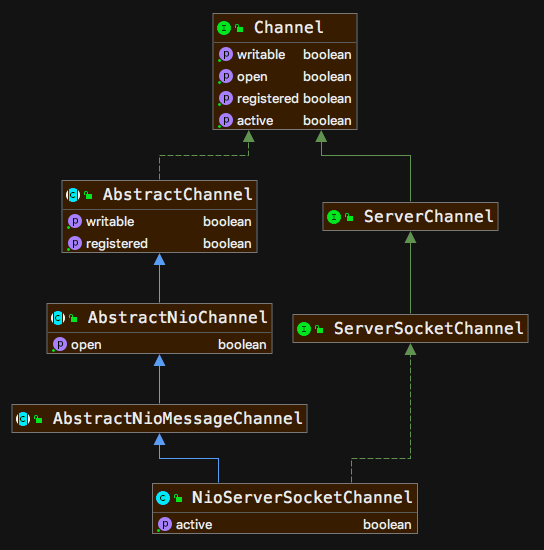
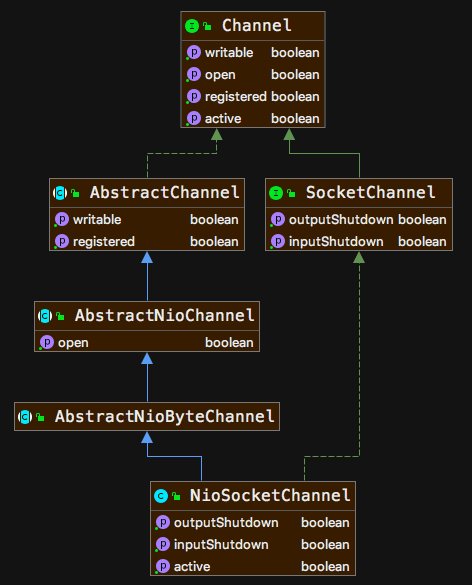
Channel 提供应用程序网络套接字或其他组件连接,提供读、写、连接和绑定等 I/O 操作。
- Channel 的当前状态(开启、关闭)
- Channel 的配置参数(接收缓冲区大小)
- I/O 操作(读、写、连接、绑定)
- ChannelPipeline,处理所有与 Channel 绑定的 I/O 事件和请求
## 所有 I/O 操作都是 ` 异步 ` 的
Netty 中所有 I/O 操作都是异步的。这意味着所有的 I/O 调用都会立即返回,不能保证在调用结束时请求的 I/O 操作是否完成。调用者会得到一个 ChannelFuture 实例,该实例会在请求的 I/O 操作成功、失败、取消时通知调用者。
## Channel 是分层级的
Channel 可以有 parent,这取决于 Channel 的创建方式。例如被 ServerSocketChannel 接收的 SocketChannel,会得到一个 ServerSocketChannel 作为它的 parent。
## 释放资源
使用完毕后,调用 close() 或 close(ChannelPromise) 释放资源非常重要。
# ChannelFuture
ChannelFuture 是一个 ` 异步 Channel I/O 操作的结果 `。如上面所说,Netty 中所有 I/O 操作都是异步的。这意味着所有的 I/O 调用都会立即返回,不能保证在调用结束时请求的 I/O 操作是否完成。调用者会得到一个 ChannelFuture 实例。
ChannelFuture 只有 2 种状态:未完成、已完成。I/O 操作开始时,将会创建一个新的 ChannelFuture 对象,初始时是未完成状态 —— 不是成功、失败或取消的任何一种状态,因为 I/O 操作还没有完成。如果 I/O 操作结束(无论成功、失败、取消),ChannelFuture 都会处于完成状态。注意即使是失败也属于完成状态。
+---------------------------+
| Completed successfully |
+---------------------------+
+----> isDone() = true |
+--------------------------+ | | isSuccess() = true |
| Uncompleted | | +===========================+
+--------------------------+ | | Completed with failure |
| isDone() = false | | +---------------------------+
| isSuccess() = false |----+----> isDone() = true |
| isCancelled() = false | | | cause() = non-null |
| cause() = null | | +===========================+
+--------------------------+ | | Completed by cancellation |
| +---------------------------+
+----> isDone() = true |
| isCancelled() = true |
+---------------------------+
我们还可以添加 ChannelFutureListener,以便在 I/O 操作完成时收到通知。
## 使用 addListener(GenericFutureListener) 而不是 await()
addListener(GenericFutureListener) 是非阻塞的,只需要将特定的 ChannelFutureListener 添加到 ChannelFuture 即可,I/O 线程会在 ChannelFuture 绑定的 I/O 操作完成时通知监听器。`ChannelFutureListener` 完全非阻塞,因此效率极高。
而 await() 是阻塞操作,一旦调用,调用者线程就会阻塞直到操作完成。使用 await() 操作更容易,但是成本更高。此外,在特定的情况下还可能出现死锁。
## 使用 ChannelHandler 而不是 await()
`ChannelHandler` 中的事件处理方法通常由 I/O 线程调用,如果 await() 是由事件处理方法(I/O 线程)调用的,那么它正在等待的 I/O 操作可能永远也不会完成,因为 await() 方法可以阻止它正在等待的 I/O 操作,也就是发生了死锁。
```java
// BAD - NEVER DO THIS
@Override
public void channelRead(ChannelHandlerContext ctx, GoodByeMessage msg) {
ChannelFuture future = ctx.channel().close();
future.awaitUninterruptibly();
// Perform post-closure operation
// ...
}
// GOOD
@Override
public void channelRead(ChannelHandlerContext ctx, GoodByeMessage msg) {
ChannelFuture future = ctx.channel().close();
future.addListener(new ChannelFutureListener() {
public void operationComplete(ChannelFuture future) {
// Perform post-closure operation
// ...
}
});
}
```
# 创建 Channel
在 Bootstrap(客户端) 和 ServerBootstrap(服务端) 的启动过程中都会调用 AbstractBootstrap#channel(…) 方法(参考文章开头的 Demo):
```java
public B channel(Class channelClass) {
if (channelClass == null) {
throw new NullPointerException("channelClass");
}
return channelFactory(new ReflectiveChannelFactory(channelClass));
}
```
对于上一行的 return 语句,首先看里面的 ReflectiveChannelFactory 对象,它是一个 ChannelFactory,通过反射调用对应 Class 的默认构造函数来实例化新的 Channel。其定义如下:
```java
public class ReflectiveChannelFactory implements ChannelFactory {
private final Class clazz;
...
}
```
clazz 是 Channel 的子类,其中 newChannel 方法仅仅是调用的 Class 的 newInstance() 方法。
再来看 return 语句中的 channelFactory 方法:
```java
public B channelFactory(io.netty.channel.ChannelFactory channelFactory) {
return channelFactory((ChannelFactory) channelFactory);
}
```
下面代码可以看出,就是将上面通过 ReflectiveChannelFactory 创建出来的 channelFactory 赋值到对应字段。注意此时并没有创建 Channel,而是在:
- 对于 NioSocketChannel,由于它充当客户端的功能,它的创建时机在 connect(…) 的时候;
- 对于 NioServerSocketChannel 来说,它充当服务端功能,它的创建时机在绑定端口 bind(…) 的时候。
```java
public B channelFactory(ChannelFactory channelFactory) {
if (channelFactory == null) {
throw new NullPointerException("channelFactory");
}
if (this.channelFactory != null) {
throw new IllegalStateException("channelFactory set already");
}
this.channelFactory = channelFactory;
return (B) this;
}
```
接下来,我们看下 ServerBootstrap 是如何创建 NioServerSocketChannel 的,以及 NioSocketChannel 是如何与 JDK 交互的。
```java
public ChannelFuture bind() {
validate();
SocketAddress localAddress = this.localAddress;
if (localAddress == null) {
throw new IllegalStateException("localAddress not set");
}
return doBind(localAddress);
}
```
首先是 validate() 方法,验证 group 和 channelFactory 不能为 null,否则会抛出异常。
```java
public B validate() {
if (group == null) {
throw new IllegalStateException("group not set");
}
if (channelFactory == null) {
throw new IllegalStateException("channel or channelFactory not set");
}
return (B) this;
}
```
然后是验证 localAddress 不为空,之后就是核心的 doBind() 逻辑了。
```java
private ChannelFuture doBind(final SocketAddress localAddress) {
final ChannelFuture regFuture = initAndRegister();
final Channel channel = regFuture.channel();
if (regFuture.cause() != null) {
return regFuture;
}
if (regFuture.isDone()) {
// At this point we know that the registration was complete and successful.
ChannelPromise promise = channel.newPromise();
doBind0(regFuture, channel, localAddress, promise);
return promise;
} else {
// Registration future is almost always fulfilled already, but just in case it's not.
final PendingRegistrationPromise promise = new PendingRegistrationPromise(channel);
regFuture.addListener(new ChannelFutureListener() {
@Override
public void operationComplete(ChannelFuture future) throws Exception {
Throwable cause = future.cause();
if (cause != null) {
// Registration on the EventLoop failed so fail the ChannelPromise directly to not cause an
// IllegalStateException once we try to access the EventLoop of the Channel.
promise.setFailure(cause);
} else {
// Registration was successful, so set the correct executor to use.
// See https://github.com/netty/netty/issues/2586
promise.executor = channel.eventLoop();
}
doBind0(regFuture, channel, localAddress, promise);
}
});
return promise;
}
}
```
首先就是 initAndRegister(),返回一个注册的 ChannelFuture,通过它来获取 Channel。
```java
final ChannelFuture initAndRegister() {
final Channel channel = channelFactory().newChannel();
try {
init(channel);
} catch (Throwable t) {
channel.unsafe().closeForcibly();
// as the Channel is not registered yet we need to force the usage of the GlobalEventExecutor
return new DefaultChannelPromise(channel, GlobalEventExecutor.INSTANCE).setFailure(t);
}
ChannelFuture regFuture = group().register(channel);
if (regFuture.cause() != null) {
if (channel.isRegistered()) {
channel.close();
} else {
channel.unsafe().closeForcibly();
}
}
return regFuture;
}
```
其中比较重要的是 `init(channel)`,它有 ServerBootstrap 和 Bootstrap 两个实现,这里就不细致展开。
还有一个重要的语句是:`ChannelFuture regFuture = group().register(channel);`,其中 group() 就是 ServerBootstrap 或 Bootstrap 的 EventLoopGroup 成员变量,每个 Bootstrap 还有一个 `private volatile EventLoopGroup childGroup;` 。
io.netty.channel.AbstractChannel.AbstractUnsafe#register 方法实现如下,
```java
@Override
public final void register(EventLoop eventLoop, final ChannelPromise promise) {
...
// 需要重用 eventloop 对象,否则用户就会得到具有不同状态的多个对象
if (AbstractChannel.this.eventLoop == null) {
AbstractChannel.this.eventLoop = new PausableChannelEventLoop(eventLoop);
} else {
AbstractChannel.this.eventLoop.unwrapped = eventLoop;
}
// 当前线程是否被 event loop 执行
if (eventLoop.inEventLoop()) {
register0(promise);
} else {
try {
eventLoop.execute(new OneTimeTask() {
@Override
public void run() {
register0(promise);
}
});
} catch (Throwable t) {
...
}
}
}
```
# NioSocketChannel
NioSocketChannel 的无参构造参数:
```java
public NioSocketChannel() {
this(DEFAULT_SELECTOR_PROVIDER);
}
public NioSocketChannel(SelectorProvider provider) {
// newSocket(provider) 方法会创建 JDK 的 SocketChannel
this(newSocket(provider));
}
```
其最终会调用:io.netty.channel.nio.AbstractNioChannel#AbstractNioChannel
```java
protected AbstractNioByteChannel(Channel parent, SelectableChannel ch) {
// 客户端关心 OP_READ 事件,等待读取服务端返回数据
super(parent, ch, SelectionKey.OP_READ);
}
protected AbstractNioChannel(Channel parent, SelectableChannel ch, int readInterestOp) {
super(parent);
this.ch = ch;
this.readInterestOp = readInterestOp;
try {
// 将 SelectableChannel 配置为「非阻塞」模式
ch.configureBlocking(false);
} catch (IOException e) {
...
}
}
```
# ServerSocketChannel
ServerSocketChannel 是一个 TCP/IP ServerChannel,处理 TCP/IP 连接请求。
# NioServerSocketChannel
NioServerSocketChannel 是一个 ServerSocketChannel 的实现,基于 NIO 选择器来接收新的连接。
# ChannelPipeline
ChannelHandler 列表处理和拦截 Channel 的传入事件和传出操作。ChannelPipeline 是 Intercepting Filter 模式的扩展,用户可以完全控制事件的处理方式和管道中 ChannelHandlers 如何交互。
## Pipeline 创建
每个 Channel 都有自己的 Pipeline,并且在创建 Channel 时会自动创建 Pipeline。
## 事件是如何在 Pipeline 中传递的
下图描述了 ChannelPipeline 是如何处理 ChannelHandler 的 I/O 事件的。 I/O 事件由 ChannelInboundHandler 或 ChannelOutboundHandler 处理,并通过调用 ChannelHandlerContext 中定义的事件传播方法(例如 ChannelHandlerContext.fireChannelRead(Object) 和 ChannelOutboundInvoker.write(Object))转发到其最近的 handler。
I/O Request
via Channel or
ChannelHandlerContext
|
+---------------------------------------------------+---------------+
| ChannelPipeline | |
| \|/ |
| +----------------------------------------------+----------+ |
| | ChannelHandler N | |
| +----------+-----------------------------------+----------+ |
| /|\ | |
| | \|/ |
| +----------+-----------------------------------+----------+ |
| | ChannelHandler N-1 | |
| +----------+-----------------------------------+----------+ |
| /|\ . |
| . . |
| ChannelHandlerContext.fireIN_EVT() ChannelHandlerContext.OUT_EVT()|
| [method call] [method call] |
| . . |
| . \|/ |
| +----------+-----------------------------------+----------+ |
| | ChannelHandler 2 | |
| +----------+-----------------------------------+----------+ |
| /|\ | |
| | \|/ |
| +----------+-----------------------------------+----------+ |
| | ChannelHandler 1 | |
| +----------+-----------------------------------+----------+ |
| /|\ | |
+---------------+-----------------------------------+---------------+
| \|/
+---------------+-----------------------------------+---------------+
| | | |
| [Socket.read() ] [ Socket.write() ] |
| |
| Netty Internal I/O Threads (Transport Implementation) |
+-------------------------------------------------------------------+
比如下面的例子,以 Inbound 开头的类表示是入站处理程序,以 Outbound 开头的类表示是出站处理程序。
```java
ChannelPipeline p = ...;
p.addLast("1", new InboundHandlerA());
p.addLast("2", new InboundHandlerB());
p.addLast("3", new OutboundHandlerA());
p.addLast("4", new OutboundHandlerB());
p.addLast("5", new InboundOutboundHandlerX());
```
上面的示例配置中,事件进入时处理顺序是 1,2,3,4,5;事件出站顺序为 5,4,3,2,1。
- 3 和 4 没有实现 ChannelInboundHandler,因此入站事件实际顺序是 1,2,5
- 1 和 2 没有实现 ChannelOutboundHandler,因此出站事件实际顺序是 5,4,3
- 5 同时实现了 ChannelInboundHandler 和 ChannelOutboundHandler
## 将事件转发到下一个 Handler
处理程序必须调用 ChannelHandlerContext 中的事件传播方法,将事件转发到其下一个处理程序。这些方法包括:
- 入站事件传播方法:
- ChannelHandlerContext.fireChannelRegistered()
- ChannelHandlerContext.fireChannelActive()
- ChannelHandlerContext.fireChannelRead(Object)
- ChannelHandlerContext.fireChannelReadComplete()
- ChannelHandlerContext.fireExceptionCaught(Throwable)
- ChannelHandlerContext.fireUserEventTriggered(Object)
- ChannelHandlerContext.fireChannelWritabilityChanged()
- ChannelHandlerContext.fireChannelInactive()
- ChannelHandlerContext.fireChannelUnregistered()
- 出站事件传播方法:
- ChannelOutboundInvoker.bind(SocketAddress, ChannelPromise)
- ChannelOutboundInvoker.connect(SocketAddress, SocketAddress, ChannelPromise)
- ChannelOutboundInvoker.write(Object, ChannelPromise)
- ChannelHandlerContext.flush()
- ChannelHandlerContext.read()
- ChannelOutboundInvoker.disconnect(ChannelPromise)
- ChannelOutboundInvoker.close(ChannelPromise)
- ChannelOutboundInvoker.deregister(ChannelPromise)
下面的示例说明了事件是如何传播的:
```java
public class MyInboundHandler extends ChannelInboundHandlerAdapter {
@Override
public void channelActive(ChannelHandlerContext ctx) {
System.out.println("Connected!");
ctx.fireChannelActive();
}
}
public class MyOutboundHandler extends ChannelOutboundHandlerAdapter {
@Override
public void close(ChannelHandlerContext ctx, ChannelPromise promise) {
System.out.println("Closing ..");
ctx.close(promise);
}
}
```
## 建立 Pipeline
假定用户在 Pipeline 中具有一个或多个 ChannelHandler,用于处理 I/O 事件。比如:
- 协议解码器:将二进制数据(例如 ByteBuf)转换为 Java 对象。
- 协议编码器:将 Java 对象转换为二进制数据。
- 业务逻辑处理程序:执行实际的业务逻辑(数据库访问)。
一个代码示例:
```java
static final EventExecutorGroup group = new DefaultEventExecutorGroup(16);
...
ChannelPipeline pipeline = ch.pipeline();
pipeline.addLast("decoder", new MyProtocolDecoder());
pipeline.addLast("encoder", new MyProtocolEncoder());
// Tell the pipeline to run MyBusinessLogicHandler's event handler methods
// in a different thread than an I/O thread so that the I/O thread is not blocked by
// a time-consuming task.
// If your business logic is fully asynchronous or finished very quickly, you don't
// need to specify a group.
pipeline.addLast(group, "handler", new MyBusinessLogicHandler());
```
## 线程安全性
ChannelHandler 可以在任何时候添加到 ChannelPipeline 中,也可以随时从 ChannelPipeline 中移出,它是 ** 线程安全 ** 的。
# EventExecutorGroup
定义如下:
```java
public interface EventExecutorGroup
extends java.util.concurrent.ScheduledExecutorService, java.lang.Iterable
```
`EventExecutorGroup` 顾名思义,就是 `EventExecutor 的 group`,负责通过其 next() 方法 ` 提供要使用的 EventExecutor`。除此之外,它还负责处理 EventExecutor 的生命周期,并允许以全局方式关闭它们。
# EventExecutor
EventExecutor 是一个特殊的 EventExecutorGroup,它提供一些方便的方法来查看某个线程是否在事件循环中执行。

# EventLoop
在一个 Channel 注册后,将处理这个 Channel 的所有 I/O 操作。` 一个 EventLoop 实例通常将处理多个 Channel`。
# Promise
可写的 Future。
# ChannelPromise
可写的 ChannelFuture。下图中上面的 Future 是 JDK 的 Future,下面的 Future 是 Netty 自定义的 Future,具有异步操作的结果。

Netty 自定义的 Future 接口其方法如下图,增加了很多方法:
- addListener:添加 listener
- await:等待 future 完成
- sync:等待 future 完成,如果失败会抛出失败原因
