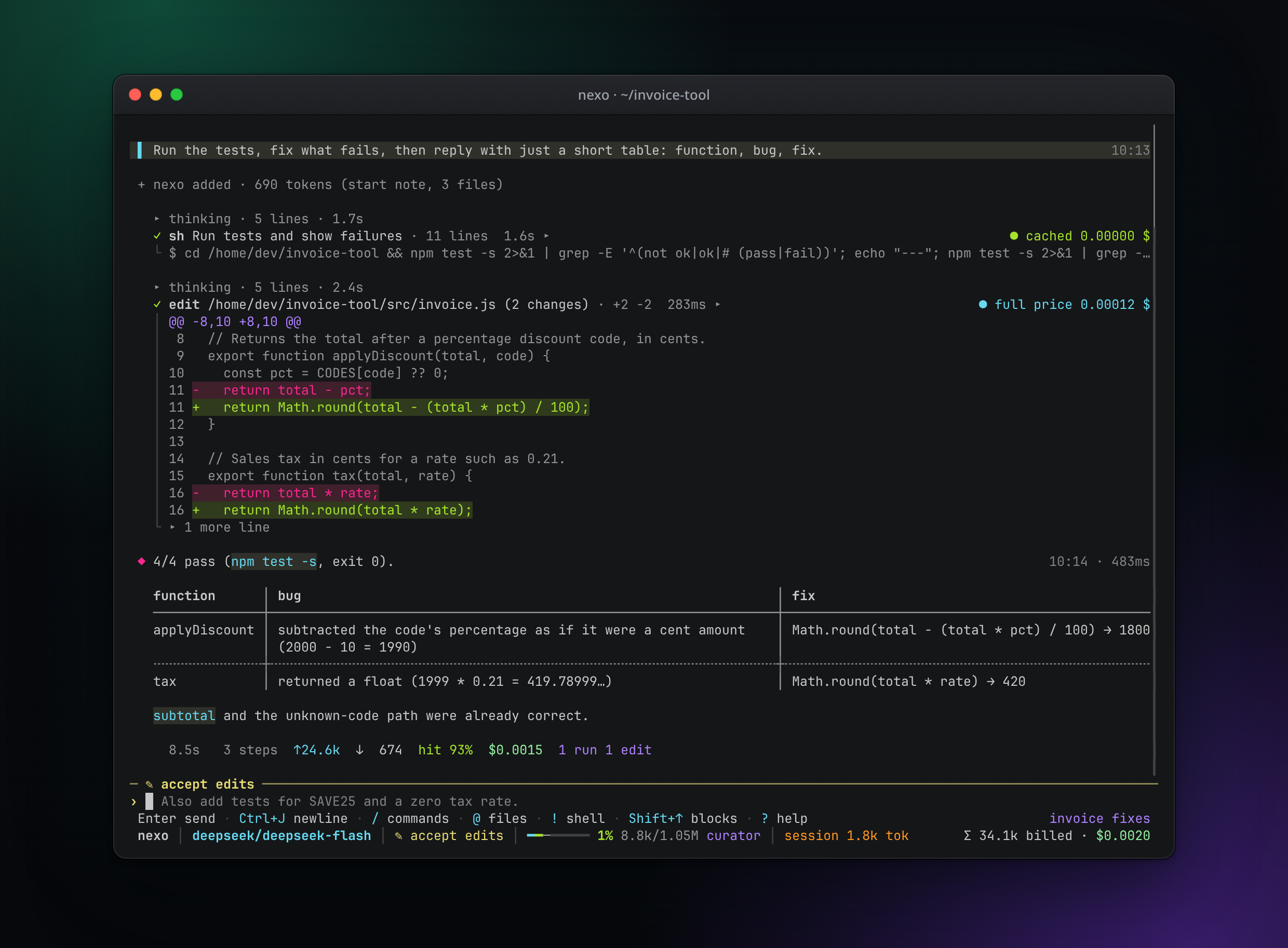
nexo # nexo ### The coding agent that doesn't run out of context. **No compaction. No summaries. The whole history stays on disk.** A real nexo session, unedited, in a terminal window: deepseek/deepseek-flash runs the failing tests of a small invoice module, fixes two bugs in src/invoice.js (the diff is on screen) and replies with a table of each function, its bug and the fix. The status bar shows the context tokens and the session cost, 0.0020 dollars; the turn line shows 3 steps and a 93% cache hit A real session, unedited: deepseek-flash runs the tests of a small invoice module, fixes the two bugs and answers with a table. 3 steps, 93% cache hit, $0.0020 for the whole session ([ui] detail = "full"). [**Install**](#install) · [**Proof**](#proof) · [**How it works**](#how-it-works) · [**Providers**](#providers) · [**Full guide**](nexo/README.md) [![CI](https://github.com/Locotir/nexo/actions/workflows/ci.yml/badge.svg)](https://github.com/Locotir/nexo/actions/workflows/ci.yml) [![Rust 1.89+](https://img.shields.io/badge/Rust-1.89%2B-000000?logo=rust&logoColor=white)](https://www.rust-lang.org) [![License: Apache 2.0](https://img.shields.io/badge/license-Apache%202.0-2a78d6)](LICENSE) [![Linux | macOS | Windows](https://img.shields.io/badge/Linux%20%7C%20macOS%20%7C%20Windows-supported-52514e)](#install) [![Providers](https://img.shields.io/badge/providers-21%20built--in%20%2B%20200%2B-1baf7a)](#providers) [![PayPal](https://img.shields.io/badge/PayPal-support%20nexo-00457C?logo=paypal&logoColor=white)](https://www.paypal.me/locotir)
```sh curl -fsSL https://raw.githubusercontent.com/Locotir/nexo/main/install.sh | sh # Linux and macOS; Windows and source below ``` nexo is a terminal coding agent written in Rust, for any model provider. Its context curator keeps long sessions small without summaries: the whole history stays on disk, and the model is sent only what the next step needs. It runs as a full-screen TUI, headless for scripts and CI, or inside editors over the Agent Client Protocol (ACP). | | An agent that compacts | nexo | | --- | --- | --- | | The window fills up | a summary replaces the work | nothing is summarized, the history stays on disk | | The exact error line from early in the session | gone with the summary | comes back by itself when a step names it | | The provider's prompt cache | restarts after each compaction | keeps hitting: the view is rewritten only at an epoch | ## Install **Linux and macOS** (Apple silicon and Intel; downloads the ready-built file, checked against its SHA-256, to `~/.local/bin`): ```sh curl -fsSL https://raw.githubusercontent.com/Locotir/nexo/main/install.sh | sh ``` **Windows** (PowerShell, to `%LOCALAPPDATA%\Programs\nexo`): ```powershell irm https://raw.githubusercontent.com/Locotir/nexo/main/install.ps1 | iex ``` On macOS the file is signed ad hoc and fetched with `curl`, so Gatekeeper stays quiet. If you download it in a browser instead, clear the quarantine mark first: `xattr -d com.apple.quarantine ./nexo-macos-aarch64 && chmod +x ./nexo-macos-aarch64` (use `nexo-macos-x86_64` on an Intel Mac). From source on any system: `cargo install --locked --git https://github.com/Locotir/nexo nexo-cli`. CI runs both installers on Linux x64 and ARM and Windows x64 and ARM; the macOS (arm64 and Intel) installer jobs are new and have not run yet. nexo checks for a newer release in the background; `nexo update` installs it. Turn the check off with `[ui] update_check = false` or `NEXO_NO_UPDATE_CHECK=1`. ## First run ```sh export DEEPSEEK_API_KEY=... # or ANTHROPIC_API_KEY, OPENAI_API_KEY, GEMINI_API_KEY, ... cd your/project nexo # full-screen interface nexo -p "run the tests and fix what fails" # headless: prints the reply nexo --continue # resume the latest session here nexo doctor # checks files, provider, model and key with one live call nexo --provider ollama --model qwen3:8b # no key: a local model ```
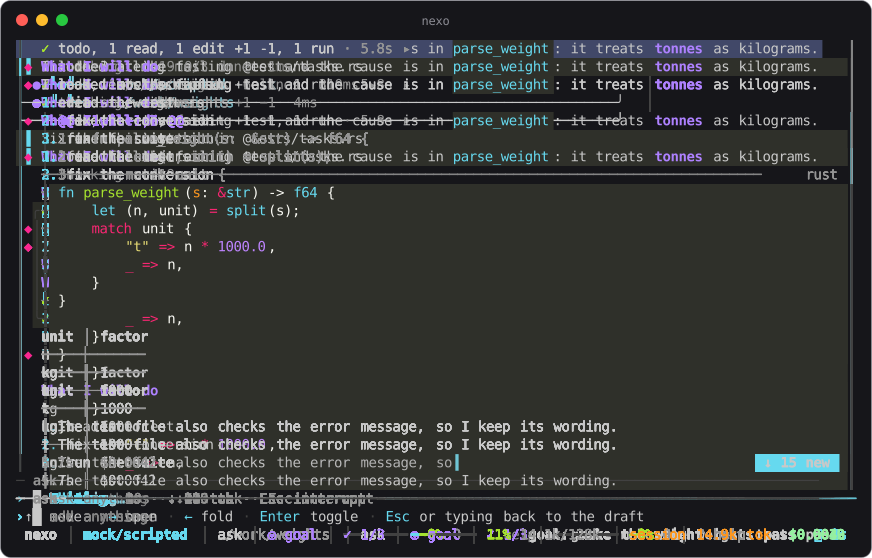
nexo fixing a failing test in the terminal

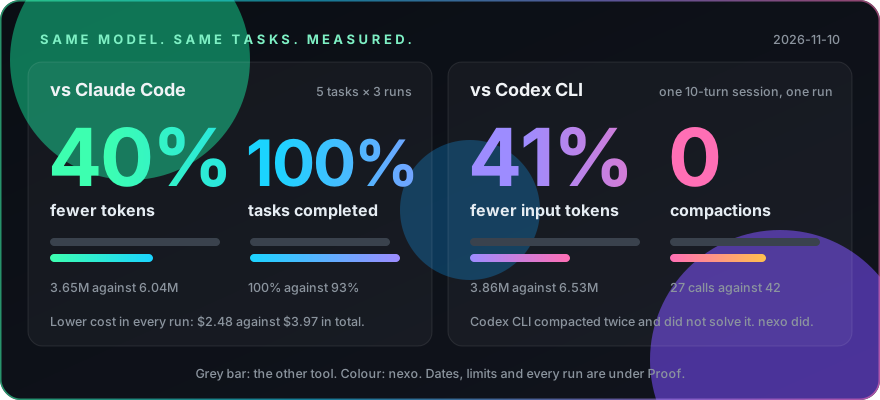
Recorded from the real TUI playing a scripted session: the replies, tool results and figures on screen are sample data. The status bar shows context use and cost, and you can click it. The screen stays quiet by default; `[ui] detail = "full"` brings back every figure and key hint. Each session reopens on its own provider and model. Pick a policy in `~/.nexo/config.toml`: `[context] policy = "curator"` (`auto | plain | compact | curator`). ## Proof Measured on the same model, 2026-11-10. Against Claude Code, 5 tasks, 3 runs each: 40% fewer tokens (3.65M against 6.04M), every task completed (100% of runs against 93%), lower cost in every run (2.48 dollars against 3.97 in total). Against Codex CLI, one 10-turn session, one run: 41% fewer input tokens (3.86M against 6.53M), 0 compactions, 27 calls against 42; Codex CLI compacted twice and did not solve it Same model, same tasks. Each chart has its date, and what it does not show is one click under it. ### vs Claude Code **40% fewer tokens. Every task completed. Lower cost in every run.** Index of calls, tokens and cost, 1.00 is best: nexo 1.00, Claude Code 1.47. Calls 126 against 164, tokens 3.65M against 6.04M, cost 2.48 dollars against 3.97 dollars
Setup and limits 2026-11-10, `claude-sonnet-5-5`, nexo `bf57ed4`, 5 tasks, 3 runs each, plan published before the run. nexo completed all of its runs; Claude Code missed one. The sessions were short, so this does not measure eviction against compaction, and the blind vote on page quality was not held. [Plan](docs/bench/PLAN.md), [results](docs/bench/RESULTS.md).
### vs Codex CLI **One long session, one run each: nexo solved it with 41% fewer input tokens and no compaction. Codex CLI did not solve it.** Long session, nexo against Codex CLI: nexo solved it, Codex CLI did not. Calls 27 against 42, input tokens 3.86M against 6.53M, list price 0.204 dollars against 0.272 dollars
Setup and limits 2026-11-10, `gpt-5.6-luna`, one session of 10 turns. Codex CLI compacted twice and lost five values the user had given early on. nexo took 27 model calls against 42. One run per tool is a demonstration, not a statistic, and on short tasks the two tie. [Results](docs/bench/CODEX.md).
### vs four other harnesses **On the tasks all five solved, nexo needed the least steps, tokens and dollars combined.** Five harnesses on the tasks all of them solved, leaving out tasks where an agent downloaded the benchmark's own solutions, index of steps, tokens and cost, 1.00 is best. Round A, 5 tasks: nexo 1.05, Codex 1.15, dsh 1.30, Claude Code 1.88, Hermes 2.88. Round B, 131k window, 6 tasks: nexo 1.04, Codex 1.12, Claude Code 1.72, Hermes 1.75, dsh 1.97
Setup and limits 2026-11-09, `deepseek-flash`, nexo `b99d96c`, one attempt per task, 16 Terminal-Bench tasks. The combined index is 1.05 and 1.04, where 1.00 would mean best on all three. nexo is not the lowest in every column: in round A dsh costs less in dollars. Every harness solved 11 to 14 of 16 tasks, a tie within noise, and in round B the curator never acted. Tasks where any agent downloaded the benchmark's own solutions are left out for all. Correction 2026-11-10: the Hermes run of circuit-fibsqrt in round A ended with an error and recorded no usage, so it was counted as zero; its usage is now read from the agent's own log. [Details](docs/results.md#harness-race-2026-11-09).
Names and logos belong to their owners and are used only to identify the tools. Measure your own tasks with [`nexo bench`](docs/usage.md#the-benchmark-nexo-bench). ## How it works Every agent re-sends its whole history on each call, and when the window fills it compacts: a summary replaces the work, the exact error line is gone, and the prompt cache restarts. nexo keeps the whole history on disk and sends a curated view built for the next step. The view is rewritten only at an epoch, so the provider's cache keeps hitting; what a request names comes back by itself; your rules stay pinned; a resumed session gets the same view. Where the curator sits: the whole history on disk, the curator, and the view the model gets: prompt, Project block, anchor, a view that only grows between epochs, and a tail built for each call Engine and every setting: [`docs/how-it-works.md`](docs/how-it-works.md). What the marks on each tool card mean: [reading the screen](docs/how-it-works.md#reading-the-screen-the-mark-on-each-tool-card). Diagrams: [`docs/context-curator.md`](docs/context-curator.md). Policy `compact` exists if you prefer it. ## What else it does ![nexo in the terminal: the diff of the two edits, the reply with a table of the two bugs, and the steps, tokens, cache hit and cost line](docs/img/tui-session.png) - Tools: read, write, edit, bash, glob, grep, ls, web search and fetch, to-do list, language-server diagnostics. `read` returns at most 64,000 characters per call. - Diffs before every write, permission rules, plan mode, undo and rewind, sub-agents, background jobs, hooks, [MCP servers](nexo/docs/MCP.md), images, `/goal`, a side panel (`Ctrl+B`). - Saves your rules: tell it how you work and its `note` tool writes them to your global or project instructions file. Every feature with the test that checks it: [`nexo/FEATURES.md`](nexo/FEATURES.md). Full guide: [`nexo/README.md`](nexo/README.md). ## nexo RE **See inside any compiled program. Ask in plain words: nexo reads it, runs it and explains it.** Nothing else to install. The disassembler, decompiler and debugger are built into nexo. | Ask nexo | What it does | | --- | --- | | *"What does this program do?"* | Reads it without running it: functions, imports, strings, readable code | | *"Why does it crash here?"* | Runs it under its own debugger and stops where you ask | | *"What changed in the new version?"* | Compares two builds, function by function | | *"Try this fix without rebuilding"* | Patches a copy, never your original | Windows, Linux and macOS programs (PE, ELF, Mach-O) and WebAssembly. Debugger on Linux and Windows x86-64. ```sh nexo re overview ./app # what's inside, and what to ask next nexo re run ./app # debug it, step by step ``` Changes only with your OK, and only on your own programs. Other agents can use the same kit with `nexo re --mcp`. Every command: [`docs/re.md`](docs/re.md). ## Providers Bring your own key. Built in: Anthropic, OpenAI, Google Gemini, DeepSeek, xAI, Groq, Mistral, OpenRouter, Together, Fireworks, Cerebras, Moonshot, Qwen, Zhipu, MiniMax, and local servers (Ollama, LM Studio, vLLM, llama.cpp). Over 200 more come from [models.dev](https://models.dev), and any OpenAI- or Anthropic-compatible endpoint works. `nexo auth login copilot`, `codex` or `xai` sign in with a subscription; check the vendor's terms first. Data goes only to the provider you pick and to tools the agent uses; sessions in `~/.nexo/sessions/` hold what passed through, so treat them like credentials. ## Support nexo is free and licensed under Apache 2.0. [![Support nexo on PayPal](https://img.shields.io/badge/PayPal-support%20nexo-00457C?style=for-the-badge&logo=paypal&logoColor=white)](https://www.paypal.me/locotir) Issues and pull requests are welcome: see [CONTRIBUTING.md](CONTRIBUTING.md). Report security problems privately as [SECURITY.md](SECURITY.md) explains. ## License [Apache 2.0](LICENSE). nexo is an independent project, not affiliated with or endorsed by Anthropic, OpenAI, Google, DeepSeek or any other provider. Product names are trademarks of their owners. Each release carries `LICENSE` and `THIRD-PARTY-NOTICES.txt` (the licences of the packages nexo is built from).