# Auto Browser
[](https://mcptoplist.com/server/glama%2FLvcidPsyche%2Fauto-browser)
[](https://github.com/LvcidPsyche/auto-browser/actions/workflows/ci.yml)
[](https://pypi.org/project/auto-browser-client/)
[](./LICENSE)
[](./README.md)
[](./README.md)
[](https://codespaces.new/LvcidPsyche/auto-browser?quickstart=1)
 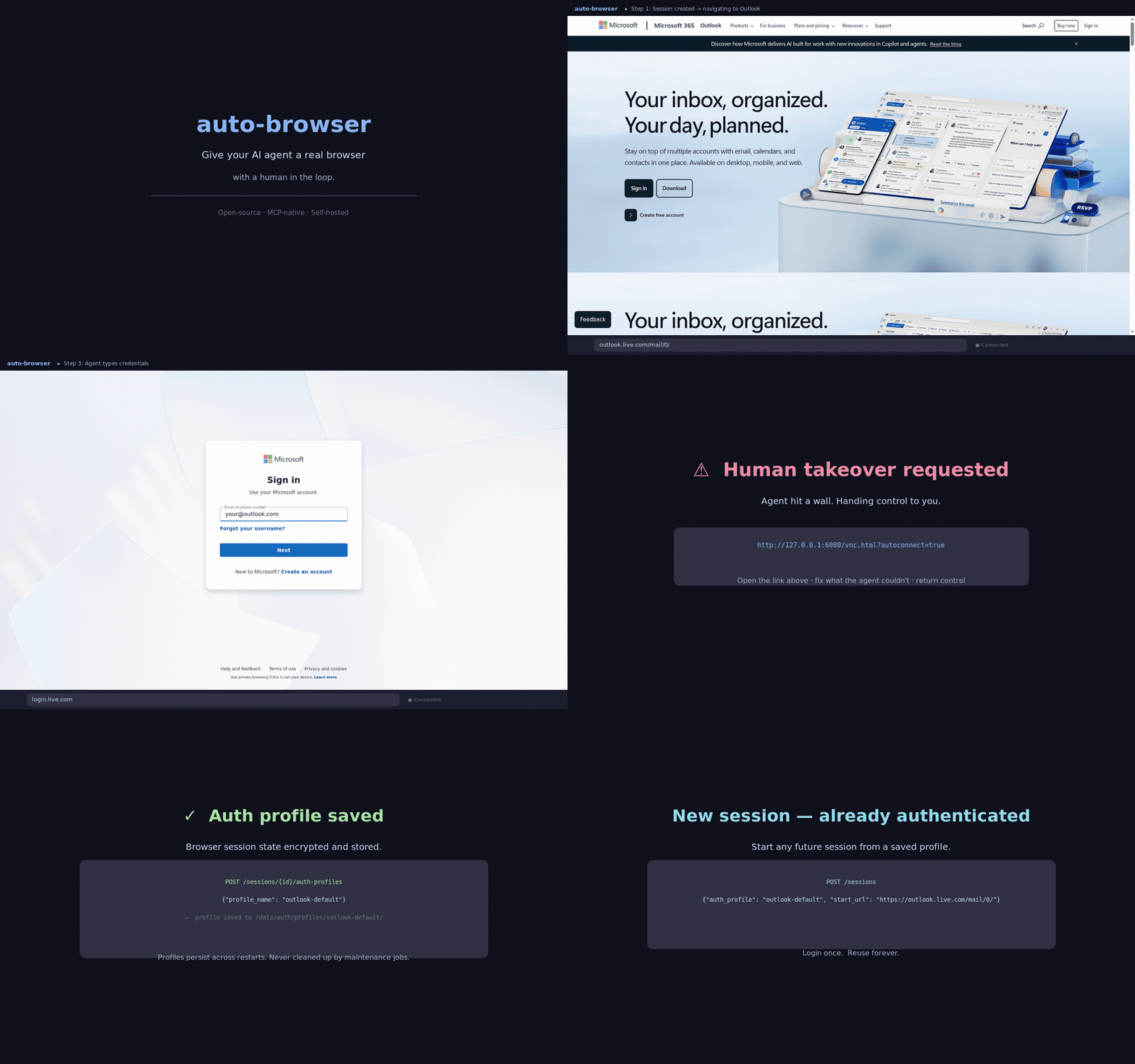
> **Give your AI agent a real browser, with a human in the loop.**
Auto Browser is an MCP-native browser control plane for authorized workflows. It gives MCP clients, LLM agents, and operators a shared Playwright browser with human takeover, reusable auth profiles, approvals, audit trails, and local-first deployment.
Works with:
- Claude Desktop
- Cursor
- any MCP client that can talk HTTP or stdio
- direct REST callers when you want curl-first control
## Why Auto Browser
- **MCP-native from day one.** The browser surface is already packaged as an MCP server instead of bolted on after the fact.
- **Human takeover when the web gets brittle.** noVNC keeps the same live session available when a person needs to step in.
- **Login once, reuse later.** Save named auth profiles and reopen fresh sessions that are already signed in.
- **Local-first by default.** Run the full stack on your own box with Docker Compose, or use Codespaces for a quick hosted demo.
- **Safety rails built in.** Approvals, operator identity, PII scrubbing, Witness receipts, and policy presets are all part of the product surface.
- **Evidence you can hand to someone else.** Witness receipt chains are Ed25519-signed, and an exported bundle verifies with [`scripts/verify_witness_bundle.py`](./scripts/verify_witness_bundle.py) — which imports nothing from this project, so a recipient need not run or trust this controller to check it.
- **We audit ourselves in public.** [`docs/audits/2026-08-execution-audit.md`](./docs/audits/2026-08-execution-audit.md) documents an adversarial audit of this repo that found safety controls which reported success while doing nothing, with reproductions, the fixes, and the gates that close the class.
- **Governed skill induction.** Verified browser traces can become staged skill candidates with signed provenance, verifier adapters, and review-only graduation — agents that prove they can repeat themselves correctly, not just act once.
## Release Highlights (v1.5.0)
- **Read a page without paying for pixels.** The new `text` observation preset returns the accessibility outline, extracted text, and interactables with no screenshot and no OCR — the cheapest way for an agent to read a page. Set `PERCEPTION_PRESET_DEFAULT=text` to make it a deployment-wide default.
- **Find a string on the page in one call.** `browser.find_elements` now takes a `query` (plain text or regex, case-insensitive) instead of a CSS selector and returns each match with surrounding context — no full observe needed to check one value.
- **Errors agents can act on.** Invalid tool arguments report field-level details, handler messages pass through instead of a generic failure, and the MCP bridge's cold-start error now says exactly how to start the controller.
- **Any OpenAI-compatible model can drive the browser.** A single generic adapter serves every model reachable over an OpenAI `/chat/completions` endpoint. New providers: `openrouter` (one key → ~every frontier model), `xai` (Grok), `deepseek`, `minimax`, and `openai_compatible` (custom base URL for self-hosted Ollama / vLLM / LM Studio, Azure, Together, Groq, Fireworks, …). Vision + function-calling with a content-parse fallback for endpoints that ignore `tool_choice`.
- **`browser://audit/events` MCP resource.** List and read recent audit events across sessions directly over MCP.
- **Playwright pin parity enforced in CI.** The controller (pip) and browser-node (npm) Playwright versions must match exactly — a single-side bump can no longer merge and crash-loop compose deployments.
- **On PyPI.** `pip install auto-browser-client` for the SDK, `pip install auto-browser-langchain` for the LangChain/LangGraph/CrewAI adapters, and `uvx auto-browser-mcp` to run the MCP stdio bridge with zero setup. Releases publish via PyPI trusted publishing (OIDC) on tag push.
### Since v1.3.0
- **`browser_manager.py` is now a pure facade + composition root** (1,284 → 769 lines), with domain logic extracted into `app/browser/services/`.
- **Fork state exports are encrypted at rest** and shadow-browse state never touches disk.
- **Download capture tasks can no longer be garbage-collected mid-flight**, shadow-browse failures roll back cleanly, and page listeners survive object-id reuse.
- **Release gates in CI** enforce dependency audits, fixture evals, client tests, Python wheel builds, and the 80% controller coverage gate on Python 3.11 and 3.14.
See [CHANGELOG.md](./CHANGELOG.md) for the full release history.
## Good Fits
- internal dashboards and admin tools
- operator-assisted QA and browser debugging
- login-once, reuse-later account workflows
- brittle sites where a human may need to recover the flow
- MCP-powered agent workflows that need a real browser, not just HTML fetches
## Not the Goal
- CAPTCHA solving
- unauthorized scraping or account automation
- deceptive identity shaping or bypass tooling
## What You Get
| Browser Control | Operator Safety | Deployment and Integration |
| --- | --- | --- |
| Playwright-backed sessions with screenshots, DOM summaries, OCR excerpts, tab controls, downloads, and network inspection | approval gates, operator identity headers, audit events, PII scrubbing, Witness receipts, and protection profiles | MCP over HTTP, bundled stdio bridge, REST API, Docker Compose, Codespaces, auth profiles, and optional per-session isolation |
## Quickstart
```bash
git clone https://github.com/LvcidPsyche/auto-browser.git
cd auto-browser
docker compose up --build
```
That is enough for local development with the default settings.
Optional:
```bash
cp .env.example .env
make doctor
```
Run `make doctor` from a normal terminal with local Docker access and permission to open localhost sockets.
Open:
- API docs: `http://127.0.0.1:8000/docs`
- Operator dashboard: `http://127.0.0.1:8000/dashboard`
- Visual takeover: `http://127.0.0.1:6080/vnc.html?autoconnect=true&resize=scale`
All published ports bind to `127.0.0.1` by default.
## Try It in Codespaces
[](https://codespaces.new/LvcidPsyche/auto-browser?quickstart=1)
Codespaces provisions the stack automatically. The dashboard and noVNC tabs are usually ready in about 90 seconds.
## First Useful Demo
The highest-signal flow in this repo is:
1. create a session
2. log in manually if the site needs a human
3. save the session as a named auth profile
4. open a new session from that auth profile
5. continue work without reauthing
Start here:
- [`examples/login-and-save-profile.md`](./examples/login-and-save-profile.md)
- [`examples/README.md`](./examples/README.md)
Minimal session creation:
```bash
curl -s http://127.0.0.1:8000/sessions \
-X POST \
-H 'content-type: application/json' \
-d '{"name":"demo","start_url":"https://example.com"}' | jq
```
Minimal observation:
```bash
curl -s http://127.0.0.1:8000/sessions//observe | jq
```
## MCP Clients
Auto Browser exposes:
- an HTTP MCP endpoint at `http://127.0.0.1:8000/mcp`
- convenience endpoints at `http://127.0.0.1:8000/mcp/tools` and `http://127.0.0.1:8000/mcp/tools/call`
- a stdio bridge: `uvx auto-browser-mcp` from PyPI, or [`scripts/mcp_stdio_bridge.py`](./scripts/mcp_stdio_bridge.py) in a repo checkout
The default MCP tool profile is `curated`, which keeps the browser surface compact for better tool selection. If you want the full internal tool surface, set:
```bash
MCP_TOOL_PROFILE=full
```
Raw tool-call example:
```bash
curl -s http://127.0.0.1:8000/mcp/tools/call \
-X POST \
-H 'content-type: application/json' \
-d '{
"name":"browser.create_session",
"arguments":{
"name":"demo",
"start_url":"https://example.com"
}
}' | jq
```
Client setup guides:
- [`docs/mcp-clients.md`](./docs/mcp-clients.md)
- [`examples/claude-desktop-setup.md`](./examples/claude-desktop-setup.md)
- [`examples/cursor-mcp-setup.md`](./examples/cursor-mcp-setup.md)
- [`examples/claude_desktop_config.json`](./examples/claude_desktop_config.json)
For resource listing, resource reads, and subscription-style update examples,
see [`docs/mcp-clients.md#resources-and-subscriptions`](./docs/mcp-clients.md#resources-and-subscriptions).
## Convergence Harness
Auto Browser ships a Stage 0 convergence harness for Agent Skill Induction. It runs a structured task contract, records tamper-checked traces, verifies completion, and writes a staged skill candidate with signed provenance. Generated skills are staged only — promotion stays explicit and reviewed.
Read-only inspection tools (`harness.list_runs`, `harness.get_status`, `harness.get_trace`) are exposed in the default `curated` MCP tool profile so agents can introspect harness state without elevated access. Convergence runs, drift checks, candidate management, and graduation require `MCP_TOOL_PROFILE=full`, or can be invoked directly over REST.
Start with [`docs/convergence-harness.md`](./docs/convergence-harness.md). A deterministic local smoke is:
```bash
python -m controller.harness.run --contract evals/contracts/example_read.json --mock-final-url https://example.com --mock-final-text "Example Domain"
```
For MCP clients, set `MCP_TOOL_PROFILE=full` to expose the `harness.*` tools.
## Security and Compliance
For a real private deployment, set at least:
```bash
APP_ENV=production
API_BEARER_TOKEN=
REQUIRE_OPERATOR_ID=true
AUTH_STATE_ENCRYPTION_KEY=<44-char-fernet-key>
REQUIRE_AUTH_STATE_ENCRYPTION=true
REQUEST_RATE_LIMIT_ENABLED=true
METRICS_ENABLED=true
STEALTH_ENABLED=false
```
`COMPLIANCE_TEMPLATE` can apply a preconfigured posture at startup:
| Preset | Auth Encryption | Operator ID | PII Scrub | Isolation | Max Session Age |
| --- | --- | --- | --- | --- | --- |
| `strict` | required | required | all layers | `docker_ephemeral` | 4h |
| `balanced` | - | required | network + text | shared | 24h |
Both presets require upload approvals and enable Witness receipts. Startup writes the applied policy to `/data/compliance-manifest.json`. The legacy names (`HIPAA`, `SOC2`, `GDPR`, `PCI-DSS`) still work as deprecated aliases and emit a warning at startup.
Example:
```bash
COMPLIANCE_TEMPLATE=strict docker compose up
```
For deployment details, hosted Witness notes, CLI auth modes, and reverse-SSH guidance, see:
- [`docs/deployment.md`](./docs/deployment.md)
- [`docs/production-hardening.md`](./docs/production-hardening.md)
## Architecture at a Glance
```mermaid
flowchart LR
User[Human operator] -->|watch / takeover| noVNC[noVNC]
LLM[Any model: OpenAI / Claude / Gemini / OpenRouter / Grok / DeepSeek / MiniMax / local] -->|shared tools| Controller[Controller API]
Controller -->|Playwright protocol| Browser[Browser node]
noVNC --> Browser
Browser --> Artifacts[(screenshots / traces / auth state)]
Controller --> Artifacts
Controller --> Policy[Allowlist + approval gates]
```
### Model providers
First-class adapters for **OpenAI**, **Claude**, and **Gemini** (API or CLI). Beyond those,
a single generic **OpenAI-compatible** adapter drives any model reachable over an OpenAI
`/chat/completions` endpoint — set an API key to enable it:
| Provider | Reaches |
|----------|---------|
| `openrouter` | one key → ~every frontier model (Claude, GPT, Gemini, Grok, DeepSeek, Llama, Mistral, Qwen, …) |
| `xai` | Grok |
| `deepseek` | DeepSeek (text-only; driven from the DOM/accessibility outline) |
| `minimax` | MiniMax |
| `openai_compatible` | any custom base URL — self-hosted Ollama / vLLM / LM Studio, Azure OpenAI, Together, Groq, Fireworks, … |
Vision (screenshots) is used for every provider except text-only ones. See `.env.example` for
the `*_API_KEY` / `*_BASE_URL` / `*_MODEL` settings.
Core components:
- `browser-node/` runs Chromium, Xvfb, x11vnc, and noVNC
- `controller/` exposes the FastAPI controller, MCP transport, policy rails, and orchestration endpoints
- `data/` holds runtime artifacts, auth state, approvals, audit logs, and optional CLI caches
- `scripts/` contains local helpers for doctor, smoke tests, bridges, and release checks
## Repo Guide
| Path | What It Contains |
| --- | --- |
| [`controller/`](./controller/) | controller API, MCP transport, tests, and packaging |
| [`browser-node/`](./browser-node/) | browser runtime and Playwright connection layer |
| [`examples/`](./examples/) | copy-paste flows and MCP client setup |
| [`integrations/langchain/`](./integrations/langchain/README.md) | LangChain, LangGraph, and CrewAI adapters |
| [`docs/`](./docs/) | architecture, deployment, hardening, and launch docs |
| [`scripts/`](./scripts/) | doctor, smoke harnesses, stdio bridge, and auth helpers |
| [`ops/`](./ops/) | supporting service templates and operational assets |
## Common Commands
| Command | Purpose |
| --- | --- |
| `make help` | list available repo commands |
| `make lint` | run Ruff checks on app, tests, and helper scripts |
| `make test` | run controller tests in Docker |
| `make test-local` | run controller tests on host Python 3.10+ |
| `make eval` | run deterministic provider/profile eval scoring |
| `make doctor` | run the local readiness smoke |
| `make release-audit` | run the fuller release-validation pass |
| `make smoke-isolation` | verify per-session Docker isolation |
| `make smoke-reverse-ssh` | verify reverse-SSH remote access |
## Documentation Map
| If You Want To... | Start Here |
| --- | --- |
| understand the system shape | [`docs/architecture.md`](./docs/architecture.md) |
| connect Claude Desktop or Cursor | [`docs/mcp-clients.md`](./docs/mcp-clients.md) |
| run the curl-first examples | [`examples/README.md`](./examples/README.md) |
| deploy on a trusted host | [`docs/deployment.md`](./docs/deployment.md) |
| review production constraints | [`docs/production-hardening.md`](./docs/production-hardening.md) |
| run the convergence harness | [`docs/convergence-harness.md`](./docs/convergence-harness.md) |
| inspect release history | [`CHANGELOG.md`](./CHANGELOG.md) |
| see where the project is headed | [`ROADMAP.md`](./ROADMAP.md) |
## Contributing
If you want to help, start with:
- [`CONTRIBUTING.md`](./CONTRIBUTING.md)
- [`docs/good-first-issues.md`](./docs/good-first-issues.md)
- [`CODE_OF_CONDUCT.md`](./CODE_OF_CONDUCT.md)
If Auto Browser is useful, a star helps other people find it. Sponsorship and tip options live in [`TIPS.md`](./TIPS.md).

> **Give your AI agent a real browser, with a human in the loop.**
Auto Browser is an MCP-native browser control plane for authorized workflows. It gives MCP clients, LLM agents, and operators a shared Playwright browser with human takeover, reusable auth profiles, approvals, audit trails, and local-first deployment.
Works with:
- Claude Desktop
- Cursor
- any MCP client that can talk HTTP or stdio
- direct REST callers when you want curl-first control
## Why Auto Browser
- **MCP-native from day one.** The browser surface is already packaged as an MCP server instead of bolted on after the fact.
- **Human takeover when the web gets brittle.** noVNC keeps the same live session available when a person needs to step in.
- **Login once, reuse later.** Save named auth profiles and reopen fresh sessions that are already signed in.
- **Local-first by default.** Run the full stack on your own box with Docker Compose, or use Codespaces for a quick hosted demo.
- **Safety rails built in.** Approvals, operator identity, PII scrubbing, Witness receipts, and policy presets are all part of the product surface.
- **Evidence you can hand to someone else.** Witness receipt chains are Ed25519-signed, and an exported bundle verifies with [`scripts/verify_witness_bundle.py`](./scripts/verify_witness_bundle.py) — which imports nothing from this project, so a recipient need not run or trust this controller to check it.
- **We audit ourselves in public.** [`docs/audits/2026-08-execution-audit.md`](./docs/audits/2026-08-execution-audit.md) documents an adversarial audit of this repo that found safety controls which reported success while doing nothing, with reproductions, the fixes, and the gates that close the class.
- **Governed skill induction.** Verified browser traces can become staged skill candidates with signed provenance, verifier adapters, and review-only graduation — agents that prove they can repeat themselves correctly, not just act once.
## Release Highlights (v1.5.0)
- **Read a page without paying for pixels.** The new `text` observation preset returns the accessibility outline, extracted text, and interactables with no screenshot and no OCR — the cheapest way for an agent to read a page. Set `PERCEPTION_PRESET_DEFAULT=text` to make it a deployment-wide default.
- **Find a string on the page in one call.** `browser.find_elements` now takes a `query` (plain text or regex, case-insensitive) instead of a CSS selector and returns each match with surrounding context — no full observe needed to check one value.
- **Errors agents can act on.** Invalid tool arguments report field-level details, handler messages pass through instead of a generic failure, and the MCP bridge's cold-start error now says exactly how to start the controller.
- **Any OpenAI-compatible model can drive the browser.** A single generic adapter serves every model reachable over an OpenAI `/chat/completions` endpoint. New providers: `openrouter` (one key → ~every frontier model), `xai` (Grok), `deepseek`, `minimax`, and `openai_compatible` (custom base URL for self-hosted Ollama / vLLM / LM Studio, Azure, Together, Groq, Fireworks, …). Vision + function-calling with a content-parse fallback for endpoints that ignore `tool_choice`.
- **`browser://audit/events` MCP resource.** List and read recent audit events across sessions directly over MCP.
- **Playwright pin parity enforced in CI.** The controller (pip) and browser-node (npm) Playwright versions must match exactly — a single-side bump can no longer merge and crash-loop compose deployments.
- **On PyPI.** `pip install auto-browser-client` for the SDK, `pip install auto-browser-langchain` for the LangChain/LangGraph/CrewAI adapters, and `uvx auto-browser-mcp` to run the MCP stdio bridge with zero setup. Releases publish via PyPI trusted publishing (OIDC) on tag push.
### Since v1.3.0
- **`browser_manager.py` is now a pure facade + composition root** (1,284 → 769 lines), with domain logic extracted into `app/browser/services/`.
- **Fork state exports are encrypted at rest** and shadow-browse state never touches disk.
- **Download capture tasks can no longer be garbage-collected mid-flight**, shadow-browse failures roll back cleanly, and page listeners survive object-id reuse.
- **Release gates in CI** enforce dependency audits, fixture evals, client tests, Python wheel builds, and the 80% controller coverage gate on Python 3.11 and 3.14.
See [CHANGELOG.md](./CHANGELOG.md) for the full release history.
## Good Fits
- internal dashboards and admin tools
- operator-assisted QA and browser debugging
- login-once, reuse-later account workflows
- brittle sites where a human may need to recover the flow
- MCP-powered agent workflows that need a real browser, not just HTML fetches
## Not the Goal
- CAPTCHA solving
- unauthorized scraping or account automation
- deceptive identity shaping or bypass tooling
## What You Get
| Browser Control | Operator Safety | Deployment and Integration |
| --- | --- | --- |
| Playwright-backed sessions with screenshots, DOM summaries, OCR excerpts, tab controls, downloads, and network inspection | approval gates, operator identity headers, audit events, PII scrubbing, Witness receipts, and protection profiles | MCP over HTTP, bundled stdio bridge, REST API, Docker Compose, Codespaces, auth profiles, and optional per-session isolation |
## Quickstart
```bash
git clone https://github.com/LvcidPsyche/auto-browser.git
cd auto-browser
docker compose up --build
```
That is enough for local development with the default settings.
Optional:
```bash
cp .env.example .env
make doctor
```
Run `make doctor` from a normal terminal with local Docker access and permission to open localhost sockets.
Open:
- API docs: `http://127.0.0.1:8000/docs`
- Operator dashboard: `http://127.0.0.1:8000/dashboard`
- Visual takeover: `http://127.0.0.1:6080/vnc.html?autoconnect=true&resize=scale`
All published ports bind to `127.0.0.1` by default.
## Try It in Codespaces
[](https://codespaces.new/LvcidPsyche/auto-browser?quickstart=1)
Codespaces provisions the stack automatically. The dashboard and noVNC tabs are usually ready in about 90 seconds.
## First Useful Demo
The highest-signal flow in this repo is:
1. create a session
2. log in manually if the site needs a human
3. save the session as a named auth profile
4. open a new session from that auth profile
5. continue work without reauthing
Start here:
- [`examples/login-and-save-profile.md`](./examples/login-and-save-profile.md)
- [`examples/README.md`](./examples/README.md)
Minimal session creation:
```bash
curl -s http://127.0.0.1:8000/sessions \
-X POST \
-H 'content-type: application/json' \
-d '{"name":"demo","start_url":"https://example.com"}' | jq
```
Minimal observation:
```bash
curl -s http://127.0.0.1:8000/sessions//observe | jq
```
## MCP Clients
Auto Browser exposes:
- an HTTP MCP endpoint at `http://127.0.0.1:8000/mcp`
- convenience endpoints at `http://127.0.0.1:8000/mcp/tools` and `http://127.0.0.1:8000/mcp/tools/call`
- a stdio bridge: `uvx auto-browser-mcp` from PyPI, or [`scripts/mcp_stdio_bridge.py`](./scripts/mcp_stdio_bridge.py) in a repo checkout
The default MCP tool profile is `curated`, which keeps the browser surface compact for better tool selection. If you want the full internal tool surface, set:
```bash
MCP_TOOL_PROFILE=full
```
Raw tool-call example:
```bash
curl -s http://127.0.0.1:8000/mcp/tools/call \
-X POST \
-H 'content-type: application/json' \
-d '{
"name":"browser.create_session",
"arguments":{
"name":"demo",
"start_url":"https://example.com"
}
}' | jq
```
Client setup guides:
- [`docs/mcp-clients.md`](./docs/mcp-clients.md)
- [`examples/claude-desktop-setup.md`](./examples/claude-desktop-setup.md)
- [`examples/cursor-mcp-setup.md`](./examples/cursor-mcp-setup.md)
- [`examples/claude_desktop_config.json`](./examples/claude_desktop_config.json)
For resource listing, resource reads, and subscription-style update examples,
see [`docs/mcp-clients.md#resources-and-subscriptions`](./docs/mcp-clients.md#resources-and-subscriptions).
## Convergence Harness
Auto Browser ships a Stage 0 convergence harness for Agent Skill Induction. It runs a structured task contract, records tamper-checked traces, verifies completion, and writes a staged skill candidate with signed provenance. Generated skills are staged only — promotion stays explicit and reviewed.
Read-only inspection tools (`harness.list_runs`, `harness.get_status`, `harness.get_trace`) are exposed in the default `curated` MCP tool profile so agents can introspect harness state without elevated access. Convergence runs, drift checks, candidate management, and graduation require `MCP_TOOL_PROFILE=full`, or can be invoked directly over REST.
Start with [`docs/convergence-harness.md`](./docs/convergence-harness.md). A deterministic local smoke is:
```bash
python -m controller.harness.run --contract evals/contracts/example_read.json --mock-final-url https://example.com --mock-final-text "Example Domain"
```
For MCP clients, set `MCP_TOOL_PROFILE=full` to expose the `harness.*` tools.
## Security and Compliance
For a real private deployment, set at least:
```bash
APP_ENV=production
API_BEARER_TOKEN=
REQUIRE_OPERATOR_ID=true
AUTH_STATE_ENCRYPTION_KEY=<44-char-fernet-key>
REQUIRE_AUTH_STATE_ENCRYPTION=true
REQUEST_RATE_LIMIT_ENABLED=true
METRICS_ENABLED=true
STEALTH_ENABLED=false
```
`COMPLIANCE_TEMPLATE` can apply a preconfigured posture at startup:
| Preset | Auth Encryption | Operator ID | PII Scrub | Isolation | Max Session Age |
| --- | --- | --- | --- | --- | --- |
| `strict` | required | required | all layers | `docker_ephemeral` | 4h |
| `balanced` | - | required | network + text | shared | 24h |
Both presets require upload approvals and enable Witness receipts. Startup writes the applied policy to `/data/compliance-manifest.json`. The legacy names (`HIPAA`, `SOC2`, `GDPR`, `PCI-DSS`) still work as deprecated aliases and emit a warning at startup.
Example:
```bash
COMPLIANCE_TEMPLATE=strict docker compose up
```
For deployment details, hosted Witness notes, CLI auth modes, and reverse-SSH guidance, see:
- [`docs/deployment.md`](./docs/deployment.md)
- [`docs/production-hardening.md`](./docs/production-hardening.md)
## Architecture at a Glance
```mermaid
flowchart LR
User[Human operator] -->|watch / takeover| noVNC[noVNC]
LLM[Any model: OpenAI / Claude / Gemini / OpenRouter / Grok / DeepSeek / MiniMax / local] -->|shared tools| Controller[Controller API]
Controller -->|Playwright protocol| Browser[Browser node]
noVNC --> Browser
Browser --> Artifacts[(screenshots / traces / auth state)]
Controller --> Artifacts
Controller --> Policy[Allowlist + approval gates]
```
### Model providers
First-class adapters for **OpenAI**, **Claude**, and **Gemini** (API or CLI). Beyond those,
a single generic **OpenAI-compatible** adapter drives any model reachable over an OpenAI
`/chat/completions` endpoint — set an API key to enable it:
| Provider | Reaches |
|----------|---------|
| `openrouter` | one key → ~every frontier model (Claude, GPT, Gemini, Grok, DeepSeek, Llama, Mistral, Qwen, …) |
| `xai` | Grok |
| `deepseek` | DeepSeek (text-only; driven from the DOM/accessibility outline) |
| `minimax` | MiniMax |
| `openai_compatible` | any custom base URL — self-hosted Ollama / vLLM / LM Studio, Azure OpenAI, Together, Groq, Fireworks, … |
Vision (screenshots) is used for every provider except text-only ones. See `.env.example` for
the `*_API_KEY` / `*_BASE_URL` / `*_MODEL` settings.
Core components:
- `browser-node/` runs Chromium, Xvfb, x11vnc, and noVNC
- `controller/` exposes the FastAPI controller, MCP transport, policy rails, and orchestration endpoints
- `data/` holds runtime artifacts, auth state, approvals, audit logs, and optional CLI caches
- `scripts/` contains local helpers for doctor, smoke tests, bridges, and release checks
## Repo Guide
| Path | What It Contains |
| --- | --- |
| [`controller/`](./controller/) | controller API, MCP transport, tests, and packaging |
| [`browser-node/`](./browser-node/) | browser runtime and Playwright connection layer |
| [`examples/`](./examples/) | copy-paste flows and MCP client setup |
| [`integrations/langchain/`](./integrations/langchain/README.md) | LangChain, LangGraph, and CrewAI adapters |
| [`docs/`](./docs/) | architecture, deployment, hardening, and launch docs |
| [`scripts/`](./scripts/) | doctor, smoke harnesses, stdio bridge, and auth helpers |
| [`ops/`](./ops/) | supporting service templates and operational assets |
## Common Commands
| Command | Purpose |
| --- | --- |
| `make help` | list available repo commands |
| `make lint` | run Ruff checks on app, tests, and helper scripts |
| `make test` | run controller tests in Docker |
| `make test-local` | run controller tests on host Python 3.10+ |
| `make eval` | run deterministic provider/profile eval scoring |
| `make doctor` | run the local readiness smoke |
| `make release-audit` | run the fuller release-validation pass |
| `make smoke-isolation` | verify per-session Docker isolation |
| `make smoke-reverse-ssh` | verify reverse-SSH remote access |
## Documentation Map
| If You Want To... | Start Here |
| --- | --- |
| understand the system shape | [`docs/architecture.md`](./docs/architecture.md) |
| connect Claude Desktop or Cursor | [`docs/mcp-clients.md`](./docs/mcp-clients.md) |
| run the curl-first examples | [`examples/README.md`](./examples/README.md) |
| deploy on a trusted host | [`docs/deployment.md`](./docs/deployment.md) |
| review production constraints | [`docs/production-hardening.md`](./docs/production-hardening.md) |
| run the convergence harness | [`docs/convergence-harness.md`](./docs/convergence-harness.md) |
| inspect release history | [`CHANGELOG.md`](./CHANGELOG.md) |
| see where the project is headed | [`ROADMAP.md`](./ROADMAP.md) |
## Contributing
If you want to help, start with:
- [`CONTRIBUTING.md`](./CONTRIBUTING.md)
- [`docs/good-first-issues.md`](./docs/good-first-issues.md)
- [`CODE_OF_CONDUCT.md`](./CODE_OF_CONDUCT.md)
If Auto Browser is useful, a star helps other people find it. Sponsorship and tip options live in [`TIPS.md`](./TIPS.md).