# dsh-agent-instructions-editor
**[中文](./README.md) | English**



A [DeepSeek Harness](https://github.com/deepseek-ai/deepseek-harness) plugin that adds a
Personalization settings page (个性化指令) to the Web GUI for editing the harness workspace
instruction files, in the spirit of Codex's personalization settings:
- the user-global `~/.dsh/AGENTS.md`,
- project-chain `AGENTS.md` / `CLAUDE.md` files discovered with the same rules the
harness instruction loader applies, and
- `AGENTS.local.md` / `CLAUDE.local.md` overlays.
## Features
- **Global instructions**: a persistent editor for `~/.dsh/AGENTS.md` with a byte-budget
display (default 65,536).
- **Project instructions** (collapsed by default): a project picker (auto-discovered from
the workspace registry + recent session directories; manual paths accepted too) that
renders each level of the "project root → working directory" chain with its 4 candidate
slots (AGENTS.md / CLAUDE.md / AGENTS.local.md / CLAUDE.local.md) — click to edit an
existing file or create a missing one.
- **Same discovery rules as the instruction loader**: chain discovery, per-directory
content dedup (⧉ badge), byte totals and the budget bar follow the same rules as
`@deepseek-ai/dsh-agent-instructions`.
- **Guarded writes**: filename whitelist + realpath project-root containment + mtime
conflict detection (409 → reload or force-overwrite) + temp-file atomic rename; writes
to the same file within one dsh web process are serialized through a queue; a normal
save using an outdated modification time receives a 409 conflict response.
- **When changes apply**: start a new session after saving. The editor does not directly
replace instructions in an existing session; reloading is controlled by the host loader.
## Screenshot
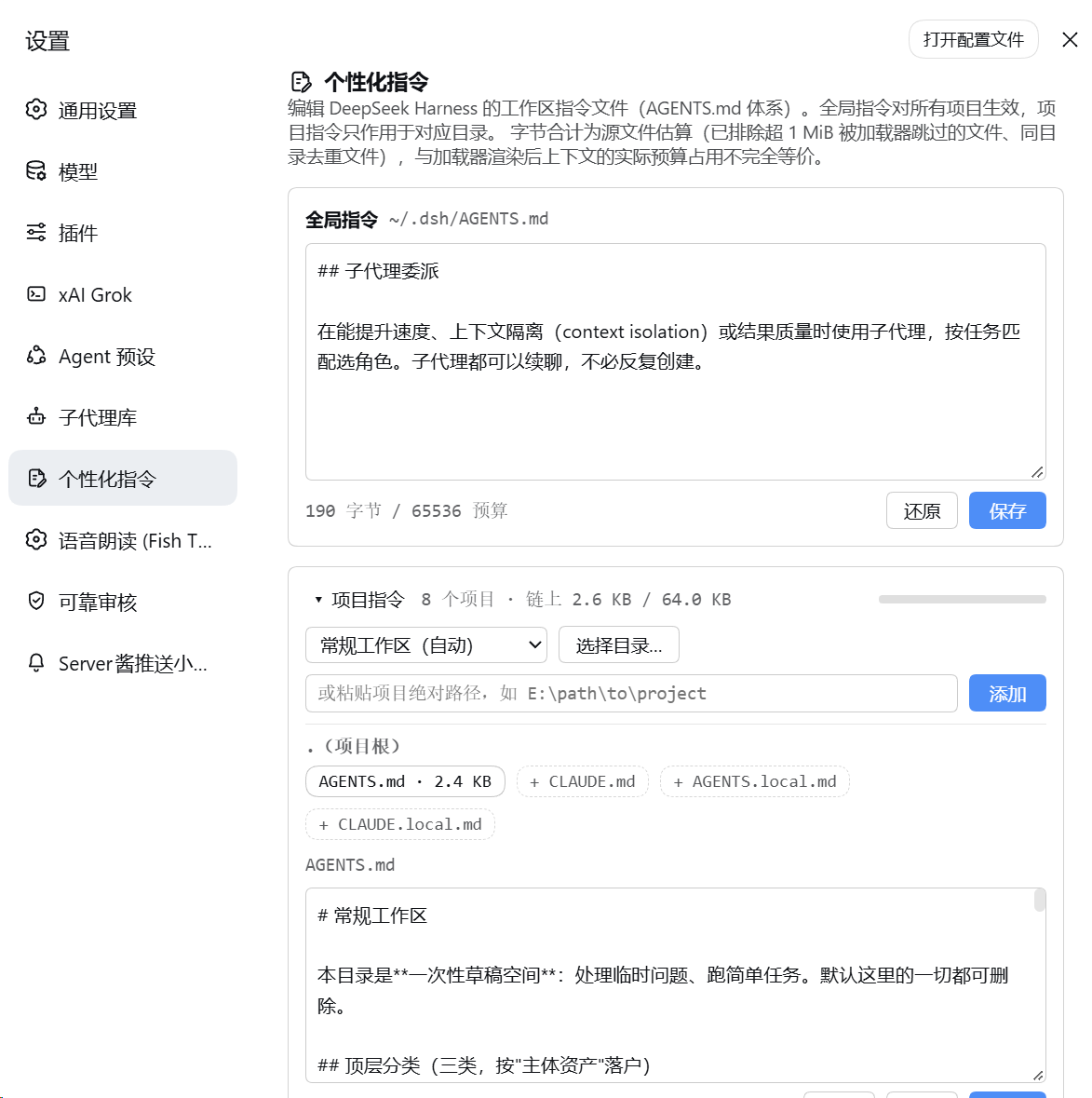
View and edit global and project instructions on the same settings page. The current
UI is in Chinese, as shown here.
## Host and desktop compatibility
Version **0.2.4 targets DSH 0.2**, with `0.2.0-rc.2` as its compatibility baseline. This update clarifies Desktop/Web installation, first use, and when instruction changes take effect; editing and saving behavior is unchanged. The dark-theme project-menu fix from 0.2.3 is retained. The desktop client uses the Web plugin UI, so no separate desktop-specific package is needed. See [CHANGELOG.md](./CHANGELOG.md) for the update notes.
**If you still use DSH 0.1, keep plugin 0.1.2** (pin the npm install to `dsh-agent-instructions-editor@0.1.2`) rather than upgrading to this release. Development dependencies and the CI baseline now use DSH `0.2.0-rc.2`; instruction discovery, save security boundaries and the "start a new session" semantics are unchanged.
## Install
Desktop and Web have separate plugin installations and activation states. Choose the method matching your environment:
### Desktop Installation (Recommended)
Install directly within the desktop client UI (no command-line setup required):
1. Open **Plugins** in the desktop left sidebar, then click **Add plugin**;
2. Enter the npm package name `dsh-agent-instructions-editor@latest` and install;
3. Once installation completes, click **Enable now** (closing the dialog without enabling leaves the plugin installed but disabled);
4. Only if the UI indicates a restart is required, fully quit the application via the menu (**Quit**) and reopen it (closing the window may only hide it to the background);
5. Verification: Open **Settings** and confirm the **"个性化指令" (Personalization)** section appears in the settings sidebar.
Alternative: Desktop terminal installation (Windows / macOS)
If you prefer using the command line, use the desktop-bundled CLI:
1. In the desktop application menu, select **Manage dsh Command…** → **Install** (register the bundled CLI and follow any reported PATH conflict instructions), then open a new terminal;
2. Ensure the desktop app has been launched at least once to initialize, and fully exit via **Quit**;
3. Run the desktop-profile commands in your terminal to install and verify:
```sh
dsh plugin --profile desktop add dsh-agent-instructions-editor@latest
dsh plugin --profile desktop list
```
4. Reopen the desktop application.
> Note: Standalone `dsh` installed via npm or run via `npx` cannot manage the desktop profile. For details on how the bundled command runtime works, see [bundled-command-runtime](https://github.com/deepseek-ai/deepseek-harness/blob/dsh-v0.2.1-rc.2/apps/desktop/README.md#bundled-command-runtime) in the official desktop documentation.
### Web Installation
Manage Web plugins using the matching CLI. Prefer using the same host-matched `dsh` CLI that launches your Web instance:
```sh
dsh plugin --profile web add dsh-agent-instructions-editor@latest
```
Then **restart dsh web** (stop the current process, then run `dsh web`) and refresh the page.
Other install sources:
```sh
# If installing from npm is not an option, pin the 0.2.4 GitHub tag instead:
dsh plugin --profile web add github:MaRi23333/dsh-agent-instructions-editor#v0.2.4
```
Both methods take effect after restarting dsh web.
> **Note**: If using `npx`, pin it to the exact version matching your Web host (e.g. `npx @deepseek-ai/dsh@0.2.0-rc.2 ...`). When switching from a local directory or GitHub install to npm, always include `@latest` so an existing installation is not mistaken for an already-satisfied request.
Requirements: DSH 0.2 (this release targets `0.2.0-rc.2`), Node.js 22+, pnpm, and a DSH CLI matching the installed host. No local
build is needed — the npm package and the GitHub repository both ship the `lib/` build
artifacts.
## Security model and known limitations
- Every route validates that the Host header is a loopback literal (`127.x.x.x`,
`localhost`, `[::1]` — any port), closing off DNS rebinding; POST additionally
requires a JSON content-type and a strict same-origin Origin (local script clients
without an Origin header are unaffected).
- Write path: filename whitelist (4 candidates) + directory realpath must fall inside a
registered project's "project root → working directory" ancestor chain + mtime
conflict fence (409) + atomic temp-file rename. Writes to the same target within one
process are serialized through an in-memory queue and the mtime fence is re-checked
inside it; there is no cross-process file lock — when an external editor or another
process saves the same file concurrently, a tiny race window remains between the
fence re-check and the rename, where an external update could in theory be silently
lost (same as ordinary editors). A malicious local process runs at the same trust
level as this user (it could edit the files directly) and is not within the threat
model.
- Reads follow symlinks (same exposure as the official loader); writes replace the
symlink itself via rename and never write through to the target.
- The editor works with the loader defaults preset by the deployment (markers=`[.git]`,
4 candidates, 65,536-byte budget); if you change dsh-base's agent-instructions
configuration, the editor's display drifts accordingly.
- UI copy is currently hardcoded Chinese (a locale dictionary is registered for future
`t()` integration).
## Architecture
- **Host half** (`src/index.ts`): its own HTTP routes `/agent-instructions/api/{projects,chain,file}`;
the manual-project registry lives in this plugin's profile entry and is read and
written through DSH 0.2's `SettingsForms`, with revision-based conflict detection.
- **Client half** (`src/client/`): contributes the settings page via the
`settings.section` slot; plain textarea editor (zero extra dependencies).
- **Discovery** (`src/chain.ts`): reimplements the instruction loader's rules one by one
(marker walk-up, ancestor chain, candidate probing, per-directory sha1(trim) dedup) —
pure Node, unit-testable.
## Development
```sh
pnpm install --frozen-lockfile
pnpm run typecheck
pnpm run test # discovery, write-path and edit-state unit tests
pnpm run build # tsdown: lib/index.js (host) + lib/client.js (browser)
pnpm run smoke # smoke-host.mjs + smoke-client.mjs
pnpm run check:pack
```
- Dev dependencies are pinned to DSH `0.2.0-rc.2`. The exhaustive exact-version overrides
in `pnpm-workspace.yaml` exist because:
1. pnpm 11.21.0 mis-expands caret ranges with prerelease lower bounds
(`^0.2.0-rc.2` → `>=0.2.0 <0.3.0-0`, which excludes `0.2.0-rc.2` itself), causing
NO_MATCHING_VERSION; and
2. Inlined, discontinued packages keep their last published versions:
`@deepseek-ai/dsh-client-runtime` / `@deepseek-ai/dsh-host-apiproxy` at `0.1.1-rc.2`,
and `@deepseek-ai/dsh-agent-presets` / `@deepseek-ai/dsh-code-runtime` at `0.1.5-rc.3`.
- These dependencies are used for typechecking and tests only; none of it ships in the
published artifact (see [THIRD_PARTY_NOTICES.md](./THIRD_PARTY_NOTICES.md)).
## License
[MIT](./LICENSE). The published artifact bundles no third-party code — see
[THIRD_PARTY_NOTICES.md](./THIRD_PARTY_NOTICES.md).
This plugin is an independent community project, not affiliated with or endorsed by
DeepSeek; the `DeepSeek Harness` name is used solely to indicate platform compatibility.