EUROPEAN ORGANIZATION FOR NUCLEAR RESEARCH

Variables
For each variable the physical units are listed in square brackets.
MAD uses the following canonical variables
to describe the motion of particles:
- X:
Horizontal position x of the (closed) orbit,
referred to the ideal orbit [m].
- PX:
Horizontal canonical momentum px
of the (closed) orbit referred to the ideal orbit,
divided by the reference momentum:
PX = px / p0, [1].
- Y:
Vertical position y of the (closed) orbit,
referred to the ideal orbit [m].
- PY:
Vertical canonical momentum py
of the (closed) orbit referred to the ideal orbit,
divided by the reference momentum:
PY = px / p0, [1].
- T:
Velocity of light times the negative time difference
with respect to the reference particle:
T = - c t, [m].
A positive T means that the particle arrives ahead
of the reference particle.
- PT:
Energy error, divided by the reference momentum times the velocity
of light:
PT = delta(E) / ps c, [1].
This value is only non-zero when synchrotron motion is present.
It describes the deviation of the particle from the orbit of a
particle with the momentum error DELTAP.
- DELTAP:
Difference of the reference momentum and the design momentum,
divided by the reference momentum:
DELTAP = delta(p) / p0, [1].
This quantity is used to normalize
all element strengths.
The independent variable is:
- S:
Arc length s along the reference orbit, [m].
In the limit of fully relativistic particles
(gamma >> 1, v = c, p c = E),
the variables T, PT used here agree with the longitudinal variables
used in [TRANSPORT].
This means that T becomes the negative path length difference,
while PT becomes the fractional momentum error.
The reference momentum ps
must be constant in order to keep the system canonical.
- XN:
The normalised horizontal displacement
XN = xn = Re(E1T S Z),
[sqrt(m)].
- PXN:
The normalised horizontal transverse momentum
PXN = xn = Im(E1T S Z),
[sqrt(m)].
- WX:
The horizontal Courant-Snyder invariant
WX = sqrt(xn2 + pxn2),
[m].
- PHIX:
The horizontal phase
PHIX = - atan(pxn / xn) / 2 pi [1].
- YN:
The normalised vertical displacement
YN = xn = Re(E2T S Z),
[sqrt(m)].
- PYN:
The normalised vertical transverse momentum
PYN = xn = Im(E2T S Z),
[sqrt(m)].
- WY:
The vertical Courant-Snyder invariant
WY = sqrt(yn2 + pyn2),
[m].
- PHIY:
The vertical phase
PHIY = - atan(pyn / yn) / 2 pi [1].
- TN:
The normalised longitudinal displacement
TN = xn = Re(E3T S Z),
[sqrt(m)].
- PTN:
The normalised longitudinal transverse momentum
PTN = xn = Im(E3T S Z),
[sqrt(m)].
- WT:
The longitudinal invariant
WT = sqrt(tn2 + ptn2),
[m].
- PHIT:
The longitudinal phase
PHIT = + atan(ptn / tn) / 2 pi [1].
in the above formulas Z is the phase space vector
Z = ( x, px, y, py, t, pt)T.
the matrix S is the ``symplectic unit matrix''
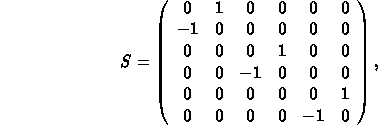
and the vectors Ei are the three complex
eigenvectors.
Several MAD commands refer to linear lattice functions.
Since MAD uses the canonical momenta (px, py)
instead of the slopes
(x', y'),
their definitions differ slightly from those
in [Courant and Snyder].
Notice that in MAD-X, PT substitutes DELTAP as longitudinal variable.
Dispersive and chromatic functions are hence derivatives with respects
to PT.
And since PT=BETA*DELTAP, where BETA is the relativistic Lorentz
factor, those functions given by MAD-X must be multiplied by BETA a number of time
equal to the order of the derivative to find the functions given in the litterature.
The linear lattice functions are known to MAD-X under the following names:
- BETX:
Amplitude function betax, [m].
- ALFX:
Correlation function alphax, [1]:
ALFX = alphax = - 1/2 * (del betax
/ del s).
- MUX:
Phase function mux, [2pi]:
MUX = mux = integral (ds / betax).
- DX:
Dispersion Dx of x, [m]:
DX = Dx = (del x / del PT).
- DPX:
Dispersion Dpx of px, [1]:
DPX = Dpx = (del px / del
PT) / ps.
- BETY:
Amplitude function betay, [m].
- ALFY:
Correlation function alphay, [1].
ALFY = alphay = - 1/2 * (del betay
/ del s).
- MUY:
Phase function muy, [2pi].
MUY = muy = integral (ds / betay).
- DY:
Dispersion Dy of y, [m]:
DY = Dy = (del y / del PT).
- DPY:
Dispersion Dpx of px, [1]:
DPY = Dpy = (del py / del
PT) / ps.
- R11, R12, R21, R22:
Coupling Matrix
- ENERGY: The total energy per particle in GeV. If given, it must
be
greater then the particle mass.
Several MAD commands refer to the chromatic functions.
(px, py) instead of the slopes
(x', y'),
their definitions differ slightly from those
in [Montague].
Notice that in MAD-X PT substitutes DELTAP as longitudinal variable.
Dispersive and chromatic functions are hence derivatives with respects
to PT.
And since PT=BETA*DELTAP, where BETA is the relativistic Lorentz
factor, those functions given by MAD-X must be multiplied by BETA a number of time
equal to the order of the derivative to find the functions given in the litterature.
The chromatic functions are known to MAD-X under the following names:
Please note that this option is needed
for a proper calculation of the chromaticities in the
presence of coupling!
- WX:
Chromatic amplitude function Wx, [1]:
WX = Wx = sqrt(ax2 +
bx2),
ax = (del betax / del PT) /
betax,
bx =
(del alphax / del PT) - (alphax /
betax) *
(del betax / del PT).
- PHIX:
Chromatic phase function Phix, [2pi]:
PHIX = Phix = atan(ax / bx).
- DMUX:
Chromatic derivative of phase function mux, [2pi]:
DMUX = (del mux / del PT).
- DDX:
Chromatic derivative of dispersion Dx, [m]:
DDX = 1/2 * (del2x / del PT2).
- DDPX:
Chromatic derivative of dispersion Dpx, [1]:
DDPX = 1/2 * (del2px / del PT2)
/ ps.
- WY:
Chromatic amplitude function Wy, [1]:
WY = Wy = sqrt(ay2 +
by2),
ay = (del betay / del PT) /
betay,
by =
(del alphay / del PT) - (alphay /
betay) *
(del betay / del PT).
- PHIY:
Chromatic phase function Phiy, [2pi]:
PHIY = Phiy = atan(ay / by).
- DMUY:
Chromatic derivative of phase function muy, [2pi]:
DMUY = (del muy / del PT).
- DDY:
Chromatic derivative of dispersion Dy, [m]:
DDY = 1/2 * (del2y / del PT2).
- DDPY:
Chromatic derivative of dispersion Dpy, [1]:
DDPY = 1/2 * (del2py / del PT2)
/ ps.
After a successful TWISS command a summary table
is created which contains the following variables:
- LENGTH:
The length of the machine, [m].
- ORBIT5:
The T (= c t, [m]) component of the closed orbit.
- ALFA:
The momentum compaction alphap, [1].
- GAMMATR:
The transition energy gammatransition, [1].
- Q1:
The horizontal tune Q1 [1].
- DQ1:
The horizontal chromaticity dq1, [1]:
DQ1 = dq1 = (del Q1 / del
PT).
- BETXMAX:
The largest horizontal betax, [m].
- DXMAX:
The largest horizontal dispersion [m].
- DXRMS:
The r.m.s. of the horizontal dispersion [m].
- XCOMAX:
The maximum of the horizontal closed orbit deviation [m].
- XRMS:
The r.m.s. of the horizontal closed orbit deviation [m].
- Q2:
The vertical tune Q2 [1].
- DQ2:
The vertical chromaticity dq2, [1]:
DQ2 = dq2 = (del Q2 / del
PT).
- BETYMAX:
The largest vertical betay, [m].
- DYMAX:
The largest vertical dispersion [m].
- DYRMS:
The r.m.s. of the vertical dispersion [m].
- YCOMAX:
The maximum of the vertical closed orbit deviation [m].
- YCORMS:
The r.m.s. of the vertical closed orbit deviation [m].
- DELTAP:
Energy difference,
divided by the reference momentum times the velocity of light, [1]:
DELTAP = delta(E) / ps c.
- SYNCH_1: First synchrotron radiation integral
- SYNCH_2: Second synchrotron radiation integral
- SYNCH_3: Third synchrotron radiation integral
- SYNCH_4: Fourth synchrotron radiation integral
- SYNCH_5: Fifth synchrotron radiation integral
Notice that in MAD-X PT substitutes DELTAP as longitudinal variable.
Dispersive and chromatic functions are hence derivatives with respects
to PT.
And since PT=BETA*DELTAP, where BETA is the relativistic Lorentz
factor, those functions given by MAD-X must be multiplied by BETA a number of time
equal to the order of the derivative to find the functions given in the litterature.
The command RUN writes tables with the following variables:
- X:
Horizontal position x of the orbit,
referred to the ideal orbit [m].
- PX:
Horizontal canonical momentum px
of the orbit referred to the ideal orbit, divided by the reference
momentum.
- Y:
Vertical position y of the orbit, referred to the ideal orbit
[m].
- PY:
Vertical canonical momentum px
of the orbit referred to the ideal orbit, divided by the reference
momentum.
- T:
Velocity of light times the negative time difference
with respect to the reference particle, [m].
A positive T means that the particle arrives ahead of the reference
particle.
- PT:
Energy difference,
divided by the reference momentum times the velocity of light, [1].
When tracking Lyapunov companions (not yet implemented),
the TRACK table defines the following dependent expressions:
- DISTANCE:
the relative Lyapunov distance between the two particles.
- LYAPUNOV:
the estimated Lyapunov Exponent.
- LOGDIST:
the natural logarithm of the relative distance.
- LOGTURNS:
the natural logarithm of the turn number.
hansg,
January 24, 1997. Revised in February 2007.
Ghislain Roy, Revised in June 2014.