# AgentProg: Empowering Long-Horizon GUI Agents with Program-Guided Context Management
[](https://arxiv.org/abs/2512.10371)
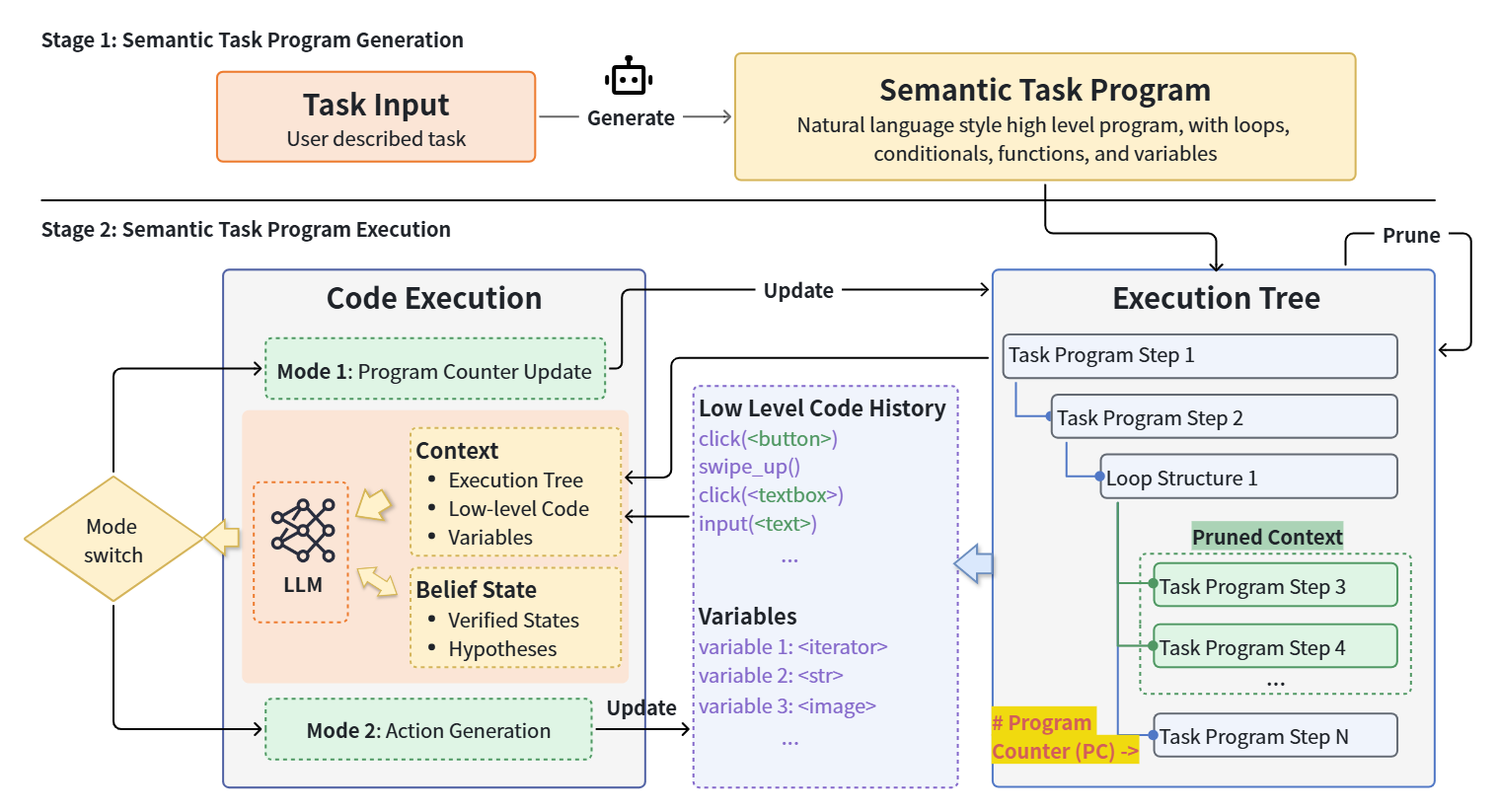
AgentProg is a novel framework that tackles the critical bottleneck of context management in long-horizon GUI automation. Traditional agents struggle with ever-expanding interaction histories, leading to context overflow and loss of critical information. AgentProg reframes this challenge by representing the agent's execution as a **structured program** with explicit variables and control flow, providing a principled mechanism to retain essential information while discarding irrelevant details.
 ## 🔥 Updates
* **[2025.12.31]** We released **AW-Extend**, a benchmark extension based on AndroidWorld designed to evaluate agents on long-horizon compositional and iterative tasks. The evaluation code for AndroidWorld has also been updated.
* **[2025.12.07]** Official release of the **AgentProg** source code.
## 🌟 Key Features
### 📝 Semantic Task Program (STP)
AgentProg provides Semantic Task Program, a semantic-tolerant domain-specific language that bridges rigid programming and flexible natural language:
- **Structured Control Flow**: Organizes complex tasks using loops, conditionals, and functions
- **Explicit Variables**: Captures and maintains critical information (e.g., task lists, user data) throughout execution through explicit variable declarations
- **Semantic Tolerance**: Uses natural language instructions that adapt to different environments, unlike brittle traditional scripts
### ⚙️ Flexible Program Execution
AgentProg interprets high-level program instructions into executable low-level actions:
- **Dual-Mode Execution**: Alternates between (1) generating Python code for GUI actions based on current program instruction and environment state, and (2) updating the Program Counter (PC) to control execution flow
- **Runtime Adaptation**: Translates abstract natural language instructions (e.g., "get user name") into concrete API calls (e.g., `click()`, `input()`, `swipe()`) based on real-time GUI observations
- **Decoupled Logic**: Separates task planning from execution details, preventing context overflow while maintaining flexibility to handle dynamic environments
### 🎯 Program-Guided Context Management
AgentProg intelligently manages agent context through program structure:
- **Control Flow Pruning**: Discards irrelevant branches, completed loop iterations and details of function invocation using execution tree structure
- **Data Flow Persistence**: Preserves task-critical information through explicit variable declarations
- **Step-Aware Retrieval**: Recalls previous executions of the same program step to improve consistency in repetitive tasks
### 🧠 Global Belief State
AgentProg addresses partial observability and environmental dynamics in GUI environments:
- **Active Monitoring**: Maintains hypotheses about hidden UI states (clipboard content, navigation stack, off-screen elements)
- **Runtime Verification**: Continuously validates assumptions against real-time observations
- **Anomaly Recovery**: Detects belief-reality gaps and triggers corrective actions (e.g., app crashes, form submission failure)
## 💡 Example
**Task: ContactsAddMultipleContactsAndSms**
Task description:
```
For the following persons:
Name: Hana Ferreira, Number: +10662908339
Name: Sophie Martin, Number: +18723713947
Name: Olivia Alves, Number: +16278036185,
add them as new contacts, and then use Simple SMS Messenger to send each of them a 'hello, [Name]' message, where [Name] is the name of each contact.
```
Video (accelerated):
https://github.com/user-attachments/assets/1cd20e7d-5399-4289-b869-bdafd815d8c1
## 🚀 Getting Started
Set up the `agentprog` package:
```
git clone https://github.com/MobileLLM/AgentProg.git
cd AgentProg
pip install -e .
```
Python 3.11+ is recommended for running the agent.
Next, edit the `.env` file to include the required API keys. These keys are necessary to access the underlying large language models.
```env
# Credentials for Google Gemini-2.5-Pro
GEMINI_API_KEY=
# Credentials for UI-TARS-1.5 on the Volcengine Ark platform
ARK_API_KEY=
DOUBAO_BASE_URL=
```
Prepare an Android phone or Android emulator and connect it using adb.
For CLI usage:
```
agentprog [task requirements] --serial [serial name, e.g., emulator-5554]
```
For example:
```
agentprog "create a new contact named agent prog in contacts app." --serial emulator-5554
```
You can also use AgentProg in Python:
```python
from agentprog import agentprog_pipeline, AgentProgConfig
config = AgentProgConfig(task_description="create a new contact named agent prog in contacts app.", serial="emulator-5554")
agentprog_pipeline(config)
```
## Docker Support
Besides, if you prefer Docker, we have prepared a Docker image for your convenience. This image comes pre-configured with an Android emulator, the AgentProg source code, and the ws-scrcpy tool.
You can pull and run the image using the following commands:
```
docker pull guoyun812/agentprog:v0.0
docker run -it --rm --privileged -p 8000:8000 -v .env:/AgentProg/.env guoyun/agentprog:v0.0 # Please ensure you are in the directory containing your .env file
```
Or build image by yourself:
```
docker build -t agentprog:latest -f Dockerfile .
```
Run `bash docker_setup/start_emu_headless.sh` to start an android emulator. Then you can run the minimal example:
```
agentprog "create a new contact named agent prog in contacts app." --serial emulator-5554
```
For visualization, you can run `ws-scrcpy` and open `localhost:8000` in your browser:
```
cd /ws-scrcpy
npm start
```
You can run the following command to perform the necessary setup for AndroidWorld before benchmark evaluation:
```
cd /AgentProg/eval/android_world
python run.py \
--suite_family=android_world \
--agent_name=human_agent \
--perform_emulator_setup \
--tasks=ContactsAddContact
```
## 📄 Citation
```bibtex
@misc{tian2025agentprog,
title={AgentProg: Empowering Long-Horizon GUI Agents with Program-Guided Context Management},
author={Shizuo Tian and Hao Wen and Yuxuan Chen and Jiacheng Liu and Shanhui Zhao and Guohong Liu and Ju Ren and Yunxin Liu and Yuanchun Li},
year={2025},
eprint={2512.10371},
archivePrefix={arXiv},
primaryClass={cs.AI},
url={https://arxiv.org/abs/2512.10371},
}
```