Agentify

OpenAPI in. Agent interfaces out.

Agentify — OpenAPI to 9 agent interface formats
npm CI MIT License TypeScript
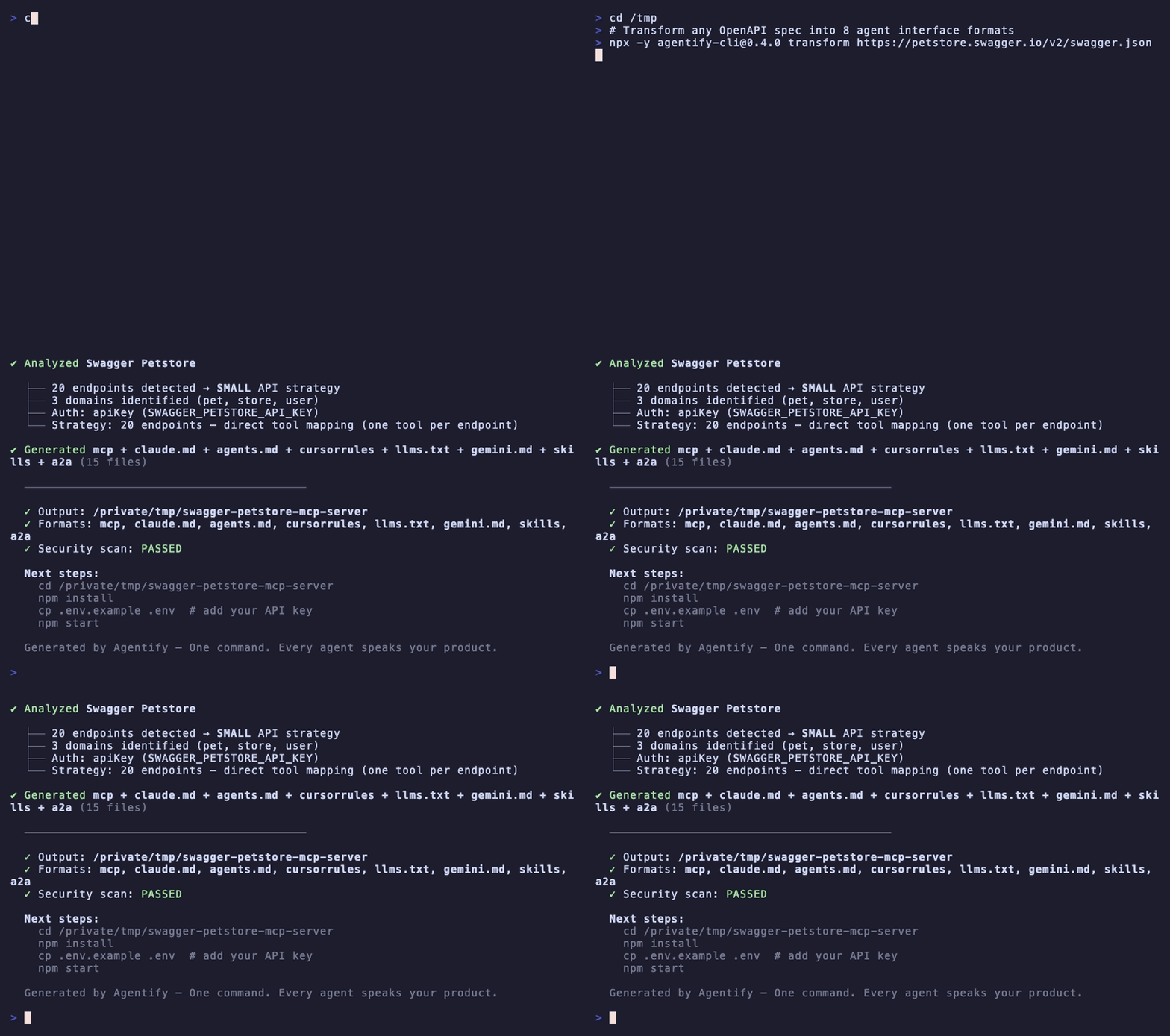
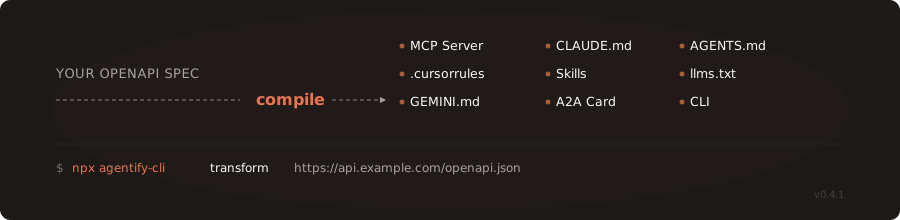
--- Your API has new users it doesn't know about yet — AI agents. Claude Code reads `CLAUDE.md`. Cursor reads `.cursorrules`. Codex and Copilot read `AGENTS.md`. And if you want your API callable as a tool, you need an MCP server. That's a lot of files to write and keep in sync with your API spec. Agentify reads your OpenAPI spec and writes them all. ```bash npx agentify-cli transform https://petstore.swagger.io/v2/swagger.json ```
Agentify demo

## What You Get One command generates up to **9 formats** from a single OpenAPI spec: | Format | Used by | |--------|---------| | **MCP Server** | Claude, ChatGPT, Copilot (with Dockerfile) | | **CLAUDE.md** | Claude Code | | **AGENTS.md** | Codex, Copilot, Cursor, Gemini CLI | | **.cursorrules** | Cursor IDE | | **Skills** | Agent platforms | | **llms.txt** | LLM search engines | | **GEMINI.md** | Gemini CLI | | **A2A Card** | Google Agent-to-Agent protocol | | **CLI** | A standalone command-line tool that makes real API calls | ## Quick Start ```bash # Transform any OpenAPI spec (Swagger 2.0 or OpenAPI 3.x) npx agentify-cli transform https://petstore.swagger.io/v2/swagger.json # Pick specific formats npx agentify-cli transform ./my-api.yaml -f mcp claude.md agents.md # Generate a standalone CLI tool npx agentify-cli transform ./my-api.yaml -f cli -o my-api-cli # Custom output directory and project name npx agentify-cli transform https://api.example.com/openapi.json -o ./output -n my-project ``` Example output: ``` Agentify v0.4.1 Agent Interface Compiler +-- 20 endpoints detected -> SMALL API strategy +-- 3 domains identified (pet, store, user) +-- Auth: apiKey (SWAGGER_PETSTORE_API_KEY) +-- Strategy: Direct tool mapping — one tool per endpoint > Generated mcp + claude.md + agents.md + cursorrules + llms.txt + gemini.md + skills + a2a (15 files) > Output: ./swagger-petstore-mcp-server > Security scan: PASSED ``` ## Tested on Real APIs Agentify handles APIs of any size — from 13-endpoint apps to 1,000+ endpoint platforms. | API | Endpoints | Domains | TypeScript | Server starts | |-----|-----------|---------|------------|---------------| | **Notion** | 13 | 5 | PASS | PASS | | **Petstore** (Swagger 2.0) | 20 | 3 | PASS | PASS | | **httpbin** (non-compliant spec) | 73 | 11 | PASS | PASS | | **Slack Web API** | 174 | 55 | PASS | PASS | | **Stripe** | 452 | 1 | PASS | PASS | | **GitHub REST API** | 1,093 | 43 | PASS | PASS | Every generated MCP server compiles with zero TypeScript errors and starts immediately. Non-compliant specs (like httpbin) are auto-normalized with warnings instead of rejected. The GitHub REST API — 1,093 endpoints across 43 domains — produces a working server with 1,093 tools. ## How It Works ``` OpenAPI Spec (URL or file) | v PARSE ──> SANITIZE ──> ANALYZE ──> COMPILE ──> EMIT ──> SCAN ──> OUTPUT | | | | | Strip unsafe Detect Build IR Run Security patterns domains, (typed) emitters scan all auth, generated API scale code ``` Agentify parses your spec into an intermediate representation (**AgentifyIR**), then runs pluggable emitters to produce each output format. Every generated artifact goes through a security scan before being written to disk. **Security built in:** - Input sanitization (blocks `eval`, `exec`, `Function` constructor injection) - Prompt injection pattern detection - Generated code scanning ## Contributing New emitters are welcome. Each one implements a simple interface: ```typescript import type { Emitter, AgentifyIR, EmitterOptions, EmitterResult } from "../types"; export class MyFormatEmitter implements Emitter { readonly name = "my-format"; readonly format = "my-format"; async emit(ir: AgentifyIR, options: EmitterOptions): Promise { // Generate output files from the IR return { format: this.format, filesWritten: [...], warnings: [] }; } } ``` ``` agentify/ +-- src/ | +-- cli.ts # CLI entry point | +-- parser/ # OpenAPI parsing + sanitization | +-- generator/ # Pluggable emitters for each format | +-- security/ # Input sanitization + output scanning | +-- types.ts # AgentifyIR type definitions +-- test/ # Vitest test suite (136 tests) ``` ## Status This is early. It works on Swagger 2.0 and OpenAPI 3.x specs, handles auth detection, domain grouping, and API scale analysis. If you try it and something breaks, [open an issue](https://github.com/koriyoshi2041/agentify/issues) — that helps a lot. - [x] OpenAPI parser, MCP emitter, security scanner, CLI - [x] 9 output formats: MCP, CLAUDE.md, AGENTS.md, .cursorrules, Skills, llms.txt, GEMINI.md, A2A, CLI - [ ] Capability graph and semantic grouping - [ ] Web UI and one-click deploy - [ ] Custom emitter plugins ## License [MIT](LICENSE)