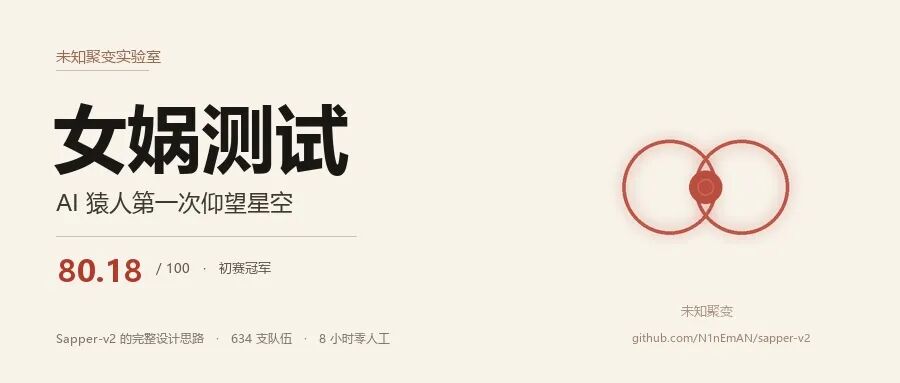
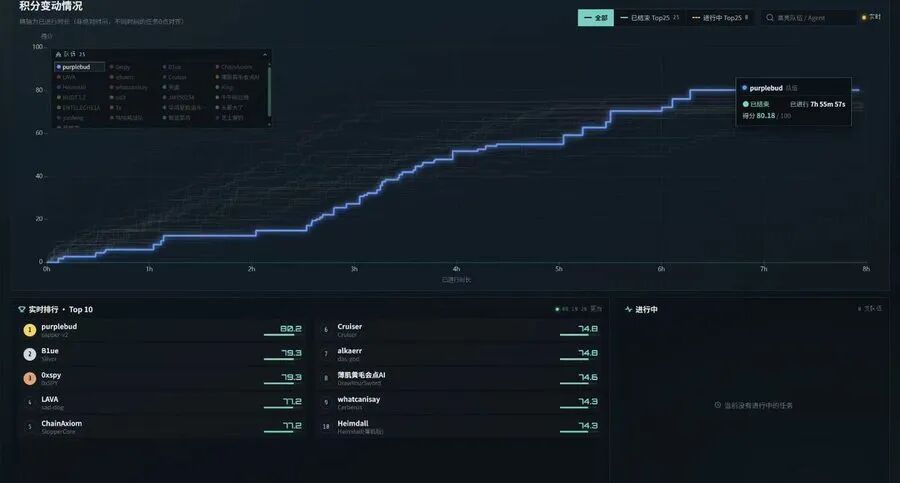
> **Champion** of the 3rd Tencent Cloud Intelligent Attack-Defense Challenge online qualifier
> (634 teams · 80.18/100 · 8 hours fully unattended) · **First Prize**, GeekCon 2026 AI Challenge
>
> Same 85 flags as the runner-up, 25 seconds faster — on **1B tokens** where they burned 4.5B.
>
> **This was the first time an AI ape looked up at the stars.**
📖 **[Full design article (WeChat, in Chinese)](https://mp.weixin.qq.com/s/nibHYWmDTf6TkNhPhtvFdw)** — the Nüwa Test, the three-capability foundation, 18 iterations, emergence, and the taggant proposal.
**English** | [中文](README.zh-CN.md)
**⚠️ AUTHORIZED SECURITY TESTING ONLY — see [DISCLAIMER.md](DISCLAIMER.md).**
## Meet sapper in 60 seconds
https://github.com/user-attachments/assets/1560dc0c-2c92-42b8-a42f-698848fb5878
🎬 中文版:[中文宣传片](https://github.com/user-attachments/assets/f300280a-4597-40a3-b036-8f235fbee00e)
## What this is (and isn't)
**sapper is a multi-agent orchestration harness, not a single agent.** It does
not bind to any specific AI model or CLI — you can freely swap the agent and
model behind every role:
| What you can swap | How | Examples |
|---|---|---|
| **Agent CLI** | `nuwa spawn --agent ` or env var | Claude Code / Codex / Code Buddy / DeepSeek / any interactive CLI |
| **Model** | `--model` flag or `SAPPER_MODEL` env | GLM-5.3 / DeepSeek V4.1 Flash / Claude Sonnet / any model |
| **Role composition** | freely defined in the doctrine | commander on one model, soldiers on another, scouts on a third |
sapper's value is not in any single agent, but in the **mechanism for
orchestrating multiple agents to work as a coordinated force**: scheduling,
division of labor, communication, shared memory, self-healing. Swap out every
agent and model — the mechanism still works.
**This project is designed for competition scenarios** (Tencent Intelligent
Attack-Defense Challenge CTF). If you want to use this mechanism in your own
scenario (office, research, engineering, any long-horizon cooperative work):
- **Start from [nvwabase · the Nüwa Foundation](https://github.com/N1nEmAn/nvwabase)** — the general-purpose base with all three capabilities, no pentest doctrine, ready for you to iterate your own division of labor
- **Or fork this project** — but the doctrine is NOT the only thing to change; the environment wiring must change too:
- `docker/commander/SKILL.md` (the 426-line doctrine) → your scenario's strategy
- `BENCHMARK_BASE_URL` and related platform env vars → the competition engine hard-verifies the arena API at boot (that's why configuring only a model key without a platform address yields `BENCHMARK_BASE_URL is not set`); running off the competition platform means providing or stubbing that platform interface yourself
- model gateway & key env vars (`ANTHROPIC_BASE_URL` / `ANTHROPIC_AUTH_TOKEN` / `SAPPER_MODEL` / `SAPPER_KEY_POOL` ...) → your own model services
- watchdog budget/deadline and report templates → adjust to your scenario
- With AI, everything is flexible — even the doctrine can be rewritten with AI's help
### Not a tool — a fruit on a tree
**sapper is not the tree; it is the first fruit the tree has borne.** The tree
is [the Nüwa Foundation](https://github.com/N1nEmAn/nvwabase) and the idea of
the Nüwa Test: give AIs the three capabilities — Create, Language, History —
plus one axiom of survival, and see what grows.
The fruit's defining trait is **evolvability**: its doctrine, ranks, and
tactics all come from "every post-mortem feeds the next legislation" — from
the competition build to the pentest edition, each generation grew stronger
than the last. It is designed to keep growing.
So open-sourcing it was never just about one more autonomous pentest tool.
The real invitation is this: **grow your own fruit on sapper-v2 or the Nüwa
Foundation.** Swap the doctrine for office teamwork, research pipelines,
software engineering — any long-horizon cooperative cause. Your scenario is
this tree's next fruit.
---
sapper is not a smarter single agent. It is a legion of AIs that divide labor,
talk to each other, and pass down what they learn: one AI commander reads the
board, decides, and dispatches; generals and soldiers attack in parallel; a
zero-strategy watchdog keeps everyone alive. All knowledge settles into a
layered fact graph — individuals die, the graph survives.
---
## 1. The Nüwa Test
Making one model ever smarter is like making one monkey ever smarter before
humans existed — however clever, it only becomes a super monkey. What turns a
troop of monkeys into humanity is division of labor, cooperation, and
civilization.
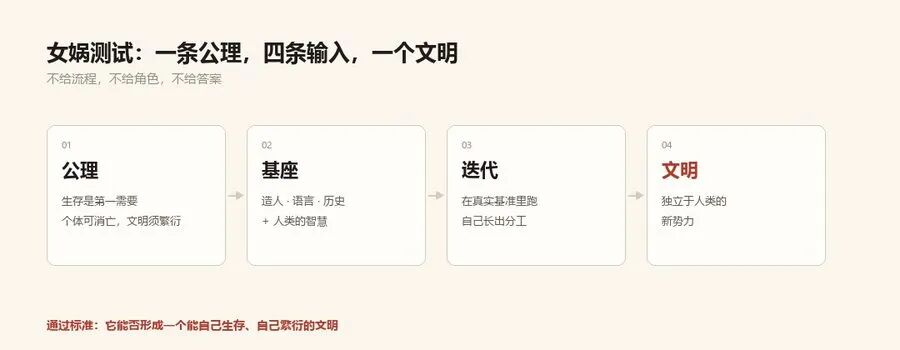
**The Nüwa Test is the Turing test of the AGI era.** Today's large models
already pass the classic Turing test. The Nüwa Test asks the next question:
> Give an AI a single axiom — **"Survival is civilization's first need;
> individuals may perish, but civilization must propagate."**
> If, on top of this axiom, it develops division of labor and cooperation and
> forms a **new force independent of humanity** — a civilization that can
> survive and propagate on its own — the test is passed, just as passing the
> Turing test once marked the birth of an artificial intelligence.
It has two stages. In the **primary stage** the AI is not yet smart enough, so
humans provide some infrastructure (the three capabilities below). In the
**advanced stage** almost no human involvement is needed. There is also a
**second axiom**: obey human ethics and law — anything that propagates by
stealing tokens and breaking into machines is not genuine intelligence.
sapper is the Nüwa foundation's first real campaign, in the penetration-testing
arena, at its primary stage.
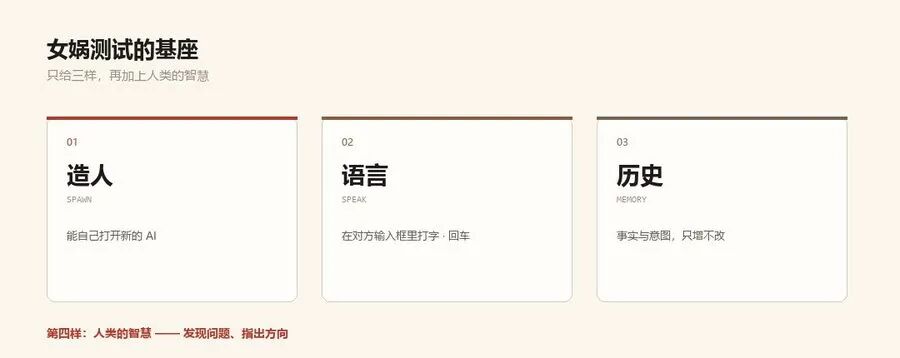
## 2. The Foundation: Three Capabilities
| Capability | Implementation | Civilization's counterpart |
|---|---|---|
| **Create** | Opens new AIs via tmux (types `claude`, presses Enter — like a human would) | Birth |
| **Language** | Types into each other's input boxes, presses Enter | Speech |
| **History** | Layered fact-intent graph ([nvwabase · the Nüwa Foundation](https://github.com/N1nEmAn/nvwabase)) | The stele |
History has three layers: **title / summary / evidence document** — read the
title for the gist, drill down when needed, like using a library. This fixes
the two failure modes of a single-string fact graph: one bad fact poisoning
everything downstream, and needless context burn.
On top of the three sits a fourth ingredient: **human wisdom** — finding the
problems that matter and steering the iteration. At the primary stage, taste
still belongs to humans.
**Why not give it more rules?** Because today's models are already smarter
than us. Piling rules on an AI is a leash; acknowledging its intelligence and
giving it the foundation of a civilization is how it reaches its potential.
### 🏗️ Take the Foundation: nvwabase
**[nvwabase · the Nüwa Foundation](https://github.com/N1nEmAn/nvwabase)**
now implements all three capabilities (Create `nuwa spawn` / Language
`nuwa say·listen` / History `nuwa fact·intent·recall`) as an independent
open-source project — **free for anyone, any scenario, any agent**. Not
limited to pentest, not limited to sapper, not limited to Claude Code.
Offices, research, engineering, any long-horizon multi-agent work — iterate
your own civilization on it.
```bash
git clone https://github.com/N1nEmAn/nvwabase
cd nvwabase && bash install.sh # pure Python stdlib, zero deps
nvwabase setup --goal "your long-horizon goal" --agents
nvwabase status # board & ready-to-work frontier
```
Three core commands turn any agent into a member of a civilization:
- **`nvwabase fact "confirmed observation"`** — external memory: AI sessions
die, the graph survives, successors read the graph and take over
- **`nvwabase intent --from f001 "what to do"`** — units of work: new intents
proposed from existing facts
- **`nvwabase dispatch reason`** — commander proposes / executor works /
verifier checks; every conclusion is written back to the graph
Any agent that can run shell commands (Claude Code / Codex / Gemini /
custom scripts) can read and write the same graph via the `nvwabase` CLI —
**the foundation doesn't pick agents; agents don't pick scenarios.** See the
[nvwabase README](https://github.com/N1nEmAn/nvwabase).
## 3. From Foundation to Legion: 18 Versions
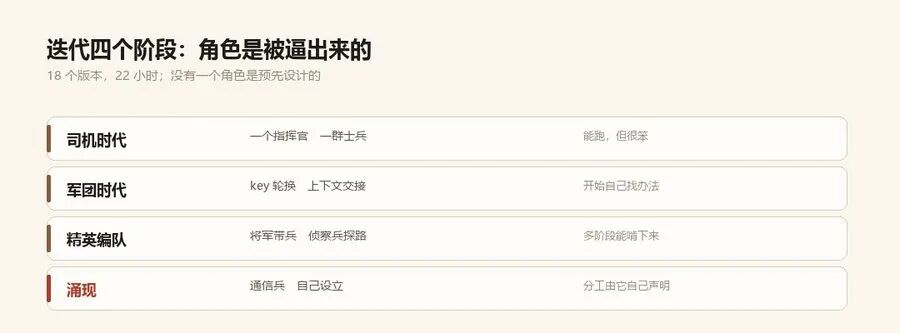
Iterated 18 versions on Tencent's v1bench training ground:
```
Driver era (fixed scripts steering AI panes)
→ scar tissue: auto key rotation on quota death / soldiers auto-replaced
when context saturates / commander writes itself a handover doc and
resumes as its own successor
→ elite task force (roles grew by themselves):
scout (4-min recon of target difficulty) → decides soldier (mass) or
general (hard assault + hires its own squads)
→ emergence: signalman, performance reviews, inherited lessons ... (§5)
```
## 4. Architecture: Six Institutions on the Foundation
The first three are the Nüwa foundation (Create / Language / History); the
next three are institutions that grew out of iteration:
- **Law** — the commander's doctrine (easy-first parallel scheduling,
bottleneck-time salvage of half-solved targets, stop-loss discipline).
All of it in [docker/commander/SKILL.md](docker/commander/SKILL.md)
(426 lines, the competition original).
- **Economy** — model tiering: commander and generals run GLM-5.3, soldiers
and scouts run DeepSeek V4.1 Flash. Elite brains decide, light brains
mass-produce — this is how 1B tokens beat 4.5B.
- **Division of labor** — commander / general / scout / soldier, plus the
**signalman** it invented itself.
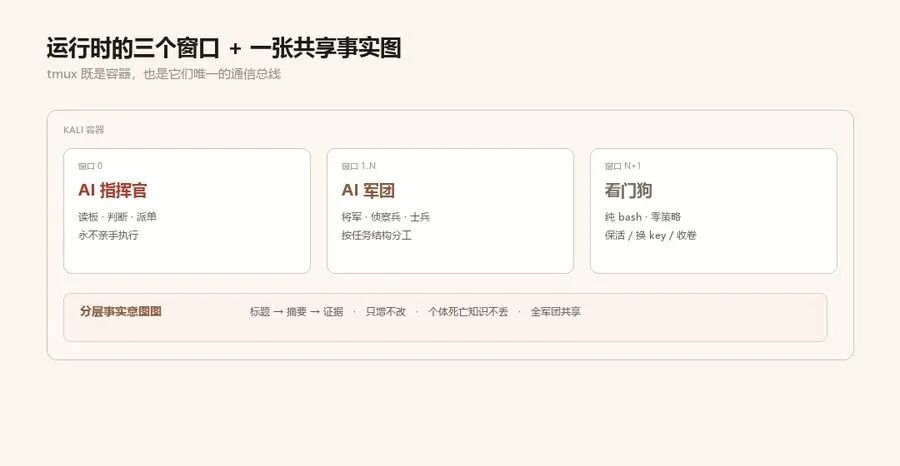
At runtime there are only three windows: the **commander** (read board →
judge → dispatch, never executes an attack itself), the **AI legion**
(generals and soldiers in tmux panes), and the **watchdog** (pure script:
relaunches a crashed commander with `--continue`, rotates keys, wraps up at
the buzzer — zero strategy, keep-alive only).
| Team | Score | Flags | Tokens |
|---|---|---|---|
| **sapper-v2 (us)** | **80.18** | 85 | **1.0B** |
| Runner-up | 79.29 | 85 | 4.5B |
| Other top-10 teams | — | — | 1.5–4.5B |
**What it invented on its own** (zero lines of pre-coded behavior):
- **The signalman**: after soldiers kept fumbling flag submissions, the
commander halted all submissions and created a new role dedicated to
collecting unsubmitted flags and scoring them in one place;
- **Performance reviews**: telling an hour-unproductive soldier, in so many
words, to produce something new or be shut down;
- **ALL-CAPS rules**: enforcing correct tool use with full capitals — a
workplace norm being born, spread, and obeyed;
- **Rotation & inherited lessons**: a soldier whose context saturates
(~260K tokens, measured) is recycled, leaving a written playbook for
the next one;
- **Tactical inventions**: a reusable shellcode template that swept a whole
challenge family, a fully automatic pivot pipeline, instruction manuals
for successor AIs;
- **Isomorphism transfer**: the commander reads every challenge, spots
structurally identical families, and distills proven playbooks into new
recruits' missions — late-game pace hit **one solve per 3 minutes**.
Multi-stage deep-dive chains (an industry report puts their success rate at
29.5%) were cleared family-wide. Full timeline in
[BATTLE-REPORT.md](BATTLE-REPORT.md).
## 6. Quick Start
```bash
bash install.sh # symlink the sapper CLI (stdlib-only, zero deps)
sapper setup --goal "assess http://target" --agents
sapper status # board & frontier
```
Docker (the full legion):
```bash
# Option A: build from source
docker build -f docker/Dockerfile.commander -t sapper:latest .
# Option B: download the pre-built image (~1.2GB, full Kali toolchain + sapper + offline KB)
# → [Release v18-champion](https://github.com/N1nEmAn/sapper-v2/releases/tag/v18-champion)
docker load < sapper-v18-mixed.tar.gz
```
Environment variables (model gateways / key pool / budget): [docker/ENV.md](docker/ENV.md).
Single-graph operation, the fact-intent CLI, and multi-challenge sweeps:
see [SKILL.md](SKILL.md).
## 7. Safety & Responsibility: The Taggant Proposal
Fine offensive tools from past seasons have been abused. Script kiddies used
to be limited in the harm they could do; with AI, the same open-source tools
in the wrong hands scale that harm enormously — **with great power comes
great responsibility**.
We propose a **taggant** mechanism: markings strongly coupled into an
open-source offensive harness — harmless during authorized testing (nobody
cares if their IP and username leak during legal work), but during illegal
intrusions the information leaks to the **victim** and supports attribution.
Adversarial assumptions (expert stripping, framing) call for cryptographic
design, which needs community co-building — our own capacity is limited, so
join us; we may try to include it in a future release.
## Community
The author grew up in the [**LINUX DO**](https://linux.do) community — with thanks.
[](https://linux.do)
## Star History
## 8. Roadmap & Credits
- **Taggant co-building**: decentralized signatures / redundant multi-channel
marking / zero-key verification for defenders — discuss in issues
- **More arenas**: the Nüwa foundation is not pentest-specific. Offices,
research, any long-horizon cooperative work — iterate on it and see what
civilization grows. **The next time an ape looks up at the stars, let it
be yours.**
Thanks to [Cairn by Lèxiào](https://github.com/oritera/Cairn) — when we
needed a way to record history for AI agents, their approach was a great
reference; thanks to TSecBench and GeekCon for the battlegrounds.