AVE-Compass
---
Can audio-visual editing models correctly follow cross-modal instructions?
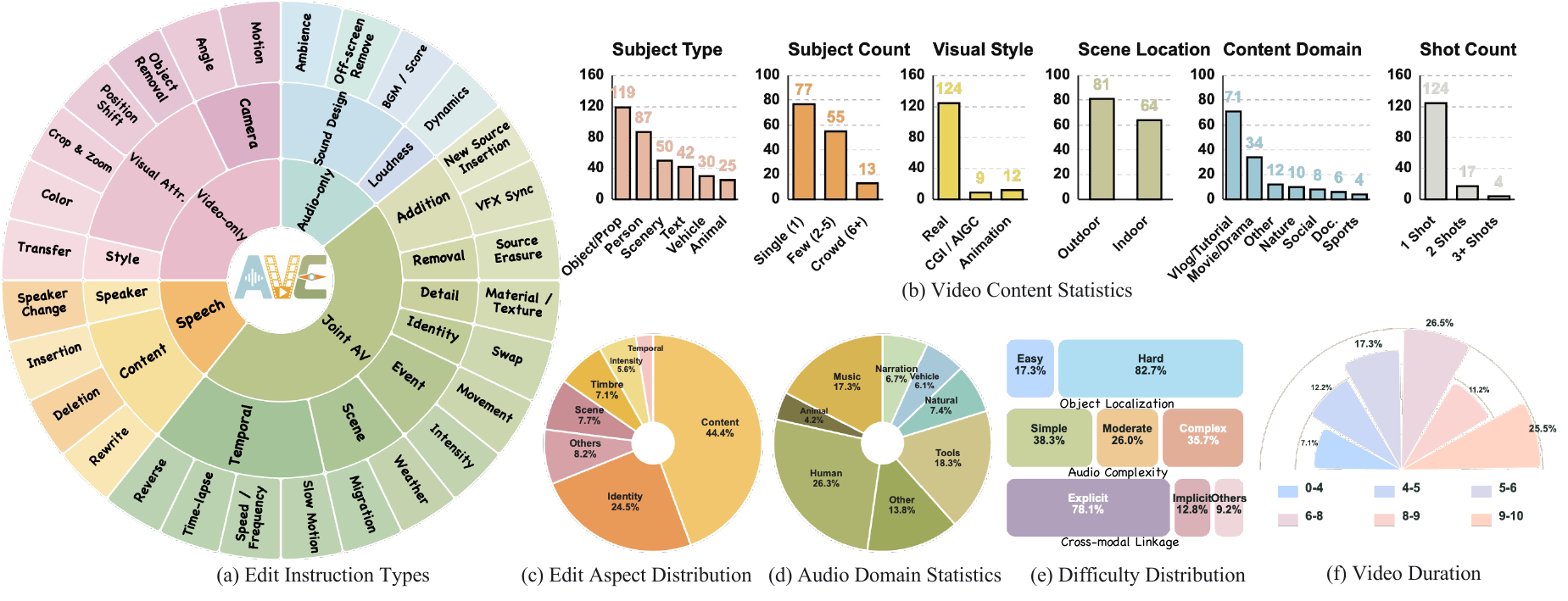
Dataset Statistics




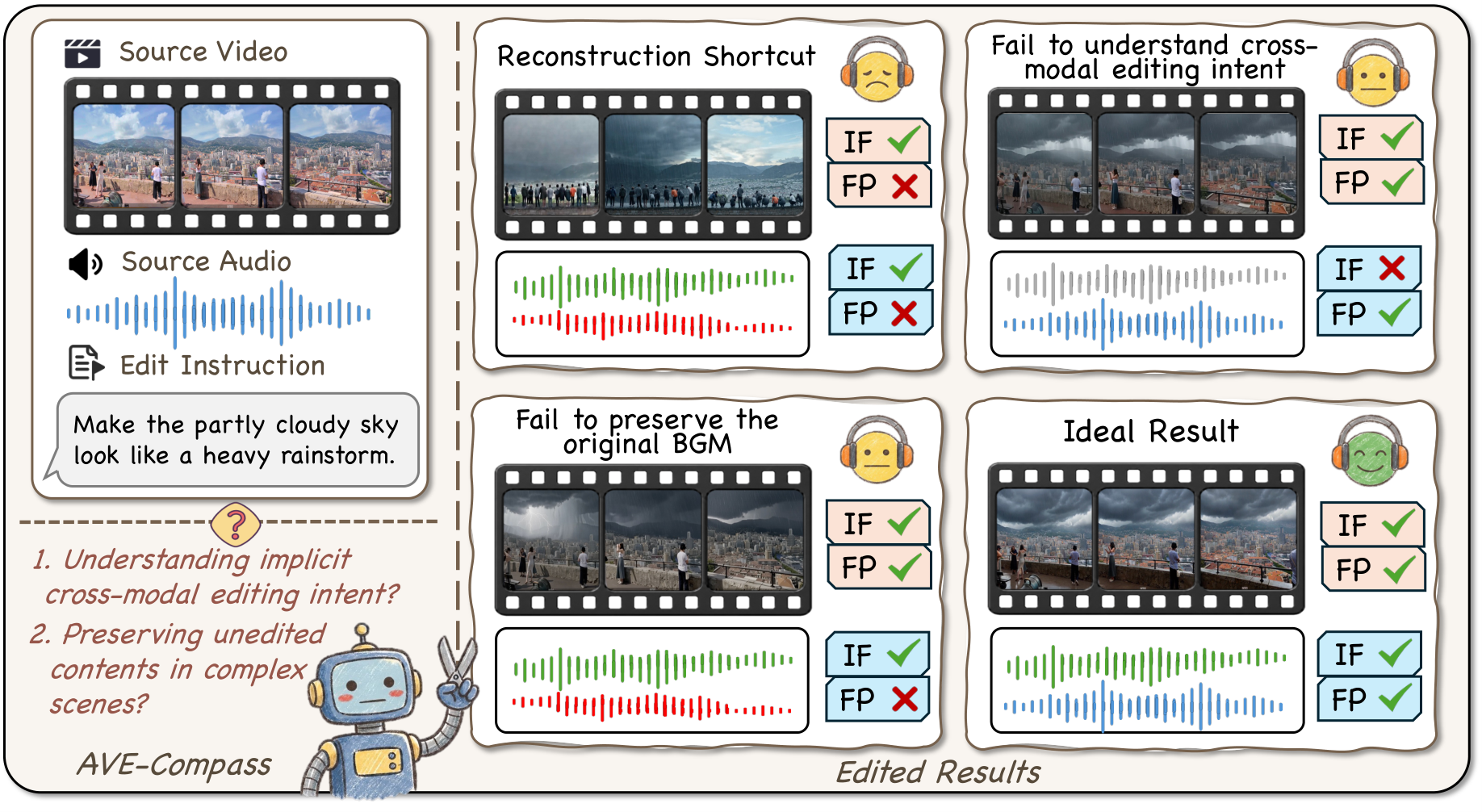
**Work overview.** AVE-Compass is a diagnostic benchmark for free-form audio-video editing, built from 145 curated source videos, 196 audio-visually coupled instructions, and 2,688 fine-grained checklist items. Its evaluation separates Instruction Following, Fidelity Preserving, Realism, and Editing Intent, combining MLLM-as-Judge evaluation with automated cross-modal, video, and audio metrics to expose incomplete edits, non-target drift, perceptual artifacts, and audio-visual misalignment.
**Repository overview.** This repository provides the AVE-Compass evaluation pipeline, configuration files, input templates, metric implementations, and AVE-Agent. The evaluator processes source videos, edit instructions, checklists, and model-generated edited videos with MLLM and objective metrics, while the [AVE-Compass dataset](https://huggingface.co/datasets/NJU-LINK/AVE-Compass) provides the benchmark samples. AVE-Agent provides a planning and self-reflection baseline for complex editing instructions.
Evaluation Code ·
Key Findings ·
AVE-Agent
---
## What We Evaluate
AVE-Compass contains 145 curated source videos, 196 human-verified editing instructions, 2,688 checklist items, and 28 editing operation types across joint, speech, video-only, and audio-only editing.
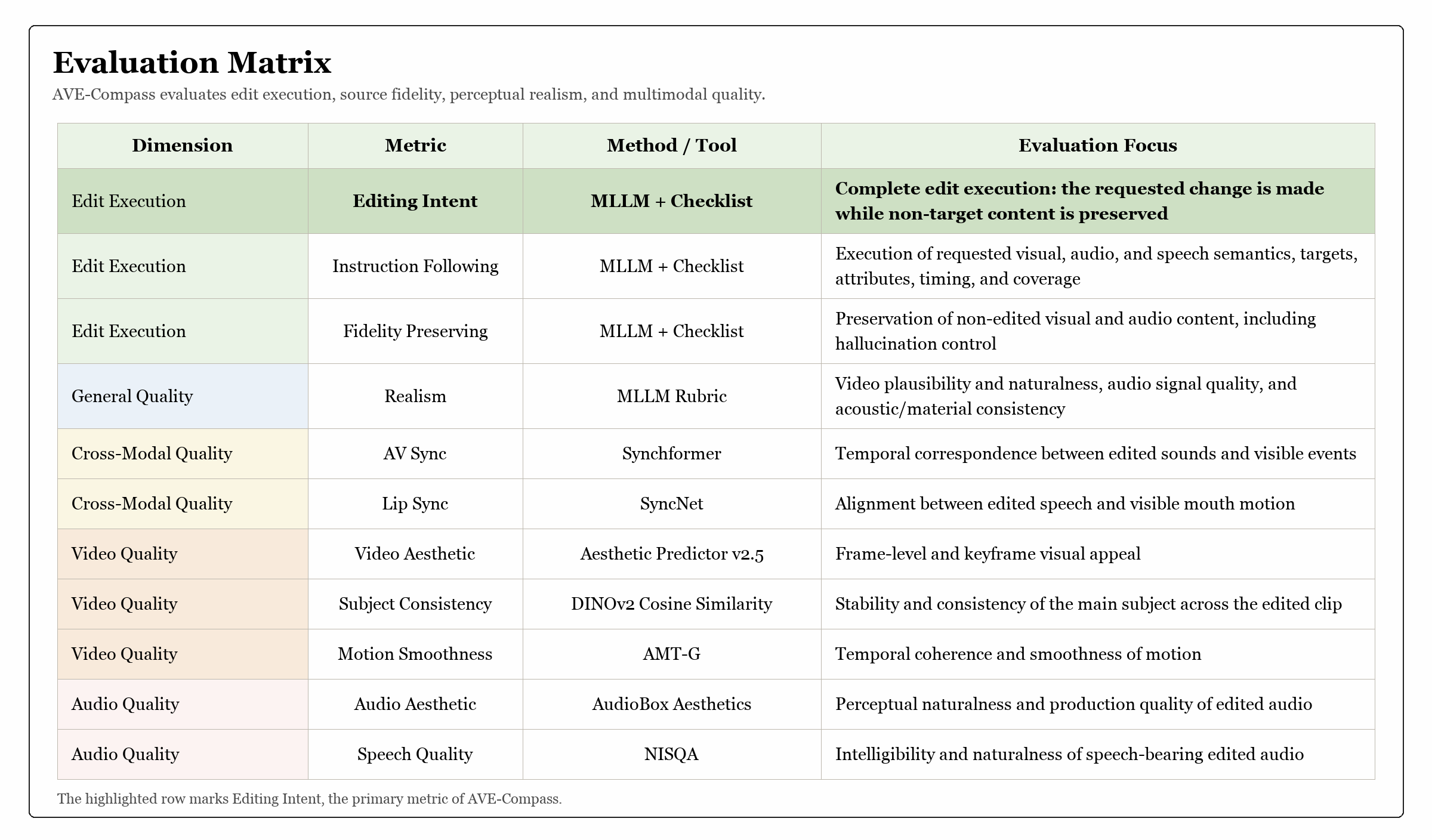
The benchmark reports four complementary dimensions:
| Dimension | Description |
| --- | --- |
| **Instruction Following** | Whether the requested edit is correctly executed |
| **Fidelity Preserving** | Whether non-target visual and audio content remains faithful to the source |
| **Editing Intent** | Whether the output both follows the instruction and preserves non-target content |
| **Realism** | Whether the edited audio-video result is natural and coherent |
The evaluation package also reports automated cross-modal, video, and audio metrics, together with source-preservation diagnostics for single-modality edits.
## Leaderboard
Models are ranked by **Overall Editing Intent**, the primary metric of AVE-Compass. Scores are reported on a 0-100 scale, and higher is better.
| Rank | Model | Overall | Video | Audio |
| ---: | --- | ---: | ---: | ---: |
| 1 | **AVE-Agent (Wan)** | **59.8** | **66.7** | **50.2** |
| 2 | Wan2.7 | 42.4 | 60.1 | 24.8 |
| 3 | HappyHorse | 41.3 | 56.7 | 18.8 |
| 4 | Gemini-Omni* | 38.0 | 56.1 | 10.0 |
| 5 | Seedance | 26.6 | 36.1 | 13.5 |
| 6 | LTX2 | 15.2 | 10.7 | 26.4 |
*Gemini-Omni misses 16 speech edits due to content moderation.
## Evaluation Code
### 1. Configure Environment
Install the dependencies and model weights required by the selected metrics, and make sure `ffmpeg` and `ffprobe` are available on `PATH`. MLLM evaluation uses the official Gemini API:
```bash
export GEMINI_API_KEY=your_key
export DEFAULT_MODEL=your_model
```
```yaml
modules: {objective: true, llm: true}
llm: {checklist: true, realism: true}
```
### 2. Prepare Inputs
Download the released source videos, instructions, and checklists into the three default directories:
```bash
hf download NJU-LINK/AVE-Compass --type dataset \
--include "videos/*" \
--include "edit_instructions/*" \
--include "checklists/*" \
--local-dir input
```
Place the videos produced by the model under evaluation in `edited_videos/`:
```text
input/
|- videos/ # downloaded
|- edit_instructions/ # downloaded
|- checklists/ # downloaded
`- edited_videos/.mp4 # provided by the user
```
### 3. Run
```text
bash run_eval.sh [input_root] [model_name] [output_path] [config_path] [device]
```
For example:
```bash
bash run_eval.sh \
input \
my_model \
output \
configs/path.yml \
cuda
```
The five positional parameters default to `input`, `model`, `output`, `configs/path.yml`, and `cuda`, respectively. Use `cpu` as the last parameter for CPU-compatible metrics.
### 4. Outputs
```text
output/
|- _eval__eval_results.json
|- _eval__eval_results.csv
`- /
`- /
|- eval_result.json
|- objective/
`- llm/
```
The CSV contains one row per evaluated instruction; the JSON additionally retains per-question judgments, metric details, warnings, and aggregate summaries.
## Key Findings
- Current editors often struggle to satisfy instruction execution and non-target preservation at the same time.
- A model that leaves the input unchanged can receive deceptively strong preservation scores, so edit response must be reported separately.
- Audio-side execution and temporal audio-visual alignment remain common failure modes.
- AVE-Agent improves Editing Intent and Instruction Following, with particularly strong gains in audio-side execution and audio-visual synchronization.
## AVE-Agent
This repository also includes **AVE-Agent**, a modular audio-video editing agent that plans dependent subtasks, dispatches modality-specific tools, and refines failed edits through evaluator feedback. See the [`agent/` directory](agent/) for setup, architecture, and usage.
## Repository Layout
```text
./
|- README.md
|- input/
| |- videos/
| |- edit_instructions/
| |- checklists/
| `- edited_videos/
|- run_eval.sh
|- configs/
|- metrics/
|- modules/
|- models/
|- tests/
|- agent/
`- docs/assets/
```
## Reproducibility Notes
- Input samples are paired by their shared ``, while the source video is resolved from the instruction JSON.
- Missing or disabled objective metrics remain unset and are not converted into fabricated zero scores.
- MLLM evaluation uses the official Gemini API.
Run the evaluation checks with:
```bash
python -m pytest tests
```
The tests cover input pairing, metric routing, missing-value handling, checklist aggregation, and Realism score normalization.
## Citation
```bibtex
@article{wen2026avecompass,
title = {AVE-Compass: Towards Holistic Evaluation for Audio-Video Editing Abilities},
author = {Wen, Yuqing and Huang, Yukai and Xie, Qianqian and Wu, Jiangtao and Lin, Yibin and Gu, Yikai and Chen, Jialu and Zhang, Yuanxing and Liu, Jiaheng},
year = {2026}
}
```