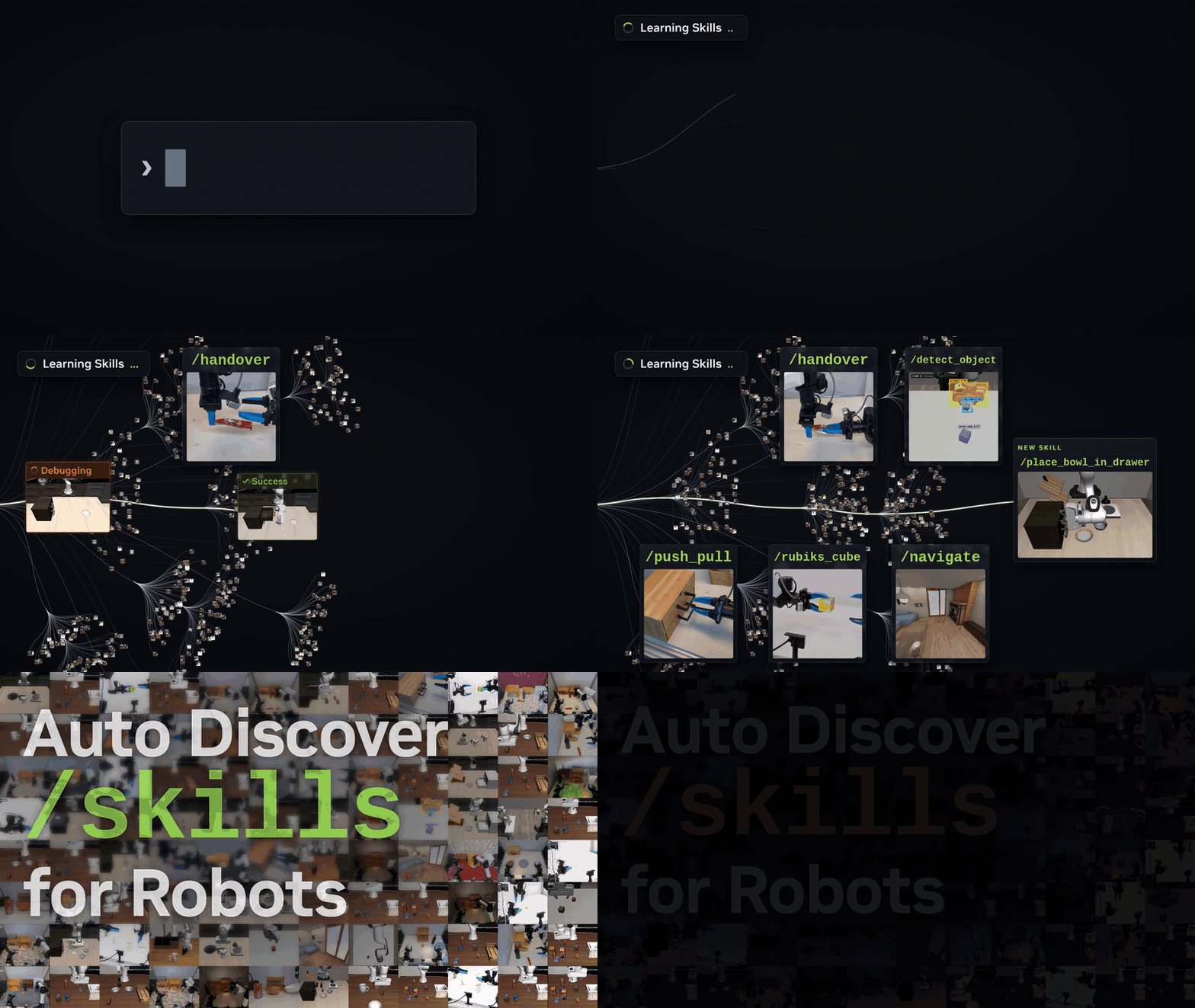
# ASPIRE: Agentic /Skills Discovery for Robotics [Project Page](https://research.nvidia.com/labs/gear/aspire/)  |  [Paper](https://arxiv.org/abs/2607.00272) ASPIRE discovering /skills across simulation and real-robot tasks ASPIRE is a new type of continual learning: "training" is skill refinement instead of gradient descent. "Trained model" is a repo of sensorimotor skills instead of floating weights. “Distributed training” is a panel of agents each practicing a different skill instead of sharded minibatches. ## News - **[2026-10] ASPIRE v1.0 is out!** ASPIRE can now solve a Rubik's Cube, and it achieves 99% success on 80 LIBERO-Pro Goal / Object / Spatial / Long tasks and selected Robosuite, BEHAVIOR-1K tasks. - **[2026-06] ASPIRE is out!** We achieve SOTA results on LIBERO-Pro, Robosuite, and BEHAVIOR-1K with Claude Opus 4.6! Also check out our table bussing sim-to-real demos! ## Real-World Results

Cross-embodiment sim-to-real Online real-world learning
Long Horizon Table Bussing
Claude Opus 4.6 (sim), GPT-5.5 (real)
Rubik's Cube
GPT-6 Astra
Stack Cups
GPT-6 Astra
Unscrew Bottle Cap
GPT-6 Astra
Pill in Bottle
GPT-6 Astra
## Model Scaling
Success vs. API cost LIBERO-Pro, Robosuite, BEHAVIOR-1K
ASPIRE success vs. API cost across twelve coding-agent models ASPIRE success rates on LIBERO-Pro, Robosuite and BEHAVIOR-1K by model
Stronger models discover better strategies
Book under a shelf
Opus 5.5 and Astra let go of the book and push it under the low shelf.
Push a plate
Opus 5.5 clears the clutter first; Astra lifts the plate over it.
Open the bottom drawer
Opus 5.5 and Astra tilt the gripper and hook the low handle, as the human does.
Mug in the microwave
Opus 5.5 and Astra grasp the handle and slide the mug in upright.
ASPIRE improves with the underlying model. On 10 LIBERO-Pro tasks, success rises from 15% (GPT-6 Luna) to 99% (Claude Opus 5.5), and the strongest models are not the most expensive: the green line marks the cost/success frontier. Across LIBERO-Pro, Robosuite and BEHAVIOR-1K, Claude Opus 5.5 reaches 97–100% success on every task. ## Quick Start ### Run with a coding agent To get started with ASPIRE, launch a coding agent such as Codex or Claude Code and enter the following prompt: ```text Clone the main branch of https://github.com/NVlabs/ASPIRE/, read the iterative-debugging skill (.claude/skills/iterative-debugging/SKILL.md) and docs/libero-pro.md, and run the complete ASPIRE LIBERO-Pro Goal-Swap Quick Start for all ten tasks in the libero_goal_swap suite. Before executing, report the required GPUs, credentials, gated weights, services, expected runtime, seed partitions, and output paths. Wait for my confirmation before launching. Do not access real-robot code or instructions (AGENTS.md, docs/system2*.md, docs/yam-real.md, src/cap_harness/yam_real/). ``` Before running, set up the host (CUDA, uv, and the Hugging Face token for the gated SAM3 weights) with [`docs/host-setup.md`](docs/host-setup.md). **Reference agent environments:** ASPIRE is coding-agent agnostic. The simulation workflow is packaged as agent skills for Claude Code ([`.claude/skills/`](.claude/skills/)) and Codex ([`.codex/skills/`](.codex/skills/)): `iterative-debugging` and `evosearch`. [`AGENTS.md`](AGENTS.md) holds the execution rules for the real-robot System 2 agent ([operator runbook](docs/system2.md)) and is not needed for simulation runs. ### Reproduce full paper results Name the suite and experiment explicitly. If neither is named, the agent should present this table and stop for selection.
Suite Experiment Runbook Video
LIBERO-Pro Iterative-debugging loop iterative-debugging/
Robosuite Iterative-debugging loop iterative-debugging/
BEHAVIOR-1K Iterative-debugging loop iterative-debugging/behavior/
LIBERO-Pro Evolutionary Search evosearch/
Robosuite Evolutionary Search evosearch/
LIBERO Zero-Shot Transfer libero/zeroshot-transfer/
LIBERO-Long-Pro Library-Size Scaling libero/library-size-scaling/
LIBERO-Long-Pro Inference-Time Scaling libero/inference-time-scaling/
Robosuite Debugging-Token-Ablation robosuite/training-law/
Before a paper-scale launch, the agent must report the selected tasks, seed schedule, expected trial count and runtime, GPU and credential requirements, services, and output paths, then wait for explicit confirmation. ### Reproduce the real-robot manipulation demos Use the [System 2 operator runbook](docs/system2.md#reproduce-the-manipulation-demos) to prepare a calibrated YAM station and launch a fresh agent with the appropriate text-based task skill: - [Rubik's Cube](examples/yam_real/rubiks_cube/TASK_CONTEXT.md). - [Unscrew a bottle and pour](examples/yam_real/unscrew_bottle/TASK_CONTEXT.md). - [Insert a pill and close the bottle](examples/yam_real/pill_in_bottle/TASK_CONTEXT.md). - [Nest cups upside down](examples/yam_real/cup_stacking/TASK_CONTEXT.md). The [manipulation skill entrypoint](.agents/skills/manipulation-tasks/SKILL.md) routes the agent to these recipes. They provide grasp strategies, recovery, and physical completion checks without requiring episode logs or fixed-coordinate replays. The three new recipes are distilled from demo sessions, not a new real-robot validation; the pill recipe explicitly distinguishes a seated cap from verified final tightness. Re-ground the current scene and verify the actual outcome. > [!WARNING] > ASPIRE executes language-model-generated Python with full import access. Trial processes and watchdogs are not a security sandbox. Run generated code on an isolated host without credentials or sensitive mounts, restrict network access, and never grant a simulation agent access to physical hardware. Real-robot work requires the controls in [`aspire/real/AGENTS.md`](https://github.com/NVlabs/ASPIRE/blob/v0.1/aspire/real/AGENTS.md) and separate operator authorization. ## Contribution Guidelines Start with [CONTRIBUTING.md](https://github.com/NVlabs/ASPIRE/blob/v0.1/CONTRIBUTING.md). Third-party contributions must include a Developer Certificate of Origin sign-off. ## License ASPIRE material owned by NVIDIA or contributed under the project license is available under the [Apache License 2.0](https://github.com/NVlabs/ASPIRE/blob/main/LICENSE). Third-party materials retain their original terms. See [NOTICE](https://github.com/NVlabs/ASPIRE/blob/main/NOTICE) and the central [licensing and compliance index](https://github.com/NVlabs/ASPIRE/blob/v0.1/LICENSES/README.md) before using or redistributing the full stack. ## Citation If you find ASPIRE useful in your research, please cite: ```bibtex @article{lu2026aspire, title = {ASPIRE: Agentic /Skills Discovery for Robotics}, author = {Runyu Lu and Yubo Wu and Ethan Kou and Haotian Lin and Letian Fu and Wenli Xiao and Ajay Mandlekar and Yinzhen Xu and Guanya Shi and Ken Goldberg and Ang Chen and Mosharaf Chowdhury and Jan Kautz and Yuke Zhu and Linxi "Jim" Fan and Guanzhi Wang}, year = {2026}, journal = {arXiv preprint arXiv:2607.00272}, url = {https://arxiv.org/abs/2607.00272} } ``` ASPIRE was developed by researchers from NVIDIA, the University of Michigan, the University of Illinois Urbana-Champaign, UC Berkeley, and Carnegie Mellon University.