[](https://github.com/NVlabs/RADIO/stargazers)
[](LICENSE)
[](https://arxiv.org/abs/2601.17237)
[](https://openreview.net/pdf?id=lioemOcq3H)
[](https://arxiv.org/abs/2412.07679)
[](https://openaccess.thecvf.com/content/CVPR2025/papers/Heinrich_RADIOv2.5_Improved_Baselines_for_Agglomerative_Vision_Foundation_Models_CVPR_2025_paper.pdf)
[](https://arxiv.org/abs/2412.07679)
[](https://arxiv.org/abs/2410.01680)
[](https://arxiv.org/abs/2312.06709)
[](https://openaccess.thecvf.com/content/CVPR2024/papers/Ranzinger_AM-RADIO_Agglomerative_Vision_Foundation_Model_Reduce_All_Domains_Into_One_CVPR_2024_paper.pdf)
# \[CVPR 2024, 2025\] AM-RADIO: Agglomerative Vision Foundation Model - Reduce All Domains Into One
Official PyTorch implementation of \[CVPR 2025\] [**RADIOv2.5: Improved Baselines for Agglomerative Vision Foundation Models**](https://arxiv.org/abs/2412.07679)
Official PyTorch implementation of \[CVPR 2024\] [**AM-RADIO: Agglomerative Vision Foundation Model - Reduce All Domains Into One**](https://arxiv.org/abs/2312.06709)
Check out our preprints: [**PHI-S: Distribution Balancing for Label-Free Multi-Teacher Distillation**](https://arxiv.org/abs/2410.01680) and [**FeatSharp: Your Vision Model Features, Sharper**](https://www.arxiv.org/abs/2502.16025).
Mike Ranzinger, Greg Heinrich, [Jan Kautz](https://jankautz.com/), [Pavlo Molchanov](https://www.pmolchanov.com/).
[NVIDIA Research](https://www.nvidia.com/en-us/research/)
For business inquiries, please visit our website and submit the form: [NVIDIA Research Licensing](https://www.nvidia.com/en-us/research/inquiries/)
\[[C-RADIOv4 Tech Report](https://arxiv.org/abs/2601.17237)\]
\[[RADIOv2.5](https://arxiv.org/abs/2412.07679)\]\[[FeatSharp](https://www.arxiv.org/abs/2502.16025)\]\[[PHI-S](https://arxiv.org/abs/2410.01680)\]\[[AM-RADIO](https://arxiv.org/abs/2312.06709)\]\[[BibTex](#citing-radio)\]
## Latest Models
C-RADIOv4 Model Family ([Commercially Permissive](https://developer.download.nvidia.com/licenses/nvidia-open-model-license-agreement-june-2024.pdf))
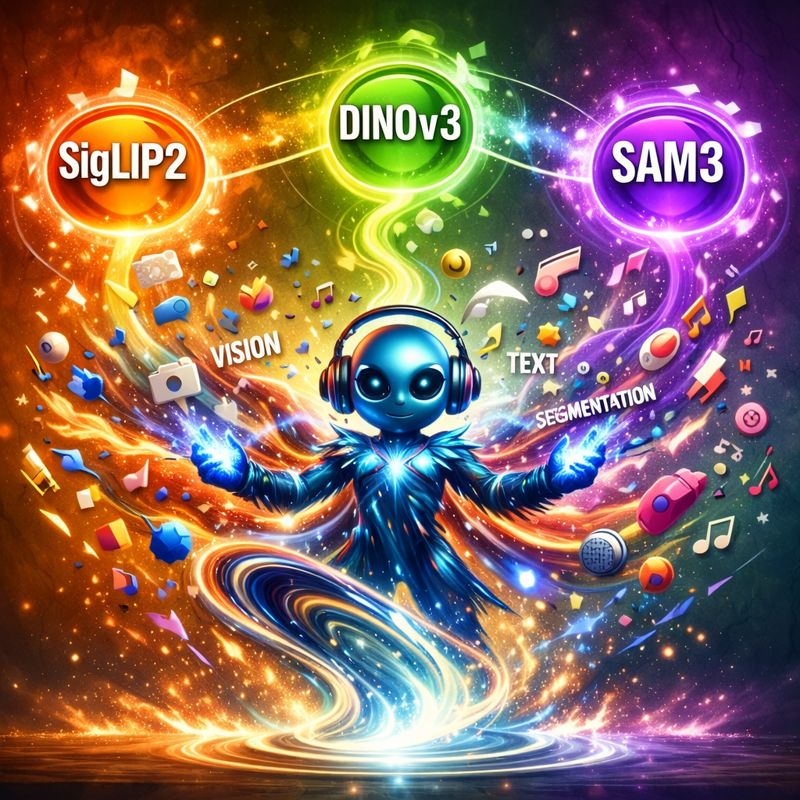
We've updated our teacher set to \[SigLIP2-g-384, DINOv3-7B, SAM3\], along with some other things, and the result is our strongest set of models to date. See our [tech report](https://arxiv.org/abs/2601.17237) for more details.
Loadable via torchhub (e.g. `model_version='c-radio_v4-h'` or `model_version='c-radio_v4-so400m'`) or from HuggingFace:
- [C-RADIOv4-SO400M](https://huggingface.co/nvidia/C-RADIOv4-SO400M)
- [C-RADIOv4-H](https://huggingface.co/nvidia/C-RADIOv4-H)
```Python
from PIL import Image
import torch
from torch.nn import functional as F
from torchvision.transforms.functional import pil_to_tensor
model_version="c-radio_v4-h" # for C-RADIOv4-H model (ViT-H/16)
# model_version="c-radio_v4-so400m" # for C-RADIOv4-H model (ViT-H/16)
# NOTE: `force_reload` will re-download the source code too. If you have used our TorchHub in the past, we strongly recommend
# running with this flag once to pull the latest code.
model = torch.hub.load('NVlabs/RADIO', 'radio_model', version=model_version, progress=True, skip_validation=True, force_reload=True)
model.cuda().eval()
x = Image.open('assets/cradio_v4.png').convert('RGB')
x = pil_to_tensor(x).to(dtype=torch.float32, device='cuda')
x.div_(255.0) # RADIO expects the input values to be between 0 and 1
x = x.unsqueeze(0) # Add a batch dimension
#### Example 1 ####
# Regular Usage
###################
nearest_res = model.get_nearest_supported_resolution(*x.shape[-2:])
x = F.interpolate(x, nearest_res, mode='bilinear', align_corners=False)
# RADIO expects the input to have values between [0, 1]. It will automatically normalize them to have mean 0 std 1.
summary, spatial_features = model(x)
#### Example 2 ####
# Returning features in NCHW format, for easier spatial handling
###################
# By default, RADIO will return the spatial_features in NLC format, with L being a combined height/width dimension.
# You can alternatively ask for the features in the more computer-vision-convenient format NCHW the following way:
summary, spatial_features = model(x, feature_fmt='NCHW')
assert spatial_features.ndim == 4
#### Example 3 ####
# AMP autocasting (mixed precision, critical for fast performance with self attention)
###################
# RADIO also supports running in mixed precision:
with torch.autocast('cuda', dtype=torch.bfloat16):
summary, spatial_features = model(x)
#### Example 4 ####
# Decoupled input normalization
###################
# If you'd rather pre-normalize the inputs, then you can do this:
conditioner = model.make_preprocessor_external()
# Now, the model won't change the inputs, and it's up to the user to call `cond_x = conditioner(x)` before
# calling `model(cond_x)`. You most likely would do this if you want to move the conditioning into your
# existing data processing pipeline.
with torch.autocast('cuda', dtype=torch.bfloat16):
cond_x = conditioner(x)
summary, spatial_features = model(cond_x)
#### Example 5 ####
# Teacher adaptors, e.g. for text alignment
###################
# Adaptors
# One or more may be specified via the `adaptor_names` argument
model = torch.hub.load('NVlabs/RADIO', 'radio_model', version=model_version, progress=True, skip_validation=True, adaptor_names=['siglip2-g'])
model.cuda().eval()
vis_output = model(x)
# These are the usual RADIO features
backbone_summary, backbone_features = vis_output['backbone']
# There will also be summary and feature pairs for each of the loaded adaptors
sig2_vis_summary, sig2_vis_features = vis_output['siglip2-g']
# The 'siglip2-g' and 'clip' adaptors (when available) are special because they also support text tokenization and encoding
sig2_adaptor = model.adaptors['siglip2-g']
text_input = sig2_adaptor.tokenizer(['An image of an alien wearing headphones, with three orbs floating overhead']).to('cuda')
text_tokens = sig2_adaptor.encode_text(text_input, normalize=True)
sim = F.cosine_similarity(sig2_vis_summary, text_tokens)
print(sim)
```
We also demonstrate how to use C-RADIOv4 to replace the vision encoder in SAM3 here: https://github.com/mranzinger/sam3-radio/blob/main/demo_sam3_radio.py
## RADIO1D (Research)
RADIO1D is a Vision Transformer variant that compresses spatial tokens into a variable-length 1D sequence of "global tokens" during encoding, and reconstructs the full spatial resolution via a decoder. The number of tokens can be chosen at inference time, providing a tunable trade-off between feature compactness and reconstruction fidelity.
A RADIO1D model exposes two named "necks":
- `encoder` — the compressed 1D global tokens, shape `(B, num_tokens, C)`
- `decoder` — the spatially-reconstructed features, shape `(B, H*W, C)`
Two new arguments on `radio_model()` / `RADIOModel.forward()` plumb this through:
- `num_tokens: Optional[int]` — number of tokens to keep in the 1D encoder output (default: model's max).
- `neck_name: Optional[str]` — which neck's output to return (default: returns a dict of all necks for multi-neck models).
You can qualitatively visualize the trade-off by sweeping `num_tokens` over a single image with [`examples/visualize_features.py`](./examples/visualize_features.py):
```bash
python examples/visualize_features.py -v -d \
--neck decoder --animate-radio1d \
--radio1d-start 1 --radio1d-end 512 --radio1d-step 32
```
Pretrained checkpoints are not yet released.
## Older Models
C-RADIOv3 Model Family ([Commercially Permissive](https://developer.download.nvidia.com/licenses/nvidia-open-model-license-agreement-june-2024.pdf))
Loadable via torchhub (e.g. `model_version='c-radio_v3-h'`) or from HuggingFace:
- [C-RADIOv3-B](https://huggingface.co/nvidia/C-RADIOv3-B)
- [C-RADIOv3-L](https://huggingface.co/nvidia/C-RADIOv3-L)
- [C-RADIOv3-H](https://huggingface.co/nvidia/C-RADIOv3-H)
- [C-RADIOv3-g](https://huggingface.co/nvidia/C-RADIOv3-g)
Now, also supported as a [Foundation Model in TAO Toolkit](https://docs.nvidia.com/tao/tao-toolkit/text/foundation_models/overview.html)!
---
## News/Release
- [1.29.2026] RADSeg code was open sourced. [Code](https://github.com/RADSeg-OVSS/RADSeg) [Paper](https://arxiv.org/abs/2511.19704)
- [1.27.2026] C-RADIOv4 has been released.
- Load via TorchHub or
- HuggingFace: [C-RADIOv4-SO400M](https://huggingface.co/nvidia/C-RADIOv4-SO400M) [C-RADIOv4-H](https://huggingface.co/nvidia/C-RADIOv4-H)
- [11.26.2025] [RADSeg](https://arxiv.org/abs/2511.19704): Shout out to Alama, Jariwala, Bhattacharya et al. who have pushed RADIO even further in the domain of Open Vocabulary Semantic Segmentation in both the 2D and 3D domains. They've strongly set the SOTA, both in raw metrics, and especially on pareto, running significantly faster than nearby competitors.
- [6.25.2025] [FeatSharp](https://github.com/NVlabs/FeatSharp) code is now available! We used this to train all of the C-RADIOv3 models, and also the C-RADIOv2-VLM model that's powering Llama Nemotron Nano VL 8B, currently \#1 on [OCR Bench v2](https://ling99-ocrbench-v2-leaderboard.hf.space/).
- [6.3.2025] 🔥🔥🔥 C-RADIOv3 has been released. These are [commercially viable models](https://developer.download.nvidia.com/licenses/nvidia-open-model-license-agreement-june-2024.pdf), and also represent our strongest models to date!
- Can be loaded using TorchHub, or:
- Huggingface: [C-RADIOv3-B](https://huggingface.co/nvidia/C-RADIOv3-B) [C-RADIOv3-L](https://huggingface.co/nvidia/C-RADIOv3-L) [C-RADIOv3-H](https://huggingface.co/nvidia/C-RADIOv3-H) [C-RADIOv3-g](https://huggingface.co/nvidia/C-RADIOv3-g)
- [5.1.2025] FeatSharp has been accepted to **ICML 2025**.
- [2.26.2025] RADIOv2.5 paper has been accepted to **CVPR 2025**. See you in Nashville.
- [12.18.2024] We release C-RADIO, a ViT-H/16 model which can be used for commercial products, under the [NVIDIA Open Model License Agreement](https://developer.download.nvidia.com/licenses/nvidia-open-model-license-agreement-june-2024.pdf) license!
- [12.11.2024] We release RADIOv2.5 ViT-g/14, our biggest model yet!
- [12.10.2024] We release \[[RADIO-Amplified](https://arxiv.org/abs/2412.07679)\] to ArXiv with details on our method to address the mode-switching issue (previously described in this [tech report](./RADIOv2.5_tech_report.md)) and our efficient VLM integration method.
- [10.2.2024] 🔥🔥 RADIOv2.5 ViT-H/16 model is released. We have also released \[[PHI-S: Distribution Balancing for Label-Free Multi-Teacher Distillation](https://arxiv.org/abs/2410.01680)\] to ArXiv that details one of the major algorithm updates behind the version 2.5 releases.
- [7.22.2024] 🔥 RADIOv2.5 ViT-B/16 and ViT-L/16 are released. For VLLM tasks, RADIOv2.5-B is as good or better than RADIOv2, and RADIOv2.5-L is much better! See [tech report](./RADIOv2.5_tech_report.md).
- [4.30.2024] 🔥 README is updated with more metrics, Arxiv is updated with new results.
- [3.21.2024] 🔥 RADIOv2.1 is released. Trained in bf16, improves metrics!
- [2.26.2024] AM-RADIO paper has been accepted to **CVPR 2024**
- [2.15.2024] RADIOv2 is released. Trained with DFN CLIP; OpenAI CLIP; DINOv2; SAM teachers. Note that SAM teacher was not used in previous models.
- [1.5.2024] Initial github repo is released.
---
## Abstract
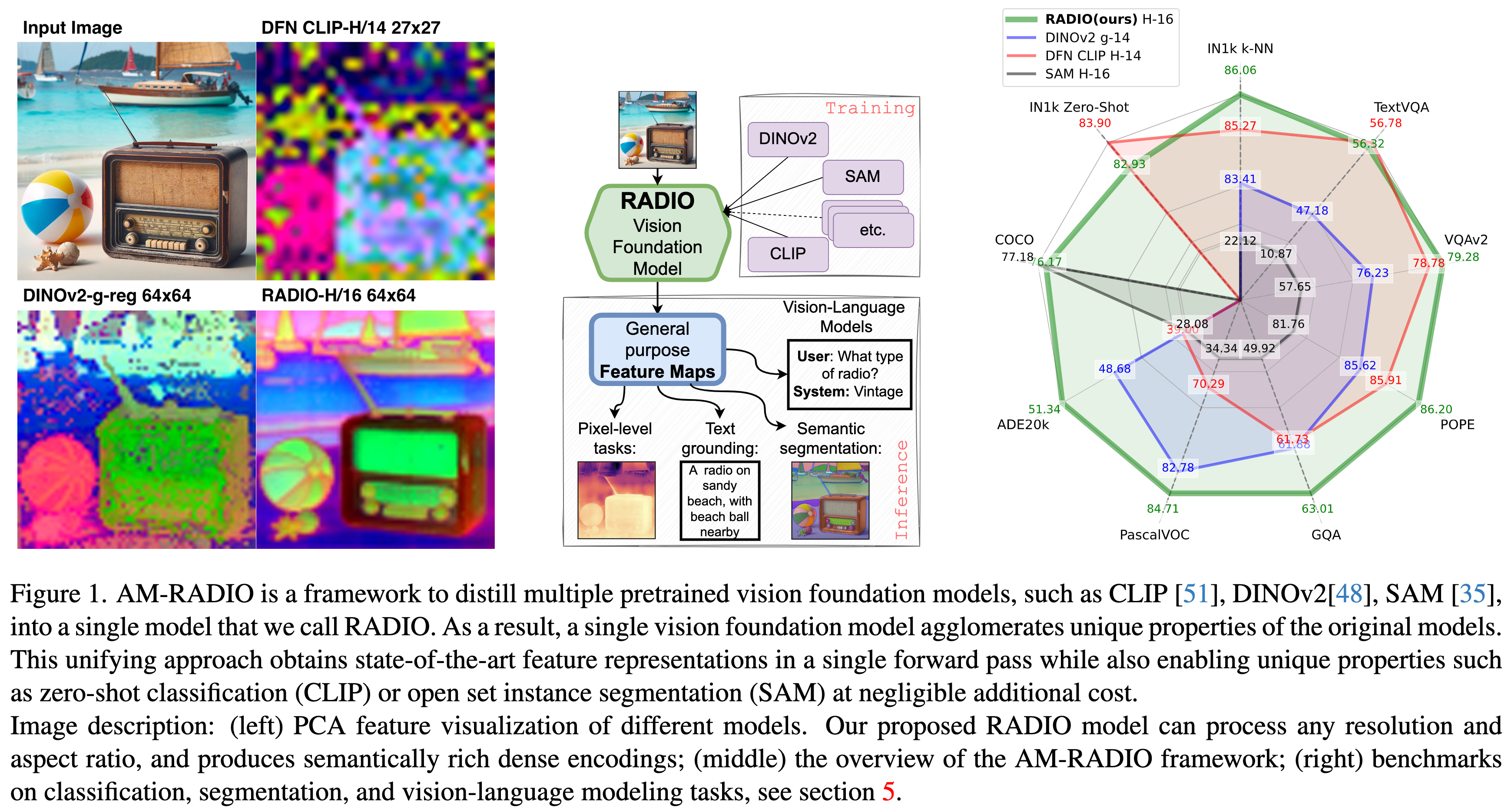
AM-RADIO is a framework to distill Large Vision Foundation models into a single one.
RADIO, a new vision foundation model, excels across visual domains, serving as a superior replacement for vision backbones. Integrating CLIP variants, DINOv2, and SAM through distillation, it preserves unique features like text grounding and segmentation correspondence. Outperforming teachers in ImageNet zero-shot (+6.8%), kNN (+2.39%), and linear probing segmentation (+3.8%) and vision-language models (LLaVa 1.5 up to 1.5%), it scales to any resolution, supports non-square images. We offer an efficient variant, E-RADIO, which achieves is 6-10x faster than CLIP and DINOv2.
 Official PyTorch implementation of \[CVPR 2025\] [**RADIOv2.5: Improved Baselines for Agglomerative Vision Foundation Models**](https://arxiv.org/abs/2412.07679)
Official PyTorch implementation of \[CVPR 2024\] [**AM-RADIO: Agglomerative Vision Foundation Model - Reduce All Domains Into One**](https://arxiv.org/abs/2312.06709)
Check out our preprints: [**PHI-S: Distribution Balancing for Label-Free Multi-Teacher Distillation**](https://arxiv.org/abs/2410.01680) and [**FeatSharp: Your Vision Model Features, Sharper**](https://www.arxiv.org/abs/2502.16025).
Mike Ranzinger, Greg Heinrich, [Jan Kautz](https://jankautz.com/), [Pavlo Molchanov](https://www.pmolchanov.com/).
[NVIDIA Research](https://www.nvidia.com/en-us/research/)
For business inquiries, please visit our website and submit the form: [NVIDIA Research Licensing](https://www.nvidia.com/en-us/research/inquiries/)
\[[C-RADIOv4 Tech Report](https://arxiv.org/abs/2601.17237)\]
\[[RADIOv2.5](https://arxiv.org/abs/2412.07679)\]\[[FeatSharp](https://www.arxiv.org/abs/2502.16025)\]\[[PHI-S](https://arxiv.org/abs/2410.01680)\]\[[AM-RADIO](https://arxiv.org/abs/2312.06709)\]\[[BibTex](#citing-radio)\]