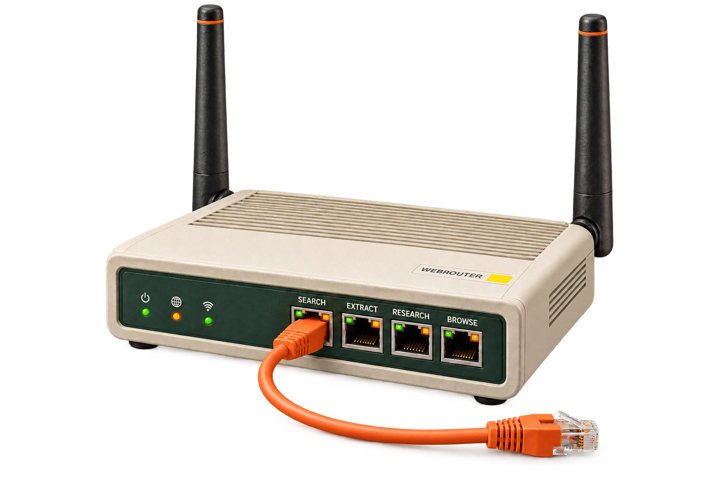
WebRouter
The open source standard for agent web access.





Documentation ·
Quickstart ·
Providers ·
Examples
WebRouter connects agents to search, extract, live data, answer, research and
browsers through one typed interface, across many providers.
- **Agent web primitives.** Find pages, read them, ask for an answer, run
deep research, call a site's structured scraper, or drive a browser.
- **Smart routing.** Static fallback and optional routers trade off cost,
latency and coverage for each task and the providers you have keys for.
- **No vendor lock-in.** Calls and results keep the same shape when you switch
providers. WebRouter is Apache 2.0 and runs with your own keys.
- **Providers and vendor APIs.** Use one call shape across web providers, then
use the curated catalog for provider-specific APIs.
- **Governance and security.** Control provider selection and routing, keep
keys scoped to their provider, reject unsupported constraints, and require
explicit opt-in for vendor writes.
Useful? Star the repo so more agent developers can find it. ⭐
> **Developer preview:** the API may change before 1.0. Share feedback on [Discord](https://discord.gg/MGztFWSjZh).
## Quickstart
Install WebRouter and make a search with no API key:
```bash
pip install "webrouter[all]"
```
```python
from web_router import WebRouter
response = WebRouter().search("what is retrieval augmented generation", max_results=5)
for result in response.results:
print(result.title, result.url)
print(response.provider) # which backend actually answered
pages = WebRouter().extract(response.urls[:3], format="markdown")
for document in pages.documents:
print(document.url, len(document.content))
```
The [full Quickstart](https://docs.webrouter.net/quickstart) adds a named
provider, API keys, async usage, install extras and source setup.
[Runnable examples](https://github.com/Nimbleway/webrouter/tree/main/examples)
cover each core method, routing, integrations and common errors. Most need no
credentials.
## Documentation
The docs site is the canonical guide for getting started and for the core
methods. This README keeps the advanced and contributor-facing surfaces that
have not moved there yet.
| Start here | Core methods | Reference |
| --- | --- | --- |
| [Introduction](https://docs.webrouter.net) | [Search](https://docs.webrouter.net/search) | [Configuration](https://docs.webrouter.net/configuration) |
| [Quickstart](https://docs.webrouter.net/quickstart) | [Extract](https://docs.webrouter.net/extract) | [Errors](https://docs.webrouter.net/errors) |
| [How it works](https://docs.webrouter.net/how-it-works) | [Answer](https://docs.webrouter.net/answer) | [Providers](https://docs.webrouter.net/providers) |
| [Examples](https://github.com/Nimbleway/webrouter/tree/main/examples) | [Research](https://docs.webrouter.net/research) | [MCP server](https://github.com/Nimbleway/webrouter/blob/main/docs/mcp.md) |
| | [Browser sessions and agents](https://docs.webrouter.net/browser) | |
## Provider support
Twelve search backends, seven extract backends, a live data catalogue, five
answer backends, three agentic research backends (plus Exa's, retired upstream), five
browser-session backends and three browser agents. One call each. Switching
between them is one argument.
A provider name serves the methods it serves and no others: `brave` searches
and cannot extract, `oxylabs` extracts and cannot search, `nimble` searches,
extracts, runs live data and researches, and `browserbase` opens
sessions, runs browse tasks and extracts.
Ask a method for another's backend and it says so, naming the backends that
method does serve.
### Search
`[search]` installs all of these but AgentCore, which needs `[aws]`. The first column is what you pass to
`WebRouter(...)` to pick one at runtime. The string beside it is the same value,
and what `response.provider` and `configured_providers()` report back.
| Pass | Name | Provider | Backed by | Options mapped |
| --- | --- | --- | --- | --- |
| `Provider.NIMBLE` | `nimble` | [Nimble](https://nimbleway.com) | `nimble-python` | all but `effort` |
| `Provider.TAVILY` | `tavily` | [Tavily](https://tavily.com) | `tavily-python` | all but `effort` |
| `Provider.YOU` | `you` | [You.com](https://you.com/platform) | direct HTTP | all but `effort` |
| `Provider.BRAVE` | `brave` | [Brave](https://brave.com/search/api/) | direct HTTP | all but `effort`; `search_depth` at `lite` only |
| `Provider.EXA` | `exa` | [Exa](https://exa.ai) | direct HTTP | all but `locale` |
| `Provider.PARALLEL` | `parallel` | [Parallel](https://parallel.ai) | direct HTTP (`/v1/search`, `mode=fast` unless `effort` sets it) | all but `locale`; `search_depth` at `lite` and `fast` |
| `Provider.PERPLEXITY` | `perplexity` | [Perplexity](https://docs.perplexity.ai) | direct HTTP | all of them; `search_depth` at `lite` and `fast` |
| `Provider.LINKUP` | `linkup` | [Linkup](https://www.linkup.so) | direct HTTP | `max_results`, `include_domains`, `exclude_domains`, `recency`, `effort` |
| `Provider.WEBIQ` | `webiq` | [WebIQ](https://api.microsoft.ai) (Microsoft AI Web Search) | direct HTTP | all but `recency` and `effort` |
| `Provider.KEENABLE` | `keenable` | [Keenable](https://docs.keenable.ai) | direct HTTP; keyless with `allow_keyless=True` (rate-limited per IP) | `max_results`, `search_depth` (`lite`, `fast`), `include_domains` (one), `recency`, `effort` |
| `Provider.DEEPSEEK` | `deepseek` | [DeepSeek Search](https://api-docs.deepseek.com/guides/search) | direct HTTP | `max_results` (at most 50), `search_depth` (`lite`, `deep`), `include_domains`, `exclude_domains`, `locale`, `recency`, the last four sent inside the query, which must fit 128 characters |
| `Provider.AGENTCORE` | `agentcore` | [AWS AgentCore Web Search](https://docs.aws.amazon.com/bedrock-agentcore/latest/devguide/gateway-target-connector-web-search-tool.html), through your own AgentCore Gateway ([setup](docs/agentcore-setup.md)) | MCP over HTTP, SigV4 via `botocore` (`[aws]`) | `max_results` (at most 25), `include_domains`, `exclude_domains`, `recency` (connector 1.2.0 or later). An end date is AgentCore's own `provider_options={"filters": {"publishedDateFilter": {"to": ...}}}`. Queries up to 200 characters. AWS's terms: show each result's citation, and do not store results in bulk |
| `Provider.YOU_MCP` | `you-mcp` | [You.com MCP](https://api.you.com/mcp) | direct HTTP, **no key** | all but `effort` |
| `Provider.EXA_MCP` | `exa-mcp` | [Exa MCP](https://exa.ai/docs/reference/exa-mcp), its `web_search_advanced_exa` tool | direct HTTP, **no key** | all but `locale` |
| `Provider.PARALLEL_MCP` | `parallel-mcp` | [Parallel Search MCP](https://docs.parallel.ai/integrations/mcp/quickstart) | direct HTTP, **no key** | `max_results` (applied to the response: the tool ignores a count) |
| `Provider.AUTO` *(default)* | `auto` | — | every backend you hold a key for, in the order the frozen benchmark results rank them, then the keyless ones — so a key held only for research serves searches too, and those calls bill; see [Working with no credentials](#working-with-no-credentials) | every option some member maps, each request routed to a member that maps what it sets |
A backend maps an option only where its API has a documented field or query
operator for it; [Search](https://docs.webrouter.net/search) says how each one does, and
`contracts/search/.json` holds the exact fields sent. Mapping another is a
small PR and the most useful thing to contribute — see
[CONTRIBUTING.md](CONTRIBUTING.md#promoting-a-provider-option).
### Extract
`[extract]` installs all of these, and `configured_extract_providers()` reports
which ones this environment can use.
| Pass | Name | Provider | Credentials | Formats |
| --- | --- | --- | --- | --- |
| `Provider.NIMBLE` | `nimble` | [Nimble Extract](https://docs.nimbleway.com/api-reference/extract/extract) | `NIMBLE_API_KEY` | `markdown`, `html` |
| `Provider.TAVILY` | `tavily` | [Tavily Extract](https://tavily.com) | `TAVILY_API_KEY` *(keyless only through `auto`)* | `markdown`, `text` |
| `Provider.EXA` | `exa` | [Exa Contents](https://exa.ai) | `EXA_API_KEY` | `text` |
| `Provider.LINKUP` | `linkup` | [Linkup Fetch](https://docs.linkup.so) | `LINKUP_API_KEY` | `markdown`, `html` |
| `Provider.FIRECRAWL` | `firecrawl` | [Firecrawl Scrape](https://firecrawl.dev) | `FIRECRAWL_API_KEY`, or keyless with `allow_keyless=True` (capped per IP per day) | `markdown`, `html` |
| `Provider.OXYLABS` | `oxylabs` | [Oxylabs Web Scraper](https://oxylabs.io) | `OXYLABS_USERNAME` + `OXYLABS_PASSWORD` | `markdown`, `html` |
| `Provider.BRIGHTDATA` | `brightdata` | [Bright Data Web Unlocker](https://brightdata.com) | `BRIGHTDATA_API_TOKEN` + `BRIGHTDATA_ZONE` | `markdown`, `html` |
| `Provider.WEBIQ` | `webiq` | [WebIQ Browse](https://api.microsoft.ai) (Microsoft AI) — pages in WebIQ's own index | `WEBIQ_API_KEY` | `markdown`, `text` |
| `Provider.KEENABLE` | `keenable` | [Keenable Fetch](https://docs.keenable.ai/api-reference/fetch) | `KEENABLE_API_KEY`, or keyless with `allow_keyless=True` (rate-limited per IP) | `markdown` |
| `Provider.DEEPSEEK` | `deepseek` | [DeepSeek Fetch](https://api-docs.deepseek.com/guides/search) | `DEEPSEEK_API_KEY` | `markdown` |
| `Provider.JINA` | `jina` | [Jina Reader](https://jina.ai/reader) | **none** (`JINA_API_KEY` raises the rate limit) | `markdown`, `html`, `text` |
| `Provider.BROWSERBASE` | `browserbase` | [Browserbase Fetch](https://docs.browserbase.com/features/fetch) — a plain fetch, never a rendered page; the one backend that maps `profile` | `BROWSERBASE_API_KEY` | `markdown`, `html` |
| `Provider.AUTO` *(default)* | `auto` | — | the original backends you hold a key for, then the keyless ones, then Linkup, Exa, WebIQ, Keenable, DeepSeek and Browserbase | `markdown` *(default)*, `html`, `text`, each routed to a member that returns it; `profile` routed to one that maps it |
| `Provider.MAX` | `max` | | the same members as `auto`, **all at once**; the first document back wins, and every fetch started is paid for -- see [The fastest answer any backend can give](https://docs.webrouter.net/extract#the-fastest-answer-any-backend-can-give-max) | as `auto` |
Two need more than a key. Oxylabs authenticates with the username and password
created under Web Scraper API in its dashboard — not the ones you sign in with —
and Bright Data needs the zone that routes the request beside its token. Neither
has a default worth guessing, so a missing one is an error naming the variable
to set.
> Nimble, Tavily, Jina, Linkup, Firecrawl, Oxylabs, Bright Data and Browserbase
> were verified live — Oxylabs and Bright Data on 2026-11-03, Browserbase (both
> formats, and `profile` through the whole flow) by hand on 2026-10-29 and by
> the automated live tests on 2026-11-08. **Exa's extract
> mapping is taken from documentation** and has not been confirmed against a
> real response; its integration tests skip themselves until a working key is
> available.
#### Reading a page behind a login
`profile` is the extract side of the browser's `profile`: a saved identity on
the backend — its cookies and storage — whose cookies are sent with each fetch.
Log in once in a browser session that persists to it, release the session, and
the fetches that name the same id read the page as that user:
```python
with router.open_browser(provider="browserbase", profile=context_id, persist_profile=True) as browser:
browser.goto("https://example.com/login")
... # type the credentials, submit
response = router.extract("https://example.com/account/orders", provider="browserbase", profile=context_id)
```
The fetch never writes cookies back, so an expired login means another
session. Browserbase is the one backend that maps it, through its Contexts; a
backend without saved profiles raises `UnsupportedParameterError` rather than
fetching anonymously, and `auto` and `max` pass such members over. The MCP
server never offers it: a logged-in identity is set in code, not from a
conversation.
### Live data
Four backends serve live data. There is no keyless tier and no `auto`, so the
provider is required for every call. See the detailed [Live data](#live-data-1)
guide below.
| Pass | Name | Provider | Credentials | Page formats beside the records |
| --- | --- | --- | --- | --- |
| `Provider.NIMBLE` | `nimble` | [Nimble Extract Templates](https://docs.nimbleway.com/api-reference/extract/extract-templates) | `NIMBLE_API_KEY` | `markdown`, `html` |
| `Provider.APIFY` | `apify` | [Apify Store Actors](https://docs.apify.com/api/v2/act-run-sync-get-dataset-items-post) | `APIFY_TOKEN` | — |
| `Provider.BRIGHTDATA` | `brightdata` | [Bright Data scrapers](https://docs.brightdata.com/api-reference/web-scraper-api/synchronous-requests) | `BRIGHTDATA_API_TOKEN` | — |
| `Provider.OXYLABS` | `oxylabs` | [Oxylabs Web API dedicated scrapers](https://developers.oxylabs.io/products/web-api/scrape/dedicated-scrapers) | `OXYLABS_WEB_API_KEY` (a Web API key, not the Realtime username and password extract uses; in `provider_config["oxylabs"]` it is `web_api_key`, as `api_key` there is extract's password) | — |
Nimble was verified live on 2026-10-22: a listing, a description and a run on
a public test page. Apify and Bright Data were verified live on 2026-11-10:
each one's catalogue, a search, a description and a run (Apify's Google Maps
Actor, Bright Data's `amazon_products`). **The Oxylabs Web API is written from
its documentation** and has not yet been called live. Their integration tests
skip themselves until keys are available. Listing and describing bill nothing
on any of them; what a run bills is each vendor's own rate, recorded dated and
sourced in [`benchmarks/providers/PRICING.md`](benchmarks/providers/PRICING.md)
from the price list `web_router.prices` reads (see
[Estimated prices](#estimated-prices-experimental)). See [Live data](#live-data-1).
### Answer
`[answer]` installs these. One question, answered in one call: the backend
searches and writes the answer itself. No keyless tier, since every backend
bills the call; `auto` tries the ones you hold a key for, in the order `make chains` ranks them on the
answer benchmark. It ranks accuracy first and, where accuracy is too close to
tell apart, the cheaper at list price: Perplexity, You.com, Linkup, Parallel,
Exa, then Brave, which the scan has not measured. [Answer](https://docs.webrouter.net/answer)
explains what an unnamed call does.
| Pass | Name | Provider | Credentials | Options mapped | Citations tied to claims |
| --- | --- | --- | --- | --- | --- |
| `Provider.PERPLEXITY` | `perplexity` | [Perplexity Agent API, `fast` effort](https://docs.perplexity.ai/docs/agent-api/quickstart) | `PERPLEXITY_API_KEY` | `include_domains` or `exclude_domains` (not both), `country`, `recency` | yes: `[N]` markers, in `citation.field` |
| `Provider.YOU` | `you` | [You.com Answer API](https://you.com/docs/guides/answer.md) | `YOU_API_KEY` | `include_domains` or `exclude_domains` (not both), `country`, `recency` (`week` or wider: for `day` it cited pages days old) | yes: `[[1, 2]]` markers, in `citation.field` |
| `Provider.PARALLEL` | `parallel` | [Parallel Chat API (beta), `lite`](https://docs.parallel.ai/api-reference/chat-api-beta/chat-completions) | `PARALLEL_API_KEY` | none: the Chat API takes no source filter | no: its `basis` backs the answer as a whole |
| `Provider.EXA` | `exa` | [Exa Answer API](https://docs.exa.ai/reference/answer) | `EXA_API_KEY` | none: no source filter, and `userLocation` showed no clear effect | yes: `[N]` markers, in `citation.field` |
| `Provider.LINKUP` | `linkup` | [Linkup Search, `sourcedAnswer`](https://docs.linkup.so/pages/documentation/api-reference/endpoint/post-search) | `LINKUP_API_KEY` | `include_domains`, `exclude_domains`, `recency` | yes: `[N]` markers, in `citation.field` |
| `Provider.BRAVE` | `brave` | [Brave Answers API](https://brave.com/search/api/) | `BRAVE_ANSWER_API_KEY` (the Answers plan; not the search key) | none: no source filter, and `language` showed no effect | yes: each citation's span in the answer, in `citation.extra` |
All verified live on 2026-11-01, every mapped option seen to apply. The
medians and stated costs below are from the answer scan of 300 SimpleQA
questions on 2026-11-01, graded by `openai:gpt-4o`.
- `perplexity` answers in about two seconds (median 1.9 s over 300 questions) and cites inline as `[2]`; a
citation whose marker appears in the answer carries it in `field`, and the
response states its own cost under `raw[0]["usage"]["cost"]` (about $0.0012
an answer over 300 questions). `country` is its `user_location`: an emergency-number question
answered 999 for `GB` and 911 for `US`.
- `you` answers in about two seconds (median 1.7 s over 300 questions). Its `citations` are only the sources the
answer cites, marked `[[1, 2]]`; each carries in `field` the whole marker
group that first names it (`[[1, 2]]`, where other backends give one `[N]`), and its title comes from the pages You.com considered. It takes one
domain list, not both: asking for both raises before the call. `language` was
accepted but showed no effect, so `locale` is not mapped.
- `parallel` answers in about six seconds (median 6.3 s over 300 questions) with the `lite` model, the fastest
whose `basis` ties its sources to the answer (`speed` returned none). Each
citation carries the basis's `confidence` in `extra`; its reasoning stays in
`raw`. Its Chat API is in beta and takes no source filter, so every option
is refused.
- `exa` answers in about 1.3 seconds (median over 300 questions) and cites inline as `[1]`, numbering its
citations from 1; it states its cost under `raw[0]["costDollars"]` ($0.005 an
answer). Its Answer API has no source filter, so every option is refused.
- `linkup` answers in about a second (median 0.9 s over 300 questions) and lists every page it read; it is
asked for inline citations, so the answer marks the ones it rests on as `[N]`, numbering them from 1, and a
page read but never cited has no `field`. `recency` is its `fromDate`, and Linkup filters on the date it holds
for a page, which is not always the publication date.
- `brave` answers in two to three seconds and was verified live on 2026-11-03, outside the scan. It returns its
sources only on a streamed call, so the router streams it and reads the whole stream before answering. The
answer is the text with Brave's `` and `` tags taken out; each tag is a citation, in order,
with its `number` and its `start_index` / `end_index` into the answer in `extra`, and Brave writes no marker
into the text, so `field` is unset. Its `` tag, in `raw`, states the call's cost: $0.054 for one
question, almost all of it input tokens, about ten times the others. Every option is refused.
**Choosing one.** On 300 SimpleQA questions graded by one judge, all five land
at 94-95% and their intervals overlap, so accuracy does not separate them --
the [answer scan](benchmarks/providers/README.md#comparing-answer-backends)
reruns it. They differ in speed (Linkup, Exa, You.com and Perplexity in one to
two seconds, Parallel in about six), in the options they map (above), in
whether the answer ties each source to a sentence, and in cost: Perplexity and
Exa state theirs in the response; [`PRICING.md`](benchmarks/providers/PRICING.md)
lists the rest.
### Research
`[research]` installs all of these. Unlike the other two methods there is no
keyless tier: every agentic backend bills for the run, so `auto` here tries the
backends you hold a key for and then stops, naming the variables that would fix
it.
| Pass | Name | Provider | Credentials | Options mapped | Structured output |
| --- | --- | --- | --- | --- | --- |
| `Provider.NIMBLE` | `nimble` | [Nimble Web Search Agent](https://nimbleway.com) | `NIMBLE_API_KEY` | all of them | yes, and enrichment |
| `Provider.PARALLEL` | `parallel` | [Parallel Task API](https://parallel.ai) | `PARALLEL_API_KEY` | `effort`, `output_schema` | yes |
| `Provider.PERPLEXITY` | `perplexity` | [Perplexity Agent API](https://docs.perplexity.ai) | `PERPLEXITY_API_KEY` | `effort` | not mapped yet |
| `Provider.LINKUP` | `linkup` | [Linkup Research](https://docs.linkup.so) | `LINKUP_API_KEY` | `effort`, `output_schema` | yes |
| `Provider.YOU` | `you` | [You.com Research API](https://you.com/docs/guides/research) | `YOU_API_KEY` | `effort` | not mapped yet |
| `Provider.AUTO` *(default)* | `auto` | — | Nimble, Parallel, Perplexity, Linkup or You.com, whichever you hold, in that order | `effort`, `output_schema` | yes |
Nimble is the only backend WebRouter maps the whole surface for: source
guidance (`include_domains` / `exclude_domains`) and enrichment inputs
(`records`) are mapped for it alone so far. Parallel's Task API has a
[source policy](https://docs.parallel.ai/resources/source-policy) that is not
mapped yet. Ask another backend for either and it says so rather than running
without it.
Perplexity's and You.com's structured output is not mapped until a live run has
checked it, so neither declares `output_schema` — asking it for one raises
`UnsupportedParameterError` rather than handing back prose under the name of a
schema, which is the failure mode that quietly rots an agentic pipeline.
**Exa's Research API has been retired upstream** — every path answers `410 RESEARCH_RETIRED` — so WebRouter no longer ships an Exa research provider. Exa search and extract are unaffected.
How far each of the others has been verified, since it differs and the
difference matters:
| Provider | Verified how |
| --- | --- |
| `parallel` | **Live.** Real runs against the Task API, and every recorded payload in its tests is a real response. |
| `nimble` | **Against the `nimble-python` SDK's generated types**, produced from its OpenAPI spec — stronger than prose docs, weaker than a live call. Its `max` sends `x-high`, which Nimble's docs put at 15 to 30 minutes, longer than `research()`'s default 600-second wait: pass a larger `timeout`, or use `submit_research()` and poll, rather than leave a paid run going after the wait gives up. |
| `perplexity` | **Live.** On 2026-09-30 the chat endpoint's deep research model answered 403 ("Sonar is now the Agent API"), so research moved to `/v1/responses`: a background run was followed from `queued` through `in_progress` to `completed`, presets `low`, `medium` and `xhigh` were accepted, and a cancel left a run `cancelled`. Its payloads are the ones in the tests. |
| `linkup` | **Live.** Runs at `effort="low"` (`reasoningDepth` S, $0.25 each) were followed from start to answer, one of them with an `output_schema`, whose result was the schema's object alone; their payloads are the ones in the tests. Efforts above `low` are documentation-derived. Linkup's docs put `max` (XL) at 10 to 20 minutes and `high` (L) at 5 to 10, longer than `research()`'s default 600-second wait: pass a larger `timeout`, or use `submit_research()` and poll, rather than leave a paid run going after the wait gives up. |
| `you` | **Live.** On 2026-10-16 a background run at `effort="low"` (`lite`) was followed from `queued` through `running` to `completed` on `api.you.com` (the same path on the search host answers 403); an unknown `research_effort` was a 422 naming `lite`, `standard`, `deep`, `exhaustive` and `frontier`. Its payloads are the ones in the tests. You.com offers no cancel, so `cancel()` returns `False`. `max` maps to `exhaustive`: `frontier`, background-only and priced well above it, is reachable as `provider_options={"research_effort": "frontier"}`. Efforts above `low` are documentation-derived. |
Each has an integration test that skips itself until a credential is there.
### Working with no credentials
`auto` prefers the providers you configured, then falls back to rate-limited
keyless members for search, extract and local browser sessions. The
[Providers guide](https://docs.webrouter.net/providers#working-with-no-credentials)
covers the simple no-key path; the table below keeps the exact order.
`response.provider` always names the backend that answered. Answer, research,
browse and live data have no anonymous tier.
Every backend you hold a key for is a candidate, in a fixed order:
| Method | Keyed members, in order | Then keyless | Then members added since, with a key |
| --- | --- | --- | --- |
| `search` | Perplexity, Nimble, WebIQ, Linkup, Tavily, Exa, Parallel, Brave, You.com | Tavily keyless, You.com MCP, Exa MCP, Parallel MCP, Keenable keyless | Keenable, DeepSeek, AgentCore |
| `extract` | Nimble, Tavily, Firecrawl, Oxylabs, Bright Data | Tavily keyless, Jina Reader, Firecrawl keyless, Keenable keyless | Linkup, Exa, WebIQ, Keenable, DeepSeek, Browserbase |
| `research` | Nimble, Parallel, Perplexity, Linkup, You.com | nothing — every run bills | — |
Search's keyed order is generated, not hand-written: `make chains` ranks the
backends by accuracy on committed benchmark results; only backends too close in
accuracy to tell apart are ordered by cost, then speed.
[`benchmarks/providers/`](benchmarks/providers/README.md#the-default-auto-orders-make-chains)
explains the method, and how close the top backends are. Every
key you hold comes before the free tier — so a key you hold only for research,
Perplexity's say, serves your plain searches too. Keenable, DeepSeek and AgentCore have
no rows in those results, so they come after the keyless tier until a scan places them: with a gateway set up, a plain
`WebRouter().search()` is still served by a keyless member first, so name `Provider.AGENTCORE` to reach it. For extract, the backends that
joined later come after the keyless tier, so holding one more key never moves a
call that was already being served. Research has no free tier, so Linkup and then
You.com simply follow the others there. None of extract's, research's or browse's orders is
ranked: extract's is measured on pages returned, not graded, and research's and browse's are
unmeasured and hand-ordered.
To choose your own order, pass a `chain`.
**`auto` routes each request to a member that can serve it.** It accepts every
option some member maps, and before trying a member it reads that member's
class, which costs no credential and sends nothing. A member that does not map
an option you set, or refuses the value (a `search_depth` level it lacks, a
country off its list), is passed over for that call: ask for
`search_depth="deep"` with keys for only Perplexity and Brave, neither of which
returns whole pages, and the search goes to the keyless tier, where Exa MCP does.
The keyless tier between them maps every search option. When no member is left
it raises, naming what each one lacked, rather than running the query without
the option:
```python
router = WebRouter(provider_config={"auto": {"chain": {"search": ["perplexity", "brave"]}}})
router.search("...", search_depth="deep")
# UnsupportedParameterError: Provider 'auto' does not support search_depth='deep'. No backend
# in its chain maps it, so nothing was searched: perplexity (will not serve
# search_depth='deep'), brave (will not serve search_depth='deep'). ...
```
Among the members that can serve the call, a failure — a missing key, a refused
request, a rate limit — moves on to the next, as it always has. So does an
empty answer: a search with no results and no answer, or an extract whose every
document is blank. When every member answers empty, you get the first empty
answer, not an error. A call that ends empty has tried every member that can
serve it, one after another, and each one you hold a key for bills for it. To
stop at the first answer, empty or not:
```python
router = WebRouter(provider_config={"auto": {"fallback_on_empty": False}})
```
That switch is the library's only; the MCP server always falls through.
For `extract` the same goes for the format, which every backend, `auto`
included, **pins** to `markdown` when you name none, rather than each applying
its vendor's own default. `html` passes over Tavily and Exa, and `text` goes to
Tavily, Exa or Jina Reader. A format is never relabelled: a member that cannot return it is
not asked.
#### Choosing the order yourself
`chain` in `provider_config["auto"]` replaces the default order. Keyed by
method, it sets that method's chain and leaves the others on their defaults:
```python
router = WebRouter(
provider_config={
"auto": {
"chain": {
"search": ["perplexity", "nimble", "brave", "you-mcp"],
"extract": ["exa", ("tavily", {"allow_keyless": True}), "jina"],
}
}
}
)
```
Each member is a name, or `(name, kwargs)` for one that needs its own settings.
A member is built with its own `provider_config` entry, the chain's kwargs laid
over it, so a key passed in code reaches it through `auto` exactly as it does by
name. One backend first and another when it fails is a chain of two:
```python
router = WebRouter(
provider_config={
"nimble": {"api_key": nimble_key},
"firecrawl": {"api_key": firecrawl_key},
"auto": {"chain": {"extract": ["nimble", "firecrawl"]}},
}
)
router.extract(url) # Nimble; Firecrawl when Nimble fails. response.provider says which.
```
The chain replaces the default whole, keyless tail included, and a member still
needs its key. `provider_config["auto"]` reaches the `auto` of every method, so
a chain given as a plain list is every method's chain — key it by `"search"`,
`"extract"`, `"research"`, `"browser"` or `"browse"` unless every name in it
serves each method you call through `auto`. The
[provider scan](benchmarks/providers/README.md) prints a suggested search
order in this form, from its own judged accuracy.
This applies **only when you name no provider at all**. Ask for a provider and a
missing key is still an error naming the variable to set — a named backend is
never quietly demoted to an anonymous one:
```python
WebRouter(Provider.TAVILY).search("...") # ConfigurationError if TAVILY_API_KEY is unset
```
## Live data
A live data source is a vendor's ready-made scraper for one site -- a
retailer's product page, a maps search, a job board's listing -- that turns
the site into **records with fixed fields**, fetched for this call, rather
than page text to read through. Three calls cover a vendor's catalogue: list
it, describe one, run one. All three name the vendor, because a source's name,
inputs and fields are the vendor's own; the same site has a different name on
each.
```python
page = router.live_data_sources(provider="apify", limit=20) # one page of the catalogue
for source in page.sources:
print(source.name, source.domain, source.description)
page = router.live_data_sources(provider="nimble", query="walmart product") # find one by keyword
page.search # "native" where the vendor searched (Apify), "local" where it was matched here
source = router.live_data_source("compass~crawler-google-places", provider="apify")
source.input_schema # JSON Schema of what a run passes as `inputs`
result = router.live_data(
"compass~crawler-google-places",
{"searchStringsArray": ["coffee in Tel Aviv"], "maxCrawledPlacesPerSearch": 10},
provider="apify",
)
result.records # one dict per place, shaped by the Actor's output
result.data # the first record, for sources that answer with one
result.fetched_at # when the vendor says it fetched the page; None when it does not say
```
Every backend takes the same call -- a source's name and its inputs -- so
switching vendor changes only those two:
```python
router.live_data("amazon_products", {"url": "https://www.amazon.com/dp/B0CHX1W1XY"}, provider="brightdata")
router.live_data("amazon_products_by_keyword", {"keyword": "earbuds"}, provider="brightdata")
router.live_data("amazon/product", {"query": "B0CHX1W1XY", "domain": "com"}, provider="oxylabs")
```
| Backend | A source is named | Catalogue | Inputs | Notes |
| --- | --- | --- | --- | --- |
| `nimble` | the template's name, `walmart_pdp` | Nimble's templates, paged by Nimble | the template's own (`product_id`, `url`…) | one record per run; `format` returns the page beside it |
| `apify` | `username~name` (or `username/name`) | the Apify Store, paged by Apify | the Actor's input, sent as the body untouched | every dataset item is a record; waits up to 300 s; `provider_options` go to the run's query (`memory`, `maxItems`, `maxTotalChargeUsd`) |
| `brightdata` | the dataset id, `gd_l7q7dkf244hwjntr0`, or the scraper's name -- Bright Data's as written (`Amazon products`) or as listed (`amazon_products`); each discovery method is its own source, `amazon_products_by_keyword`. Names follow Bright Data's catalogue and gain the site if another scraper takes the same name; the `gd_` id never changes | every scraper and method, paged here (Bright Data answers with all of them; read once per provider) | one input object, e.g. `{"url": ...}` or `{"keyword": ...}` | waits about a minute, then raises naming the snapshot to fetch later; a run's failed inputs land in its `extra["errors"]`; a listed or described source's `extra["dataset_id"]` names the scraper behind it |
| `oxylabs` | the scraper's path after `/v1/scrape/`, `amazon/product` (the full path works too) | the Web API's own list, `GET /v1/scrapers`, paged here (read once per provider) | the scraper's own, typed in its description from Oxylabs' `OPTIONS` (`query` or `url`, plus `domain`, `locale`…) | asks for `output: ["json"]`, the scraper's fields; a scraper Oxylabs runs only as a job (`chatgpt`, `gemini`…) is polled for up to five minutes, or until just before the call's deadline; any error after the submit is a `LiveDataJobError` whose `job_id` names the job to read later; `metadata.timestamp` stays in `extra`, as it is not documented as the fetch time |
**Searching a catalogue.** `query` finds sources by keyword -- a site, a
brand, the kind of page -- searched the way each vendor allows:
| Backend | How `query` is searched | Order |
| --- | --- | --- |
| `apify` | natively: the Store's own `search`, over an Actor's title, name, description, owner and readme | the Store's relevance |
| `nimble` | locally: Nimble's template list takes no keywords, so the catalogue is read page by page and matched here | name and site matches first, then catalogue order |
| `brightdata` | locally: Bright Data's dataset list takes no parameters | as above |
| `oxylabs` | locally: the Web API lists its scrapers but takes no keywords | as above |
A local search matches every word, ignoring case, on a source's name, site,
kind of page and description, reads at most 5,000 sources, and pages its
matches with `limit` and `offset`. `page.total` counts the matches, and is
`None` if the catalogue was read only in part. `page.query` and `page.search`
(`"native"` or `"local"`) say what was asked and how. A custom backend whose
vendor searches its own catalogue derives from `NativeSourceSearch` as well
and implements `_search`/`_asearch`.
**A source's inputs are its own, not ours.** `inputs` is whatever its
`input_schema` names: a URL for some sources, an id, a slug or a search term
for others. That is why this is a method of its own rather than an option on
`extract`, which is keyed by URL. Read the schema -- or `source.samples`, the
runs the backend recorded -- before running a source you have not run
before; the backend refuses inputs that do not match, and an unknown name
raises `LiveDataSourceNotFoundError`. A schema is `None` where the backend
publishes none and names fields without types where that is all it publishes
(Bright Data): nothing is guessed. Oxylabs' input schema is built from the
scraper's own `OPTIONS` answer, its untouched lines kept in `source.raw`.
**Freshness is reported, not assumed.** Every backend here fetches on request.
`fetched_at` is set only from the vendor's own timestamp, and stays `None`
where the vendor documents none rather than being filled with the time the
answer arrived.
A run the backend could not complete -- a page it could not fetch, a site
that answered with an error page, a parse that failed -- **raises**
`ProviderError` with the backend's reason. `format` asks for the page beside
the records, on the backends that return one (Nimble); unset, no page comes
back. `LiveDataSourcePage.total` and `offset` say where in the catalogue a
page sits, when known. Every call tags its answer with `provider` and keeps
the untouched payload in `raw`.
**Renamed from templates.** `templates()`, `template()` and `run_template()`,
and the `Template*` types, are deprecated aliases of `live_data_sources()`,
`live_data_source()`, `live_data()` and the `LiveData*` types: they still
work, with a `DeprecationWarning`, until a later release removes them.
## Vendor data
`call_vendor()` reaches a vendor's own API with your account's credentials —
your Google Ads reports, your Datadog logs, a contact-data vendor you pay for.
It is not a method with interchangeable backends: only Google Ads knows your
Google Ads spend, so there is no `auto`, and nothing is normalized. The answer
is the vendor's own JSON, in its own field names and units. What the router
adds is everything around the call:
- **A catalog** of vendors and their useful endpoints, one JSON file per vendor
in `src/web_router/data/vendors/`, each written from the vendor's docs and
listed in [VENDORS.md](VENDORS.md). Every endpoint says what it does, its
inputs and where each goes, whether it reads or writes, and the notes a
caller gets wrong without (money in micros, timestamps in seconds, how
paging works).
- **Credentials placed the way the vendor wants them**: header keys, a query
key, HTTP Basic, or an OAuth refresh token the router exchanges for an
access token and caches until shortly before it expires.
- **Three guarantees.** Credentials only go to the vendor's own host: a path
with a scheme or host is refused, redirects are not followed, and a host
that varies by region only takes the values the vendor's file lists. No
input is dropped or invented: one the endpoint does not declare raises
`UnsupportedParameterError`, a required one left out
`MissingParameterError`. Writes are opt-in: an endpoint marked `write`, or a
raw request that is not GET/HEAD/OPTIONS, raises `VendorWriteRefusedError`
unless the call passes `allow_writes=True`.
```python
from web_router import WebRouter
router = WebRouter()
router.vendors(configured=True) # the vendors whose keys are set here
router.find_vendor_endpoints("google ads spend by campaign")
router.vendor_endpoint("google-ads.query") # inputs, notes, credentials
response = router.call_vendor(
"google-ads.query",
{
"customer_id": "1234567890",
"query": "SELECT campaign.name, metrics.cost_micros FROM campaign WHERE segments.date DURING LAST_30_DAYS",
},
)
response.data # Google's JSON, untouched
# A path the catalog does not name, still with the vendor's credentials:
router.vendor_request("datadog", "GET", "/api/v2/users", query={"page[size]": 10})
# The catalog names only endpoints that read. A write goes through vendor_request,
# refused unless you say so. Dry-run first where the vendor can.
router.vendor_request(
"google-ads",
"POST",
"/customers/1234567890/campaignBudgets:mutate",
body={"operations": [...], "validateOnly": True},
allow_writes=True,
)
```
Credentials come from the environment (or `.env`), under the variable names
each vendor's file lists — `make vendors` writes them all into
`.env.example`. To pass them in code instead, give the router
`vendor_credentials={"datadog": {"api_key": ..., "app_key": ...}}`, read
before the environment; anything with a `get(vendor, name, env)` method can
stand in for both, a vault, say. A vendor whose host depends on your region
or account takes it as a setting: `DD_SITE=datadoghq.eu`.
An HTTP error raises `ProviderError` with every credential masked out of the
vendor's message, including URL-encoded copies of a key sent in the query.
`AsyncWebRouter` has the same methods, awaited. The vendor methods need the
`vendors` extra (httpx), which `all` and `mcp` include.
To pin a vendor's file or add one without forking, point
`WEB_ROUTER_VENDOR_CATALOG` at a directory of JSON files: one named for a
shipped vendor replaces it whole. A vendor of your own takes one of the
shipped shelves as its `category`, or `custom` when none fits.
[AGENTS.md](AGENTS.md#adding-a-vendor) has the format's rules.
## The MCP server
The package ships a **self-hosted stdio MCP server**, so an agent can call these
methods as tools: `search`, `extract`, the live data tools, `answer`, `research`,
`browse`, the `browser_*` tools for driving a browser itself, and `web_run`,
`budget_start` and `budget_status` for [smart routing](#smart-routing-experimental).
It runs in your own process and sends each key only to the backend it belongs to.
The [MCP guide](https://github.com/Nimbleway/webrouter/blob/main/docs/mcp.md)
covers installation, client setup, credentials, tool costs, browser guards,
routing and budgets.
## Integrating a framework
Which backend serves a call stays the caller's choice. The shipped integrations
are the [MCP server](#the-mcp-server), [LangChain](#langchain),
[Claude](#claude-agents), and [OpenAI](#openai-agents).
`auto` uses every key held; see the [`Provider.AUTO`](#search) row in the search table.
### Framework checklist
When integrating WebRouter:
- [ ] Accept a `search_provider` or `extract_provider` parameter
- [ ] Default to `"auto"` (WebRouter's default provider)
- [ ] Pass it to `WebRouter(search_provider)` or `AsyncWebRouter(...)`
- [ ] Use `router.search()` or `router.extract()` in your implementation
- [ ] Let `WebRouterError` propagate or wrap it in your own exception
- [ ] Document credential environment variables (`NIMBLE_API_KEY`, etc.)
- [ ] Document the `auto` behavior above
Error types are in [Errors](https://docs.webrouter.net/errors). Adding a backend, or keeping one private,
is [Adding a provider](CONTRIBUTING.md#adding-a-provider).
## LangChain
`web_router.integrations.langchain` puts search and extract in front of a
LangChain agent as two tools, `web_search` and `web_extract`:
```python
from langchain.agents import create_agent
from web_router import WebRouter
from web_router.integrations.langchain import web_router_tools
tools = web_router_tools(WebRouter(), provider="nimble", max_results=5)
agent = create_agent("openai:gpt-4.1", tools=tools)
```
Or build them one at a time — `WebRouterSearch(router=..., provider=...,
max_results=..., search_depth=...)` and `WebRouterExtract(...)` — and pass
`async_router=AsyncWebRouter()` to serve `agent.ainvoke` without a worker thread.
`WebRouterAnswer(router=..., provider="linkup")` adds `web_answer`, a backend's
written answer to one question with its sources. It is not among
`web_router_tools()`: every answer backend needs a key and bills each call.
**The model supplies the query or the URLs; you supply everything else.** The
provider, `max_results`, `search_depth` and the domain filters are fixed when
the tool is built and sent unchanged on every call, so an agent behaves the
same whichever backend serves it and switching backends is one argument. An
option the provider does not map raises on the first call, to you — not to the
model, which could not fix it.
**The model reads a compact rendering; you keep the whole response.** Each
tool answers in LangChain's `content_and_artifact` form: the model sees JSON in
one layout for every backend, each result's text cut to `result_chars` (a
page to `document_chars`), and the tool message's `artifact` carries the
untouched `SearchResponse` or `ExtractResponse`. A backend failure reaches the
model as a one-line error it can react to; `web_extract` names the URLs it
could not read rather than failing the call.
## Claude agents
`web_router.integrations.anthropic` gives a Claude agent the same two tools,
as plain custom tool definitions, and the guide that says when to use which:
```python
from anthropic import AsyncAnthropic
from web_router import AsyncWebRouter
from web_router.integrations.anthropic import WebRouterTools
tools = WebRouterTools(AsyncWebRouter(), provider="nimble", max_results=5)
agent = await AsyncAnthropic().beta.agents.create(
name="researcher",
model="claude-opus-5",
system=tools.guide(), # when to reach for which tool
tools=tools.definitions(), # web_router_search, web_router_extract
)
# In the session, for each agent.custom_tool_use event:
result = await tools.acall(event.name, event.input)
await client.beta.sessions.events.send(
session.id, events=[{"type": "user.custom_tool_result", "custom_tool_use_id": event.id, **result.event_fields()}]
)
```
The definitions serve a Managed Agents agent and the Messages API's `tools`
alike, and the module needs no SDK and no extra: your Anthropic client sends
them, and `call` / `acall` run each call here, on your keys. The options rule
is the LangChain tools' — the model supplies the query or the URLs, you fix the
rest — and so is the rendering, byte for byte. Input the model got wrong comes
back as an error result it can fix; a backend failure does too; your own setup
mistake raises. The tools are named `web_router_search` and
`web_router_extract`, never `web_search`, so an agent that also holds Claude's
built-in search cannot confuse the two.
**Answer is opt-in.** `methods=["search", "extract", "answer"]` adds
`web_router_answer`: one question in, the backend's written answer and its
citations out, each snippet cut to `result_chars`. It goes to `answer_provider`,
else to `provider` when that backend answers, else to the router's default
answer backend, and the tools raise `NoAnswerProviderError` when they are built
if there is none to use. It sends only the question; the search options are not
passed to it.
`routing_guide()` (or `tools.guide()`, for exactly the tools you expose) is a
first version of the judgment half: cheapest tool first, one fact per search,
read a page only when its snippet falls short. Research and browse join the
tools once the guide can say when one is worth its bill.
## OpenAI agents
`web_router.integrations.openai` gives an OpenAI model the same two tools, as
function tool definitions:
```python
from openai import OpenAI
from web_router import WebRouter
from web_router.integrations.openai import WebRouterTools
client = OpenAI()
tools = WebRouterTools(WebRouter(), provider="nimble", max_results=5)
request = {"model": "gpt-4.1", "instructions": tools.guide(), "tools": tools.definitions()}
response = client.responses.create(input="Who won the 2026 Tour de France?", **request)
while calls := [item for item in response.output if item.type == "function_call"]:
outputs = [tools.call(c.name, c.arguments).function_call_output(c.call_id) for c in calls]
response = client.responses.create(input=outputs, previous_response_id=response.id, **request)
print(response.output_text)
```
It is the Claude module with an OpenAI envelope: the same constructor, tools,
rendering, errors and routing guide, and no SDK or extra. `definitions()` is
the Responses API shape and `chat_definitions()` the Chat Completions one;
answer a call with `function_call_output(call_id)` or
`tool_message(tool_call_id)`. `call` / `acall` take the arguments as the JSON
string OpenAI hands over, or already decoded, and arguments that are not valid
JSON come back as an error result the model can fix. The definitions are
strict, so OpenAI holds the model's arguments to the schema. OpenAI has no
error flag on a tool's output, so an error's text says on its own that the
call failed or did not run. The tools keep their `web_router_` names, so they
never collide with OpenAI's built-in `web_search` either.
## Wrapping `search` for your own agent
The integrations above already fix `max_results` when the tool is built, so the
model never picks it. A model that may pick it will sometimes ask for one
result and answer thinly. For a framework with no integration, do the same:
keep `max_results` out of the schema the model sees and pin 5 to 10 yourself.
`WebRouterTools` gives you that schema and the compact rendering, whatever
sends them:
```python
from web_router import WebRouter
from web_router.integrations.anthropic import WebRouterTools
tools = WebRouterTools(WebRouter(), methods=["search"], max_results=8)
schema = tools.definitions()[0]["input_schema"] # only `query`
def web_search(query: str) -> str:
return tools.call("web_router_search", {"query": query}).content
```
If you do expose `max_results`, its description in `SearchRequest`'s JSON
schema tells the model when to ask for more. The MCP server shows it the same
text.
## Agent benchmark
[`benchmarks/agent/`](benchmarks/agent/README.md) answers the question the
router has to win: the same Claude agent on its **built-in web search**, against
the same agent on **WebRouter's tools and routing guide**. Each arm is a
Managed Agents agent with the same model and task prompt, run over
[FRAMES](#evaluating-accuracy); a `:no-guide` arm keeps the tools and drops the
guide, so the tools' share and the guide's share are measured apart. The report
puts judged accuracy beside tool calls, tokens, Claude's web searches, the list
cost Anthropic reports and latency.
## Benchmarking providers
The package promises that a call behaves the same whichever backend serves it
— not that every backend serves it equally well. `benchmark()` runs one search
through several providers at once, each through the same `search()` path you
would call yourself, and reports what each did on *your* query with *your*
keys:
```python
report = router.benchmark("nvidia q3 earnings", providers=["nimble", "tavily", "you-mcp"], max_results=5, timeout=20)
for run in report.runs:
if run.ok:
print(f"{run.provider:10} {run.latency * 1000:6.0f} ms {run.count} results")
else:
print(f"{run.provider:10} {run.error}")
report["tavily"].response.urls # the full SearchResponse rides along
```
```python
report = await AsyncWebRouter().benchmark("nvidia q3 earnings", timeout=20)
```
Leave `providers` unset to compare every search backend this environment can
use — the ones you hold keys for plus the keyless tier — minus `auto`, which
would only repeat one of them. The other search options (`search_depth`,
`country`, …) go to every row unchanged.
What the report carries is **measured facts only**: wall-clock latency around
the call, the result count, and the full `SearchResponse` so you can apply your
own judgment. There is no quality score, relevance estimate or price — judging
results against your task is your (or your LLM judge's) job, and any price
table shipped here would drift; when you want that judgment made for you, on a
question set with known answers, that is [`evaluate()`](#evaluating-accuracy).
What it never does is fail as a whole: a
provider that refuses an option, has no key, errors, or runs out of `timeout`
is its own row's `error` (a `BenchmarkTimeoutError` for the last), and the
others are unaffected.
`benchmark_extract()` is the same comparison over `extract()`: the same URLs
through several extract backends at once, each row measured around the same
`extract()` call you would make, with the documents that came back and the
URLs that did not:
```python
report = router.benchmark_extract(["https://example.com", "https://arxiv.org/abs/1706.03762"], timeout=60)
for run in report.runs:
if run.ok:
print(f"{run.provider:10} {run.latency * 1000:6.0f} ms {run.count} pages, {len(run.response.failures)} failed")
else:
print(f"{run.provider:10} {run.error}")
report["nimble"].response.documents[0].content # the full ExtractResponse rides along
```
Leave `providers` unset to compare every extract backend this environment holds
credentials for plus the keyless Jina Reader, minus `auto`. `format` goes to
every row unchanged; leave it unset and each backend answers in markdown where
it can and its own default where it cannot, so every backend serves — name one
and a backend that cannot return it is that row's `UnsupportedFormatError`,
never a substitution. A call that fetched some of the URLs and not others is an
answered row whose `response.failures` say which, exactly as the call itself
stays partly successful; only a call where nothing came back is the row's
error. The same measured facts only: how long, what came back, what did not.
Whether a page's text is complete or correct is your judgment, as relevance is
for a search. [`benchmarks/providers/extract.py`](benchmarks/providers/README.md#comparing-extract-backends)
runs it over a URL set and tabulates the rows per backend and per category.
`search` and `extract` only: `research`, `browse` and `open_browser` bill per
run or per minute, and starting several at once to compare them is a decision
to make explicitly per provider, not a default a comparison method should hide.
## Evaluating accuracy
`benchmark()` tells you how fast each backend answered and how much came back.
`evaluate()` tells you how *right* it was: it runs a set of questions with
known answers through several providers, has an LLM judge turn each provider's
results into one answer and grade it against the gold, and scores every
provider. One fixed judge grades every backend, so the only thing that varies
between rows is the retrieval feeding it:
1. Each question is one `benchmark()` fan-out — the same `search()` call you
would make, one row per provider.
2. For every provider that answered, the judge synthesizes one answer from its
ranked results (system prompt: *"Answer the query using only the provided
search results."*) with one fixed model, so the only thing that differs
between providers is the retrieval feeding it.
3. The judge grades that answer against the gold with the SimpleQA grader
prompt from [`openai/simple-evals`](https://github.com/openai/simple-evals),
vendored byte-for-byte: `correct`, `incorrect` or `not_attempted`. It is
MIT-licensed, © 2024 OpenAI, and ships with its license beside it at
`web_router/evals/prompts/LICENSE-simple-evals`.
The built-in judge is `OpenAIJudge`, which uses `gpt-4o`, and needs the `evals`
extra and `OPENAI_API_KEY`:
```bash
make setup # the evals extra is part of every extra
export OPENAI_API_KEY=... # the judge only; no search backend reads it
```
```python
from web_router import WebRouter
from web_router.evals import Dataset
router = WebRouter()
dataset = Dataset.simpleqa(limit=50) # the canonical seeded slice of the SimpleQA test set
report = router.evaluate(dataset, providers=["nimble", "tavily", "brave"])
for score in report.scores:
print(
f"{score.provider:10} {score.accuracy or 0:6.1%} "
f"failure rate {score.failure_rate:.1%} p50 {(score.latency_p50 or 0) * 1000:5.0f} ms"
)
```
`AnthropicJudge` is the other built-in, on `claude-sonnet-5-5` with
`ANTHROPIC_API_KEY` and the same extra — for when what you are comparing is
built on GPT and `gpt-4o` would be grading its own family:
`router.evaluate(dataset, judge=AnthropicJudge())`. Its report reads
`anthropic:claude-sonnet-5-5`, and its figures compare only with that judge's.
`Dataset.simpleqa()` downloads the test set from `openai/simple-evals` (pass
`path=` for a local copy); `limit` samples with `random.Random(seed)` exactly as
`simple-evals` does, so `limit=500` with the default seed is the same 500
questions every published SimpleQA figure was measured on. `Dataset.frames()`
is Google's [FRAMES](https://huggingface.co/datasets/google/frames-benchmark)
test set, sampled the same way: 824 multi-hop questions, each put together from
several Wikipedia articles, so one search rarely settles it — a test for an
agent more than for one retrieval. `Dataset.simpleqa_verified()` is Google
DeepMind's [SimpleQA Verified](https://huggingface.co/datasets/google/simpleqa-verified),
1,000 cleaned single-fact questions pinned to one commit of the dataset.
`Dataset.sealqa("seal-0" | "seal-hard")` is [SealQA](https://huggingface.co/datasets/vtllms/sealqa)
(111 and 254 questions, pinned), built so that search turns up conflicting or unhelpful
pages; it needs `pyarrow`, which the `evals` extra installs, and it withholds results from
its own pages and copies before judging, so a backend is not scored on finding the answer
key (each row's `withheld` counts them). `Dataset.for_set(name)` loads any of
these by the name the benchmarks use (`simpleqa`, `simpleqa-verified`, `frames`,
`sealqa-0`, `sealqa-hard`), or `csv` with a `path`. Your own questions
come from a CSV with a header, and any `Judge` subclass can stand in for the
built-in one — another vendor, a local model:
```python
from web_router.evals import Dataset, Judge
class MyJudge(Judge):
name = "mine"
def _complete(self, system: str, user: str) -> str:
return my_model.chat(system, user) # one prompt in, the model's text out
async def _acomplete(self, system: str, user: str) -> str:
return await my_model.achat(system, user)
dataset = Dataset.from_csv("questions.csv", question_column="question", answer_column="expected")
report = router.evaluate(dataset, judge=MyJudge())
```
`evaluate()` calls the judge's `check()` before the first search, so override
it to raise on a setup that cannot work — the built-in judges raise there on a
missing SDK or key.
Two things about the knobs. A `Dataset` is a model, so loop over
`dataset.questions`, not the dataset itself. And `search_depth` and
`max_results` go to every provider in the call unchanged, which is what makes
the rows comparable — so to pin each backend to a particular vendor tier, run
`evaluate()` once per depth on the same dataset and set the tables side by
side. The [search-depth guide](https://docs.webrouter.net/search#search-depth) says what each vendor makes of
`lite` / `fast` / `deep`; for example Nimble's `lite` and Tavily's `basic` are
both `search_depth="lite"`, while You.com's `highlights` extraction is
`search_depth="fast"`.
Each `ProviderScore` carries `questions`, `served`, `failed`, `correct`,
`incorrect`, `not_attempted`, `failure_rate` and `latency_p50` / `latency_p95`
(search latency alone; judging is not counted), and two accuracies. `accuracy`
is `correct / served`: a question the backend served but the answer did not
attempt counts as a miss, because the call reached the backend and failing to
answer costs what answering wrong does. `accuracy_when_attempted` is
`correct / (correct + incorrect)`, the figure `simple-evals` publishes, which
leaves `not_attempted` out. A row that failed — at the search, or at either
judge call — is excluded from both and counted in `failure_rate`, with the
error and the stage under `EvaluationRow.error` / `failed_at`. Every row is in
`report.rows`, answer and grade included, so a surprising score can be read
back to the question that produced it.
Three things to keep in mind. **Accuracy is a judgment, not a measurement**:
the report names the judge (`report.judge`, e.g. `openai:gpt-4o`), and the
number is comparable only with figures the same judge produced. **It bills**:
every question is one search per provider plus two judge calls per provider
that answered, so 500 questions across three providers is 1,500 searches and
up to 3,000 LLM calls — start with `limit=20`. The judge calls dominate the
cost: the grader prompt is ~1,600 tokens every time, and the synthesis prompt
carries the results' text, from ~1,000 tokens for a snippet-only backend to
~3,500 for one that returns long excerpts at ten results. And it **fails fast**: a
missing key or SDK for a built-in judge raises before the first search is
paid for. `evaluate()` is `search` only, for the same reason `benchmark()` is.
## Smart routing (experimental)
Everything in this section is experimental: any name in it may change before
1.0. With no router and no budget, nothing here changes a call.
A router is your code. WebRouter shows it a prompt and the candidates that
could serve it, each priced and timed; the router picks the method and orders
the backends; WebRouter checks its answer, holds the call to its budget and
runs it.
```python
from web_router import Budget, RouteDecision, RouteRequest, WebRouter
def route(req: RouteRequest) -> RouteDecision:
if req.urls: # the http(s) URLs in the prompt
return RouteDecision(tools=["extract"], reason="names a URL")
if "compare" in req.prompt:
return RouteDecision(tools=["research", "search"], params={"research": {"effort": "low"}})
return RouteDecision() # no opinion: the static order runs
wr = WebRouter(router=route, url_policy="public_only")
plan = wr.plan("read https://example.com/pricing") # runs nothing
response = wr.run(plan, budget=Budget(max_cost_usd=0.05))
```
A router takes a `RouteRequest` and returns a `RouteDecision`: a function,
method, `functools.partial` or coroutine function, or an object with
`route(req)` or `aroute(req)`; an object that is only callable is refused.
A string names a registered router, such as the built-in `remote`: see
[A router service](#a-router-service-routerremote).
A router is shown a `RouteRequest` and nothing else: the `prompt`, the `urls`
found in it, the `budget`, the method you pinned (`pinned_tool`), its own
time to answer (`deadline_s`) and the `candidates`, each a `Candidate` named
`tool:provider` (`search:exa`) with `est_cost_usd` and `est_latency_s` (p90),
`None` when unknown. It holds no key values. The router runs in your process;
what it sends elsewhere is up to your code. With no router attached, nothing
extra leaves the process. Every
`RouteDecision` field is optional: `tools` and `providers`, best first,
`exclude`, `params`, `confidence` and `reason`. A router gets 50 ms unless it
sets a `timeout_s` attribute. One that raises, runs out of time or answers
something else leaves the static order -- `auto`'s, as in
[Working with no credentials](#working-with-no-credentials) --
and `fail_on_router_error=True` raises `RouterError` instead.
Its answer is merged. The method is the first in `tools` that has a backend
left, else search: without a research key, the snippet's "compare" rule plans
a search. The backends are its ranking first, then the static order. Only
`exclude` removes a backend, never the last one, and a router may set only
search's `max_results` and `search_depth`, research's `effort`, and the URLs
for extract and browse -- never an option you set yourself. Each option is
priced on the request the call runs (an `effort`, a `search_depth`, more
`max_results` than a price assumes, extract's URLs per page), and one that
does not fit the budget is set aside in the record's `ignored`. An extract you
did not pin that is left with no URL to read -- none in the prompt, and every
URL the router gave set aside by `url_policy` or the budget -- searches
instead when a search backend is offered. With none, `plan()` and
`run(prompt)` raise `MissingParameterError`; its message names the prompt's
URLs that `url_policy` refused, by host, or says no URL was found. A fallback
never moves to another method.
Attached with `router=`, a router also orders the backends of a plain
`search`, `extract`, `answer`, `research` or `browse` sent to `auto`, without
changing the method. `route_tools=` limits that to some methods;
`plan()` and `run()` always ask the router:
```python
wr = WebRouter(router=route, route_tools=("search", "research"))
```
A router may declare its own default, as it declares `timeout_s`: a
`route_tools` attribute on the function or object, read when the caller
passes none. The caller's `route_tools` always wins, and a router that
declares none is asked on all five. A slow router can leave out the tools it
would slow down more than its order is worth:
```python
class SlowRouter:
timeout_s = 3.0
route_tools = ("research", "browse") # minutes-long jobs; a search runs in auto's order
async def aroute(self, req): ...
```
Which tools a router of each kind should declare is measured by
[`router_latency.py`](benchmarks/providers/README.md#router-latency-which-tools-a-router-should-order),
whose last run and the examples' declarations are there: a tool asks the
router only when the router's p50 is below a quarter of the tool's p50, the
p50 of the first backend in its `auto` chain. Latency moves with the model,
the network and the hour: rerun the script for your own router.
### `plan()` and `run()`
`plan(prompt, budget=, tool=)` runs nothing. It returns a `Plan`: the method
(`tool`), its options (`params`), the backends in order (`providers`) and the
decision record. With no router it is a search, unless `tool` pins a method.
`run(plan)` calls that method on `auto` in that order and returns its own
response: a `SearchResponse`, `ExtractResponse`, `AnswerResponse`,
`ResearchResponse` or `BrowseResponse`. `run(prompt)` does both. A saved
`Plan` runs as planned: `run(plan)` does not ask the router again, so to
re-route, call `plan()` again. A plan whose method was left no backend calls
nothing: `run` raises `BudgetExceededError`, naming each, when the budget
dropped them, and otherwise fails as `auto` does with no backend to try.
### Budgets
`budget=Budget(max_cost_usd=, time_limit_s=, strict=)` caps one call to
`search`, `extract`, `answer`, `research`, `browse`, `plan` or `run`; a
limit that is not a finite number of 0 or more raises `ValueError`. Before
each attempt WebRouter checks its estimate against what is left and skips it
if it does not fit; when nothing fits, it raises `BudgetExceededError`, naming
each skip. Costs are estimates from the list prices in
[`web_router.prices`](#estimated-prices-experimental), not your bill, and a
failed attempt still counts.
- **Unknown price.** Under a cost cap, a backend whose price is unknown never
runs: it is skipped, and the record says why. A price marked as a floor
(Brave's answer, Browser Use's browse, Anchor's browser) counts as unknown,
and so does a search asking for more results than its price assumes
(Nimble's and You.com's deep search, Exa's search), and any request with
`provider_options` or a search `effort` other than `medium`, either of which
can change what is billed. With no cost cap it
runs.
- **Free tiers.** The keyless MCP search endpoints (`you-mcp`, `exa-mcp`,
`parallel-mcp`) are priced $0, so a cost cap does not skip them. Keyless
Tavily is priced, $0.008 a search. Keyless Keenable has no price, so a
cost cap skips it.
- **Unknown p90.** Under a time cap, a backend with no measured p90 runs
within the time left; `strict=True` skips it instead. Research's p90 comes
from the effort table first, then the price list.
- **A p90 that does not fit.** Under a time cap, a backend whose measured p90 is
more than the time left is skipped.
- **Time cap.** Search, extract and answer stop at it and raise
`DeadlineExceededError`. Research and browse are capped on the wait, not the
job: they wait at most `min(timeout, time left)`, then raise
`ResearchTimeoutError` or `BrowseTimeoutError` with the job id, the job
still running.
- **Research effort.** Under a cost or time cap, a research call with no
`effort` set runs at the cheapest measured effort whose accuracy is within
the noise floor of the best measured effort that fits the budget left. It is
chosen once, before the router is asked, to fit every backend it may try and
to be one each of them takes for the request (Nimble refuses `low` on an
enrichment, so a $0.10 cap runs it at `medium`); its candidates are priced
at it. That holds on `auto` or a named backend, routed or not, for
`plan()`/`run()` and for `submit_research`. With no effort that fits and
that a backend takes, it runs at its default, which the budget checks like
any other. An effort you or the router set is kept.
To spend several calls from one budget:
```python
with wr.budget(Budget(max_cost_usd=3.0, time_limit_s=600)) as b:
b.search("...")
b.research("...") # calls on wr inside the block spend from it too
b.status() # spent, reserved, remaining, elapsed, time left
```
Every `search`, `extract`, `answer`, `research`, `browse`, `plan`, `run`,
`submit_research` and `submit_browse` inside the block spends from it; `live_data` and `open_browser` do not,
nor do the calls of another router. Each call is capped at what is left, in
dollars and seconds, and that is what a router is shown. A call spends from
every scope of its router in force when it starts, wherever the scope was
made, so a scope made before an outer block cannot escape that block's cap.
Each attempt reserves its estimate before it starts, so parallel threads and
tasks cannot reserve past the cap together. The cap is on estimates, not on
the bill. A call a backend makes inside a budgeted call, on its own router or
another, is reserved once, by the call it is made in; it settles in the shared budget
even when it runs in another thread or task, or after the call that started it
has ended. An outer call's own `budget=` counts every nested call's attempts
too, `auto` or a named backend, with or without a `budget=` of its own. A thread started inside the block calls through `b`. On
`AsyncWebRouter`, every method here is awaited and the scope is
`async with awr.budget(...)`.
### `url_policy`
`url_policy="public_only"` refuses loopback, link-local, cloud-metadata,
private, shared and reserved hosts, and URLs a browser could read another host
from, among the URLs a plan finds in a prompt and those a router supplies; the
record lists each refusal under `dropped` or `ignored`, by scheme and host. A
refused URL is not sent to a backend as a URL, but it stays in the prompt,
which still goes out as the search query or the browse task. It is a check of
the host as written, before dispatch: it resolves no DNS and follows no
redirect, so a public name that resolves to a private address is not caught.
A URL with no host is refused even with no policy.
It is off by default, and leaves the URLs you pass to `extract` yourself
alone; on the MCP server it holds for `web_run`'s plans only.
### The decision record
`response.decision` and `plan.decision` hold a `DecisionRecord` (`from
web_router import DecisionRecord`) on every routed or budgeted call, and
`None` on any other. Every field may be `None`:
- `decision_id`, `router`, `router_ms`, `router_timeout`, `reason`;
- `offered`, the candidates the router saw; `dropped`, those left out before
it, with why; `ranked`, its picks that survived the budget; `excluded` and
`ignored`, what it excluded and what of its answer was set aside, including
picks the budget had removed;
- `merged`, the order tried; `ran`, the position in it that answered;
`attempts`, each try with `est_cost_usd` and `seconds`; `hops`, each
candidate moved past and why;
- `params`, `params_source` and `params_reason`, the options set and who set
them;
- `estimated_cost_usd`, `cost_is_estimate`, `unmeasured`, `prompt_sha256`;
- `members`, with a composite router such as `fallback`: each router it
asked, as `name`, `outcome` (`ok`, `router_timeout`, `router_error`,
`router_invalid` or `router_empty`), `ms`, and `counted`, whether its
decision is the one used.
It holds no prompt text and no key values. `prompt_sha256` is an unsalted
SHA-256 of what the router reads: the query or task, for an extract its whole
URLs (query string included), and for a plan its whole prompt. It is a
pseudonymous id, not anonymisation: anyone who can guess a prompt or URL can
confirm it from the hash, and equal prompts share one. Elsewhere a URL shows
only its scheme and host, a non-ASCII host as its IDNA form. Candidate ids do
show which backends you have configured, and `reason`, `excluded` and
`ignored` hold the router's own words.
To score a router offline before you attach it, route-eval
(`benchmarks/providers/route_eval.py`) replays it over the committed benchmark
results against the static order. The default search and answer orders come
from it; research, extract and browse are hand-ordered and unmeasured. See
[`benchmarks/providers/`](benchmarks/providers/README.md#route-eval-replaying-a-router).
The library ships one keyless router, `web_router.routing.rules.rules`: a
prompt with a URL is extracted, anything else searched, and two model routers,
`router="llm"` and `router="systemone"`: see
[Decision APIs](#decision-apis-deciderrouter-routerllm-and-routersystemone).
Six example routers, tested offline: [rules](examples/router_rules.py), a
[scikit-learn classifier](examples/router_classifier.py), a
[decider of your own](examples/router_decider.py), the built-in
[`llm` router on a preset](examples/router_llm.py),
[Jev](examples/router_jev.py), TypeSafe's model, written out by hand, and
[OpenAI's Decisions API](examples/router_openai_decisions.py) as a decider.
The last three are model routers: each sends the prompt to that model's
server, which bills for it. The
MCP server brings the same to an agent with
`web_run`, `budget_start` and `budget_status`, under a ceiling the operator
sets: see [docs/mcp.md](docs/mcp.md#routing-and-budgets-web_run-budget_start-budget_status).
### A router service: `router="remote"`
A router can run as a service of its own, in any language, and be shared by
every process that routes. The built-in `remote` router asks one over HTTP:
```python
wr = WebRouter(
router="remote",
router_config={
"url": "https://router.example.com/route",
"timeout_s": 1.0, # the default; cut to the call's budget and deadline
"route_tools": None, # its own route_tools: the tools it orders when you pass none; all five if None
},
) # api_key=, else WEB_ROUTER_REMOTE_ROUTER_API_KEY
```
Each routed call posts its `RouteRequest` as JSON and reads a `RouteDecision`
back, both carrying `"schema": 1`, the wire format's major version, with the
contract types' own field names. The JSON Schema files ship in the package,
generated from those types: `web_router/data/schemas/router/v1/request.json`
and `response.json`; `web_router.routing.wire` reads and writes both sides. A
service ignores request fields it does not know, and the router ignores
decision fields it does not know. A request, and a decision (every decision
field may be left out or `null`):
```json
{
"schema": 1,
"prompt": "read https://example.com/pricing",
"candidates": [
{
"tool": "extract",
"provider": "jina",
"est_cost_usd": 0.0,
"est_latency_s": 2.1,
"id": "extract:jina"
},
{
"tool": "search",
"provider": "tavily",
"est_cost_usd": 0.008,
"est_latency_s": 1.2,
"id": "search:tavily"
}
],
"deadline_s": 1.0,
"urls": [
"https://example.com/pricing"
],
"budget": {
"max_cost_usd": 0.05,
"time_limit_s": 30.0,
"strict": false
},
"pinned_tool": null
}
```
```json
{
"schema": 1,
"tools": [
"extract"
],
"providers": {
"extract": [
"jina"
]
},
"exclude": {
"search:tavily": "the prompt names a URL"
},
"params": null,
"confidence": 0.9,
"reason": "the prompt names a URL"
}
```
- **What the service is sent.** What any router is shown: the prompt and the
URLs in it, whole, query strings included, the budget and the candidates.
Candidate ids (`search:tavily`) name the backends you have configured; that
is by design. No key value is ever sent: the one credential is the service's
own bearer key, `api_key` in `router_config` or
`WEB_ROUTER_REMOTE_ROUTER_API_KEY` (read once, when the router is built,
and refused unless it is visible ASCII), never logged.
- **Transport.** httpx (`pip install "webrouter[remote]"`, or any method
extra), imported only when the router is built. The router is async only,
so a call past its time is cancelled rather than left running, from sync and
async code alike. Its one connection pool belongs to the event loop that
first used it -- for `WebRouter`, web-router's private loop, where all its
calls run -- so warm calls reuse their connection; a call from another loop
gets a client of its own, closed when the call ends. Closing the router
closes the pool on its own loop, waiting at most 2 s without blocking an
async caller's loop, and leaves the router closed: a later call is a
`router_error` and opens nothing. A pool that will not close, or whose loop
ended first, is dropped with a `ResourceWarning`: `aclose()` an
`AsyncWebRouter` before its loop ends. One request, never retried; no
redirect is followed, and no proxy or other setting is read from the
environment. The URL must be `https`, or `http` to `localhost`, 127.0.0.0/8
or `::1` (not `*.localhost`, not `0.0.0.0`); a URL with credentials, a query
or a fragment, or one a browser could read two ways, is refused when the
router is built, and the error does not echo it.
- **Failures.** A timeout is `router_timeout`; a transport error, a status
other than 200 or a decision naming a `schema` other than 1 is
`router_error`; an answer that is not an `application/json` decision of at
most 64 KiB, with at most 64 entries in any one list or mapping of the
decision or of a method's `params` (one level down) -- a missing `schema`
included -- is `router_invalid`. Either
way the static order runs, the record's `reason` says which, and
`fail_on_router_error=True` raises `RouterError` instead. The service's
`reason` and `exclude` reasons are cut to 300 characters, a name it sets
(candidate id, provider, option) longer than 128 characters is dropped, and
an echo of its own bearer key is redacted.
- **The URLs it may set.** The URLs a service sets for extract or browse are
held to `url_policy="public_only"` even when you set no `url_policy`: a
service cannot name a loopback, private or metadata address by hostname. A
refused URL is set aside in the record's `ignored`. Your own `url_policy`
applies when you set one. `public_only` checks the hostname as written and
does not resolve it, so a service could name a host whose DNS points at a
private address; that matters only for a backend that fetches from your
machine, such as a provider you register or host yourself. Every built-in
backend hands the URL to its vendor, which fetches it from its own network.
- **What is shown.** The decision record names it `remote(://)`:
never the URL's path, and never the key.
[`examples/router_remote_server.py`](examples/router_remote_server.py) is a
reference service in the standard library: the wire format around the
built-in rules router, to run beside your code or port. It binds 127.0.0.1
(any other host needs the key), answers only a `Host` naming it, checks the bearer key in constant time and
caps a request at 1 MB.
`remote` is a registered name. `register_router(name, factory)` adds your own
(`unregister_router(name)` removes it, bringing back a built-in of that name;
`available_routers()` lists every name),
and `WebRouter(router=name, router_config={...})` builds one by calling
`factory(**router_config)`; a key the factory does not take, or one it needs
and is not given, raises `ConfigurationError` naming the key, never its
value. A router that `WebRouter` builds by name is its to
close: `close()` calls the router's `close()` (else its `aclose()`), and
`aclose()` its `aclose()` (else `close()`). A router passed in is yours to close, as a provider is. A
router names itself in the record with a `router_name` attribute; without
one, its qualified name is used, and with a `min_url_policy` attribute
(`"public_only"`) holds the URLs it sets to that policy when you set none.
### Decision APIs: `DeciderRouter`, `router="llm"` and `router="systemone"`
A classifier, a model or a decision API answers one question: which of these
options fits this prompt. A *decider* answers just that, and `DeciderRouter`
does the rest. It asks the decider a `DeciderQuestion` -- the `prompt`, the
`instructions`, and `options`, each candidate id with its method, backend,
estimated cost and p90 latency (extract only when the prompt names a URL) --
and reads back a `DeciderReply`: `ranked`, option ids best first, with
optional `scores` and `confidence`, each from 0 to 1. Options it leaves out
keep the static order. A reply naming an id not offered, an id twice, or a
number that is not a finite 0..1 is set aside whole (`router_invalid`). The
ranking becomes `tools` and `providers`; a `DeciderRouter` never sets options,
exclusions or URLs, and its reason holds the decider's `name`, the first id
and its score when the decider gives one, never the decider's own words. A
decider has `decide(question)` or `async adecide(question)`, and may declare
`name`, `timeout_s` and `route_tools`, which the router declares in turn:
```python
from web_router import DeciderQuestion, DeciderReply, DeciderRouter, WebRouter, register_router
class SearchFirst:
name, timeout_s = "search-first", 0.05
def decide(self, question: DeciderQuestion) -> DeciderReply:
return DeciderReply(ranked=[cid for cid in question.options if cid.startswith("search:")])
register_router("search-first", lambda **config: DeciderRouter(SearchFirst(**config)))
wr = WebRouter(router="search-first")
```
Two deciders are built in, each a registered name. Nothing is on by default:
each sends the prompt off your machine only when you name it. Both post with
httpx, so install the `remote` extra (`pip install "webrouter[remote]"`, or
`all`) to use them.
- **`router="llm"`**: a chat model on any OpenAI-compatible chat-completions
API, posted with httpx (no SDK, so no `OPENAI_BASE_URL` or other variable is
read). The model is asked for a ranking, a score per ranked id (as a list of
`{"id", "p"}`, which a strict schema can hold) and a confidence. `model` is required: the router names no default model, so pass the
model's name as its server spells it. `router_config` also takes either a
`preset` or a `base_url`, and `api_key_env`, `api_key`, `timeout_s` (3 s) and `route_tools`
(research and browse unless set). Presets: `openai` and `anthropic` (a strict
JSON schema whose enum is the offered ids), `openrouter` (the same, where the
model supports it), `deepseek` and `groq` (JSON mode). A `base_url` of your
own asks for JSON in the prompt only, and needs `api_key_env` unless it is
on this machine. `response_format` (`json_schema`, `json_object` or
`prompt`) overrides either choice. Either way the reply is checked as above.
```python
WebRouter(router="llm", router_config={"preset": "openai", "model": ""})
```
- **`router="systemone"`**: a System One decision API, asked one `choice`
question per call; its probability per option is the score, and ranks them.
Preset: `typesafe` (TypeSafe's Jev, model `jev-1.14.0`,
`TYPESAFE_API_KEY`), pinned so a new
release changes nothing until you pass `model`; another server takes `base_url`, `path`, `model` and `api_key_env`. `timeout_s` is
1 s, and `route_tools` every tool but search, unless set.
```python
WebRouter(router="systemone", router_config={"preset": "typesafe"})
```
Each preset's key comes from that vendor's variable (`OPENAI_API_KEY`,
`ANTHROPIC_API_KEY`, `DEEPSEEK_API_KEY`, `GROQ_API_KEY`,
`OPENROUTER_API_KEY`, `TYPESAFE_API_KEY`), read once
when the router is built, and is sent only to that vendor's host: naming one
for another `base_url` raises `ConfigurationError`, as does a key that is
missing. Each call sends the server the prompt -- for an extract, its URLs
whole, query strings included -- the budget, and the candidate ids, which name
your configured backends, with their estimated cost and p90 latency; never a
provider key. The transport is the `remote` router's: `https` only (plain
`http` only to this machine), no credentials, query or fragment in the URL,
one request, no retries, no redirects, no proxy read from the environment, and
answers of `application/json` under 256 KiB. A failure leaves the static
order, and the record says only `router_timeout`, `router_error` or
`router_invalid`; with `fail_on_router_error=True`, the `RouterError` it
raises carries the error class or HTTP status and the scheme and host on its
`__cause__`, never the URL's path or the key. The record names each
`llm()` or `systemone()`: the host, not the model. Both need
httpx, which the `remote` extra installs. Each call bills on that server: the
router's own call is billed by its vendor and is not counted in a `Budget`'s
cost or the record's `estimated_cost_usd`.
### Chaining routers: `router="fallback"`
The built-in `fallback` router asks a list of routers in order, until one
decides something:
```python
WebRouter(
router="fallback",
router_config={
"routers": [
{"name": "remote", "url": "https://router.example.com/route"}, # a registered name and its config
my_classifier, # or any router function or object
]
},
)
```
A member is a registered name, a mapping of a `"name"` and that router's
config, or a router function or object, sync or async. Each keeps its own
`timeout_s` (50 ms when it declares none) and is given the smaller of that and
the time left. A member that times out, raises, answers something other than a
decision, or answers a decision that decides nothing is passed over, and the
next is asked. When none decides anything, the call runs on the static order,
recorded as `router_empty`, or `router_timeout` when the time ran out before
one did (the members asked are recorded either way); with
`fail_on_router_error=True` it raises `RouterError` with that code instead. It
stops asking 20 ms before its deadline, so its answer is always read in time.
Its own limit is the sum of its members' plus those 20 ms, unless
`router_config["timeout_s"]` sets it to more than those 20 ms, and a member that declares `route_tools`
is asked only on those tools.
**It sends the prompt to every member it asks**, a member that times out after
receiving it included: put a member you would rather not send prompts to
last. The record names it `fallback(, ...)` and lists each member
asked in `members`. A member passed in is named by its `router_name`, else
`custom`, never its import path; one built by name by its `router_name` (for
`remote`, `remote(://)`), else its registered name. Members it
built by name are closed when it is; those passed in stay yours.
A router of your own that asks others can answer the same way: return a
`CompositeDecision` (`from web_router import CompositeDecision`), a
`RouteDecision` with `members`, a tuple of `DecisionMember`, which the record
copies. The wire format does not carry it, so a router service cannot set it.
## Routing and extending
### Routing between providers
```python
router = WebRouter(
Provider.NIMBLE,
provider_config={
Provider.NIMBLE: {"api_key": "..."},
Provider.TAVILY: {"api_key": "...", "timeout": 30},
},
)
response = router.search("query", provider=Provider.TAVILY) # per-call override
```
`provider_config` is the one place credentials and client settings are passed
explicitly; everything else comes from the environment. It reaches a backend
`auto` calls as well as one you name, and a backend given an `api_key` there
joins `auto`'s default chain as one whose key is in the environment does. Providers are
constructed lazily and cached, so configuring a backend you never call costs
nothing.
Switching backend on every call? Build the provider once and pass it, so its
settings travel with it instead of being restated:
```python
from web_router.providers.tavily import TavilyProvider
tavily = TavilyProvider(api_key="...", timeout=30)
for query in queries:
router.search(query, provider=tavily)
```
A provider you construct is yours: the router uses it, never caches it, and
`router.close()` leaves it open for you to close.
Already hold an authenticated Nimble client — one per end user, say, with
your own headers and a connection pool shared across your app? Pass it as
`async_client` to any of the three Nimble classes, directly or through
`provider_config`, and the provider calls through it instead of building one
from a key:
```python
from nimble_python import AsyncNimble
client = AsyncNimble(api_key=user_key, default_headers={...})
async with AsyncWebRouter(provider_config={Provider.NIMBLE: {"async_client": client}}) as router:
await router.search("query") # auto counts Nimble as configured, no NIMBLE_API_KEY needed
```
The client stays yours: the provider reads no key, builds no sync client — a
sync call raises `ConfigurationError`, and so does a synchronous `WebRouter`
handed one in `provider_config`, rather than letting `auto` pass over Nimble
unannounced — and never closes it. Its credential is the one used: an
`api_key` passed beside it raises `ConfigurationError` instead of replacing it.
Other options passed beside it, such as `timeout`, apply to a copy that shares
its connection pool, and research keeps the client's own timeouts, clamping
only the read limit to the run's budget.
### Estimated prices (experimental)
`web_router.prices` is the price list the library ships: the published list
price of every (provider, method, mode) WebRouter calls, each with the vendor
page it comes from and the date it was checked. It is experimental and may
change before 1.0. The figures are estimates -- pay-as-you-go list prices, not
your plan's or a negotiated rate, and a call can bill more than its row (content
add-ons, tokens) -- and the router never puts one in a response.
```python
from web_router import prices
prices.estimate("tavily", "search") # 0.008: one request at the default depth
prices.estimate("tavily", "search", "fast") # 0.016: search_depth="fast"
prices.estimate("linkup", "research", "max") # 2.5: one run at effort="max"
prices.estimate("perplexity", "research") # None: billed by tokens
row = prices.price("exa", "search") # the whole row: unit, note, source_url, checked
```
`estimate()` is the cost of one request, page, run or browser-minute, and
`None` when the vendor publishes no price (`unit="unknown"`), bills by tokens
(`unit="token_billed"`), or the list has no row for that mode -- never another
mode's price. A mode is WebRouter's own `search_depth` or `effort` value, or a
vendor mode sent through `provider_options` written with a leading `:`
(`":ultra-fast"`); leave it unset for a call that sets none.
[`PRICING.md`](benchmarks/providers/PRICING.md) shows the same list as tables,
with the notes behind each figure.
A search or answer row also carries measured latency, from the committed
benchmark results in `benchmarks/providers/frozen/`: the median and
90th-percentile seconds of the calls that succeeded, how many there were
(`latency_n`), the runs pooled (`latency_runs`) and the newest one's date
(`latency_measured`).
```python
prices.estimate_latency("exa", "answer") # (1.317, 1.618): p50 and p90 seconds
prices.estimate_latency("tavily", "extract") # None: not measured
```
It is `None` for every method and mode no benchmark measured -- extract,
research, browse and the modes the scans did not run -- never a guess. A
benchmark latency drifts from run to run, which is why each row pools every
run that covers it, leaving out reruns of the same questions so none counts
twice. `make latency` rewrites the fields from the frozen
results, and a test fails while they disagree.
### Which providers can I actually use?
```python
from web_router import available_providers, configured_providers
available_providers() # every name the router knows
configured_providers() # the ones you have a credential for, plus the keyless ones
```
Both return plain strings, not `Provider` members: they report what is
registered at runtime, which includes backends you added yourself and so cannot
be an enum. Feed a result straight back to `search(provider=...)`.
`configured_providers()` reads environment variables only — a key passed through
`provider_config` will not show up there (a router's `auto` still counts it), and a key that is present may still be
rejected by the service. It answers "worth trying", not "guaranteed to work".
### Reaching a provider's own options
Every search API has capabilities beyond the shared surface. Those pass through
untranslated:
```python
router.search("nvidia earnings", provider_options={"topic": "news"})
```
`provider_options` is an escape hatch, not a destination. Options used through
it are provider-specific by definition, so the portability guarantee above does
not apply to them.
**If you work on a search API, this is the part to change.** Promoting one of
your options into the shared surface — so it works the same way across every
backend — is a small, well-defined PR, and the fastest way to make WebRouter
represent your API properly. See
[CONTRIBUTING.md](CONTRIBUTING.md#promoting-a-provider-option).
### Adding a provider
Most of these APIs have no Python SDK worth the dependency, so the short path is
`HttpSearchProvider` — it owns the client, auth headers, HTTP error handling and
cleanup, and leaves you two methods:
```python
from web_router import register_provider
from web_router.providers import HttpSearchProvider, build_payload
from web_router.types import SearchRequest, SearchResponse, SearchResult
class AcmeProvider(HttpSearchProvider):
name = "acme"
supported_parameters = frozenset({"max_results"})
base_url = "https://api.acme.com"
search_path = "/v1/search"
env_api_key = "ACME_API_KEY"
def _build_payload(self, request: SearchRequest) -> dict:
return build_payload(request, {"max_results": "limit"}, query=request.query)
def _to_response(self, request: SearchRequest, payload: dict) -> SearchResponse:
return SearchResponse(
provider=self.name,
query=request.query,
results=[SearchResult(url=hit["url"], title=hit["title"]) for hit in payload["hits"]],
raw=payload, # nothing is thrown away
)
register_provider("acme", AcmeProvider) # custom names are strings: the enum is closed
```
Wrapping a real SDK instead? Subclass `SearchProvider` and implement `_search`
and `_asearch`, as `nimble.py` and `tavily.py` do.
Either way you write translation only. The base class rejects options you did
not declare and wraps whatever your backend raises in `ProviderError` — which is
why you implement `_search` and callers use `search`. `build_payload` handles the
other two: it drops the options you left unset and always passes
`provider_options` through last.
An extract backend is the same shape against `HttpExtractProvider`, with
`extract_path` in place of `search_path` and a `format` table instead of a depth
one:
```python
from web_router import register_extract_provider
from web_router.providers import HttpExtractProvider, build_payload
from web_router.types import ExtractedDocument, ExtractRequest, ExtractResponse
ACME_FORMATS = {"markdown": "md", "html": "raw"}
class AcmeExtractProvider(HttpExtractProvider):
name = "acme"
supported_parameters = frozenset({"format"})
supported_formats = frozenset(ACME_FORMATS) # the table is the single description
default_format = "html"
base_url = "https://api.acme.com"
extract_path = "/v1/fetch"
env_api_key = "ACME_API_KEY"
def _build_payload(self, request: ExtractRequest, urls: list[str]) -> dict:
return build_payload(request, url=urls[0], as_=ACME_FORMATS[self.format_of(request)])
def _to_response(self, request: ExtractRequest, urls: list[str], payload: dict) -> ExtractResponse:
return ExtractResponse(
provider=self.name,
documents=[
ExtractedDocument(
# This call's own URL, not `request.urls[0]` -- the base
# class calls you once per URL, so the request holds them all.
url=urls[0],
content=payload["body"],
format=self.format_of(request),
)
],
raw=[payload],
)
register_extract_provider("acme", AcmeExtractProvider)
```
`batches_urls` is left alone above, so the base class calls this once per URL and
assembles one response. Set it to `True` only if a single call really takes the
whole list, as Tavily's and Exa's do.
`perplexity.py` and `firecrawl.py` are the shortest complete examples, and
[CONTRIBUTING.md](CONTRIBUTING.md#adding-a-provider) has the full checklist —
keyless endpoints, redirects, and reusing an existing provider's normalization.
## Development
```bash
make install # venv + all extras + dev deps + pre-commit hooks
make check # lint, typecheck, unit tests
```
`make test` runs offline and needs no credentials. Tests that hit a live API are
marked `integration` and read a gitignored `.env`; any provider whose key is
missing skips rather than fails, so you only need keys for the backends you are
working on:
```bash
cp .env.example .env # then fill in the keys you have
make test-integration
```
Tests that launch a real Chromium on this machine are marked `browser`, skip
when none is installed, and stay out of `make test`:
```bash
make test-browser
```
- [CONTRIBUTING.md](CONTRIBUTING.md) — setup and the PR workflow
- [STYLE_GUIDE.md](STYLE_GUIDE.md) — the standards code is reviewed against
- [AGENTS.md](AGENTS.md) — conventions for AI coding agents working on this repo
- [docs/mcp.md](docs/mcp.md) — the MCP server, for agents *using* the package
- [docs/agent-prompt.md](docs/agent-prompt.md) — a baseline system prompt for
an agent whose tools are WebRouter's, and
[skills/web-router/SKILL.md](skills/web-router/SKILL.md), the same contract
packaged as an agent skill
## Community
- [Discord](https://discord.gg/MGztFWSjZh). Best for: questions in #help, chatting with other
builders and the maintainers, and showing what you built in #showcase.
- [GitHub Issues](https://github.com/Nimbleway/webrouter/issues). Best for: bugs
and gaps in a provider's support.
- [GitHub Discussions](https://github.com/Nimbleway/webrouter/discussions). Best
for: proposals and design ideas.
- [SECURITY.md](https://github.com/Nimbleway/webrouter/blob/main/SECURITY.md). Best for: vulnerabilities. Never in a public channel.
## License
WebRouter is licensed under the [Apache License 2.0](LICENSE).
The SimpleQA grader prompt vendored at `src/web_router/evals/prompts/` keeps
its own MIT license, in `LICENSE-simple-evals` beside it.