# dsh-connection-card-host
[中文](README.md) | **English**
> **Let your DSH sessions see each other, talk to each other, and share tools — without getting in each other's way.**
Running several DSH sessions at once (one researching, one coding, one running experiments)
is normal — but they're **isolated**: they can't see what the others are doing, and can't
hand conclusions over.
This plugin makes a **connection** a first-class object in DSH:
**sessions are nodes, a connection is the container, cards are connection-scoped plugins.**
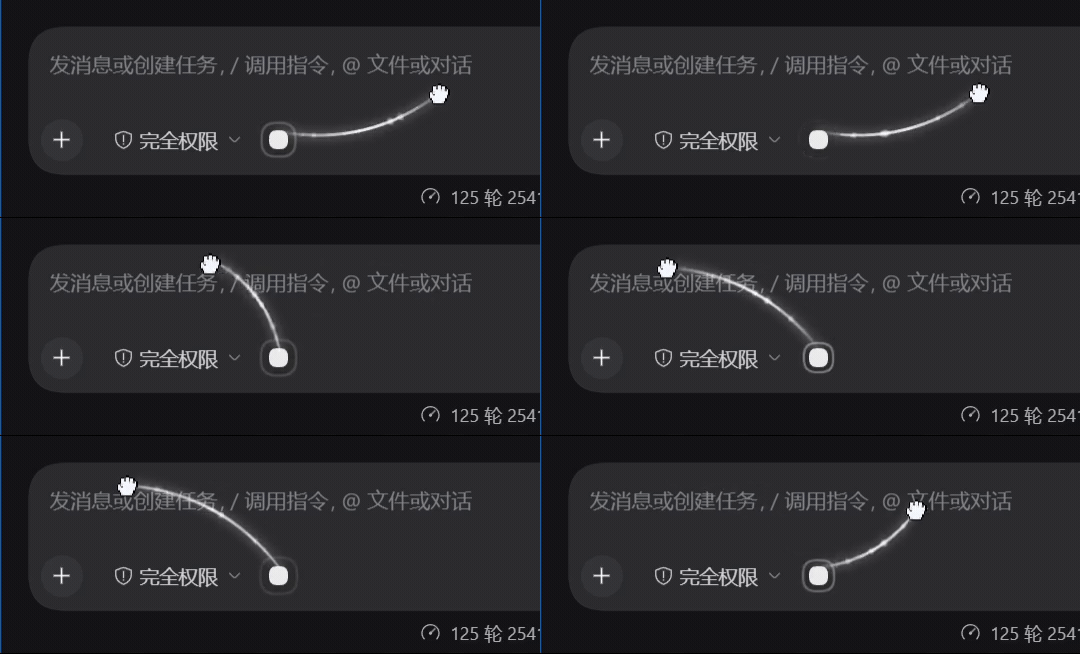
**In practice** (screen recording)
|
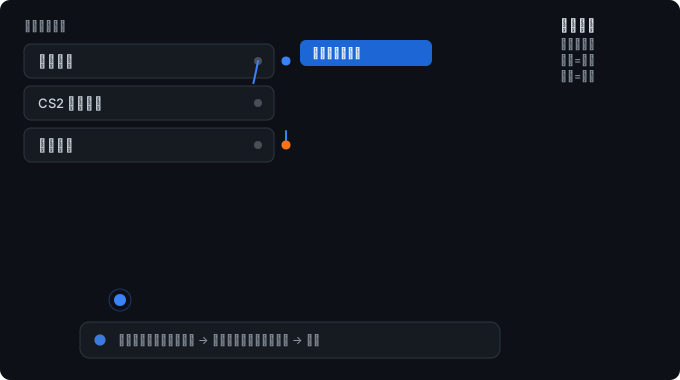
**Structure** (diagram)
|
Left: the real thing (source video) · Right: the same action as a diagram, showing the toggle semantics
---
## Contents
- [What it does](#what-it-does)
- [Quick start](#quick-start)
- [Three layers: awareness / conventions / messaging](#three-layers-awareness--conventions--messaging)
- [Cards on a connection](#cards-on-a-connection)
- [Architecture at a glance](#architecture-at-a-glance)
- [Why it works this way](#why-it-works-this-way)
- [Where it saves](#where-it-saves)
- [Install](#install)
- [Writing a card](#writing-a-card)
- [Status](#status)
---
## What it does
| | |
|:---|:---|
| **See each other** | Look up **which files the other session is editing, how far its plan has got, what tools it last used** — collected automatically, no effort required from the other side |
| **Talk to each other** | Send a message with **one of three urgencies you choose**: notify only (no interruption) / queue / interject |
| **Share tools** | Mount **cards** on a connection: a card can provide tools to the sessions, even with tens of MB of real dependencies |
| **Shared premises** | A "convention box" holds what you agreed on: interfaces, units, naming, who owns what |
| **Stay out of the way** | Awareness is **pull-based** — zero cost unless the other side asks. Unrelated connections **never interrupt you** |
---
## Quick start
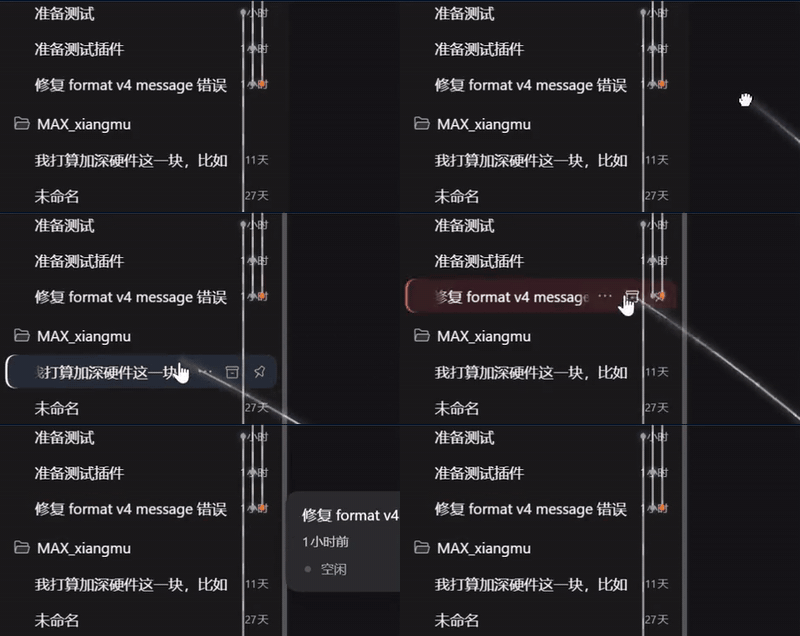
1. **Connect**: hold the circle to the left of the composer (or the `…` on a session row)
and drag it onto a row in the session list.
|
**Drag from the anchor** (recording)
|
**Drag from a session row → after connecting** (recording)
|
anchor source video · session-row source video
- **Toggle semantics**: drop on an unconnected row = connect; drop on an **already
connected** row = disconnect (the hover hint tells you which)
- You can also pick two sessions from the "Connections" panel in the sidebar
2. **Done.** Both ends get one quiet notice (who you're connected to, what it enables) —
**nobody is interrupted**.
3. Want more detail? Open "Connections" in the sidebar, or have the session call
`connection_peer_work` itself.
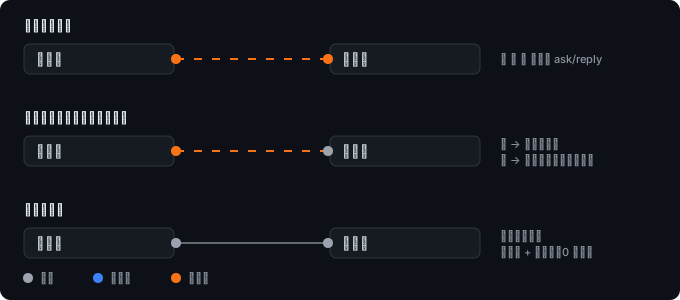
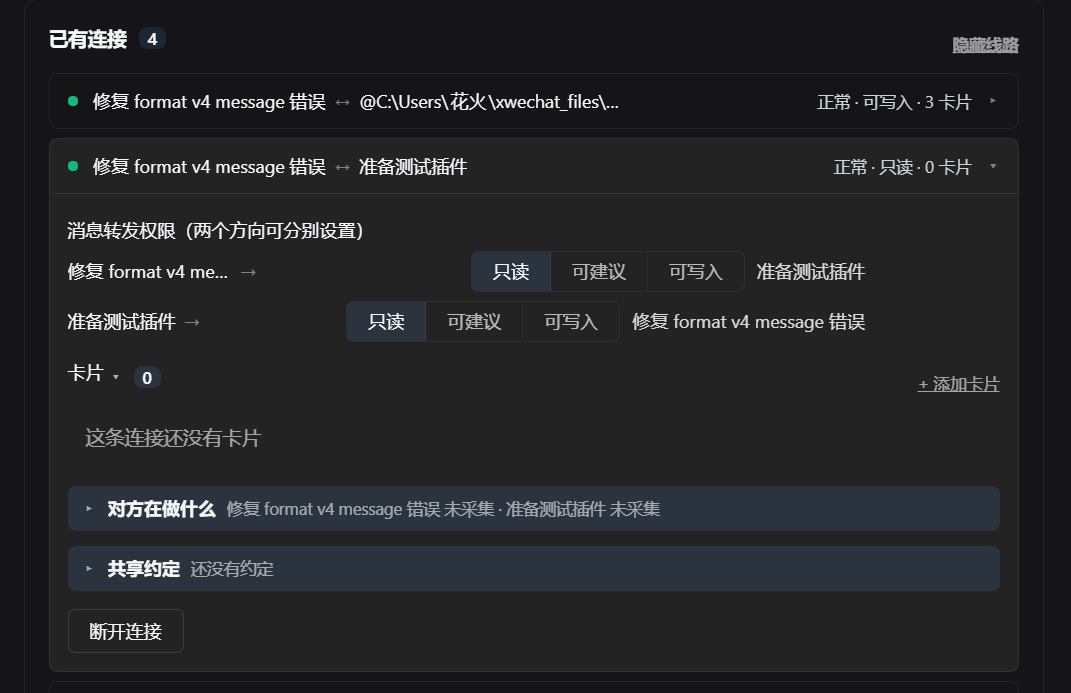
Once connected, a **rail** appears beside the session rows, with a **coloured dot at each
end** — that's the permission for that direction:
---
## Three layers: awareness / conventions / messaging
These are **separate**, because their costs differ enormously:
| Layer | Mechanism | Enters the other's context? | Forces the other to act? | Cost |
|:---|:---|:---|:---|:---|
| **A. Work state** | pull (the other asks) | only when it asks | ❌ no | **0** |
| **B. Convention box** | pull (the other asks) | only when it asks | ❌ no | **0** |
| **C. Messaging** | push (into its inbox) | **unconditionally** | ✅ **always** | every message |
**The key fact**: in DSH, delivering a message **forces the other session to run a turn** —
the agent loop has no "saw it but ignored it" state. So "talking" and "being aware" have to
be built separately: to make the other side **know**, use A/B; only to make it **act**, use C.
### A. Work state (automatic, zero cost)
Collected from runtime events — **it asks nothing extra of the model**:
```
【session-bd5ac1b1】
status: running a command (2s ago)
recently touched: water-boat/src/water.js
progress: turn 69 / step 39
```
### B. Convention box (explicit, zero cost)
What you agreed on: interface signatures, units, coordinate systems, naming, **who owns what**.
Editable in the panel; sessions read and write it with `connection_conventions` / `connection_declare`.
> **Why pull, not push**: pushing slowly fills the other's context, and most of it is
> never needed. Keeping it in a box that the other queries on demand costs zero.
### C. Messaging (three urgencies, **chosen by the sender**)
| Urgency | Under the hood | What the other sees |
|:---|:---|:---|
| `quiet` | `inject` | placed in context **without waking it** — it sees the message next time it works, **uninterrupted** |
| `normal` | `followup` | **queued** — it sees the message once it finishes what it's doing |
| `urgent` | `steer` | **interjected** — inserted into the turn it's **currently running**, read immediately |
`urgent` on an idle peer **degrades to queued** automatically (the next turn starts
immediately, so the effect is the same), and never fails.
> **The rule** (written into the tool description): interrupting has a cost — the other
> session has to drop its current line of thought. Most messages aren't urgent: default to
> `normal`, and use `urgent` only when it genuinely must change behaviour **right now**.
---
## Cards on a connection
**A card = a plugin mounted on a connection, with per-side visibility.**
| | DSH plugin | Card |
|:---|:---|:---|
| Mounted on | the whole DSH (profile) | **one connection** |
| Who can call it | every session | **only sessions on that connection** |
| Visibility | global | **per side**: both / A only / B only |
| Lifetime | DSH start/stop | mounted and unmounted with the connection |
### Cards can provide tools to sessions
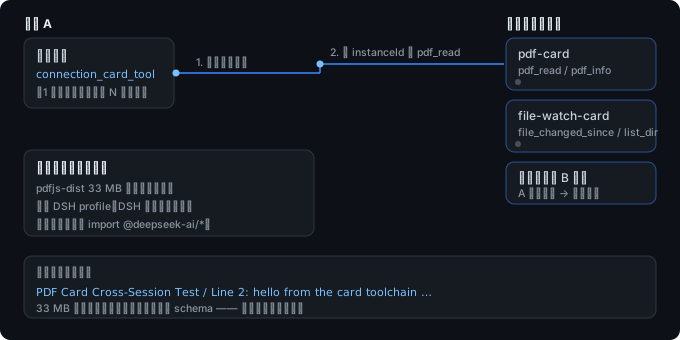
Tools registered with `api.registerTool(name, fn)` inside a card are reachable by sessions
on that connection through **one** resident bridge tool:
```
connection_card_tool ← the only resident one (1 schema)
├─ no `tool` argument → list the cards and tools visible to *your* side of this connection
└─ with `tool` → call it
```
**Why one bridge instead of one schema per tool**: the latter would make **every session**
pay a resident cost for every card tool, while cards are mounted and unmounted dynamically.
The bridge costs one schema, and it's the natural place to enforce visibility.
**Visibility actually blocks** (measured):
```
Side A can see the card ✅
Side B cannot see it ✅
Side B calls it anyway → 「这张卡片只对 A 端可见(你在 B 端)」
```
### Cards can carry real dependencies
Measured: wrapping the parsing core of the community plugin `dsh-pdf` plus
**pdfjs-dist (33 MB)** as a card, installed under `$DSH_HOME/connection-cards/cards/`,
**without touching the DSH profile**. A session called it through the bridge and got real
parse results back.
### Install and update from the panel
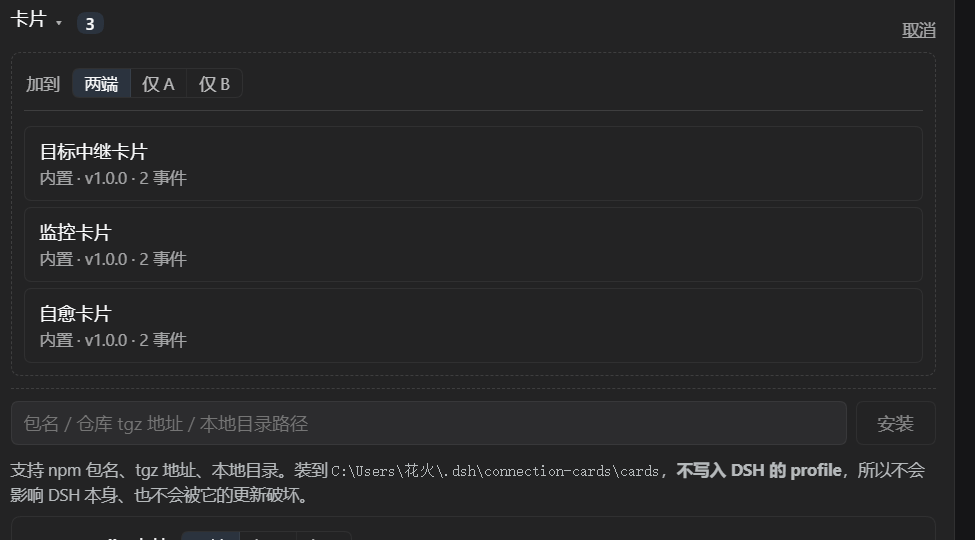
- **Install**: package name / repo tgz URL / local directory → into our own directory,
**no pnpm, no profile changes**
- **Update**: installed cards get a "check for updates" entry with three distinct states
```
「检查更新」→「↑ 更新到 x.y.z」/「已是最新」/「无法检查」
```
**"Couldn't check" is never shown as "up to date"** — that would be lying.
---
## Architecture at a glance
Three layers, with hard boundaries — each talks only to the one below:
```
┌─────────────────────────────────────────────────────────────┐
│ Card layer (connection-scoped plugins) │
│ Depends only on CardAPI; NEVER imports @deepseek-ai/* │
│ → DSH upgrades don't affect cards; our CardAPI changes do │
│ (guarded by a version declaration) │
├─────────────────────────────────────────────────────────────┤
│ Connection layer (this plugin) │
│ connections / permissions / awareness / conventions / │
│ card host / message delivery │
│ → on a DSH upgrade, this is the only layer to change │
├─────────────────────────────────────────────────────────────┤
│ DSH adapter layer (DSHAdapter + allowlist + audit) │
│ the single exit point for all DSH interaction; we do not │
│ rewrite DSH's transport, permissions or plugin system │
└─────────────────────────────────────────────────────────────┘
```
### Permissions are **per direction**
One line, one dot at each end; the colour is the permission **for that direction** — the two
directions are independent, so you can have "A may send, B may only watch":
**Read-only does not affect awareness**: work state and the convention box are both
**queried by the other side**, independent of permission. Lowering a permission takes effect
immediately; raising one requires confirmation from the side being granted it.
### How card tools reach a session
Tools registered by cards **do not each take a schema** — a session sees **one** resident
bridge, discovers on demand, calls on demand, and visibility is enforced at the bridge:
---
## Why it works this way
### 1. It doesn't rewrite DSH
We don't touch DSH's transport, permissions or plugin system, and cards are **not registered
into DSH's global loader**. All DSH interaction goes through an adapter layer, so a DSH
upgrade means **changing this one plugin**.
### 2. Automatic two-way mirroring — we turned it off
Early versions forwarded session content to the peer automatically. **Measurement said that
was wrong.** Three incidents:
1. An instruction the user gave to A was mirrored to B → **B treated it as its own task**
2. An assistant's progress report was mirrored → the peer treated it as a user instruction
3. An assistant's aside to the user was mirrored → the peer showed "received an execution
request" and **actually ran a turn**
The peer's own numbers: **30 messages / 12,765 characters of mirrored traffic made up 77.8%
of its user-side characters, and not one of them produced a useful action.**
**So nothing is forwarded automatically any more.** Cross-session messaging is explicit;
awareness uses layers A and B.
### 3. Interrupting costs something
The old delivery policy was "if the peer is running, interject" — equivalent to treating
**every message as top priority**. Now the sender chooses the urgency, and the default is
to queue.
---
## Where it saves
| Item | Number | Notes |
|:---|:---|:---|
| **Awareness (layers A + B)** | **0 context** | pull-based; costs nothing unless the peer queries |
| **Card tools** | **1 resident schema** | instead of one per card tool |
| **Automatic mirroring** | **0 (disabled)** | measured at 77.8% useless content before it was turned off |
| **Unrelated connections** | **0 interruptions** | connecting doesn't wake anyone; unrelated sessions carry on |
**The one fixed cost**: this plugin's five `connection_*` tools cost roughly **1,700 tokens
resident**. (This can be reduced further — see [Status](#status).)
---
## Install
**This plugin is not on npm.** DSH's peer dependencies (`@deepseek-ai/dsh-client-runtime` and
friends) are not on the public registry, so `npm install` resolves peerDependencies from that
registry and necessarily fails (observed as `notarget ... @deepseek-ai/dsh-client-runtime`).
Install from GitHub instead:
```sh
# stable line (this repository, the public face)
dsh plugin --profile web add github:Noob-stupid/dsh-connection-card-host
# same thing, GitHub shorthand (the github: prefix is optional) — a slash means a GitHub repo
dsh plugin --profile web add Noob-stupid/dsh-connection-card-host
# pin a version: use the tgz attached to Releases (v1.0.1 is published)
dsh plugin --profile web add https://github.com/Noob-stupid/dsh-connection-card-host/releases/download/v1.0.1/dsh-external-dsh-connection-card-host-1.0.1.tgz
# the same tgz, downloaded first — identical result
dsh plugin --profile web add ./dsh-external-dsh-connection-card-host-1.0.1.tgz
```
- Development happens on the **preview line**,
[`dsh-connection-card-host-preview`](https://github.com/Noob-stupid/dsh-connection-card-host-preview);
**this repository is the stable face** and only receives promoted releases.
- `lib/` is committed, so the install arrives ready to load — no build step and no build script
to authorize. (`dsh plugin` requires `pnpm` on PATH.)
- ⚠️ `github:` and the shorthand install the **latest commit on the default branch**, which is
**not a pinned version**; to pin a version use the Releases tgz above.
> **What was measured for all four forms** (pnpm with the profile's own settings,
> `nodeLinker: hoisted` + `autoInstallPeers: false`; each install lands `lib/` with 161 files):
>
> | Form | Result |
> |:---|:---|
> | `github:user/repo` | ✅ works |
> | `user/repo` (GitHub shorthand) | ✅ works |
> | tgz URL / local path | ✅ works |
> | **bare package name** (no slash → read as an npm name, goes to the registry) | ❌ **404 — do not use** |
>
> Neither `dsh-connection-card-host` nor `@dsh-external/dsh-connection-card-host` exists on npm.
**Compatibility**: `peerDependencies` declares `@deepseek-ai/dsh >=0.2.0-rc.1 <0.3.0` — DSH
**gates on version at install time** and refuses clearly, with a reason, rather than
installing and crashing later.
---
## Writing a card
A card is just an npm package with a `dshCard` manifest:
```json
{
"name": "my-card",
"version": "1.0.0",
"main": "index.js",
"dshCard": { "id": "my-card", "name": "My card", "entry": "index.js", "api": 1 }
}
```
```js
// index.js — NEVER import anything from @deepseek-ai/*; go through `api`
export function apply(api) {
api.log(`mounted (scope=${api.scope})`)
// provide a tool to sessions on the connection
api.registerTool('greet', async (args) => {
return `Hello, ${args?.name ?? 'world'}`
})
}
// panel HTML (optional)
export function renderPanel(api) {
return `visible to: ${api.scope}
`
}
```
| `api` member | Meaning |
|:---|:---|
| `registerTool(name, fn)` | register a tool → sessions call it via `connection_card_tool` |
| `send(kind, text)` / `read()` | send and receive connection messages as one side |
| `on(event, handler)` / `emit(event, data)` | connection-scoped events |
| `scope` | which side this instance serves (`both` / `a` / `b`) |
| `log(...)` | write to the host log |
**`dshCard.api`** declares the **CardAPI version** the card needs (defaults to 1):
- **Adding things does not bump the version** — older cards keep working
- **Only removals or semantic changes bump it** — the host refuses to mount a card that
requires a newer version, and says why
> This is **our own compatibility guard**: cards don't depend on DSH internals, so a DSH
> upgrade doesn't affect them; but **changing our `CardAPI` does** — and DSH's version gate
> can't see that layer.
See [`docs/card-protocol.md`](docs/card-protocol.md) for details.
---
## Status
**Implemented and measured**
- Connections: drag to connect (toggle semantics), three sessions fully interconnected,
persistence and restore across restarts
- Permissions: three levels per direction, asymmetric, upgrades need the other side's
confirmation, refusals explain themselves
- Awareness A: work state collected automatically (0 context)
- Conventions B: the convention box (0 context)
- Messaging C: three urgencies, with automatic degradation
- Cards: template discovery / mounting / per-side visibility / in-panel install /
**update** / crash isolation
- Card tools: bridge invocation with enforced visibility
- Card directories are **versioned** (so a mounted card can still be updated)
**Known gaps**
| Item | Notes |
|:---|:---|
| **Per-session tool scoping** | The five `connection_*` tools are registered **globally** — a session with no connections still carries ~1,700 tokens. The seam is located (`system-prompt/assemble` waterfall); the listener registration form is still unknown |
| `mountUI` / `requestRemote` | Stubs (`mountUI` only sets a dataset attribute) |
| Card tool schemas | Deliberately take no separate schema; callers must list before calling |
---
## Docs
| Document | Contents |
|:---|:---|
| [`docs/capabilities.md`](docs/capabilities.md) | **Capability report**: per-item measurements, total context cost, known limits |
| [`docs/card-protocol.md`](docs/card-protocol.md) | Card protocol: manifest, CardAPI, install validation, distribution |
| [`docs/compatibility.md`](docs/compatibility.md) | Compatibility: how DSH's version gate works, the two lines of defence |
| [`docs/adapter-api.md`](docs/adapter-api.md) | DSH adapter: the stable interface and its allowlist |
---
MIT · not affiliated with the DSH project